Preferences
Privacy is important to us, so you have the option of disabling certain types of storage that may not be necessary for the basic functioning of the website. Blocking categories may impact your experience on the website. More information
Privacy is important to us, so you have the option of disabling certain types of storage that may not be necessary for the basic functioning of the website. Blocking categories may impact your experience on the website. More information

The 8 best content marketing courses compared on price, length, level and certificate, checked on each official site, with a guide to pick the right one.

In short
The best content marketing courses are HubSpot Academy's free Content Marketing Certification for beginners, Ahrefs Academy's free Blogging for Business for SEO-led content, and the AMA and CMI Content Marketing Certification for a paid professional credential. Pick by level, budget and whether you need a certificate.
Want to go further? Ask
Quick quiz
Which content should you focus on first?
Our advice for you
HubSpot Academy Content Marketing Certification is the right solution for you
Number 1 in this ranking, the best match for your answers.
Our advice for you
Ahrefs Academy: Blogging for Business is the right solution for you
Number 2 in this ranking, the best match for your answers.
Our advice for you
Semrush Academy content marketing courses is the right solution for you
Number 3 in this ranking, the best match for your answers.
Our advice for you
UC Davis: The Strategy of Content Marketing (Coursera) is the right solution for you
Number 4 in this ranking, the best match for your answers.
We checked every course below on its official page on 26 November 2026: price, length, level, certificate and who it is for. No affiliate links, no sponsored places. Where a figure was not published, we say so instead of guessing.
The comparison table answers the first question fast: which course fits your level and budget. Free vendor academies cover the basics well, university courses add structure and a recognised certificate, and the paid professional programs target marketers who already work in content.
| Course | Best for | Main strength | Level | Length | Certificate | Starting price |
|---|---|---|---|---|---|---|
| HubSpot Academy Content Marketing Certification | Beginners and inbound marketers | Full method, from strategy to measurement | Beginner | About 8 h 23 min | Yes, HubSpot | Free |
| Ahrefs Academy Blogging for Business | Bloggers and SEO-led content teams | Search traffic and link building for blogs | Beginner to intermediate | 4 h 56 min | No | Free, no sign-up |
| Semrush Academy content marketing courses | Marketers who want quick certificates | Topic clusters and AI search | Beginner | About 1 h 10 per course | Yes, per course | Free |
| UC Davis The Strategy of Content Marketing (Coursera) | Marketers who want a university course | Structured strategy and competitive analysis | Intermediate | 9 h | Yes, paid option | Free to start |
| CMI Content Marketing University and AMA certification | Content leads and managers | Professional credential with an exam | Experienced | About 15 h plus exam | Yes, AMA PCM | $1395 ($1295 for AMA members) |
| DMI Track: Content Marketing | Marketers who want AI-focused modules | AI from research to campaigns | Associate | 6.5 h | Yes, after a 40-question exam | Not published |
| Google Digital Marketing and E-commerce Certificate (Coursera) | Career changers | Broad digital marketing foundation | Beginner | About 6 months at 10 h a week | Yes, Google | $49 per month (US and Canada) |
| Introduction to Content Marketing: From Basics to AI (Coursera) | Absolute beginners short on time | Short course with a module on AI | Beginner | 4 h | Yes, paid option | Free to start |
The lengths are the video and study times published by each provider. Real time is usually higher, because you pause, take notes and do the exercises.
Each review below says what the course is, who it suits, what it does well, one honest limit and the price read on the official site on 26 November 2026. The order follows value for most readers: free, complete and recent first, then paid credentials, then broader or shorter options.
 HubSpot Academy Content Marketing Certification
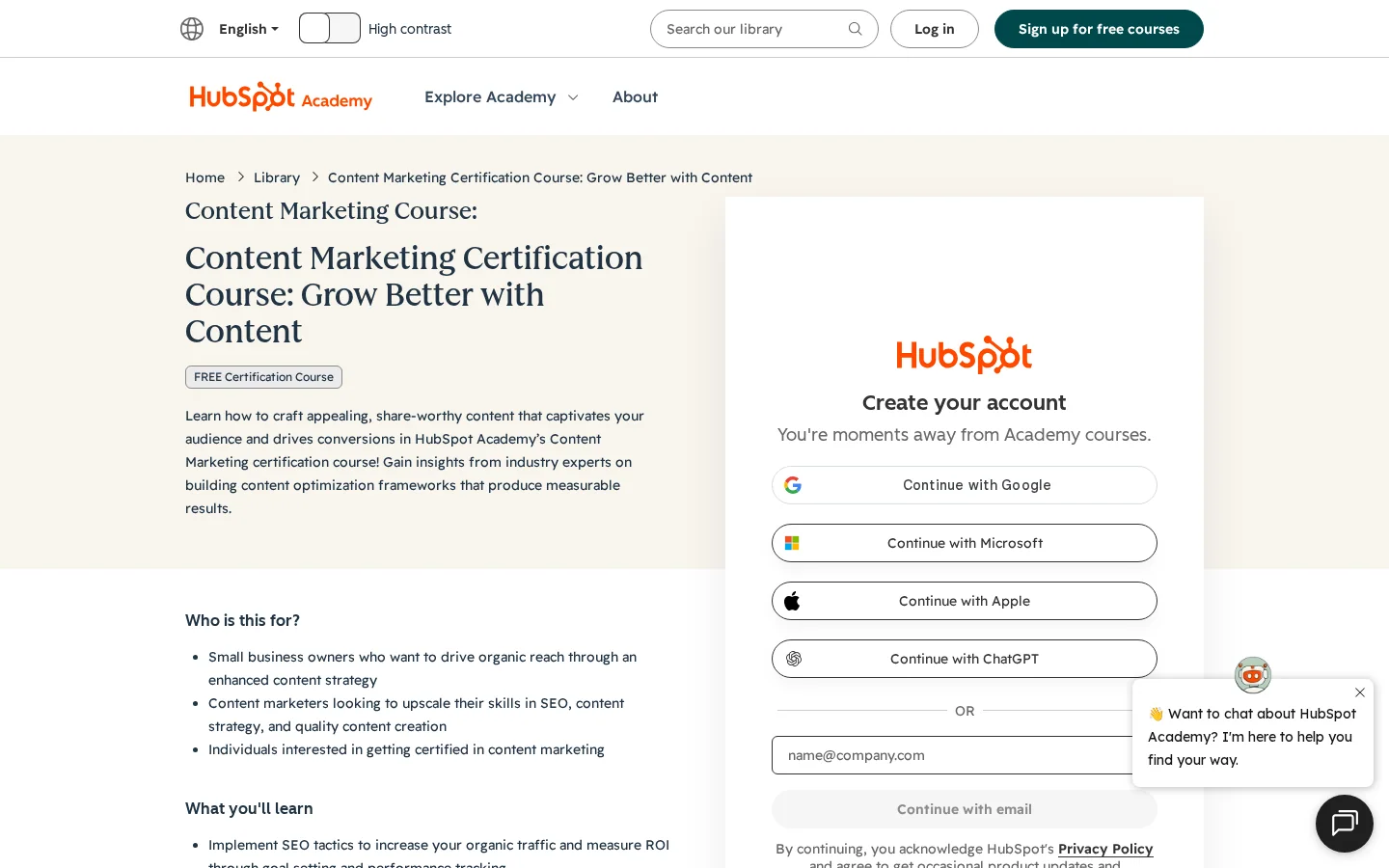
What it is. The HubSpot Academy Content Marketing Certification course is a free certification course. The course listing shows 14 lessons, 54 videos and 11 quizzes, for about 8 hours 23 minutes. In its announcement of the rebuilt course (last updated 22 November 2019), HubSpot lists the themes: storytelling, a content creation framework, long-term strategy and audits, idea generation, blogging for search, repurposing, topic clusters and pillar pages, video, guest blogging, promotion and performance measurement.
Who it is for. Beginners, small business owners and marketers who want one complete method and a certificate they can show on LinkedIn.
Strengths. It covers the whole cycle, from strategy to measurement, in one place. Guest experts such as Andy Crestodina (Orbit Media) bring practitioner views. The quizzes force you to check what you retained.
Honest limit. The structure dates from the 2019 rebuild, so check how much of the current version deals with AI answers before you rely on it for that subject.
Price. Free, checked on 26 November 2026.
 Ahrefs Academy: Blogging for Business
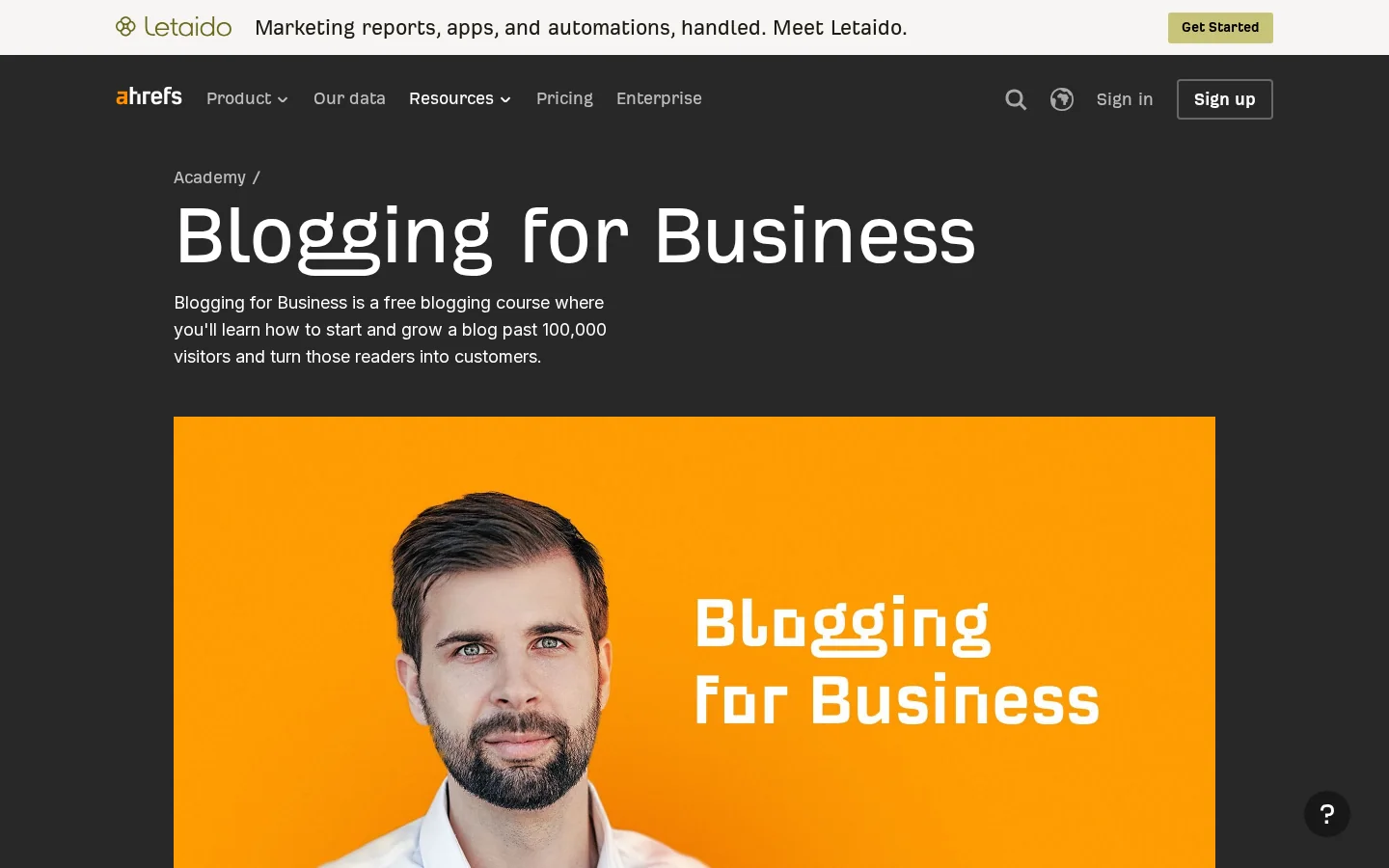
What it is. Blogging for Business is a free video course taught by Tim Soulo, CMO of Ahrefs: 40 lessons in 11 modules, 4 hours 56 minutes in total, with no sign-up required. It covers blogging strategy, keyword research and traffic potential, finding ideas, on-page optimisation and search intent, link-worthy content, promotion, link building and outreach, with guest interviews of Noah Kagan, Bryan Harris and Ramsay Taplin. The same academy offers a shorter free Content Marketing Course by Sam Oh (9 videos, about 1 hour 51 minutes) on strategy for leads, content hubs, product-led content and content audits.
Who it is for. Content marketers, bloggers, freelance writers and team leads whose main channel is Google.
Strengths. It is the most practical free course on getting a business blog found in search. The idea of "traffic potential" (target the topic, not just one keyword) changes how you plan a calendar.
Honest limit. There is no certificate, and some demonstrations use the Ahrefs tool.
Price. Free, checked on 26 November 2026.
 Semrush Academy content marketing courses
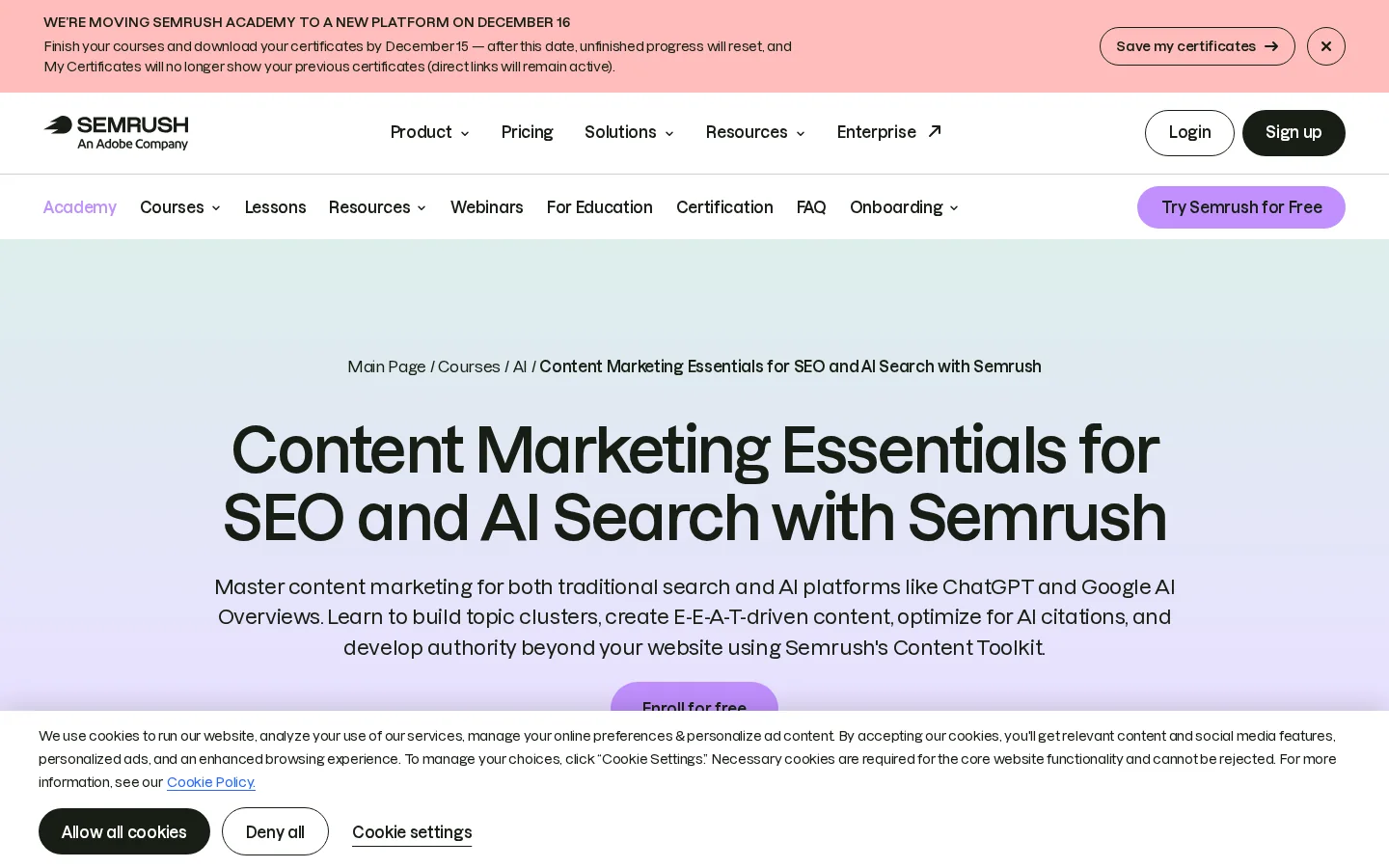
What it is. Semrush Academy offers several short, free courses with a certificate. Content Marketing Essentials for SEO and AI Search, taught by Rita Cidre (Head of Academy), has 16 video lessons for about 69 minutes: content strategy for AI-era search, topic clusters, SERP analysis, briefs, optimising existing content and extending content beyond your site. Content Marketing Principles for Business, taught by Chima Mmeje, has 6 lessons for about 73 minutes, including a six-step content-led SEO process and a ten-step plan for topic clusters.
Who it is for. Marketers who want short certificates on their profile, and teams that already use Semrush.
Strengths. Short, recent and one of the few free courses that treats AI search as part of content marketing.
Honest limit. Lessons rely on Semrush tools, and one hour per subject stays introductory. Semrush says its Academy moves to a new platform on 16 December: download any certificate you already earned before 15 December.
Price. Free, checked on 26 November 2026.
 UC Davis: The Strategy of Content Marketing (Coursera)
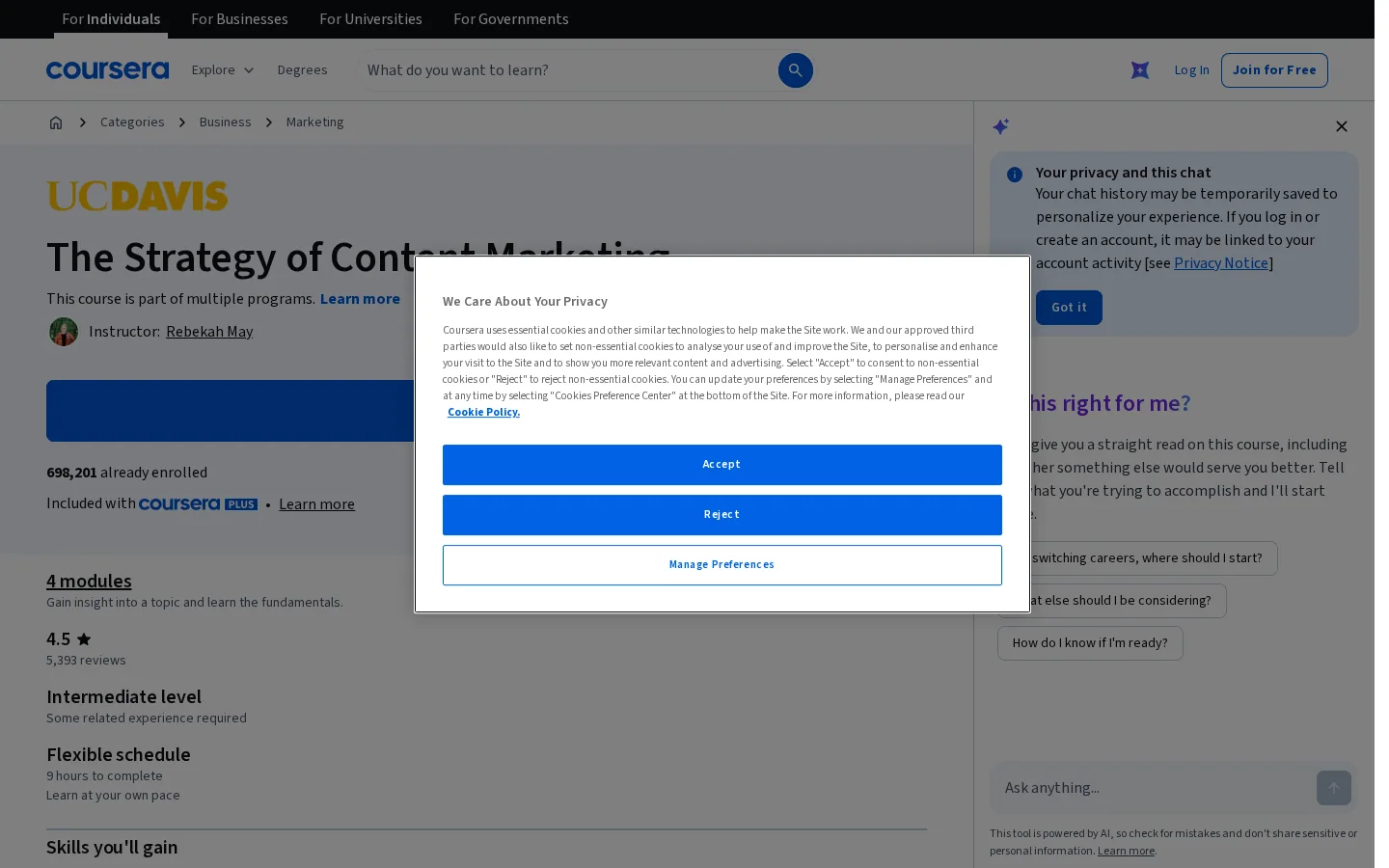
What it is. The Strategy of Content Marketing is a University of California, Davis course taught by Rebekah May. It takes about 9 hours in 4 modules: what content marketing is, getting started with a strategy, planning a content strategy and competitive analysis. Coursera shows a rating of 4.5 from 5393 reviews.
Who it is for. Marketers with some experience who want a university name on their certificate.
Strengths. The competitive analysis module is rare in free courses, and the structure is clear enough to follow alone.
Honest limit. Coursera labels it intermediate, with some related experience required, so a complete beginner should start with HubSpot first.
Price. Free to start. The shareable certificate requires the paid certificate option or a Coursera Plus subscription, whose price depends on your country (checked on 26 November 2026).
What it is. Content Marketing University is the self-paced program of the Content Marketing Institute: 11 core sessions, with the master class series presented by Robert Rose, CMI's chief strategy officer, and extra sessions by Andy Crestodina, Nancy Harhut and others. The American Marketing Association's Content Marketing Certification page explains that it built the program with CMI: about 15 hours of learning, then a 100-question exam in two hours, an 80% passing score and three attempts within one year. Holders renew every three years with continuing education units.
Who it is for. Content leads and managers who want a recognised professional credential. The AMA suggests a degree plus a few years of marketing experience, but no prerequisite is required.
Strengths. The only course in this list with a proctored-style exam and a credential that a marketing employer recognises outside one vendor.
Honest limit. It is the most expensive option, and the AMA offers no payment plan.
Price. $1395 for non-members, $1295 for AMA members. Exam only: $349, or $249 for members. A 20% November discount was displayed on the CMI site when we checked on 26 November 2026.
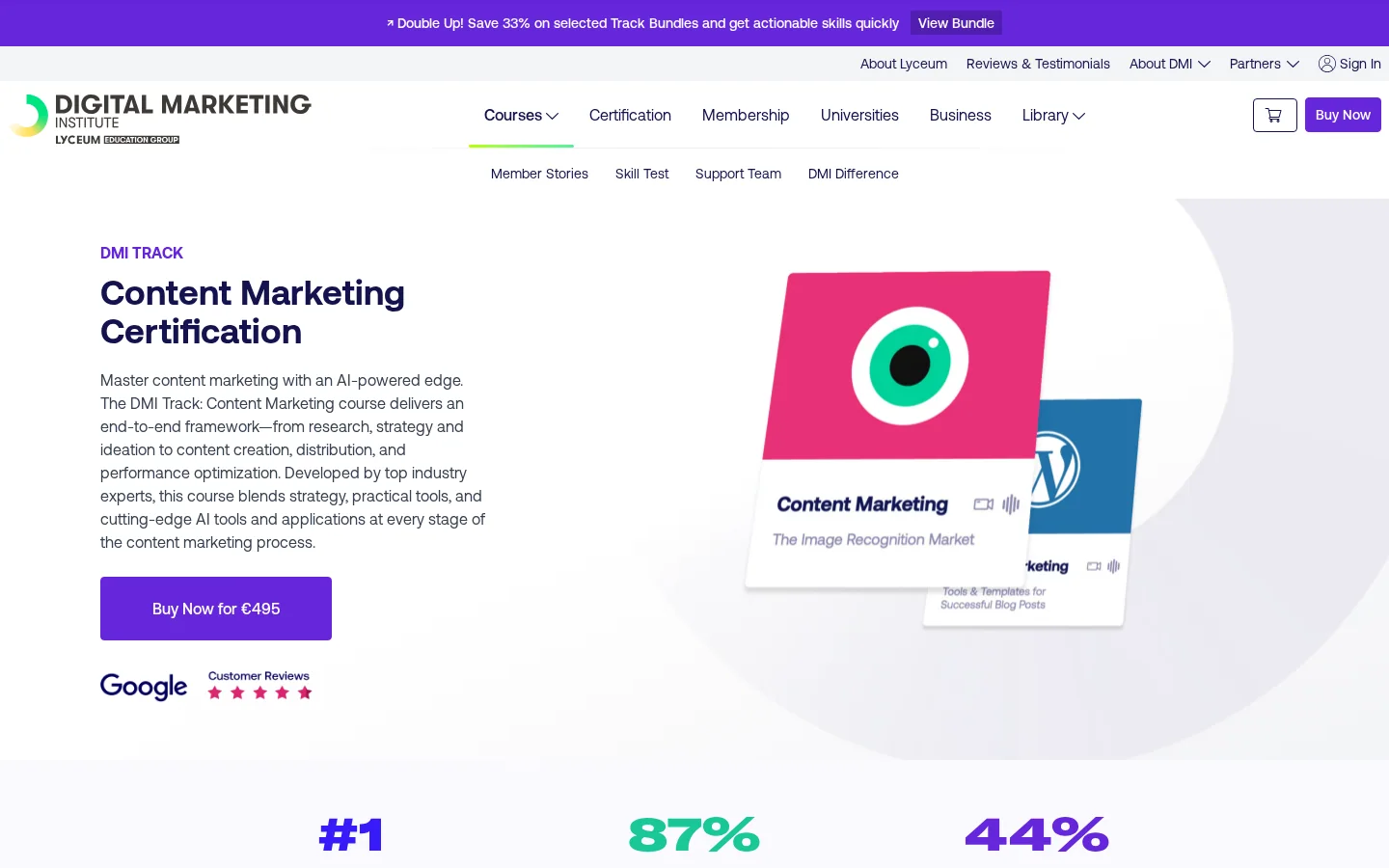
What it is. The DMI Track: Content Marketing is a 6.5-hour self-paced course in 4 modules: research and planning with AI, creating and curating content, enhancing content with AI and running AI-powered campaigns. You have 12 weeks to finish, then a 40-question multiple-choice exam leads to an Associate certificate. DMI Professional Membership is included.
Who it is for. Content marketers, copywriters, social media staff and small business owners who want AI built into every step.
Strengths. The most AI-centred syllabus in this list, and no marketing background is required.
Honest limit. The price was not displayed on the course page, so you must go through the checkout to see it.
Price. Not published on the page on 26 November 2026.
Google Digital Marketing and E-commerce Professional Certificate (Coursera)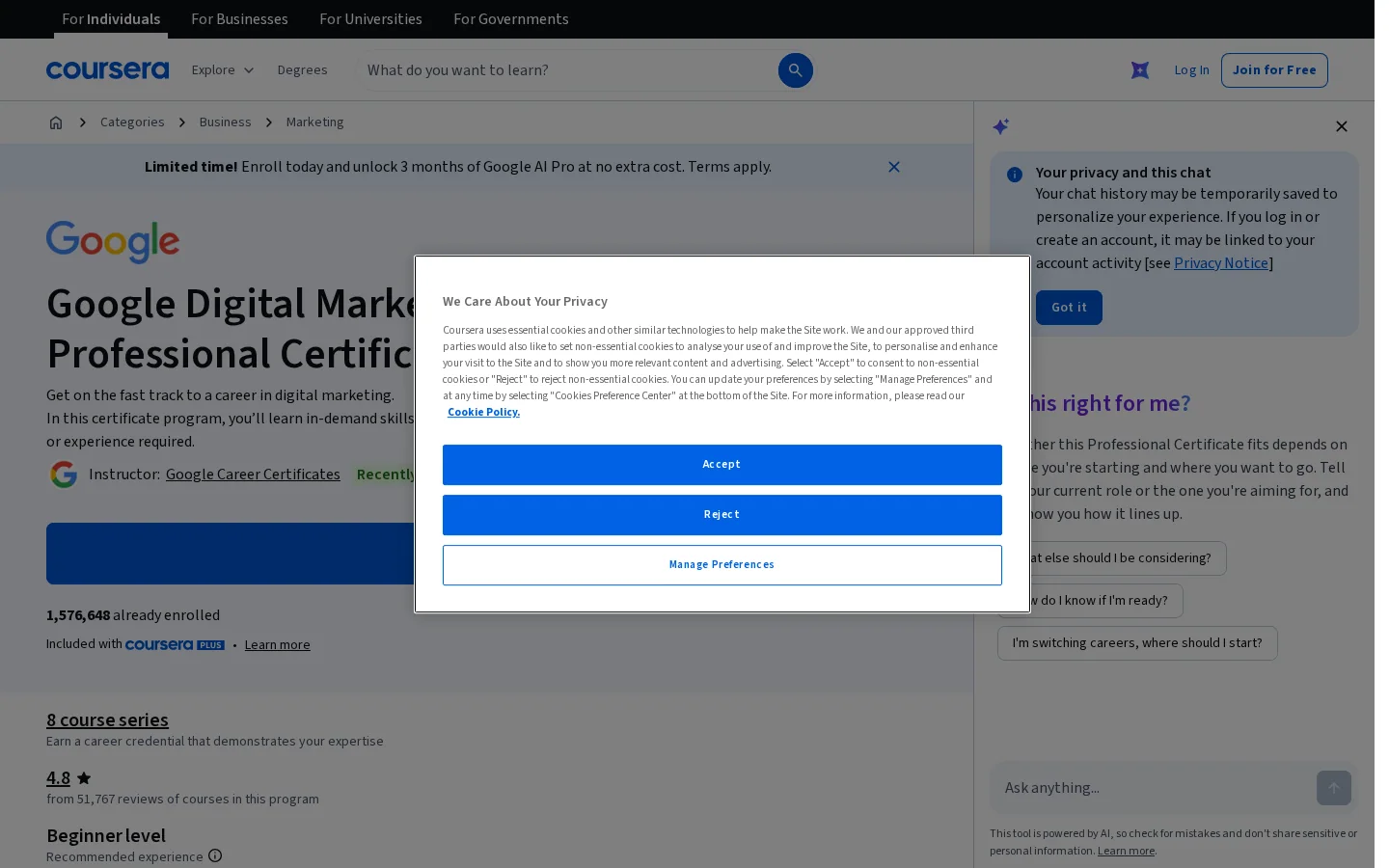
What it is. The Google Digital Marketing and E-commerce Professional Certificate has 8 courses, about 6 months at 10 hours a week, at beginner level. Content is taught mainly in course 2 (Attract and Engage Customers with Digital Marketing, on SEO and search marketing) and course 3 (From Likes to Leads, on social media content). Coursera shows 4.8 from 51767 reviews and 1576648 learners enrolled.
Who it is for. People changing career into marketing who need a recognised entry certificate.
Strengths. Huge practice base, a Google certificate and an ACE recommendation of up to 9 college credits.
Honest limit. Content marketing is one part of a broad program, not the whole subject.
Price. $49 per month in the US and Canada after a 7-day free trial; Coursera says most learners finish for under $300 (checked on 26 November 2026).
Introduction to Content Marketing: From Basics to AI (Coursera)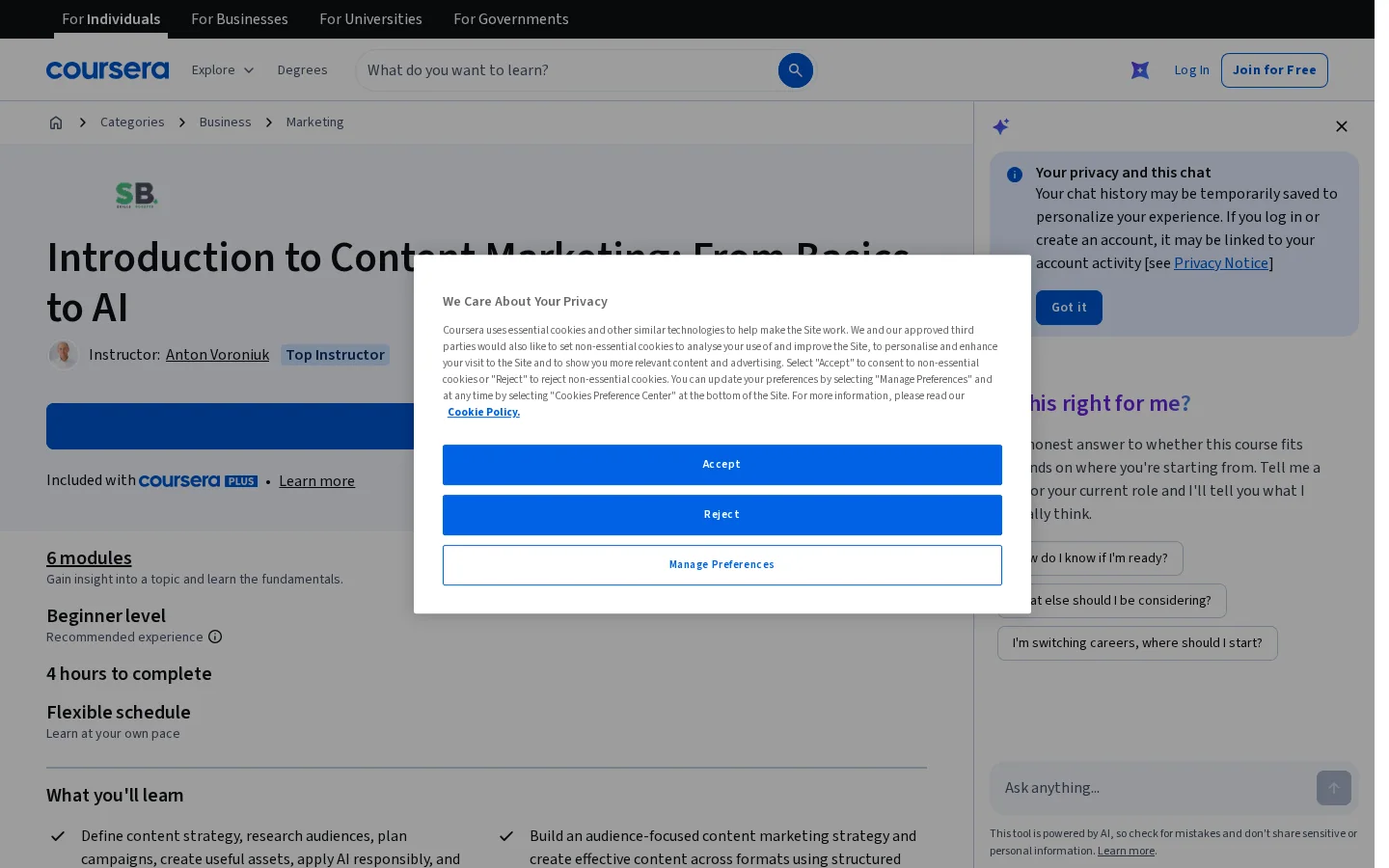
What it is. Introduction to Content Marketing: From Basics to AI is a 4-hour beginner course by SkillsBooster Academy, taught by Anton Voroniuk. Its 6 modules go from foundations to audience research, an editorial calendar, content formats, using AI responsibly and measurement.
Who it is for. Absolute beginners who want the whole picture in one afternoon.
Strengths. Short, recent and with a full module on responsible use of AI.
Honest limit. No course rating was shown on the page, and the provider is a training company, not a university or a known content brand.
Price. Free to start; the certificate requires the paid option or Coursera Plus (checked on 26 November 2026).

There are four ways to learn content marketing: free vendor academies, university courses on MOOC platforms, paid professional certifications, and learning by publishing. Each one fits a different goal, and most good content marketers combine two of them.
Principle. A software company (HubSpot, Ahrefs, Semrush) teaches the method its tool supports, for free, to attract future users. When to use it. First steps, or to learn one precise skill fast. Advantages. Free, often updated, taught by practitioners. Limits. The method leans toward the tool, and certificates carry little weight outside the vendor's ecosystem. Example. Ahrefs' Blogging for Business for SEO-led blogging.
Principle. A university or a big brand publishes a structured course on Coursera, with graded work. When to use it. When you need structure and a certificate with an academic or Google name. Advantages. Clear progression, peer-reviewed assignments, recognised certificates. Limits. Content updates more slowly than vendor academies, and the certificate is paid. Example. UC Davis' The Strategy of Content Marketing.
Principle. A professional body sets an exam and a renewal cycle. When to use it. When you lead a content team or sell content services and want proof that does not depend on a vendor. Advantages. Exam-based credential, renewal keeps it current. Limits. Price and time. Example. The AMA PCM Content Marketing certification built with CMI.
Principle. You learn by planning, writing and measuring real content on a real site, with a course as a map. When to use it. Always, from week one. Advantages. The only way to get results to show. Limits. Slow feedback without a method, and easy to repeat the same mistakes. Example. Publishing one article a week from a step by step content marketing strategy and reviewing the data each month.
| Way to learn | Cost | Credential value | Update speed | Best moment |
|---|---|---|---|---|
| Free vendor academy | Free | Low to medium | Fast | Start, or one precise skill |
| University course on Coursera | Free to start, paid certificate | Medium to high | Slow | When you need structure |
| Professional certification | High | High | Medium, with renewal | Lead role or agency |
| Learning by publishing | Your time | Results speak | Real time | From week one |
Free vendor academy vs paid professional certification
A good content marketing course teaches a full loop: audience research, strategy, keyword and topic planning, writing, distribution, measurement and, now, visibility in AI answers. If one of these steps is missing, you will have to fill the gap with another resource.
Every serious course starts with goals and audience, then builds a calendar. Look for a lesson on the content calendar and how to plan it, because the calendar is where strategy becomes weekly work. Then comes writing for a reader and for search: briefs, structure, search intent and on-page optimisation. HubSpot, Ahrefs and Semrush all spend real time here.
Google rewards sites that cover a subject in depth. A course should explain the pillar and cluster model, where one broad page links to detailed pages on each sub-question. Our guide to topic clusters and pillar pages details the structure; HubSpot and both Semrush courses teach it.
Publishing is half of the job. A course must teach promotion (email, social, communities, links) and the metrics that prove value. Without this, you cannot defend a content budget. Compare what you learn with our list of content marketing KPIs by goal.
The newest gap is AI. People now ask ChatGPT, Gemini and Claude before they search Google, and those assistants cite pages that answer clearly. Of the courses above, Semrush's Content Marketing Essentials and the DMI track treat AI as a core subject. For a deeper course on how AI answers pick their sources, the free Sorank GEO SEO course complements any content marketing course.
What the syllabus should include
Choose your course in five steps: define your goal, check your level, set a budget, decide if you need a certificate, then test the first lesson before you commit. This takes 30 minutes and avoids paying for a course that repeats what you already know.
Choose your course in 5 steps
Goal "grow traffic from a blog": Ahrefs Blogging for Business, then Semrush Content Marketing Essentials. Goal "get hired": Google Digital Marketing and E-commerce Certificate, plus HubSpot's certification. Goal "lead a team": AMA and CMI certification. Goal "understand the basics in one day": Introduction to Content Marketing from Basics to AI.
The UC Davis course asks for some related experience. The AMA suggests several years of marketing experience. If you have never written a brief, these courses will feel abstract. Start free, publish five articles, then move up.
When two courses look equal, give each a simple score. Weight what matters to you; the example below suits a marketer who wants results more than a credential.
Course score = (Fit to goal x 3) + (Recency x 2) + (Practice exercises x 2) + (Certificate value x 1) - (Cost penalty x 1)

Each criterion from 0 to 5. Cost penalty: 0 if free, 2 under $300, 5 over $1000.
Example, Ahrefs Blogging for Business for a blog owner:
(5 x 3) + (3 x 2) + (4 x 2) + (0 x 1) - (0 x 1) = 29Every Coursera course here is free to start, and HubSpot, Ahrefs and Semrush are free throughout. Watch the first lesson at normal speed. If the examples are from before AI answers existed and nothing mentions them, keep looking or pair the course with a recent one.
Tip
Practise each lesson on a real article. The free content brief generator gives you a full SEO brief in seconds, so you can apply the course method right away instead of filling a blank page.
Free courses ask between about 1 and 8.5 hours of video, while paid programs ask from 6.5 hours to several months. Real time is two to three times the video length once you do the exercises, so plan your weeks before you enrol.
The AMA and CMI certification costs $1395, or $1295 for AMA members, with no payment plan. The Google certificate runs at $49 per month in the US and Canada, and Coursera says most learners finish for under $300. The DMI track did not display its price. University courses on Coursera are free to start, and you pay only for the certificate.
The courses in numbers
Sources: Coursera course pages and American Marketing Association, checked 26 November 2026
Tie the course to one measurable output: "after this course, I will publish a topic cluster of 8 articles in 60 days and report leads from them". Then measure the return with the same formula you will use for any content investment. Our content marketing ROI calculator does the arithmetic.
Content ROI (%) = (Revenue attributed to content - Content cost) / Content cost x 100
Content cost = course fees + hours spent x hourly cost + toolsA course only pays off when you apply it on a real site within the first month. The plan below follows the order of most syllabi, with one concrete output per week, so you end the month with published work and data.
| Week | Course part | What you produce | How you check it |
|---|---|---|---|
| 1 | Goals, audience, strategy | A one-page strategy: goal, audience, 3 themes | Your manager or a peer can repeat it in one sentence |
| 2 | Keyword research and clusters | One pillar topic and 6 to 8 cluster subjects mapped to search intent | No two subjects target the same query |
| 3 | Briefs and writing | Two published articles from proper briefs | Each answers its question in the first paragraph |
| 4 | Distribution and measurement | A distribution checklist and a simple dashboard | Impressions in Search Console, clicks, first leads |
Write your strategy on one page. Then pick one pillar topic and list its sub-questions. A good test: if two planned articles would answer the same query, merge them. If you want to see how this looks in practice for different budgets, read our guide to content marketing basics and examples.
Publish two articles, share each one in at least two channels, and log the results. Add the pages to a simple tracking sheet with the date, the target query, impressions and clicks after 14 and 28 days.
If you want to keep the rhythm after the course without writing every brief and article by hand, Sorank's AI content calendar that plans and publishes your blog turns your topics into a schedule and publishes the articles. Teams can see how it fits their process on the page for content teams and content marketers.
The most common mistake is to collect certificates without publishing anything. The others come from choosing a course that does not match your level, your goal or the way search works now.
How people take courses vs how to take them
What it is. Finishing several free certifications and still having no published content. How to spot it. Your LinkedIn shows badges, but you cannot link to one article you wrote. How to fix it. Stop at one course and follow the 30-day plan above. One published cluster beats three badges in any interview.
What it is. A beginner in an intermediate university course, or an experienced writer in an introduction. How to spot it. You either feel lost after the first module or skip most lessons. How to fix it. Read the stated level and prerequisites; UC Davis and the AMA program both publish them.
What it is. Learning a method built before AI answers changed how people find content. How to spot it. No lesson mentions AI Overviews, ChatGPT, Gemini or Claude. How to fix it. Pair the course with a recent one, such as Semrush's Content Marketing Essentials for SEO and AI Search, or our list of the best AI courses for marketers.
What it is. Taking a course that mostly shows one software and thinking you learned content marketing. How to spot it. Every lesson ends with a screen of the vendor's tool. How to fix it. Keep the method, note which steps need a tool, and compare options in our review of the best content marketing tools stage by stage.
What it is. Spending over $1000 when your goal is traffic, not a job title. How to spot it. Nobody in your hiring process or client base asked for it. How to fix it. Use the free courses first and keep the paid certification for a lead role or an agency pitch.
What it is. Writing good articles that nobody finds. How to spot it. Search Console shows few impressions after two months. How to fix it. Add one search course; our comparison of the best SEO training courses, free and paid lists them.
For most readers, start with HubSpot Academy's free Content Marketing Certification, add Ahrefs' Blogging for Business if your channel is search, and take Semrush's Content Marketing Essentials for the AI part. Go for the AMA and CMI certification only when you lead a content program and need a vendor-neutral credential.
Whatever you choose, do one thing today: write your goal in one sentence, open the first lesson of the course that matches it, and put a two-hour slot in your calendar each week for the next month.
This ranking reflects my own experience and opinion as an SEO expert with more than 7 years in the field. It is based on verified facts, but the order itself is my personal view.
HubSpot Academy's Content Marketing Certification is the most complete free option, with about 8 hours of video, quizzes and a certificate. If your main channel is Google, add Ahrefs Academy's free Blogging for Business, which needs no sign-up.
A certification is worth it when you change career, lead a content team or pitch clients, because it proves your knowledge to people who do not know your work. If your goal is traffic or leads, free courses plus published articles with results are worth more than a paid credential.
The basics take a few hours to a few weeks: free courses run from about 1 to 8.5 hours of video. Becoming good takes months of practice, so apply each lesson to real articles and review the data after 4 to 8 weeks.
We analyse your competitors, your website and your AI visibility to create a tailored content plan for free.
 Website Value Calculator
 Website Accessibility Checker
 Google Analytics Checker
 Duplicate Content Checker
 Mobile-Friendly Test
 Website Speed Test
 Subdomain Finder
 Domain Age Checker
 CMS Detector
 Googlebot Simulator
 Nofollow Link Checker
 Meta Tag Checker
 Keyword Cannibalization Checker
 Keyword Intent Checker
 Keyword Extractor
 Google Ads Cost Calculator
 CPC Calculator
 Local Citation Finder
 Reddit Threads Finder
 Disavow File Generator
 Redirect Generator
 Canonical Tag Generator
 Passive Voice Checker
 Google Location Changer
 Google Review Calculator
 Google Review Link Generator
 Keyword Combiner
 Podcast Show Notes Generator
 AI Content Rewriter
 AI Text Humanizer
 ChatGPT Prompt Generator
 Twitter Thread Generator
 Tweet Generator
 Landing Page Copy Generator
 Google Ads Copy Generator
 Pinterest Pin Description Generator
 Anchor Text Generator
 Social Media Post Generator
 LinkedIn Post Generator
 Free AI Writer
 Review Response Generator
 LSI Keyword Generator
 YouTube Video Ideas Generator
 YouTube Tag Generator
 YouTube Description Generator
 Product Description Generator
 CTA Generator
 Blog Introduction Generator
 Conclusion Generator
 Hook Generator
 AI Content Brief Generator
 FAQ Schema Generator
 AI Blog Post Ideas Generator
 Structured Data Validator (Schema Validator)
 Alt Text Checker
 Internal Link Analyzer
 Backlink Challenge
 AI Meta Description Generator
 AI Blog Title Generator
 Google Indexability Checker
 AI Blog Outline Generator
 UTM Link Builder
 Keyword Clustering Tool
 Canonical Tag Checker
 XML Sitemap Generator
 Broken Link Checker
 AI SEO Title Generator
 Headline Analyzer
 SERP Preview Tool
 Redirect Checker
 Hreflang Tag Generator
 Heading Structure Analyzer
 HTTP Headers Checker
 Favicon Extractor
 SERP CTR Calculator
 SEO vs Paid Search Savings Calculator
 SEO Share of Voice Calculator
 SEO ROI Calculator
 SEO Traffic and Revenue Forecast Calculator
 SEO Budget Calculator
 SEO Break-Even Calculator
 SaaS SEO ROI Calculator
 ROAS Calculator
 Reading Time Calculator
 Ranking Gain Simulator
 Organic Traffic Value Calculator
 Organic Traffic Estimator and Website Traffic Checker
 LTV to CAC Ratio Calculator
 Local SEO ROI Calculator
 Link Building Cost Calculator
 Keyword Value Calculator
 Keyword Opportunity Score Calculator
 Keyword Density Calculator
 GEO ROI Calculator
 GEO Content Investment Calculator
 Ecommerce SEO ROI Calculator
 Customer Lifetime Value Calculator
 Customer Acquisition Cost Calculator
 CTR Calculator
 Cost Per Article Calculator
 Conversion Rate Calculator
 Content Marketing ROI Calculator
 ChatGPT Referral Traffic Estimator
 Bounce Rate Calculator
 Backlink ROI Calculator
 AI Visibility Score Calculator
 AI Traffic Value Calculator
 AI Share of Voice Calculator
 Cost of AI Invisibility Calculator
 AI Citation Rate Calculator
 llms.txt Validator
 AI Overview Checker and AI Overviews Rank Checker
 Robots.txt Checker
 AI SEO Audit
 LLM Readability Checker
 SearchGPT Readiness Checker
 Structured Data LLM Audit
 Website Crawlability AI Audit
 Why ChatGPT Is Not Recommending My Website
 Gemini Ranking Tool
 Perplexity Ranking Checker
 LLM Citation Checker
 Answer Engine Optimization Audit
 GEO Audit
 AI Search Visibility Test
 ChatGPT Visibility Checker
 llms.txt Generator
 URL Extractor
 Webpage to Markdown
 Sitemap Checker
 SERP Volatility Sensor
 Page Size Checker
 Word Counter
 Slug Generator
 Schema Generator
 Robots Generator
 OG Preview
 Meta Tags Generator
 Image Compressor
 Favicon Generator
 On-Page SEO Audit: SEO Checker and SEO Analyzer
 Backlink Analysis Tool
 Keyword Research Tool
 Domain Authority Checker
 “I tested Sorank on a real client site and it's insane. It does everything an agency would bill you $1500 a month for. It's going into production on that client now.”

 Guillaume Guersanguersanguillaume.com“We are an Ads agency and we wanted to get our SEO back on track once and for all. Sorank gave us a clear view of our site, helped us prioritize optimizations, and properly structure our content. The tool is easy to use, well designed for a team, and very practical for centralizing tracking without having to juggle multiple platforms. A very solid foundation to start fresh with our SEO.”
 Gaspard MadouiAds Agency
 “I just let the Sorank software do its thing, and now my DR is 25 and my page is ranking higher.”
 Lucas Flandrefoundertrace.fr“I specialized in GEO thanks to Sorank. The GEO Leaderboard allows me to show my clients their position vs competitors on ChatGPT. It’s a real commercial differentiator.”
 MélanieSEO Freelance“Great service, works well for our website and helps us understand how to improve it to rank better on Google and elsewhere. Congrats, keep going, I recommend it.”
 Hugo T.E-commerce merchant