Summary
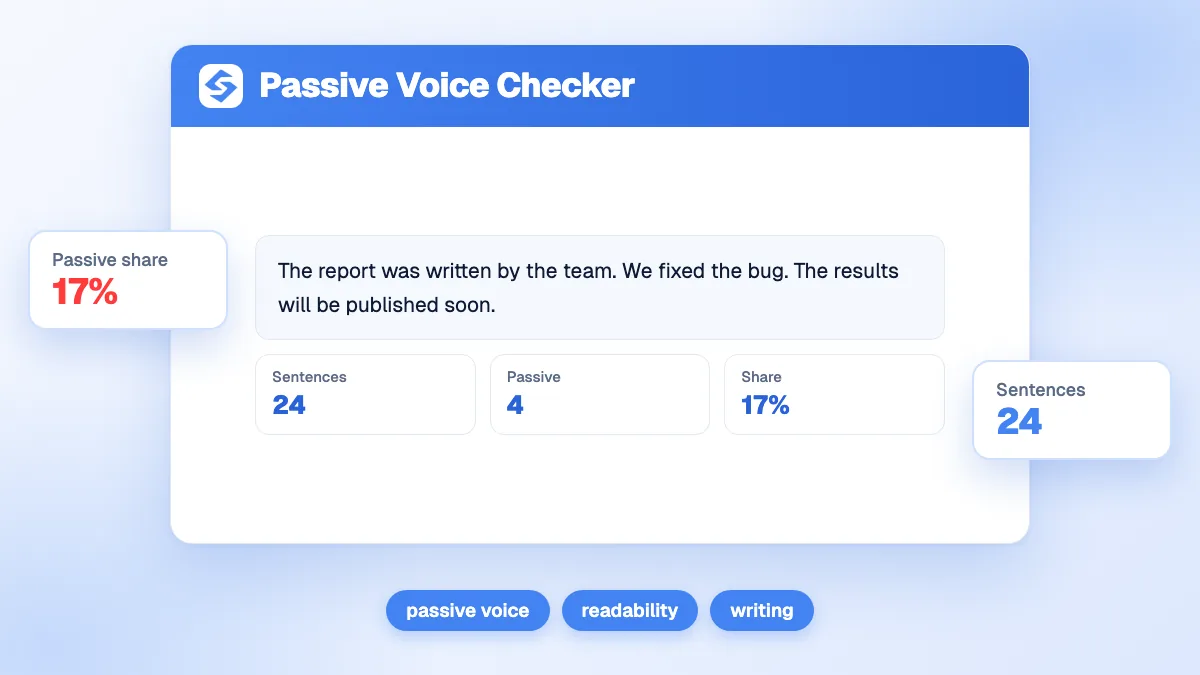
The passive voice checker finds English sentences built as a form of "be" plus a past participle, such as "was written" or "will be published". Paste your text and it counts your sentences, flags the passive ones, highlights the exact words and shows their share. Above 10%, it suggests rewriting with the actor first.
Want to go further? Ask


Passive voice hides who does what. Google's style guide for its developer documentation puts it simply: "In general, use active voice", and it asks writers to "make the doer the subject of the sentence" whenever possible (Google developer documentation style guide, voice). This checker shows you where your text drifts from that rule, sentence by sentence, so you can decide what to rewrite.
What does the passive voice checker do?
It scans English text for one pattern: a form of the verb "be" followed by a past participle. The forms it reads are am, is, are, was, were, be, been, being, and the negative forms isn't, aren't, wasn't and weren't. Up to two adverbs can sit between the two words, so "was quickly fixed" and "is not always used" are caught too.
It recognizes regular participles ending in -ed, plus a built-in list of common irregular ones such as written, made, sent, taken or bought. It skips a short list of adjectives that look like participles, such as interested, tired or worried, and it ignores the expressions "used to" and "supposed to".
The analysis runs in your browser and updates as you type. There is no account to create and the tool sets no length limit. It works on English only: text in other languages is not analysed.
How do you use the passive voice checker?
- Paste your English text in the box: a blog post, a product page, an email or a landing page.
- Read the three tiles: Sentences, In the passive voice, and Share of passive sentences.
- Check the message under the tiles. At 10% or below you get a short note; above 10% you get a warning.
- Scroll to the list of passive sentences. The passive words are highlighted in each one.
- Rewrite the sentences that read better with the actor first, directly in the box. The result updates as you edit.
Under the list, three tips remind you when to switch to the active voice and when to keep the passive.
How do you read the result?
Sentences counts every piece of text that ends with a period, a question mark or an exclamation mark, plus each new line. Abbreviations such as e.g., i.e., Mr. or Dr. do not split a sentence. A heading on its own line counts as one sentence, so headings slightly lower the share.
In the passive voice counts sentences, not occurrences. A sentence with two passive verbs counts once, but both are highlighted.
Share of passive sentences is the number of passive sentences divided by the number of sentences, rounded to a whole percent. Above 10%, the tile turns to a warning. That threshold is the tool's own rule of thumb, not a Google rule. Read it as a prompt to review, not as a grade.
If you paste the example shown in the empty box ("The report was written by the team. We fixed the bug. The results will be published soon."), you get 3 sentences, 2 in the passive voice and a share of 67%.
What does the checker flag, and what does it miss?
Detection uses word patterns, so it helps to know how it behaves on typical sentences. Every result below follows from the rules the tool applies.
| Sentence | Result | Why |
|---|---|---|
| The report was written by the team. | Flagged | "was" plus an irregular participle |
| The results will be published soon. | Flagged | "be" plus a participle in -ed |
| The bug was quickly fixed. | Flagged | One adverb between the two words is allowed |
| She is interested in SEO. | Not flagged | "interested" is on the adjective list |
| She is used to long reports. | Not flagged | "used to" is treated as an expression |
| The page is left blank. | Flagged by mistake | "left" works as an adjective here |
| The prize was given to us. | Missed | "given" is not in the irregular list |
| He got promoted last year. | Missed | Only forms of "be" are checked, not "get" |
| They're paid monthly. | Missed | Contractions such as "they're" are not read as "be" |
How do you rewrite a passive sentence? Examples
Put the person or thing doing the action first, when you know it and it matters.
- "The report was written by the team." becomes "The team wrote the report." Shorter, and the reader sees the actor at once.
- "Mistakes were made in the audit." becomes "We made mistakes in the audit." The passive hid who was responsible.
- "The settings can be changed in the dashboard." becomes "You can change the settings in the dashboard." Addressing the reader turns a description into an instruction.
- "The invoice was sent on Monday." stays as it is. Who sent it does not matter. Google's guide gives a similar acceptable example: "The database was purged in January."
- "That site can't be found." stays passive. The Microsoft Writing Style Guide on verbs recommends the passive to avoid blaming the customer in errors and warnings.
What are the common mistakes when fixing passive voice?
- Rewriting every flagged sentence. Google's guide says that "in certain cases, it's okay to use passive voice", for example when readers do not need to know who acted.
- Confusing past tense with passive. "We fixed the bug" is in the past tense and in the active voice. The checker does not flag it, and it should not.
- Trusting every highlight. "Is left" or "is closed" can describe a state rather than an action. Read the sentence before you change it.
- Inventing an actor. "Someone sent the invoice" is weaker than "The invoice was sent". If the actor is unknown, keep the passive.
- Replacing a vague passive with a vague active. "Work is done on the page" should become a precise verb, such as "We rewrite the page", not "We do work on the page".
- Treating a low share as proof of quality. A text can be fully active and still be unclear.
What are the limits of this checker?
- English only. French, German or Spanish passives are not detected, even if you paste them.
- Patterns, not grammar. The tool does not parse sentences. It misses the "get" passive, passives inside contractions, some irregular participles such as given or flown, and passives with more than two words between "be" and the participle.
- False positives. Adjectives that look like participles, outside its short exclusion list, can be flagged.
- Sentence splitting. List items, headings and short lines each count as a sentence, which changes the share.
- No rewriting. The tool highlights; you rewrite.
- One criterion only. It does not measure sentence length, word count or structure. Use the word counter for length and the LLM readability checker to see how easily an AI can extract your page.
Does passive voice hurt SEO, and when should you move to Sorank?
Passive voice and Google
No Google documentation names passive voice as a ranking factor. Google's page on creating helpful, reliable, people-first content asks other questions: does the content have "any spelling or stylistic issues", and is it "produced well"? Active sentences help with that because they are direct and easy to follow. The glossary entry on helpful content explains Google's people-first standard, and the guide on how to improve readability in blog posts covers the other levers, from sentence length to formatting.
From one page to a whole site
Use the checker to clean one text at a time; use a system when you have dozens of pages. Checking and rewriting every old article by hand takes time. Sorank content optimization fixes and rewrites your old pages on autopilot, and the guide to SEO writing for Google and the AIs shows how to write new pages clearly from the start.