




Summary
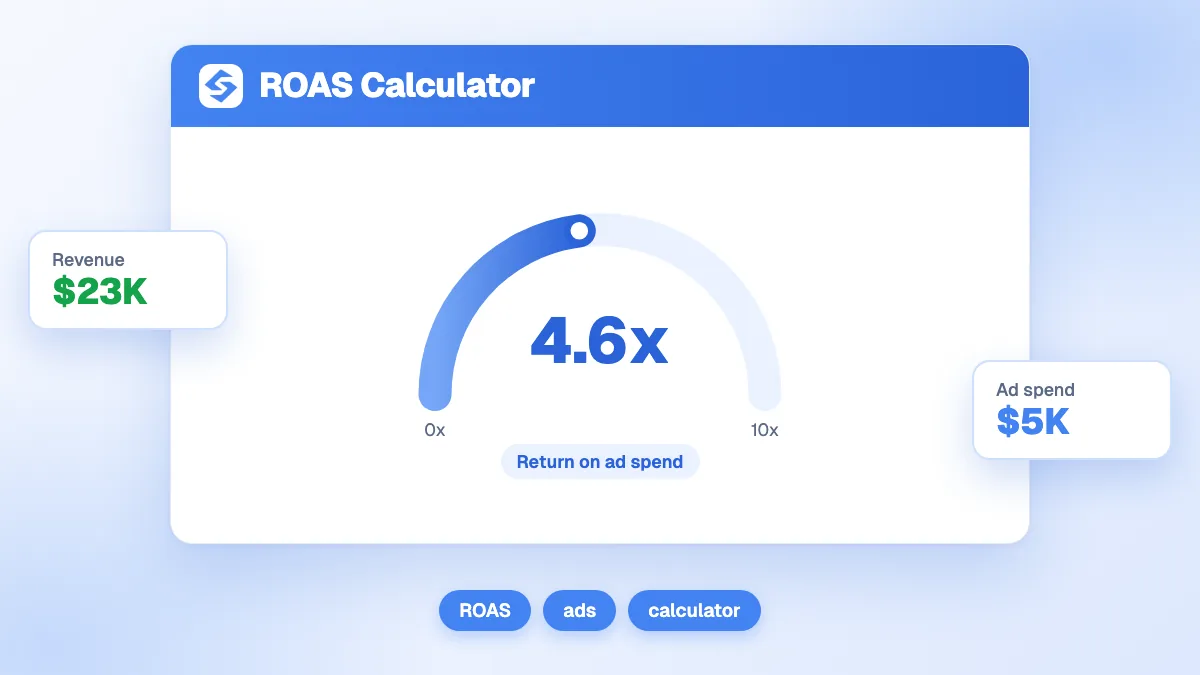
ROAS (return on ad spend) is the revenue your ads generate divided by what they cost. The calculator adds what really decides profitability: your break-even ROAS, which is 1 divided by your gross margin, your gross profit after ad spend, and your advertising cost of sales (ACOS). With 24,000 of revenue for 6,000 of spend at a 45% margin, ROAS is 4.00, break-even is 2.22 and the campaign earns 4,800 of gross profit.
Want to go further? Ask


The ROAS calculator tells you whether a campaign makes money, not just whether it sells. Google Ads defines the same ratio when you set a target: $5 of sales for each $1 of ad spend is a target ROAS of 500% (Google Ads Help, Target ROAS bidding). The number alone is misleading, though. A ROAS of 3 is excellent for a business with 60% margins and a loss for one with 25%. The calculator puts your ROAS next to the threshold your own margin sets.

How do you calculate ROAS?
Enter three numbers: the revenue attributed to the campaign, the ad spend, and your gross margin. The calculator returns four results.
| Result | Formula | Example (24,000 revenue, 6,000 spend, 45% margin) |
|---|---|---|
| ROAS | Revenue ÷ ad spend | 24,000 ÷ 6,000 = 4.00 |
| Break-even ROAS | 1 ÷ gross margin | 1 ÷ 0.45 = 2.22 |
| Gross profit | Revenue × margin − ad spend | 10,800 − 6,000 = 4,800 |
| Advertising cost of sales (ACOS) | Ad spend ÷ revenue × 100 | 6,000 ÷ 24,000 = 25% |
A ROAS of 4.00 can also be written 400%, the format Google Ads uses. ACOS is the same ratio upside down, the format marketplaces such as Amazon use: a ROAS of 4 equals an ACOS of 25%.
What is break-even ROAS and why does it matter?
Break-even ROAS is the ROAS at which the gross profit from ad sales exactly pays for the ads. Below it, every sale from the campaign loses money once you pay for the product. It depends only on your gross margin, which is why there is no universal "good ROAS".
| Gross margin | Break-even ROAS | Break-even ACOS |
|---|---|---|
| 20% | 5.00 | 20% |
| 25% | 4.00 | 25% |
| 30% | 3.33 | 30% |
| 40% | 2.50 | 40% |
| 50% | 2.00 | 50% |
| 60% | 1.67 | 60% |
| 70% | 1.43 | 70% |
The last column gives an easy rule: your break-even ACOS equals your gross margin. If ads cost more than your margin share of the revenue they bring, they destroy profit.
How do you read the result?
The gauge colours your ROAS on a general scale: below 1, the campaign loses money even before product costs; from 1 to 2, it is below par; from 2 to 4, healthy; above 4, excellent. Then compare it with your break-even ROAS, which matters more than the colour.
- ROAS above break-even: the campaign contributes profit, even if the ROAS looks modest next to someone else's.
- ROAS between 1 and break-even: sales cover the ads but not the product. Only acceptable for a deliberate reason, such as acquiring customers who will buy again.
- ROAS below 1: the ads cost more than the revenue they bring.
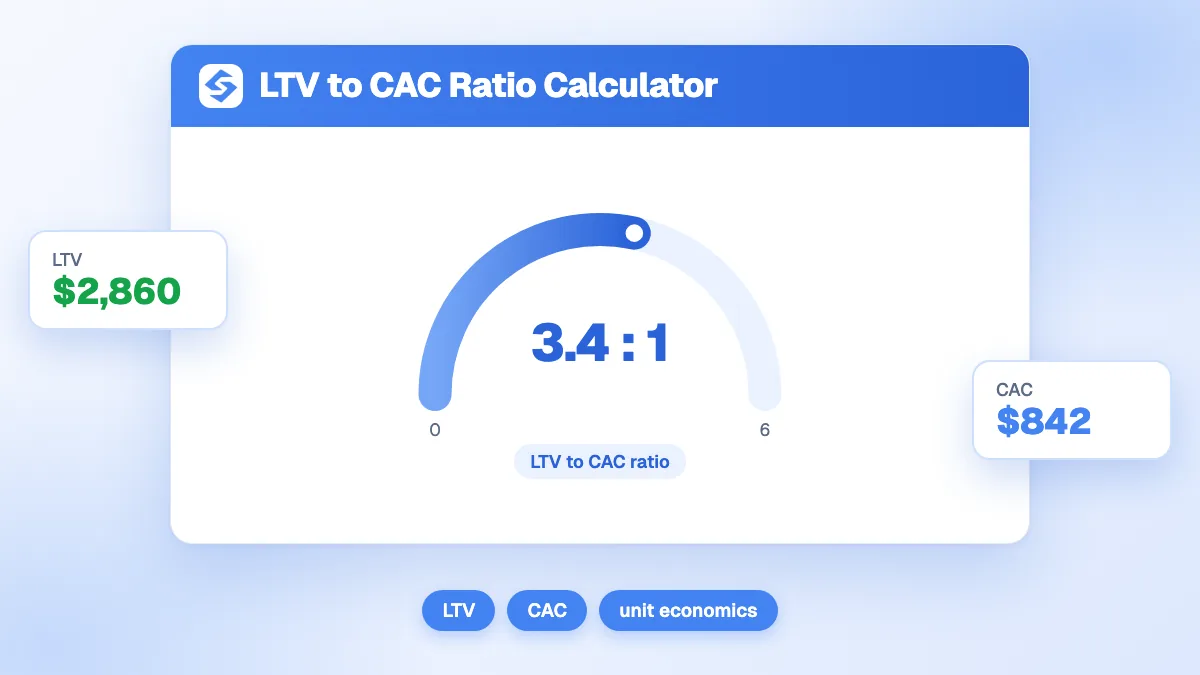
If you accept a loss on the first order, measure what a customer is worth over time with the customer lifetime value calculator and compare it with your customer acquisition cost.
What ROAS can you expect from search ads?
Work it out from your clicks. ROAS = conversion rate × average order value ÷ cost per click. Industry averages give an order of magnitude: in 2026, search ads cost $5.42 per click on average, with an average conversion rate of 8.18% (LocaliQ, search advertising benchmarks).
At those averages, each conversion costs about $66 in clicks (5.42 ÷ 0.0818). A conversion worth $66 gives a ROAS of 1.00; with a 45% margin, it must be worth about $147 to reach break-even. Plug your own rates into the formula: a better landing page raises the conversion rate and lifts ROAS without touching the bids. The conversion rate calculator helps you measure it.

Which costs make ROAS look better than it is?
The ones that sit outside the ad platform. Add them before you call a campaign profitable.
- Returns. US retailers expected 16.9% of their 2024 sales to be returned (National Retail Federation and Happy Returns, 2024). At that rate, a ROAS of 4.00 on gross sales is closer to 3.32 on kept sales.
- Payment and shipping fees, which lower your real margin and therefore raise your break-even ROAS.
- Attribution. The attribution model you choose changes which conversions are credited to which ads, and Google Ads lets you compare ROAS across models (Google Ads Help, attribution models). A sale credited to both your ads and your newsletter is counted twice across your reports.
- Agency and tool fees, which are part of the cost of advertising even if they are not in the ad spend.
How is ROAS different from ROI and CPA?
The three metrics answer different questions, and mixing them up leads to wrong decisions.
| Metric | Formula | Question it answers |
|---|---|---|
| ROAS | Revenue ÷ ad spend | How much revenue does each unit of ad spend bring? |
| ROI | (Return − investment) ÷ investment | Does the whole investment make money once all costs are counted? |
| CPA | Ad spend ÷ conversions | How much does one sale or lead cost? |
The gross profit line of the calculator bridges ROAS and ROI: it subtracts the ad spend from the margin earned on ad revenue. Use CPA when conversions have no direct revenue, such as leads, and compare it with what a customer is worth.
Should you judge ROAS per campaign or for the whole account?
Per campaign, then per product group. An account-wide ROAS of 3 can hide a brand campaign at 12 and a prospecting campaign at 1.2. Brand campaigns often capture buyers who were already looking for you, so their high ROAS flatters the account. Cut or fix what sits below break-even, and fund what sits above it.
How do you improve ROAS?
Work on the three parts of the formula: the value of each conversion, the share of clicks that convert, and the price of each click.
- Raise the order value with bundles, free shipping thresholds or upsells on the landing page.
- Raise the conversion rate: match the landing page to the ad's promise, cut form fields, show reviews and delivery terms early.
- Cut wasted clicks with negative keywords and by pausing search terms that never convert.
- Bid on margin, not revenue: give high-margin products a lower target ROAS than low-margin ones, since their break-even point is lower.
- Separate brand and non-brand campaigns so that one does not hide the other.
How does ROAS compare with SEO?
Paid traffic stops the day you stop paying; organic traffic keeps arriving at no cost per click. When your ROAS hovers near break-even, part of the budget may work harder in content that ranks for the same keywords.
- Price your organic clicks with the SEO vs PPC calculator, which compares what the same traffic would cost in ads with what your SEO costs.
- Find the expensive keywords you could rank for with the Sorank keyword research.
- Follow both channels in the GEO and SEO dashboard, alongside your visibility in AI answers.
For definitions, see our glossary entries on PPC, CPC and paid traffic.
A good ROAS is any ROAS above your break-even point, and your margin sets that point. Check your campaigns with the calculator above, then see the Sorank plans to grow the traffic you do not pay for per click.