Summary
The free domain authority checker measures how strong a domain is in Google from what it actually wins: estimated monthly organic traffic, number of ranking keywords, keywords in the top 10, traffic value and the spread of positions. Run it on your domain, then on the sites that rank above you: the gap between the numbers shows how much ground you need to cover. Authority scores are estimates from SEO tools; Google does not use them.
Want to go further? Ask


A domain authority checker answers one question: how much weight does this site carry in search results? Links between pages have shaped Google's ranking since the start. Google still lists PageRank among its core ranking systems and says that how it works "has evolved a lot" since launch (Google, guide to Search ranking systems). No outside tool can read that internal signal, so every authority metric you see is an estimate. This checker estimates authority from its result: the keywords and the traffic a domain earns.

What does the free domain authority checker show?
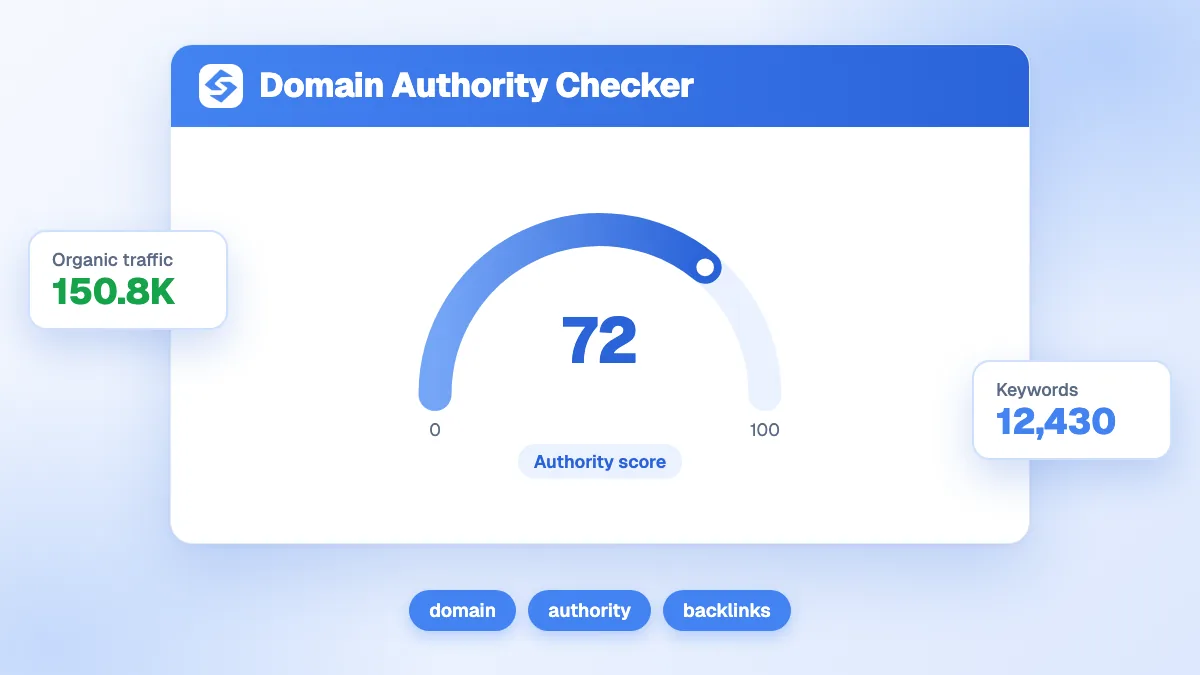
Enter a domain such as example.com, and the tool returns four headline numbers and two charts, calculated for the country you browse from.
| Metric | What it measures | How to read it |
|---|---|---|
| Traffic | Estimated monthly visits from Google organic results | The overall reach of the domain; compare it with direct competitors, not with giant sites |
| Keywords | Number of keywords for which the domain appears in organic results | The breadth of the footprint: how many topics Google trusts it on |
| Top 10 | Keywords ranking in positions 1 to 10 | The keywords that bring real clicks, since few searchers go past page one |
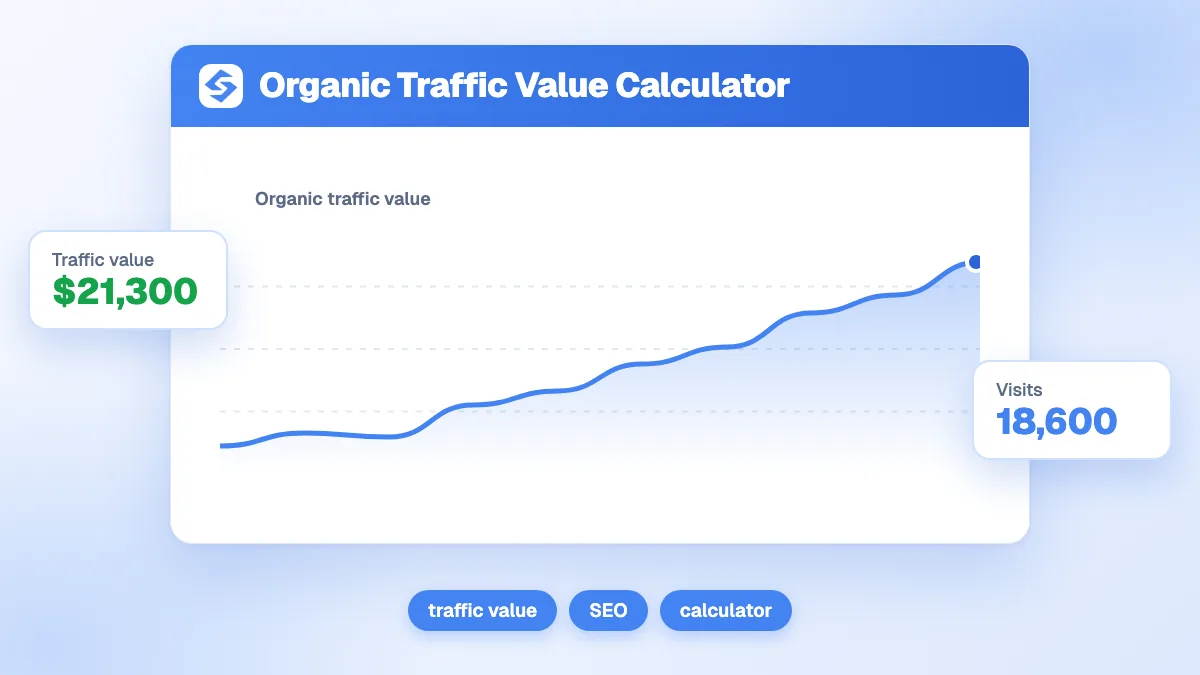
| Traffic value | What the same traffic would cost as Google Ads clicks | Turns rankings into a budget figure finance understands |
| Position distribution | Keywords split into top 1, 2 to 3, 4 to 10, 11 to 20 and beyond | Shows where the domain wins and where it almost wins |
| Keywords by position | The same split as bars | A tall 11 to 20 bar means many pages are close to page one |
Three free analyses per day are included after a short email check. A Sorank account removes the limit and unlocks the organic versus paid comparison.
How is the authority of a domain measured?
There are two families of measures, and they answer different questions. Link-based scores estimate the strength a domain should have from the links pointing to it. Footprint measures show the strength it already turns into rankings. The best known link-based score, Domain Authority, was created by Moz and runs from 1 to 100; it is easier to go from 20 to 30 than from 70 to 80, because the top of the scale is taken by the largest sites.
| Approach | What it measures | Strength | Limit |
|---|---|---|---|
| Link-based score (1 to 100) | Quantity and quality of referring domains | Predicts potential before rankings move | Each vendor has its own formula; scores differ from tool to tool |
| Search footprint (this checker) | Keywords, positions and traffic actually won | Reflects results, not potential | Traffic is modelled from keyword volumes, so it is an estimate |
| Google Search Console | Real clicks, impressions and positions of your own site | Data from Google itself | Only for sites you have verified |
Use the footprint to compare domains, the backlink checker to understand why one domain is stronger, and Search Console for your own exact figures. Our guide on what domain authority is covers the link-based scores in detail.
Does Google use domain authority to rank pages?
No. Domain Authority and its equivalents are third-party metrics. Google is explicit: "Third-party tools don't have access to our internal ranking data." It adds that their predictions "may not happen" (Google, guidance on third-party SEO tools).
The metric is still useful, because the signals it summarizes overlap with what Google values: relevant sites linking to you, many pages ranking on related topics, and a site people visit. Treat the score as a thermometer, never as a goal. A page on a modest domain can outrank a page on a strong one when it answers the query better.
How do you read your results?
Look at the ratios between the numbers rather than at each number alone. They tell you whether the domain is broad, deep or close to a breakthrough.
- Top 10 share: divide the top 10 count by the total keywords. Below 10%, the domain ranks widely but rarely wins page one.
- Positions 11 to 20: these keywords are one push away from page one. Improving the pages that hold them is often the fastest traffic gain.
- Traffic per keyword: high traffic on few keywords means a dependency on a handful of pages; one ranking drop can cost a large share of visits.
- Traffic value: compare it with your SEO budget. The organic traffic value calculator does the math with your own CPC and conversion data.
For the definitions behind these numbers, see our glossary entries on domain authority and keyword difficulty.

How do you compare your domain with competitors?
Check the three to five sites that rank above you for your main keywords, not the biggest names in your industry. A local bakery has nothing to learn from a national retailer's footprint.
| What you see | What it usually means | What to do |
|---|---|---|
| The competitor has five times your keywords | They cover far more topics | Map the topics they cover and you do not |
| Similar keywords, more in the top 10 | Their pages are stronger, often through links | Compare referring domains with the backlink checker |
| Similar top 10, higher traffic | They rank on higher-volume terms | Target the head terms your best pages are close to |
| Higher traffic value | They win commercial keywords | Prioritize pages close to a purchase |
Doing this every month by hand takes time. The Sorank competitor spy watches up to five competitors and turns what they publish into keyword and content opportunities.
What is a good domain authority score?
One that is close to, or above, the sites you compete with on the same results page. Authority only has meaning in context: a footprint of 2,000 keywords is strong in a niche B2B market and weak for a national news site. Set your benchmark as the median of the domains ranking on your target keywords, write it down, and measure the gap each month.
Young domains start low on every measure. That is normal and says nothing about the quality of the content; it means Google has not yet seen enough evidence. The first gains come from ranking on long-tail, low-competition queries, which then build the trust needed for harder ones.
How do you increase your domain authority?
Earn relevant links and win more keywords; the score follows. There is no shortcut that lasts, and Google's spam policies list link schemes among the practices that can lower or remove a site from results (Google spam policies).
- Publish on the topics you are close to winning: the Sorank keyword research finds keywords you can rank for without cannibalizing existing pages.
- Get contextual links from your niche: the Sorank Backlink Network places links on relevant sites with a minimum Domain Rating you set.
- Fix what wastes authority: broken pages that still receive links, redirect chains and duplicate URLs split the value you already earned.
- Update pages in positions 11 to 20 before writing new ones: they are the cheapest wins.
Does domain authority matter for AI answers?
Indirectly. For Google's AI Overviews and AI Mode, a page must be indexed and eligible to show with a snippet, and Google says there are "no additional requirements" beyond regular SEO (Google, AI features and your website). A domain that ranks widely therefore has more pages eligible to be quoted. Google also notes that seeking inauthentic mentions "isn't as helpful as it might seem" (Google, optimizing for generative AI search), so the path is the same: real content and real mentions. See where your brand already appears with AI mention tracking.
How often should you check domain authority?
Once a month for your own domain and once a quarter for your main competitors. Footprint metrics move slowly, and Google makes broad core updates "several times a year" (Google, core updates), so weekly checks mostly show noise. Note the four headline numbers in a sheet; after three months the trend is clear. To follow your score without doing it by hand, use the domain authority tracker.
Authority is a comparison, not a target: measure your footprint, measure your competitors', and close the gap one keyword at a time. Check your domain now, then the site ranking just above you, and see the Sorank plans to track both every month.