Summary
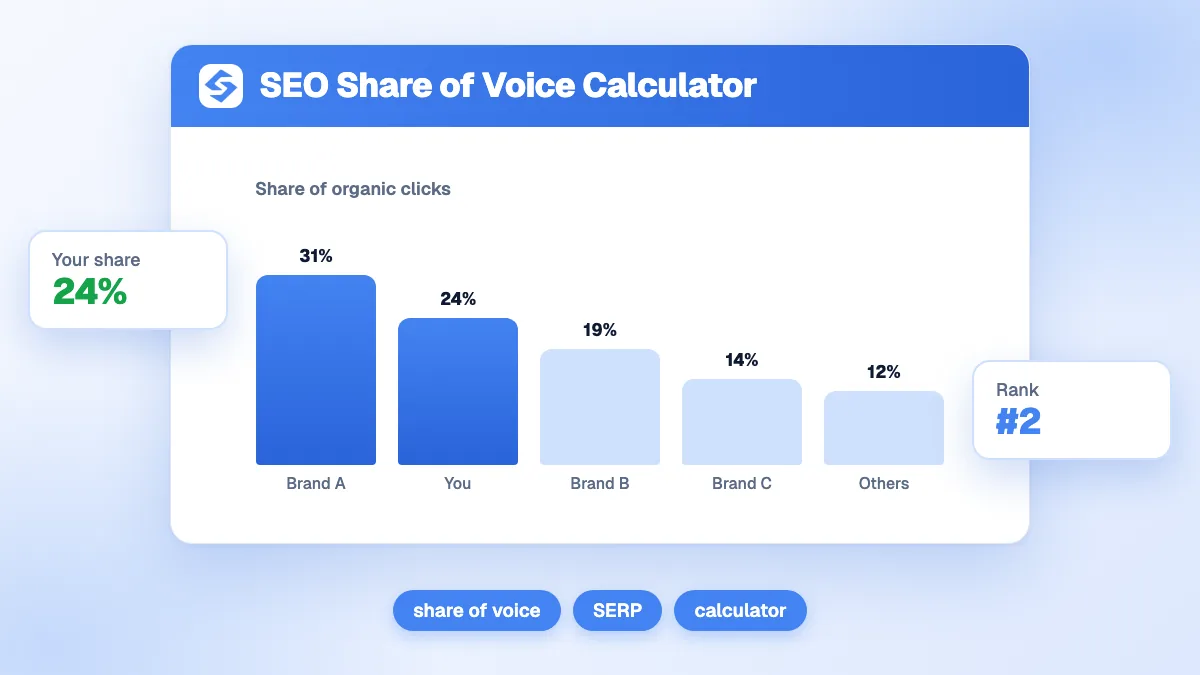
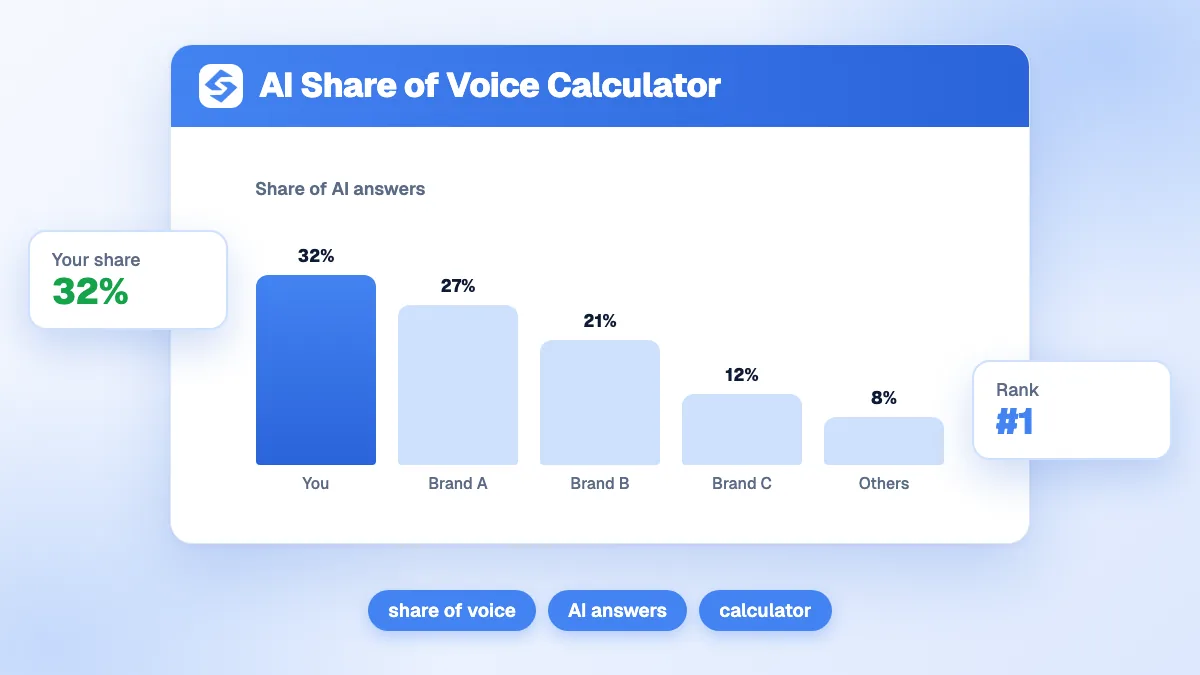
AI share of voice is the percentage of brand mentions you hold in AI answers on the prompts of your market: your mentions divided by all the mentions counted, yours, your three main competitors' and everyone else's. The calculator also gives your mentions per prompt, your rank and your gap to the leader. With 34 mentions out of 359, your share is 9.5%. Run the same prompts several times, because AI answers change from one run to the next.
Want to go further? Ask


The AI share of voice calculator puts a number on a simple question: when buyers ask ChatGPT, Perplexity or Gemini about your market, how often does your brand come up compared with the others? The question matters more every year. When Google shows an AI summary, users click a traditional result in only 8% of visits, against 15% without a summary (Pew Research Center, 2025). The brands named inside the answer take the attention that used to go to the links below it.

How do you calculate AI share of voice?
Count the AI answers that name each brand across the same set of prompts, then divide your count by the total. AI share of voice = your mentions ÷ (your mentions + competitors' mentions + everyone else's) × 100.
The calculator takes six inputs: your mentions, the mentions of three named competitors, the mentions of every other brand together, and the number of prompts you tested. It returns five results.
| Result | Formula | Example (default values) |
|---|---|---|
| Share of voice | Your mentions ÷ total mentions × 100 | 34 ÷ 359 = 9.5% |
| Total mentions | You + 3 competitors + everyone else | 34 + 96 + 61 + 48 + 120 = 359 |
| Mentions per prompt | Your mentions ÷ prompts tested | 34 ÷ 100 = 0.34 |
| Your rank | Your position among you and the 3 named competitors | 4 / 4 |
| Gap to the leader | Leader's mentions minus yours | 96 − 34 = 62 |
The "everyone else" field matters: without it, your share would be computed against your three rivals only and would look higher than it is. A chart shows the whole market, with your slice in blue.
How do you collect the mention counts?
Build a panel of prompts your buyers really type, run it on each AI assistant, and record which brands each answer names. Count a brand once per answer, whether it is named once or three times.
- Write 30 to 50 prompts per topic, the minimum the calculator recommends for a stable reading. Mix recommendation prompts ("best CRM for a small agency"), comparisons ("HubSpot or Pipedrive for B2B") and problems ("how to stop losing leads").
- Run every prompt on each assistant you care about, in a fresh conversation, so earlier messages do not steer the answer.
- Record the brands named in each answer: yours, your three main competitors, and a tally for all the others.
- Repeat the panel each month with the same prompts, so the trend means something.
Our ChatGPT visibility checker and Perplexity ranking checker give you a quick first reading before you build a full panel.
Why should you run the same prompt several times?
Because AI answers are not stable lists. In a 2026 experiment, 600 volunteers ran the same 12 prompts 2,961 times on ChatGPT, Claude and Google's AI. The researchers found less than a 1 in 100 chance that ChatGPT or Google's AI returns the same list of brands twice in 100 runs (SparkToro, AI recommendation consistency study, 2026).
The same study shows why share of voice still works. Rankings inside an answer were close to random, but how often a brand appeared across many runs was consistent: one brand was named in 85 of 95 answers to the same prompt. Frequency across many runs is a meaningful metric; a position in one answer is not. That is exactly what this calculator measures.
What is a good AI share of voice?
It depends on how many brands compete in your answers, but the calculator uses four bands as a guide.
| Share of voice | Reading | What it usually means |
|---|---|---|
| Below 5% | Below par | AI assistants rarely think of you for these prompts |
| 5 to 15% | Watch this | You are in the consideration set, but rarely first in mind |
| 15 to 30% | Healthy | You are one of the regular names in your market |
| 30% and above | Excellent | You are a reference answer on these prompts |
Read mentions per prompt next to the share. If you ran each prompt once, 0.34 means you appear in about a third of the answers; if you ran each prompt on three assistants, the maximum is 3. Rank matters too: an AI answer names a limited list of brands, sometimes only two or three, so the fourth brand of a market is often left out.

How is AI share of voice different from SEO share of voice and citation rate?
They measure three different kinds of presence. Use them together.
| Metric | What it counts | Where to calculate it |
|---|---|---|
| AI share of voice | Answers that name your brand, compared with competitors | This calculator |
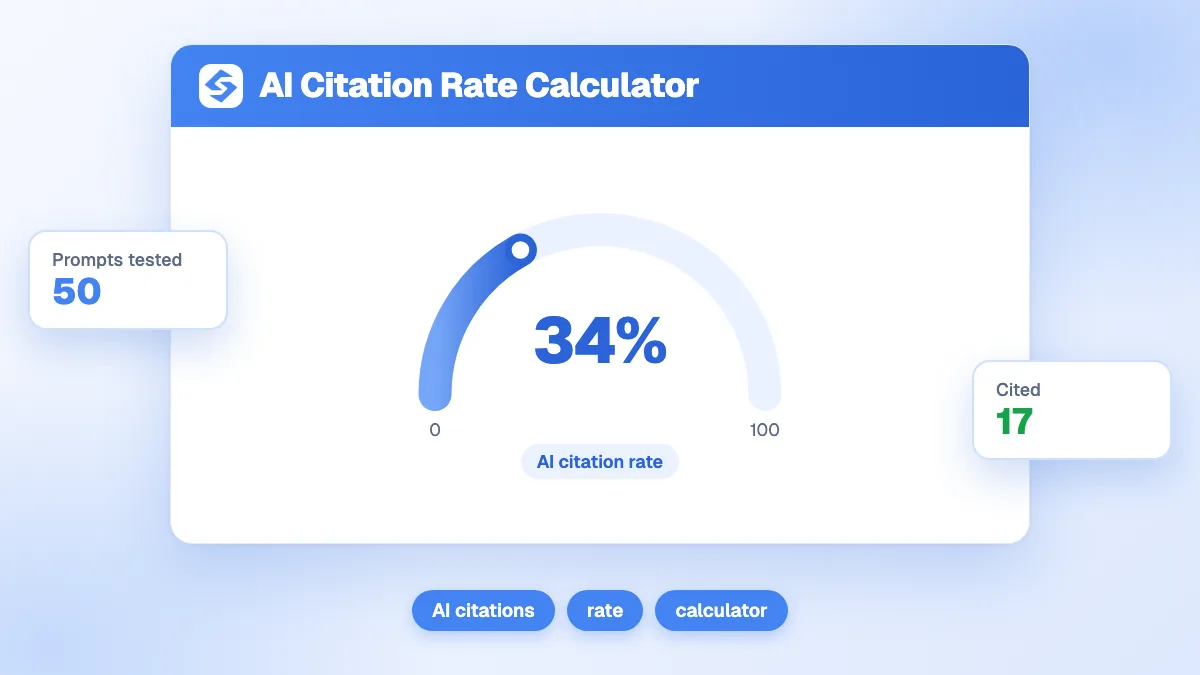
| AI citation rate | Answers that link to your site as a source | AI citation rate calculator |
| SEO share of voice | Your share of the organic search visibility in your market | SEO share of voice calculator |
A brand can be named without being linked, and linked without being recommended. When your SEO share is much higher than your AI share, your content ranks but is not the one AI assistants reuse: that gap is your GEO priority. See also our glossary entries on AI share of voice and share of model.
How do you increase your AI share of voice?
Give AI assistants more reasons, and more places, to associate your brand with the questions of your market.
- Answer the exact sub-questions. ChatGPT search rewrites a question into several targeted queries before it searches (OpenAI Help Center). The Sorank query fan-out tool shows the sub-queries ChatGPT, Claude and Gemini actually run, so you can write a page for each.
- Make your pages easy to quote: direct answers, figures, sources and tables. Researchers measured visibility gains of up to 40% in generative engine answers from this kind of optimisation (Aggarwal et al., KDD 2024).
- Be present where the answers are sourced: comparisons, reviews, directories and articles in your niche.
- Keep the brand facts consistent everywhere: name, category, offer and prices.
What are the limits of the calculation?
The result is only as good as the prompt panel behind it.
- A biased panel gives a biased share. Prompts that contain your brand name, or describe your product too closely, inflate your score.
- Each assistant is a different market. Calculate one share per assistant; an average can hide that you dominate one and are invisible on another.
- A mention is not a recommendation. Note the tone when you count: being cited as an example to avoid is not a win.
- Small panels move a lot. With 20 prompts, one extra mention changes your share noticeably; compare months only with the same panel.
How do you track AI share of voice every week?
Counting by hand works for a first measure, not for a monthly routine. The Sorank AI mention tracking follows your mentions in ChatGPT, Claude, Gemini and other AI assistants every week, per prompt and per model, and the GEO leaderboard ranks the sites AI assistants cite in your market, with your exact rank among them.
AI share of voice tells you how often AI answers think of you, compared with your rivals. Calculate yours with the tool above, then see the Sorank plans to measure it on autopilot.