Summary
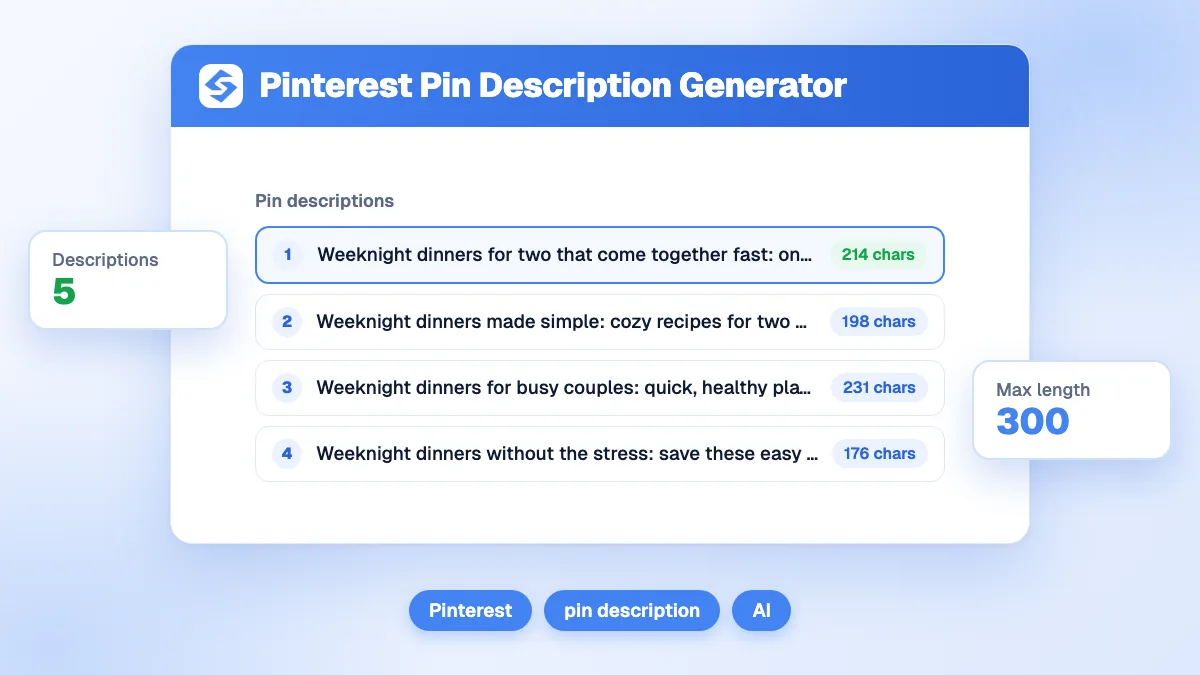
The Pinterest pin description generator writes 5 descriptions of 150 to 300 characters for one pin. Describe the subject, add a target keyword if you have one, pick a tone, and the AI returns descriptions that start with your keyword, ready to copy one by one or all at once. No account needed.
Want to go further? Ask


What does the Pinterest pin description generator do?
It turns a short subject into 5 ready-to-paste pin descriptions. You type what the pin is about, for example "easy weeknight dinners for two", and the AI writes 5 different versions of 150 to 300 characters each. Every version opens with your keyword, because the first words are the ones people and Pinterest search read first.
Pinterest treats your pin text as search material. Its own guide for creators says: "Add a title and description to your Pin, and include relevant keywords to help boost search visibility" (Pinterest fundamentals). A good description is therefore a short sentence that names the topic clearly, says what the reader gets, and invites a save or a click. The generator does that writing for you in about ten seconds.
You get:
- 5 descriptions on the same subject, each with a different angle.
- A keyword at the start of each one, when you give a target keyword.
- 4 tones: clear and professional, persuasive, friendly or expert.
- One-click copy for each description, plus a button to copy all 5.
How do you use it, step by step?
- Describe the subject of the pin in a few words (3 characters at least, 300 at most). Be concrete: "speckled handmade ceramic mugs, gift idea" works better than "mugs".
- Add a target keyword if you have one, such as "ceramic mugs". It is optional: without it, the AI works from your subject alone.
- Pick a tone that matches your brand and the board where the pin will live.
- Complete the anti-bot check, then click "Write my descriptions".
- Read the 5 suggestions, copy the one you prefer, and paste it into the description field of your pin.
The counter under the button shows how many free generations you have left today. If the quota runs out, come back the next day.
How do you read the 5 descriptions?
Treat them as 5 drafts, not 5 final texts. Each one starts with your keyword and then takes its own route: one stresses the benefit, another the use case, another the call to action. Pick the one that sounds most like you, then adjust a word or two.
Check 3 things before you paste:
- The first line says exactly what is on the pin. If someone reads only the opening words, they should know the topic.
- The facts are right. The AI does not see your image or your page. A description that mentions free shipping, a price or a number of recipes must match reality. The tool reminds you of this under the results.
- The ending invites an action: save the pin, read the guide, shop the product.
Keep in mind where the text shows. Pinterest states that descriptions "do not appear when viewing the Pin in the home feed or search feed" and accepts up to 800 characters, with a title of 100 characters max (Pinterest Help, review Pin specs). The feed is won by the image and the title; the description works for search and for people who open the pin. That is why the generator stays between 150 and 300 characters: enough to place your keywords, short enough to read in one glance.
| Pin field | Pinterest limit | What this tool does |
|---|---|---|
| Title | 100 characters max | Not written: use your own title |
| Description | Up to 800 characters | 5 versions of 150 to 300 characters |
| Keyword | No field of its own | Placed at the start of each description |
Which tone should you pick?
Pick the tone your readers would expect from your account. The same subject reads very differently in each one.
| Tone | Best for | What changes in the text |
|---|---|---|
| Clear and professional | Brands, services, guides | Plain facts, neutral wording, no hype |
| Persuasive | Product pins, shop links, offers | Stronger benefit and a direct call to buy or click |
| Friendly | Recipes, home, lifestyle, DIY | Warm, casual sentences that speak to "you" |
| Expert | Tutorials, B2B, how-to content | Precise terms and a focus on method |
Not sure? Run the same subject twice with two tones and compare. Each run counts against your daily quota.
What do good results look like? 3 examples
A recipe pin, friendly tone
Subject: "easy weeknight dinners for two". Keyword: "weeknight dinners". A typical result: "Weeknight dinners for two that come together fast: one-pan pasta, sheet-pan chicken and simple stir-fries with short shopping lists. Save this pin for your next busy evening and enjoy a calm dinner at home."
A product pin, persuasive tone
Subject: "speckled handmade ceramic mugs, gift idea". Keyword: "ceramic mugs". A typical result: "Ceramic mugs with a speckled glaze, shaped by hand so no two look the same. A thoughtful gift for coffee lovers, tea drinkers and anyone who enjoys a slow morning. Tap through to pick yours."
A guide pin, expert tone
Subject: "SEO checklist for small business blogs". Keyword: "SEO checklist". A typical result: "SEO checklist for small business blogs: check titles, internal links, page speed and search intent before you publish. Use it as a routine for every new post and fix the gaps that keep good articles out of Google."
In all three, the keyword comes first, the middle says what the reader gets, and the end asks for an action. Longer, more specific keywords usually work best on Pinterest, for the same reason a long-tail keyword works on Google: fewer competitors and a clearer intent.
What are the common mistakes?
- Stuffing keywords. "Ceramic mugs, handmade mugs, mug gift, coffee mug" reads like a list. Write one sentence with one main keyword and let the rest follow naturally.
- A vague subject. "Recipes" gives generic text. Name the dish, the audience or the occasion.
- The same text on every pin. If you make several pins for one page, give each its own description. The 5 versions are there for that.
- Trusting every detail. The AI can add a benefit you do not offer. Remove anything that is not true.
- Forgetting the image and the title. The description does not show in the feed, so a weak image or title will not be saved by a good description.
- Ignoring the destination. A pin that promises a recipe should land on that recipe, not on your home page.
What are the limits of this tool?
- It does not see your pin. It works only from the subject and keyword you type, not from the image or the linked page.
- It gives no search data. It does not tell you how often a keyword is searched on Pinterest. Pick your keyword first, then generate.
- It writes descriptions only. No pin title, no image text, no alt text.
- It does not publish. You paste the text into Pinterest yourself; nothing is scheduled or posted.
- It has a daily free quota. When you reach it, the tool asks you to come back tomorrow.
- It is an AI draft. Check facts and brand wording before you publish.
Need other short texts? The meta description generator writes the snippet Google shows under your page title, and the social media post generator drafts posts for other networks. To understand how Pinterest, TikTok or YouTube rank what people search, read our guide to social media search engines.
When should you move to Sorank?
Move to Sorank when the pins are easy and the pages behind them are the bottleneck. A pin only sends traffic to a page; if that page is thin or missing, the click is wasted. Sorank researches keywords, writes the articles, and publishes them to your site on autopilot, with the titles and descriptions already written for every page. The Sorank plan for content teams shows how that works when you publish every week. And if you wonder whether Pinterest also helps you appear in AI answers, our Pinterest AI citation study looks at how often AI assistants cite it.