Summary
The podcast show notes generator drafts your episode notes from a short description. Type the subject, add a keyword and a tone if you want, and the AI returns a summary and a chapter list with timestamps. Replace the timestamps with the real ones from your recording, then paste the notes on your show page.
Want to go further? Ask


What does the podcast show notes generator do?
It turns one line about your episode into show notes you can edit. Show notes are the text that sits under an episode on Spotify, Apple Podcasts, YouTube or your own site: a short summary, then the chapters with their start times. Listeners use them to decide whether to press play, and search engines use them to understand what the episode covers, since they cannot listen to the audio. The podcast SEO guide explains why this text matters for getting a show found outside the podcast apps.
The tool works from your description, not from your audio file. It does not listen to the episode and does not read a transcript. It writes a plausible structure for an episode on that subject, which you then align with what was really said.
How do you use it, step by step?
- Describe the subject of the episode in a few words (3 characters at least). Be specific: the guest, the story, the result. "How a bakery doubled its sales with Instagram" gives better notes than "Instagram marketing".
- Add a target keyword if you want the summary to use the words your audience types, for example "instagram for small business". The field is optional.
- Pick a tone: clear and professional, persuasive, friendly or expert. Match the voice of your show.
- Complete the anti-bot check and click "Write my show notes". The AI takes about ten seconds.
- Copy one block or click "Copy all", then edit the text in your hosting tool or show page.
The counter under the button shows how many free generations you have left today with this tool.
How do you read the result?
The result comes as a list of blocks, each with a label on the right. The Summary block is the paragraph that opens your show notes. The Chapter blocks are the lines of your chapter list, each starting with a timestamp and a short title. Every block has its own copy button, so you can keep the summary and rewrite the chapters, or the reverse.
Read the timestamps as placeholders. They show a sensible order and rhythm for the topic, but they cannot match your recording because the tool never heard it. Open your audio editor, note the minute where each part really starts, and change each time before you publish. The note under the result says it plainly: the text is written by an AI, so check the facts and adjust it to your brand.
What rules do chapters follow on each platform?
YouTube and Spotify both build clickable chapters from timestamps typed in the description, but only when the list follows their format. YouTube asks for a first timestamp at 00:00, at least three timestamps in ascending order, and chapters of 10 seconds or more (YouTube Help, video chapters). Spotify asks for one chapter per line, a first chapter at 00:00, at least three chapters in chronological order, and plain-text titles without emojis or HTML (Spotify for Creators, episode chapters).
| Rule | YouTube | Spotify |
|---|---|---|
| First timestamp | 00:00 | 00:00 or 00:00:00 |
| Minimum number of chapters | 3 | 3 |
| Order | Ascending | Chronological |
| Minimum chapter length | 10 seconds | Not stated for description chapters; Spotify advises merging chapters under 30 seconds |
| Accepted formats | Timestamp then title, one per line | MM:SS, HH:MM:SS, with or without brackets |
| Title advice | Short and descriptive | Plain text, under 40 characters recommended |
Spotify also removes numbering at the start of a title, so "1 - Introduction" becomes "Introduction". Keep your chapter titles free of numbers and emojis, and the same list works on both platforms.
What does a good result look like?
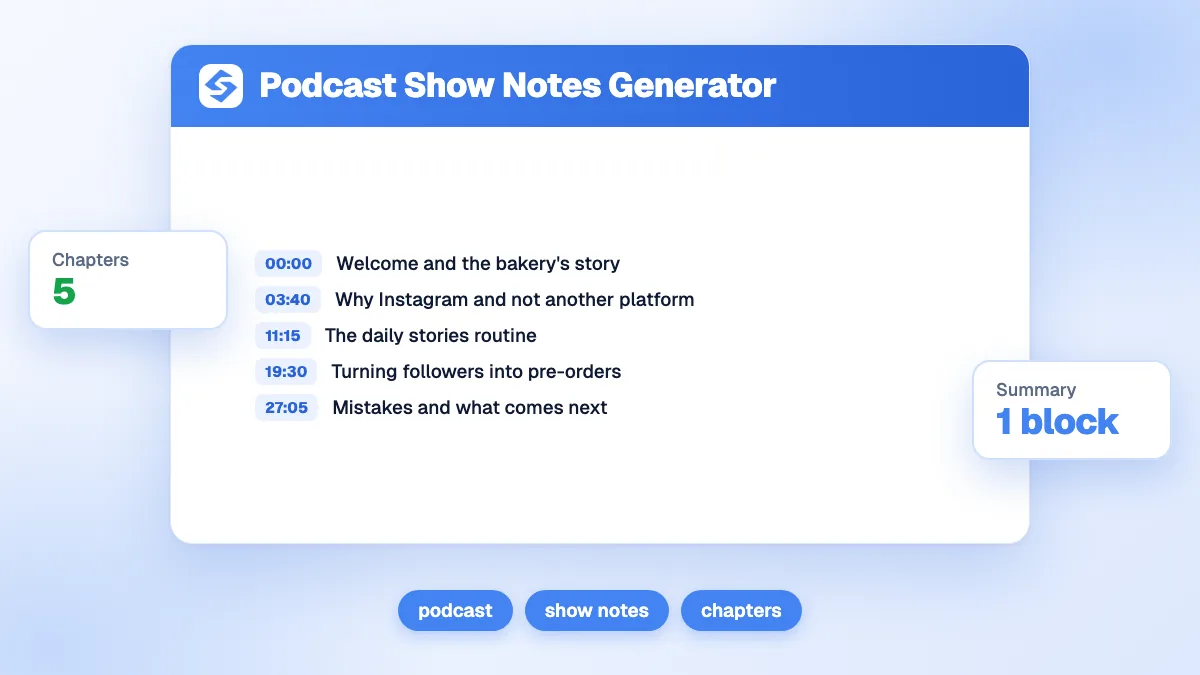
Take the subject "How a bakery doubled its sales with Instagram", the keyword "instagram for small business" and the friendly tone. A useful draft looks like this once you have fixed the times:
Summary: Our guest runs a neighbourhood bakery. She explains how daily Instagram stories, simple product photos and a pre-order button changed her sales, and what she would do differently.(00:00) Welcome and the bakery's story(03:40) Why Instagram and not another platform(11:15) The daily stories routine(19:30) Turning followers into pre-orders(27:05) Mistakes and what comes nextThe summary names the guest's situation and the promise of the episode. The chapters are short, start at 00:00 and follow the order of the conversation. A listener can jump straight to the part they care about.
What are the common mistakes with show notes?
- Publishing the AI timestamps as they are: a chapter that starts at the wrong minute frustrates listeners more than no chapter at all.
- A vague subject: "marketing tips" gives generic notes. Name the guest, the sector and the outcome.
- Repeating the episode title as the summary: the summary should add what the title cannot, such as who speaks and what the listener will learn.
- Keyword stuffing: one keyword used naturally in the summary is enough. Lists of tags read badly and help no one.
- Leaving facts unchecked: the AI may invent a figure or a detail that was never said. The guide to fact-checking AI content gives a quick routine before you publish.
- Forgetting the links: add the guest's site, the resources mentioned and your own offer. The tool does not write them for you.
What are the limits of this tool?
- It does not hear your episode: the summary and chapters come from your description, so they describe what an episode on that subject usually covers, not what your guest said.
- Timestamps are a suggestion: you must replace them with the real start times.
- No guest names, quotes or links unless you put them in the description yourself.
- A daily limit: the free generations per day are counted, and the shared AI quota can run out on busy days.
- One episode at a time: the tool does not publish anything or connect to your hosting platform.
For the video version of your episode, the YouTube description generator writes a description you can merge with these chapters. To understand how platforms and search engines index video, see the glossary entry on video SEO.
When should you move to Sorank?
Use this tool for each episode page, then build written content around your show to be found on Google and in AI answers. Show notes help listeners who already found you. Articles that answer the questions your audience types bring new ones. The content repurposing guide shows how to turn one episode into several pieces. Sorank's AI blog article generator plans and writes those articles on autopilot, and the page Sorank for podcasters explains how it fits a show.