
Preferences
Privacy is important to us, so you have the option of disabling certain types of storage that may not be necessary for the basic functioning of the website. Blocking categories may impact your experience on the website. More information

Privacy is important to us, so you have the option of disabling certain types of storage that may not be necessary for the basic functioning of the website. Blocking categories may impact your experience on the website. More information

Podcast SEO guide: episode pages, transcripts, titles, show notes, schema, YouTube, Apple and Spotify search, and how to get your podcast cited by the AIs.
Tools


In short
Podcast SEO means making your episodes findable as text, because search engines and the AIs mainly read words, not audio. The essentials are one dedicated page per episode on your own website, a full transcript, a title built on what listeners search, structured show notes and PodcastEpisode schema. Add YouTube, which is now a major podcast platform, and optimize your listings in Apple Podcasts and Spotify. Each transcript then becomes a long, quotable document that Google and AI assistants can use.
Want to go further? Ask
Podcast SEO covers two different searches: people looking for a show to listen to inside a podcast app, and people searching Google, YouTube or ChatGPT for an answer that one of your episodes happens to contain. Most podcasters only work on the first one. The second is where the long-term traffic is.
It is the set of actions that make a podcast and its episodes rank in search engines, podcast apps and AI answers. It combines classic web SEO (pages, text, links, structured data) with platform optimization (titles, descriptions, categories in each directory).
| Where people search | What gets read | Main lever |
|---|---|---|
| Episode pages, transcripts, YouTube videos | One indexable page per episode | |
| YouTube | Video title, description, chapters, captions | Video version with chapters |
| Apple Podcasts | Show title, author, episode titles and descriptions | Clear metadata in the RSS feed |
| Spotify | Show and episode titles, descriptions | Descriptive titles, consistent topic |
| The AIs | Text pages and transcripts across the web | Quotable answers in transcripts and notes |
Because a hosting player or an app listing is not a page you control, and it rarely ranks for the topic of the episode. A page on your domain can target a query, receive links and send authority to the rest of your site.
A good episode page contains:
If you host on a dedicated platform, check that it lets you publish the audio on your own domain or embed it easily; our comparison of the best podcast hosting tools covers that point.
A transcript turns 30 to 60 minutes of audio into thousands of indexable words, full of long-tail questions and precise vocabulary. It is the single most effective podcast SEO action.
Automatic transcription is now standard: Apple added automatically generated transcripts to Apple Podcasts in 2024 with iOS 17.4, starting with English, French, German and Spanish. Those transcripts live inside the app, though. To benefit in Google and in the AIs, publish your own version on your website:
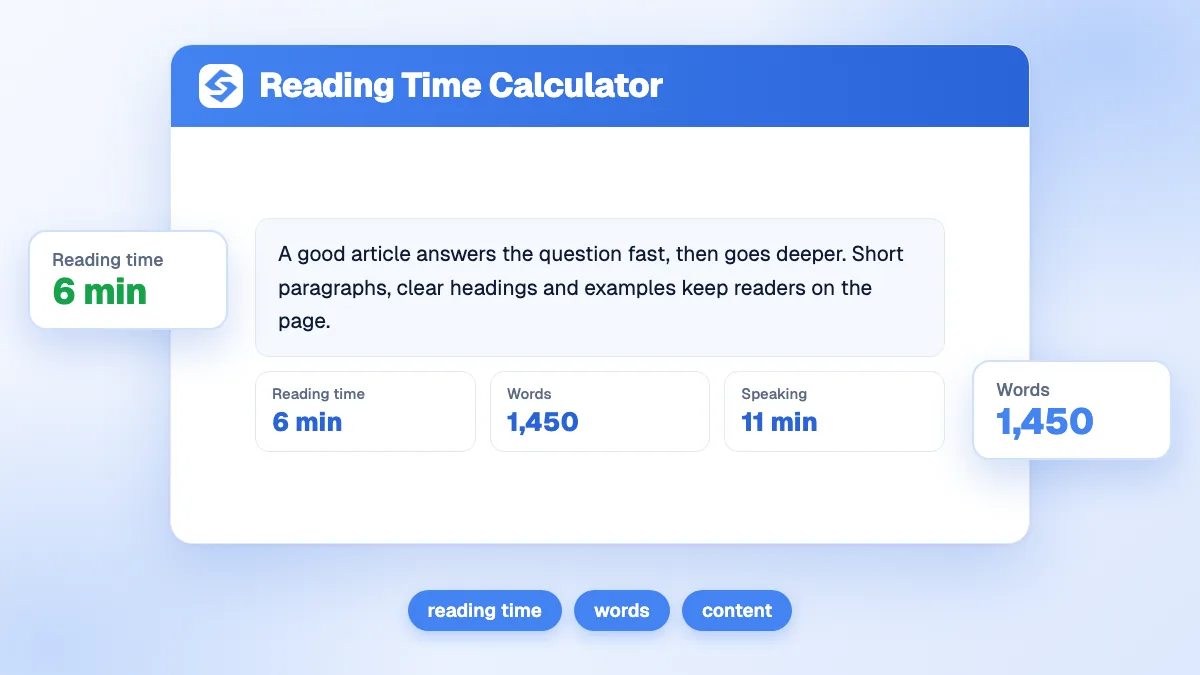
A 45-minute episode often runs to 6,000 words or more. Our reading time calculator helps you show visitors how long the written version takes, so they can choose between reading and listening.
Name the episode after the problem the listener searches, then add the guest or the angle. "Episode 47 with Marie" ranks for nothing; "How to price a freelance design project, with Marie Dupont" can rank.
Schema.org provides PodcastSeries for the show and PodcastEpisode for each episode, plus AudioObject for the audio file. This markup describes the show, the episode number, the date, the duration and the people involved in a format machines read without guessing.
Add Person markup for hosts and guests, and link the show to your organization with the same name everywhere. That consistency helps search engines and the AIs connect your podcast to your brand. You can produce the JSON-LD with our schema markup generator, then validate it with Google's Rich Results Test or the schema.org validator.
Yes: YouTube announced in February 2025 that it had passed 1 billion monthly podcast viewers, and YouTube videos regularly appear in Google results. A video version (even a static image with the audio) doubles your chances of being found.
Note that the Google Podcasts app shut down in 2024 and its users were moved to YouTube Music, which reinforces YouTube's role for podcast discovery on Google's side.
The AIs cite text they can find, understand and attribute: transcripts, episode pages and mentions on other sites. ChatGPT, Gemini, Perplexity and Claude rarely listen to audio, so a podcast without text barely exists for them.
Conversational queries also overlap with voice search: natural questions in your titles and headings match how people speak to assistants.
Podcast SEO rests on one idea: give every episode a written version that search engines and the AIs can read. Publish one page per episode with a corrected transcript, title episodes after real questions, add PodcastEpisode schema, and distribute the video version on YouTube with chapters.
If your podcast is part of a wider content strategy, Sorank can take care of the written side in autopilot: it finds the keywords of your topic, publishes optimized articles every day on your CMS and tracks whether the AIs cite your brand. You can try it with a 3-day free trial.

Yes, when each episode has its own indexable page on your website. Audio alone is hard for search engines to use, but an episode page with a transcript, a clear title and show notes gives Google and the AIs text to index and quote, and it earns links from guests who share their appearance.
Publish one page per episode on your own domain, with a descriptive title, a summary, a transcript and timestamps, and link the pages from your site. Add PodcastEpisode structured data, upload the episodes to YouTube with chapters, and submit your sitemap in Google Search Console so the pages are crawled quickly.
Yes, but as natural phrasing. Use the question or topic a listener would type, followed by the guest or angle, and keep the episode number at the end or out of the title. Avoid stuffing several keywords: it reads as spam in the apps and does not help ranking.
 AI Content Brief Generator
 FAQ Schema GeneratorAI Blog Post Ideas GeneratorStructured Data Validator
 Alt Text Checker
 Internal Link AnalyzerBacklink ChallengeAI Meta Description GeneratorAI Blog Title Generator
 Google Indexability CheckerAI Blog Outline GeneratorUTM Link BuilderKeyword Clustering ToolCanonical Tag Checker
 XML Sitemap GeneratorBroken Link CheckerAI SEO Title GeneratorHeadline AnalyzerSERP Preview ToolRedirect Checker
 Hreflang Tag GeneratorHeading Structure AnalyzerHTTP Headers CheckerFavicon Extractor
 SERP CTR Calculator
 SEO vs Paid Search Savings Calculator
 SEO Share of Voice Calculator
 SEO ROI Calculator
 SEO Traffic and Revenue Forecast Calculator
 SEO Budget Calculator
 SEO Break-Even Calculator
 SaaS SEO ROI Calculator
 ROAS Calculator
 Reading Time Calculator
 Ranking Gain Simulator
 Organic Traffic Value Calculator
 Organic Traffic Estimator
 LTV to CAC Ratio Calculator
 Local SEO ROI Calculator
 Link Building Cost Calculator
 Keyword Value Calculator
 Keyword Opportunity Score Calculator
 Keyword Density Calculator
 GEO ROI Calculator
 GEO Content Investment Calculator
 Ecommerce SEO ROI Calculator
 Customer Lifetime Value Calculator
 Customer Acquisition Cost Calculator
 CTR Calculator
 Cost Per Article Calculator
 Conversion Rate Calculator
 Content Marketing ROI Calculator
 ChatGPT Referral Traffic Estimator
 Bounce Rate Calculator
 Backlink ROI Calculator
 AI Visibility Score Calculator
 AI Traffic Value Calculator
 AI Share of Voice Calculator
 Cost of AI Invisibility Calculator
 AI Citation Rate Calculatorllms.txt ValidatorAI Overview CheckerRobots.txt CheckerAI SEO AuditLLM Readability CheckerSearchGPT Readiness Checker
 Structured Data LLM AuditWebsite Crawlability AI AuditWhy ChatGPT Is Not Recommending My Website
 Gemini Ranking ToolPerplexity Ranking CheckerLLM Citation CheckerAnswer Engine Optimization AuditGEO AuditAI Search Visibility TestChatGPT Visibility Checkerllms.txt Generator
 URL ExtractorWebpage to MarkdownSitemap CheckerSERP Volatility SensorPage Size Checker
 Word Counter
 Slug GeneratorSchema GeneratorRobots Generator
 OG PreviewMeta Tags Generator
 Image CompressorFavicon Generator
 On-Page SEO Audit
 Backlink Analysis Tool
 Keyword Research Tool
 Domain Authority Checker
THEY TRIED SORANK BEFORE YOU
 “I tested Sorank on a real client site and it's insane. It does everything an agency would bill you $1500 a month for. It's going into production on that client now.”

 Guillaume Guersanguersanguillaume.com“We are an Ads agency and we wanted to get our SEO back on track once and for all. Sorank gave us a clear view of our site, helped us prioritize optimizations, and properly structure our content. The tool is easy to use, well designed for a team, and very practical for centralizing tracking without having to juggle multiple platforms. A very solid foundation to start fresh with our SEO.”
 Gaspard MadouiAds Agency
 “I just let the Sorank software do its thing, and now my DR is 25 and my page is ranking higher.”
 Lucas Flandrefoundertrace.fr“I specialized in GEO thanks to Sorank. The GEO Leaderboard allows me to show my clients their position vs competitors on ChatGPT. It’s a real commercial differentiator.”
 MélanieSEO Freelance“Great service, works well for our website and helps us understand how to improve it to rank better on Google and elsewhere. Congrats, keep going, I recommend it.”
 Hugo T.E-commerce merchant























