
Preferences
Privacy is important to us, so you have the option of disabling certain types of storage that may not be necessary for the basic functioning of the website. Blocking categories may impact your experience on the website. More information
Privacy is important to us, so you have the option of disabling certain types of storage that may not be necessary for the basic functioning of the website. Blocking categories may impact your experience on the website. More information

A YouTube transcript citation is a reference AI makes to a video. Learn why transcripts drive citations and how to optimize yours for GEO.







Founder Sorank, 7+ years in SEO.
Summary
YouTube transcript citations are references that an AI assistant makes to a YouTube video in its answer. Most assistants do not watch the footage: they read the title, description, chapter markers and transcript, then cite the video as a source.
Want to go further? Ask
YouTube transcript citations are the video references that AI assistants give when they answer a question, and they are built from the written text around a video rather than from its images. A tutorial with a clear spoken explanation and accurate captions gives an assistant something precise to quote, while a visually strong video with no usable text gives it little to match. This changes how a video should be written, titled and published, which is the core of video SEO in AI search.
A YouTube transcript citation happens when an AI assistant names a YouTube video as a source for part of its answer, after reading the words attached to that video. The transcript is the text of everything spoken in the video, with the time at which each line is said. It can be generated automatically by YouTube or uploaded by the creator. Whatever its origin, the transcript is the version of the video that an assistant can read, search and summarize.
This is one form of LLM citations, the sources that AI models name in their answers. The citation is not a view. In Sorank's definition, a citation is a YouTube address that a model gives to support a company it recommends. It can be the company's own channel, an independent review or a tutorial that features the product, and it says nothing about whether anyone clicked.
Most assistants treat a YouTube page as a text document with a video attached. In a standard answer, they read the following elements and match them against the question:
The images play a small part in most of these systems. The one clear exception is Gemini, which can analyze a video when a user pastes its link into the chat. When an assistant cites a YouTube video for a general question, the written information around the video is usually what made it relevant. A video the model cannot see can still be cited, provided its text is clear.
In Sorank's study of 498158 AI answers, collected from August 2025 to October 2026, YouTube was cited 1.80 times per 100 answers across the assistants measured. The rate depends heavily on the assistant:
| AI assistant | Answers analyzed | YouTube citations per 100 answers |
|---|---|---|
| Gemini | 148287 | 4.01 |
| Perplexity | 118647 | 2.30 |
| Grok | 26638 | 0.72 |
| ChatGPT | 148295 | 0.06 |
| Claude | 56291 | 0.03 |
Gemini cites YouTube 157 times more often than Claude. Gemini grounds its answers in Google Search, which also owns YouTube, so it often includes videos for how-to and review queries. Perplexity runs a web search for every question, so a well-ranked video can appear whenever it matches the prompt. Claude leans on text it can check, so video pages seldom appear among its references. The same video strategy can therefore be very visible in one assistant and almost invisible in another.
The rate also moves from month to month. In the French series of the same study, it fell from 2.72 per 100 answers in July 2026 to 0.36 in October 2026. A drop like this can reflect a change in how an assistant handles video results, not a loss of interest in video, so a single month should not decide your plan.
An assistant that cannot watch a video needs words to match, and the transcript is the largest set of words a video contains. A clear spoken answer that names the product, the step or the price in full sentences gives the model a passage it can summarize. A transcript that is vague, rambling or full of misheard names gives it very little to work with.
Speech recognition is the weak point. The study recommends checking automatic captions for brand and product names, because speech recognition often gets them wrong. A misspelled name means the video may not match the brand that the assistant is looking for. Upload corrected captions for each language you target, rather than relying on the automatic version alone.
Timestamps are the link between a transcript and a specific answer. YouTube's help page on subtitles and captions explains that subtitle and caption files contain the text of what is said, together with the time each line should appear, and that transcript text is synchronized to the video. Each line therefore carries its own time, which is what lets a passage be located inside the video.
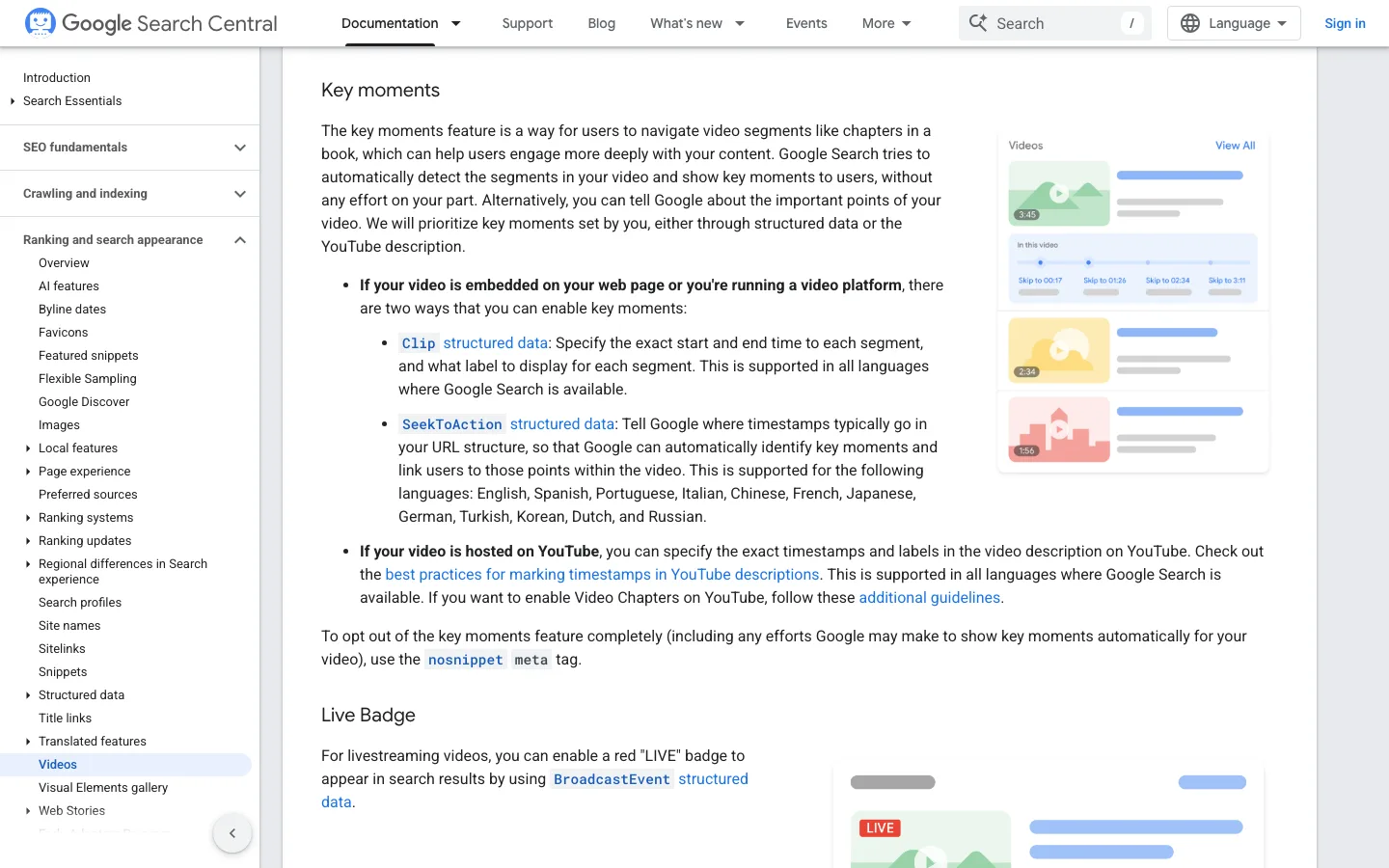
Google applies the same idea to its own results. Its documentation on key moments in video says that Google tries to detect the segments of a video automatically, and that it will prioritize key moments set by the site owner, through structured data or through the YouTube description. The screenshot below shows that section of the documentation.
For a creator, the practical rule is to label the segments yourself. Chapters with descriptive names, and a description that states the answer in plain text, let Google and the assistants find the right passage without guessing. The schema.org vocabulary also defines a transcript property for VideoObject, so a page that embeds the video can publish the same text in its markup.
For generative engine optimization, a video is a second, citable format that covers the same topic as a text page. The two work best together. The study recommends embedding key videos on the matching page of your site with a written summary, because the text page can be cited even when the video is not. That is where video joins the wider effort to earn source citation.
Published content can also grow organic traffic at scale. In the LV3D case study, a French 3D printing specialist multiplied its organic traffic by 4 in 5 months, with daily Google clicks rising from about 240 to over 1000, after Sorank began publishing articles built around its buyers' questions. That result came from text pages, not from video, so it shows the scale a content plan can reach rather than what a video alone can achieve.
Visibility also has to be measured, or it stays a guess. Sorank's AI Mention Tracking shows when ChatGPT, Claude, Gemini and other assistants mention a brand, prompt by prompt, together with the sources they cite.
Start with the transcript itself, then work outward to the title, chapters and description. Each step changes what an assistant can read:
Finally, check the results. Track which assistants cite your videos and for which prompts, then produce the tutorials that are still missing. Video is most useful when it answers questions that people already ask.
YouTube transcript citations are how AI assistants quote video: they read the words attached to a video, not its footage, and they cite the passage that answers a question. Gemini cites YouTube far more often than the other assistants in the study, but the work is the same everywhere. Correct the transcript, label the segments and state each answer in plain text, then measure which prompts bring your videos into the answer.
Sources
Most assistants read the words attached to the video: the title, description, chapter markers and transcript. They match those words to the question and cite the video as a source. Gemini is the exception, since it can analyze a video when a user pastes its link.
It depends on the assistant. In Sorank's study of 498158 AI answers, Gemini cited YouTube 4.01 times per 100 answers and Claude 0.03, so the assistant your audience uses most should guide your work.
Upload corrected captions for each language, add chapters with descriptive labels, and state each answer in plain text in the title and description. Then track which prompts cite your videos and produce the tutorials that are still missing.
 “I tested Sorank on a real client site and it's insane. It does everything an agency would bill you $1500 a month for. It's going into production on that client now.”

 Guillaume Guersanguersanguillaume.com“We are an Ads agency and we wanted to get our SEO back on track once and for all. Sorank gave us a clear view of our site, helped us prioritize optimizations, and properly structure our content. The tool is easy to use, well designed for a team, and very practical for centralizing tracking without having to juggle multiple platforms. A very solid foundation to start fresh with our SEO.”
 Gaspard MadouiAds Agency
 “I just let the Sorank software do its thing, and now my DR is 25 and my page is ranking higher.”
 Lucas Flandrefoundertrace.fr“I specialized in GEO thanks to Sorank. The GEO Leaderboard allows me to show my clients their position vs competitors on ChatGPT. It’s a real commercial differentiator.”
 MélanieSEO Freelance“Great service, works well for our website and helps us understand how to improve it to rank better on Google and elsewhere. Congrats, keep going, I recommend it.”
 Hugo T.E-commerce merchant



















