Preferences
Privacy is important to us, so you have the option of disabling certain types of storage that may not be necessary for the basic functioning of the website. Blocking categories may impact your experience on the website. More information
Privacy is important to us, so you have the option of disabling certain types of storage that may not be necessary for the basic functioning of the website. Blocking categories may impact your experience on the website. More information

The types of ecommerce explained: B2C, B2B, C2C, D2C and more, plus fulfillment models and channels, with examples, comparison tables and a 5-step choice.

In short
The types of ecommerce are the ways a business can sell online, sorted by who sells to whom (B2C, B2B, C2C, C2B, B2G, B2B2C, D2C), by how the product is sourced and shipped (dropshipping, wholesale, private label, subscription, digital) and by where the sale happens (own store, marketplace, social). Pick one of each to define your model.
Want to go further? Ask
Quick quiz
Where should your online shop find its next customers?
Sorank matches your answers


Test it for 3 days on your own site and see where you stand on Google, ChatGPT and the other AIs.
Start 3-day free trial3 days free, then stop whenever you want. 90-day results guarantee, conditions apply.
Most guides stop at the first list of letters. That is only one third of the decision. A dropshipping store and a private label brand can both be "B2C" and still have nothing in common: margins, cash needs, control over the product, and even the way they get traffic from Google and AI models differ completely. This guide covers the three layers, gives real examples for each type, compares them in tables, then walks you through choosing your model and avoiding the mistakes that sink most new stores.
The types of ecommerce are categories that describe an online business along three axes: the parties in the transaction, the fulfillment model and the sales channel. Every online store has one answer on each axis, and the combination is its business model.
Think of it as three questions you answer in order:
The answers change almost everything downstream: the price you can charge, the legal rules that apply, the size of your average order, how long the buyer takes to decide, and the pages you need to rank on Google. A B2B store selling industrial parts needs spec sheets and bulk pricing pages; a C2C marketplace needs thousands of listing pages that do not cannibalize each other.
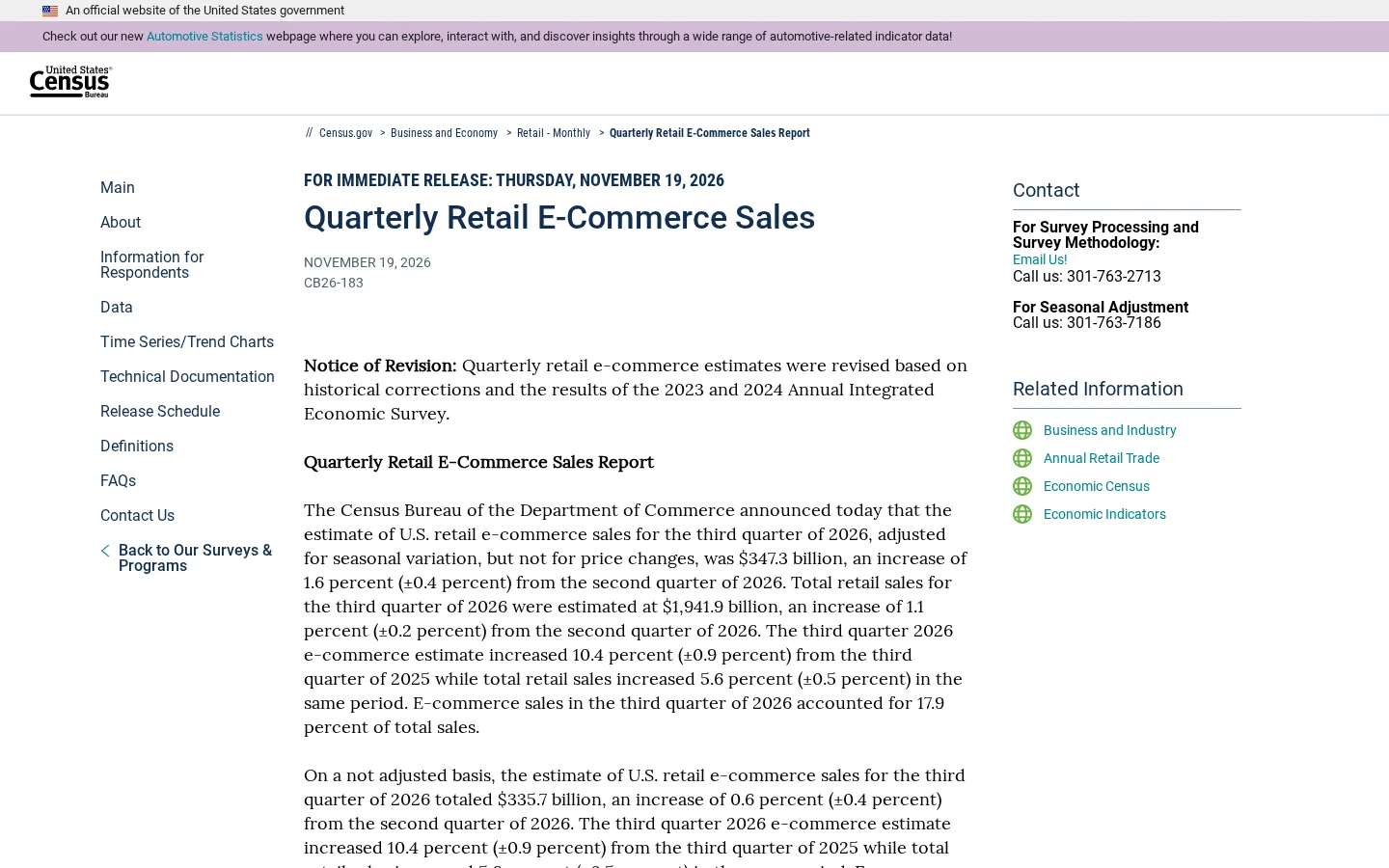
Retail ecommerce gets the headlines, but it is the smaller part of online trade. The US Census Bureau quarterly report released on November 19, 2026 puts US retail ecommerce at $347.3 billion in Q3 2026, or 17.9% of all retail sales (seasonally adjusted). Business-to-business is far more digital: in a 2021 Census Bureau analysis by Andrew W. Hait, ecommerce shipments made up 67.3% of all US manufacturing shipments in 2018, against 9.9% of retail sales the same year.
Online sales: retail versus manufacturing (US)
Sources: US Census Bureau, Quarterly Retail E-Commerce Sales (November 19, 2026) and E-Commerce Statistics 2018 (A. W. Hait, 2021)
For more figures on market size, mobile and cart abandonment, see our page of sourced ecommerce statistics.
The transaction model is the most common way to classify ecommerce: it names the seller and the buyer with a letter each (B for business, C for consumer, G for government). There are seven models you will meet in practice.
A company sells products or services to individuals. This is what most people picture when they hear "online store": Sephora, Nike.com, an independent candle shop on Shopify.
A company sells to other companies: raw materials, office supplies, software, spare parts. Examples: Grainger for industrial supplies, Uline for packaging, Alibaba.com for factory sourcing.
Individuals sell to other individuals through a platform that takes a fee: eBay, Vinted, Facebook Marketplace, Depop. The platform rarely owns stock; it earns commissions, listing fees or ads.
Individuals sell products or services to companies. Freelancers on Upwork or Fiverr, photographers on stock sites, creators paid by brands, people selling used phones to a refurbishing company.
Companies sell to public bodies: city councils, hospitals, schools, ministries. Purchases go through public procurement portals such as SAM.gov in the United States or national tender platforms in Europe. Some sources call it B2A (business to administration).
A company reaches consumers through a partner business. A snack brand sold on Amazon, an insurance product sold at a car dealer's checkout, a white-label app distributed by a telecom operator. We cover it in depth in the B2B2C ecommerce definition.
D2C (or DTC) is a sub-type of B2C where the brand that makes the product sells it directly, without retailers or wholesalers in the middle. Warby Parker, Allbirds and Glossier built their names this way.
| Model | Seller | Buyer | Typical order | Decision time | Examples |
|---|---|---|---|---|---|
| B2C | Business | Individual | Small | Minutes to days | Sephora, Nike.com |
| B2B | Business | Business | Large, recurring | Weeks to months | Grainger, Uline, Alibaba.com |
| C2C | Individual | Individual | Small, one-off | Minutes to days | eBay, Vinted, Depop |
| C2B | Individual | Business | Per job or license | Days | Upwork, Fiverr, stock photo sites |
| B2G | Business | Public body | Very large | Months | Suppliers on SAM.gov |
| B2B2C | Business via a partner | Individual | Small | Minutes to days | Brands sold on Amazon |
| D2C | Manufacturer | Individual | Small to medium | Days | Warby Parker, Allbirds |

The fulfillment model describes where your products come from and who ships them. It decides your margin, the cash you need before the first sale and how much you control quality. This is where two "B2C stores" become two completely different businesses.
You sell products you never touch: when an order comes in, a supplier ships it straight to the customer. You need almost no capital, but margins are thin, delivery times depend on the supplier and hundreds of stores sell the same product with the same photos. Ranking such a store needs specific work, explained in our guide to dropshipping SEO for stores that sell the same products as everyone else.
You buy branded products in bulk from a distributor and resell them. Cash is tied up in stock, but you control delivery speed and packaging. Your edge is selection, service and content, since the products exist elsewhere.
A manufacturer produces a generic product and you sell it under your own brand. Better margins than reselling and real differentiation, at the cost of minimum order quantities and product development.
Close to private label, but the product is identical to what the maker sells to other brands; only the logo changes. Faster to launch, weaker differentiation.
You make the product yourself or have it made to your design, sometimes only after the order (custom furniture, tailored clothes). Highest control and margin, highest operational load.
A partner prints your designs on t-shirts, mugs or posters once an order arrives, then ships it. No stock, low risk, modest margin. It suits artists and creators testing designs.
Customers pay every week or month for a box, a refill or a service: razors, coffee, pet food, meal kits. Revenue becomes predictable and lifetime value goes up, but churn becomes your main metric. Use the LTV to CAC ratio calculator to check that a subscriber is worth what you pay to acquire them.
Ebooks, courses, templates, software, music, online coaching. Nothing ships, margins are very high and the same file sells infinitely, but piracy, refunds and audience building are the real costs.
Dropshipping vs private label
| Fulfillment model | Starting capital | Margin | Control over product | Main risk |
|---|---|---|---|---|
| Dropshipping | Very low | Low | Low | Supplier delays, copycats |
| Wholesale reselling | Medium | Low to medium | Medium | Unsold stock |
| Private label | Medium to high | Medium to high | High | Minimum orders, product flop |
| White label | Medium | Medium | Medium | Weak differentiation |
| Manufacturing | High | High | Very high | Operations and quality |
| Print on demand | Very low | Low to medium | Medium | Print quality, low margin |
| Subscription | Medium | Medium to high over time | High | Churn |
| Digital products | Low | Very high | Very high | Audience building, piracy |
The channel is where the buyer clicks "buy": your own store, a marketplace, a social app, or a mix. Most stores today use more than one, but each has a different trade-off between reach and control.
A website you own, built on a platform like Shopify, WooCommerce or Magento. You keep the customer data, the brand experience and the margin, and you build an asset that ranks on Google over time. The cost: you must bring every visitor yourself. Our step-by-step guide on how to build an ecommerce website covers the setup, and the comparison of the best ecommerce platforms for SEO helps you pick the software.
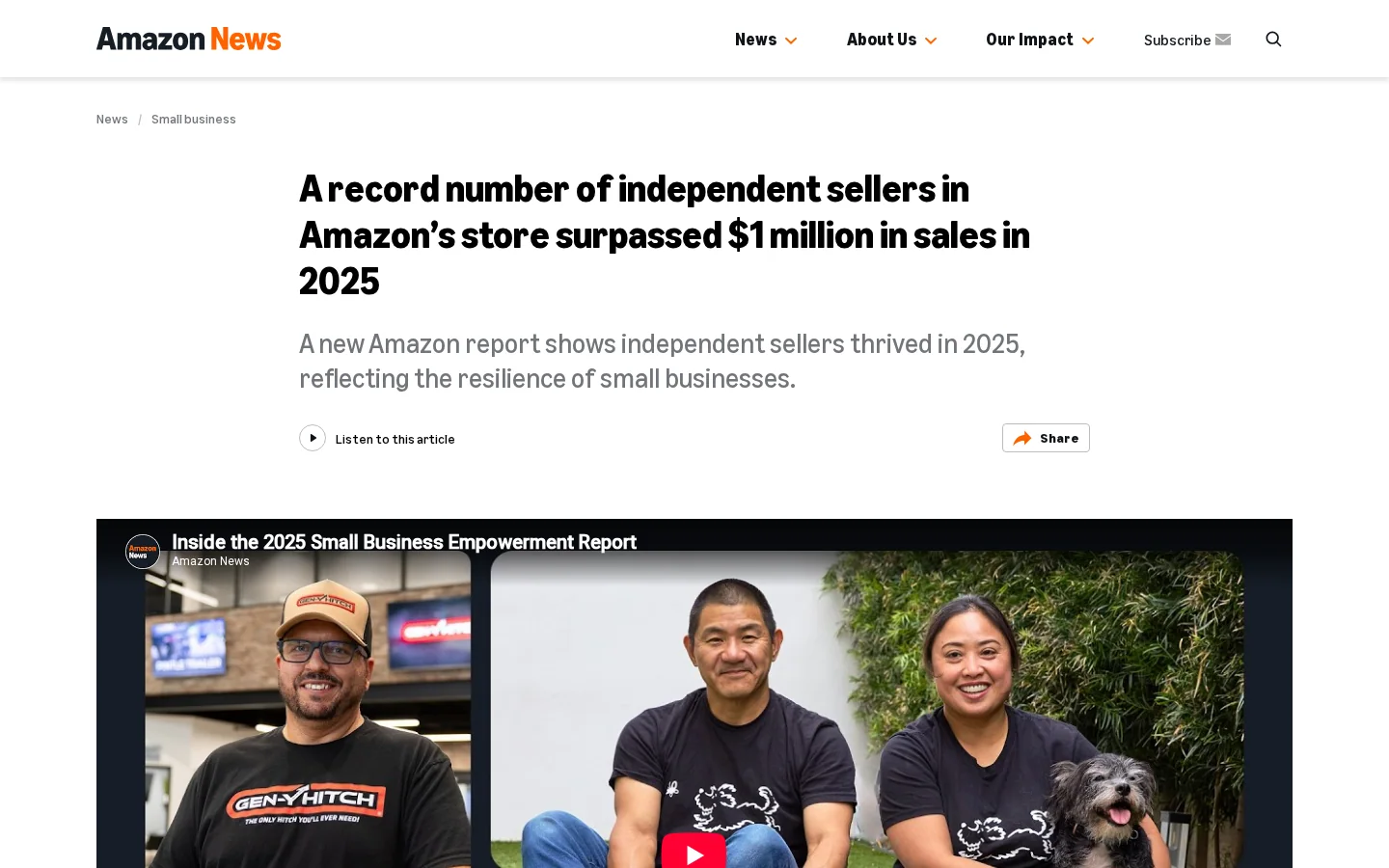
Amazon, Etsy, eBay, Zalando, Walmart Marketplace: the platform brings the buyers and takes a commission. Marketplaces are powerful because the traffic is already there. According to the Amazon 2025 Small Business Empowerment Report, published April 30, 2026, selling partners account for more than 60% of sales in Amazon's store, and more than 75000 independent sellers passed $1 million in sales in 2025. Etsy plays the same role for handmade and vintage goods, with a mix of small brands and individual makers.
The catch: the marketplace owns the customer, sets the rules and can change fees overnight. You compete with other sellers on the same product page, sometimes with the marketplace itself.
Buying inside Instagram, TikTok Shop, Pinterest or YouTube without leaving the app. It works well for impulse, visual and trend-driven products, and badly for considered or technical purchases. Content is the storefront: a product that does not film well does not sell well here.
A dedicated app makes sense once you have loyal, frequent buyers (groceries, fashion drops, food delivery). Before that, a fast mobile site does the job at a fraction of the cost.
The newest channel: shoppers ask ChatGPT, Gemini or Claude which product to buy, and AI models increasingly complete the purchase for them. Your product data, reviews and third-party mentions decide whether you are recommended. We explain the protocols in our article on agentic commerce and how brands should prepare.
Selling across your store, marketplaces, social and physical shops with one stock, one customer record and consistent prices. It is a goal more than a starting point: start with one or two channels you can run well.
Own store vs marketplace
No type of ecommerce is "best": each one fits a profile of capital, skills and product. The table below crosses the most common combinations with what they really require.
| Combination | Best for | Capital needed | Main traffic source | Hardest part |
|---|---|---|---|---|
| B2C + dropshipping + own store | Testing product ideas | Very low | Paid social ads | Standing out, margins |
| D2C + private label + own store | Building a brand | Medium | SEO, content, ads, email | Product development |
| B2C + wholesale + marketplace | Resellers with sourcing skills | Medium | Marketplace search | Fees and price wars |
| C2C marketplace operator | Platform founders | High | SEO on listings, word of mouth | Liquidity on both sides |
| B2B + stocked catalog + own store | Distributors, manufacturers | High | SEO on part numbers, sales team | Pricing and account features |
| B2C + print on demand + marketplace | Artists and creators | Very low | Etsy search, social | Low margin per item |
| B2C or B2B + subscription | Consumables, software | Medium | Content, referrals | Churn |
| Digital products + own store | Experts and educators | Low | SEO, social, newsletter | Building an audience |
| B2G | Established suppliers | Medium | Tender portals | Compliance paperwork |
Choose your model by starting from the product and the buyer, not from a trend. The five steps below take about one afternoon and save months of rework.
Choose your ecommerce model in 5 steps
Write one sentence: "I sell [product] to [buyer] who needs it because [reason]." If the buyer is a company, you are in B2B even if your product looks consumer-like (office coffee, uniforms). If both companies and individuals buy, decide which one you serve first: the site, the pricing and the content differ.
Before you order stock, measure how many people search for your product, what words they use and what they ask AI models. Search volumes show the size of the market; the questions show what your pages must answer. Our guide to ecommerce keyword research explains how to score and map keywords to store pages, and Sorank's automated keyword research for Google and AI does this mapping for your site continuously.
Tip
Run your main product terms through the free keyword intent checker. If most results are transactional, buyers are ready to purchase and a store makes sense; if most are informational, you will need content first to capture them.
Use three filters. Capital: how much can you lock in stock without stress? Control: does your promise depend on quality or delivery speed you cannot delegate? Margin: what gross margin do you need to pay for ads, returns and your own time? If the answers are "little, no, low", start with dropshipping or print on demand to learn. If they are "some, yes, high", go private label or manufacturing.
A marketplace gives you buyers on day one; your own store gives you data, margin and an asset. A common sequence is to validate on a marketplace, then build the brand store and move repeat buyers there.
Write the formula down before you launch, with your own numbers:
Contribution per order = Average order value
                       - Cost of goods
                       - Shipping and packaging
                       - Payment and marketplace fees
                       - Average cost of returns
                       - Customer acquisition cost

Break-even orders per month = Fixed monthly costs / Contribution per order
If the contribution is negative on the first order, the model only works with repeat purchases or a subscription. Check that before you scale. Our article on the ecommerce KPIs to track and their formulas lists the other numbers to follow once you sell.
Each type of ecommerce wins traffic through different pages, because buyers search differently. Building the wrong page types is one of the most expensive SEO mistakes a new store makes.
| Type | What buyers type | Pages that rank | What AI models look for |
|---|---|---|---|
| B2C / D2C | "best [product] for [need]", brand + product | Category pages, product pages, buying guides | Reviews, comparisons, clear specs |
| B2B | Part numbers, "[product] supplier", "[product] wholesale" | Spec pages, industry pages, case studies | Certifications, data sheets, client logos |
| C2C marketplace | "used [product]", "[model] for sale" | Category and filter pages, listings | Trust signals, price ranges |
| Subscription | "[product] subscription", "[product] delivery" | Plan pages, comparison pages | Pricing transparency, cancellation terms |
| Digital products | "[topic] course", "[tool] template" | Sales pages, free resources, blog | Author expertise, testimonials |
For marketplaces specifically, the challenge is scale: thousands of listings, faceted filters and seller pages. Our marketplace SEO guide for operators covers which pages to index and which to keep out of Google. For any store that wants its products recommended in ChatGPT, Gemini or Google AI Mode, read the guide to GEO for ecommerce.
Structured data tells search engines and AI models who sells, at what price, to whom and with which return policy. A B2B seller can state that an offer is for business buyers only. Here is a simplified JSON-LD example of a Product with an Offer:
<script type="application/ld+json">
{
  "@context": "https://schema.org",
  "@type": "Product",
  "name": "Stainless steel hex bolt M8 x 40, box of 100",
  "sku": "HB-M8-40-100",
  "brand": { "@type": "Brand", "name": "YourBrand" },
  "offers": {
    "@type": "Offer",
    "price": "24.90",
    "priceCurrency": "EUR",
    "availability": "https://schema.org/InStock",
    "eligibleCustomerType": "https://schema.org/Business",
    "seller": { "@type": "Organization", "name": "YourBrand Supply" },
    "eligibleQuantity": { "@type": "QuantitativeValue", "minValue": 10 }
  }
}
</script>
Generate and validate your own markup with the free schema markup generator.
Once the model is clear, the work is constant: keyword research, articles, internal links and backlinks, every week. That is what Sorank's SEO software for ecommerce runs on autopilot, and its GEO optimization tracks whether ChatGPT, Claude and Gemini recommend your store.
A hybrid model combines two or more types, for example B2B and B2C from the same catalog, or a brand store plus marketplaces. Most mature online businesses end up hybrid; the risk is to start hybrid before one model works.
Common combinations:
A typical path from one model to a hybrid
Separate what must be separate and share the rest. B2B prices should sit behind a login or on customer-specific price lists, so that consumers do not see bulk prices and Google does not index two prices for the same product. Keep one product page per item with one canonical URL, and use customer groups rather than duplicate catalogs. When you sell the same product on your store and on marketplaces, write a unique description for your own site: if you paste the same text everywhere, the marketplace page usually outranks yours.
The type of ecommerce changes the rules you must follow: consumer protection mostly applies to B2C, while B2B relies on contracts. Check the law in every country you sell to; this section only gives the main differences.
Warning
Selling to both consumers and businesses from one store means two sets of rules on the same checkout. Show the consumer rights clearly and keep a separate set of terms for business accounts.
Most failed stores did not pick a bad product; they picked a model that did not match their capital, their buyer or their traffic plan. Here are the mistakes we see most often, how to spot them and how to fix them.
What it is: starting dropshipping or a subscription box because a video said it works. How to spot it: you cannot explain why your buyer would choose you over the ten stores selling the same thing. How to fix it: go back to step 1 and write your buyer sentence; pick the model that serves that buyer best.
What it is: one product page tries to speak to a consumer and a purchasing manager at once. How to spot it: high bounce rate, business visitors asking for quotes by email, consumers confused by bulk prices. How to fix it: one audience first, then a business account area with its own prices and content.
What it is: 100% of sales come from one platform. How to spot it: a fee change or a suspended listing would stop your revenue overnight. How to fix it: start your own store early, collect emails with every order where the platform allows it, and build organic traffic in parallel.
What it is: using the manufacturer's text and photos as they are. How to spot it: search a sentence of your product page in quotes on Google; if dozens of sites show up, your page is a duplicate. How to fix it: rewrite descriptions around your buyer's questions, add your own photos, specs and FAQ.
What it is: launching ads before knowing the profit per order. How to spot it: revenue grows but the bank account does not. How to fix it: fill in the contribution formula above with real numbers, and set a maximum acquisition cost per order.
What it is: a B2B store with lifestyle blog posts but no spec pages, or a C2C platform that lets every filter combination be indexed. How to spot it: traffic that never converts, or thousands of indexed pages with no clicks in Search Console. How to fix it: list the queries your buyers type (see the traffic table above) and build the page type that answers each one.
What it is: no returns policy, no tax registration, consumer rights missing at checkout. How to spot it: disputes, chargebacks, a marketplace warning. How to fix it: write your terms per buyer type and check the tax rules of every country or state you ship to.
Before you launch: model checklist
Pick your three answers now: transaction model, fulfillment model and first channel. Write them at the top of your business plan, then check each later decision (platform, pricing, content, ads) against them.
Then estimate what organic traffic could bring with the free ecommerce SEO ROI calculator, and compare platforms if you sell handmade goods with our Etsy vs Shopify comparison.
The main types by transaction are B2C, B2B, C2C, C2B, B2G, B2B2C and D2C. A store is also defined by its fulfillment model, such as dropshipping, private label or subscription, and by its channel: own website, marketplace or social commerce.
No type is profitable by default. Models with control over the product, like private label, manufacturing, D2C or digital products, usually keep higher margins, while dropshipping and reselling have thin margins. Profit depends on contribution per order after acquisition cost.
B2C covers any business selling to consumers, including retailers that resell other brands. D2C is a sub-type of B2C where the brand that makes the product sells it directly, without retailers or wholesalers, and keeps the full margin and customer data.
We analyse your competitors, your website and your AI visibility to create a tailored content plan for free.
 Website Value Calculator
 Website Accessibility Checker
 Google Analytics Checker
 Duplicate Content Checker
 Mobile-Friendly Test
 Website Speed Test
 Subdomain Finder
 Domain Age Checker
 CMS Detector
 Googlebot Simulator
 Nofollow Link Checker
 Meta Tag Checker
 Keyword Cannibalization Checker
 Keyword Intent Checker
 Keyword Extractor
 Google Ads Cost Calculator
 CPC Calculator
 Local Citation Finder
 Reddit Threads Finder
 Disavow File Generator
 Redirect Generator
 Canonical Tag Generator
 Passive Voice Checker
 Google Location Changer
 Google Review Calculator
 Google Review Link Generator
 Keyword Combiner
 Podcast Show Notes Generator
 AI Content Rewriter
 AI Text Humanizer
 ChatGPT Prompt Generator
 Twitter Thread Generator
 Tweet Generator
 Landing Page Copy Generator
 Google Ads Copy Generator
 Pinterest Pin Description Generator
 Anchor Text Generator
 Social Media Post Generator
 LinkedIn Post Generator
 Free AI Writer
 Review Response Generator
 LSI Keyword Generator
 YouTube Video Ideas Generator
 YouTube Tag Generator
 YouTube Description Generator
 Product Description Generator
 CTA Generator
 Blog Introduction Generator
 Conclusion Generator
 Hook Generator
 AI Content Brief Generator
 FAQ Schema Generator
 AI Blog Post Ideas Generator
 Structured Data Validator (Schema Validator)
 Alt Text Checker
 Internal Link Analyzer
 Backlink Challenge
 AI Meta Description Generator
 AI Blog Title Generator
 Google Indexability Checker
 AI Blog Outline Generator
 UTM Link Builder
 Keyword Clustering Tool
 Canonical Tag Checker
 XML Sitemap Generator
 Broken Link Checker
 AI SEO Title Generator
 Headline Analyzer
 SERP Preview Tool
 Redirect Checker
 Hreflang Tag Generator
 Heading Structure Analyzer
 HTTP Headers Checker
 Favicon Extractor
 SERP CTR Calculator
 SEO vs Paid Search Savings Calculator
 SEO Share of Voice Calculator
 SEO ROI Calculator
 SEO Traffic and Revenue Forecast Calculator
 SEO Budget Calculator
 SEO Break-Even Calculator
 SaaS SEO ROI Calculator
 ROAS Calculator
 Reading Time Calculator
 Ranking Gain Simulator
 Organic Traffic Value Calculator
 Organic Traffic Estimator and Website Traffic Checker
 LTV to CAC Ratio Calculator
 Local SEO ROI Calculator
 Link Building Cost Calculator
 Keyword Value Calculator
 Keyword Opportunity Score Calculator
 Keyword Density Calculator
 GEO ROI Calculator
 GEO Content Investment Calculator
 Ecommerce SEO ROI Calculator
 Customer Lifetime Value Calculator
 Customer Acquisition Cost Calculator
 CTR Calculator
 Cost Per Article Calculator
 Conversion Rate Calculator
 Content Marketing ROI Calculator
 ChatGPT Referral Traffic Estimator
 Bounce Rate Calculator
 Backlink ROI Calculator
 AI Visibility Score Calculator
 AI Traffic Value Calculator
 AI Share of Voice Calculator
 Cost of AI Invisibility Calculator
 AI Citation Rate Calculator
 llms.txt Validator
 AI Overview Checker and AI Overviews Rank Checker
 Robots.txt Checker
 AI SEO Audit
 LLM Readability Checker
 SearchGPT Readiness Checker
 Structured Data LLM Audit
 Website Crawlability AI Audit
 Why ChatGPT Is Not Recommending My Website
 Gemini Ranking Tool
 Perplexity Ranking Checker
 LLM Citation Checker
 Answer Engine Optimization Audit
 GEO Audit
 AI Search Visibility Test
 ChatGPT Visibility Checker
 llms.txt Generator
 URL Extractor
 Webpage to Markdown
 Sitemap Checker
 SERP Volatility Sensor
 Page Size Checker
 Word Counter
 Slug Generator
 Schema Generator
 Robots Generator
 OG Preview
 Meta Tags Generator
 Image Compressor
 Favicon Generator
 On-Page SEO Audit: SEO Checker and SEO Analyzer
 Backlink Analysis Tool
 Keyword Research Tool
 Domain Authority Checker
 “I tested Sorank on a real client site and it's insane. It does everything an agency would bill you $1500 a month for. It's going into production on that client now.”

 Guillaume Guersanguersanguillaume.com“We are an Ads agency and we wanted to get our SEO back on track once and for all. Sorank gave us a clear view of our site, helped us prioritize optimizations, and properly structure our content. The tool is easy to use, well designed for a team, and very practical for centralizing tracking without having to juggle multiple platforms. A very solid foundation to start fresh with our SEO.”
 Gaspard MadouiAds Agency
 “I just let the Sorank software do its thing, and now my DR is 25 and my page is ranking higher.”
 Lucas Flandrefoundertrace.fr“I specialized in GEO thanks to Sorank. The GEO Leaderboard allows me to show my clients their position vs competitors on ChatGPT. It’s a real commercial differentiator.”
 MélanieSEO Freelance“Great service, works well for our website and helps us understand how to improve it to rank better on Google and elsewhere. Congrats, keep going, I recommend it.”
 Hugo T.E-commerce merchant