Preferences
Privacy is important to us, so you have the option of disabling certain types of storage that may not be necessary for the basic functioning of the website. Blocking categories may impact your experience on the website. More information

Privacy is important to us, so you have the option of disabling certain types of storage that may not be necessary for the basic functioning of the website. Blocking categories may impact your experience on the website. More information

Dropshipping SEO guide: handle duplicate supplier content, rewrite the product pages that matter, build categories, content and links, and get cited by AI.

Tools

In short
Dropshipping SEO means ranking a store that sells the same products as hundreds of other shops, often with the same supplier text and photos. Google filters near-identical pages and keeps one version, so copied product pages rarely rank. The stores that win rewrite their best product pages, build category pages around how buyers search, publish buying guides that answer real questions and earn a few relevant links. The same unique, structured content is what AI assistants like ChatGPT and Gemini quote when they recommend products.
Want to go further? Ask
Quick quiz
Is SEO right for you, and how should you start?
Sorank matches your answers


Test it for 3 days on your own site and see where you stand on Google, ChatGPT and the other AIs.
Start 3-day free trial3 days free, then stop whenever you want. 90-day results-or-refund guarantee.
Dropshipping SEO follows the same rules as any e-commerce SEO, with one handicap: your catalog is not exclusive. When you import a product from a supplier app, you also import its title, description and images, and so did every other store that imported it. Google's guide to creating helpful content asks: "Does the content provide substantial value when compared to other pages in search results?" A supplier description pasted into 300 stores fails that test by design. This guide shows where to put your effort, in what order, and how to do it on a catalog of hundreds of products without rewriting everything.
Three problems stack up. First, duplicate supplier content: the product text and images exist on many other sites, often older and with more links than yours. Second, competition on product names: "LED sunset lamp" or "posture corrector" is targeted by thousands of stores, marketplaces and the supplier itself. Third, weak trust signals: long or vague delivery times, generic return policies and no reviews make both Google and buyers hesitate.
The answer is to shift the battlefield. Instead of fighting for the exact product name, rank for what a niche store can own: category and use-case searches ("ergonomic accessories for home office"), comparison and buying questions, and long-tail product variants that big sites ignore.
| Problem | What happens in Google | Fix |
|---|---|---|
| Supplier descriptions copied as-is | Page filtered as a duplicate, another store's version is shown | Rewrite the top 20% of products by margin and demand |
| Supplier photos reused | Images do not stand out in Google Images or product results | Own photos or videos for best sellers, descriptive file names and alt text |
| Product-name keywords only | Competing against marketplaces and the supplier | Category pages and buying guides on long-tail searches |
| Vague shipping and returns | Fewer clicks, lower conversion, missing details in product results | Clear shipping times and return policy, in the page and in structured data |
| Thin catalog pages (one sentence, one photo) | Pages crawled but not indexed | Merge, enrich or remove products that never sell |
No manual penalty is applied for having the same product text as other stores. Google groups near-identical pages and picks one to show, a process its documentation on consolidating duplicate URLs describes as choosing the version it considers best for users. For a new dropshipping store, that version is almost never yours. The practical effect is close to a penalty: your page exists but gets no impressions. Our glossary entry on duplicate content explains the mechanism in more detail.
The real risk starts when a whole site is built from copied material. Google's spam policies list scraping ("republishing content from other sites without adding any original content or value") and scaled content abuse, which explicitly includes using generative AI "to generate many pages without adding value for users". A store that imports 2,000 products and spins every description with a one-click rewriter is exposed to both.
Watch out
Rewording a supplier text with synonyms does not make it original. Add what the supplier page lacks: real dimensions checked on a sample, who the product suits and who it does not, care instructions, and answers to the questions your customers ask.
You do not need to rewrite 2,000 products. Rank your catalog by margin, sales and search demand, then give the top 20% a full treatment. The rest can keep a shorter, clean description, and products that never sell or have no search demand can be set to noindex or removed.
Supplier titles are often keyword salads ("2024 New Hot Sale Women Bag Leather Large"). Write the title a buyer would type: product type, key attribute, material or use ("Large leather tote bag for laptop, 15 inch"). Keep the brand name of your store at the end of the title tag.
Open with two sentences on what the product does and for whom. Then cover what buyers check before ordering: exact size, materials, compatibility, what is in the box, delivery time to their country and return conditions. Our guide to the elements of a product page that ranks and converts lists the full checklist.
Order a sample of each best seller and shoot your own photos or a short video. Name the files after the product, write a precise alt text and compress them. The image SEO guide covers formats and sizes.
Supplier imports often create one product per color or size. Group variants on a single product page, and when separate URLs exist, point them to the main version with a canonical tag. This concentrates links and reviews on one page instead of splitting them.
Imported reviews copied from a marketplace are duplicate content and a trust risk. Collect reviews from your own orders, even a few per product, and display them as text on the page.
Category pages are where a dropshipping store has the best chance. A collection such as "standing desk accessories" or "dog car seat covers" targets a search with several products as the answer, which is exactly what a niche store offers. Each category page needs a short introduction above the grid, a buying guide block below it (how to choose, sizes, materials) and links to the main subcategories. The category page SEO guide details the structure.
Google's documentation on e-commerce site structure recommends linking best-selling products from the home page and making sure category pages link directly to their products with standard links, because pages with more internal links are treated as more important. In practice:
If your store runs on Shopify, watch for the duplicate product URLs that collection paths can create; our Shopify SEO integration page explains how Sorank works with the platform.
Product names are crowded. The keywords a small store can win are usually long-tail keywords with a clear buying or research intent:
| Keyword type | Example | Page to create |
|---|---|---|
| Category with attribute | waterproof dog car seat cover | Category page |
| Use case or problem | how to stop dog hair on car seats | Blog guide linking to the category |
| Comparison | hammock vs bench seat cover for dogs | Comparison article with a table |
| Buyer question | what size seat cover for an SUV | Section in a guide, plus product FAQ |
| Specific variant | dog seat cover for Tesla Model Y | Product page or filtered collection |
Group keywords by topic before writing so that each page targets one intent and two pages never compete for the same search. An automated keyword research tool can do this grouping from your site and its niche.
Tip
Read the reviews and questions on the supplier's marketplace listing and on competing stores. The complaints (size runs small, cable too short) become sections of your product page and topics for your guides.
Most dropshipping stores have no editorial content, which is your opening. A blog with buying guides, comparisons and how-to articles ranks for the research searches that come before a purchase, and links naturally to categories and products. For a niche store, two to four solid articles per month on real buyer questions are enough to build traffic within a few months.
Prioritize, in this order: buying guides for your main categories ("how to choose a..."), comparisons between product types, problem and solution articles, then seasonal content prepared six to eight weeks before the peak. Each article should contain something the supplier page cannot offer: tests, measurements, photos, a comparison table, a clear recommendation.
Links follow content. A useful guide or a small data piece (prices observed across 50 listings, return rates by category from your own orders) is easier to promote to niche blogs and forums than a product page.
ChatGPT, Gemini, Perplexity and Google's AI Overviews answer product questions with a short list of options and a few sources. They favor pages that state facts clearly: product type, dimensions, materials, price, shipping and return conditions, and an explicit "best for" statement. Copied supplier text gives them no reason to choose your store over the 300 others with the same sentence.
Three actions help both Google and the AI:
The broader shift is covered in our article on AI in e-commerce and the new AI shopping channel.
The manual work above (keyword grouping, writing guides, internal links, publishing on a regular schedule) is what most store owners drop after a month. Sorank is an SEO and GEO software that runs it on autopilot: it analyzes your store, finds the keywords, plans the articles in a content calendar, then an article generator writes and publishes them with sources, internal links to your categories and images, directly on Shopify, WordPress, Webflow or Wix (or any site through a webhook). It also obtains natural backlinks automatically from the sites of its 5,000+ users and tracks whether ChatGPT, Claude and Gemini cite your store.
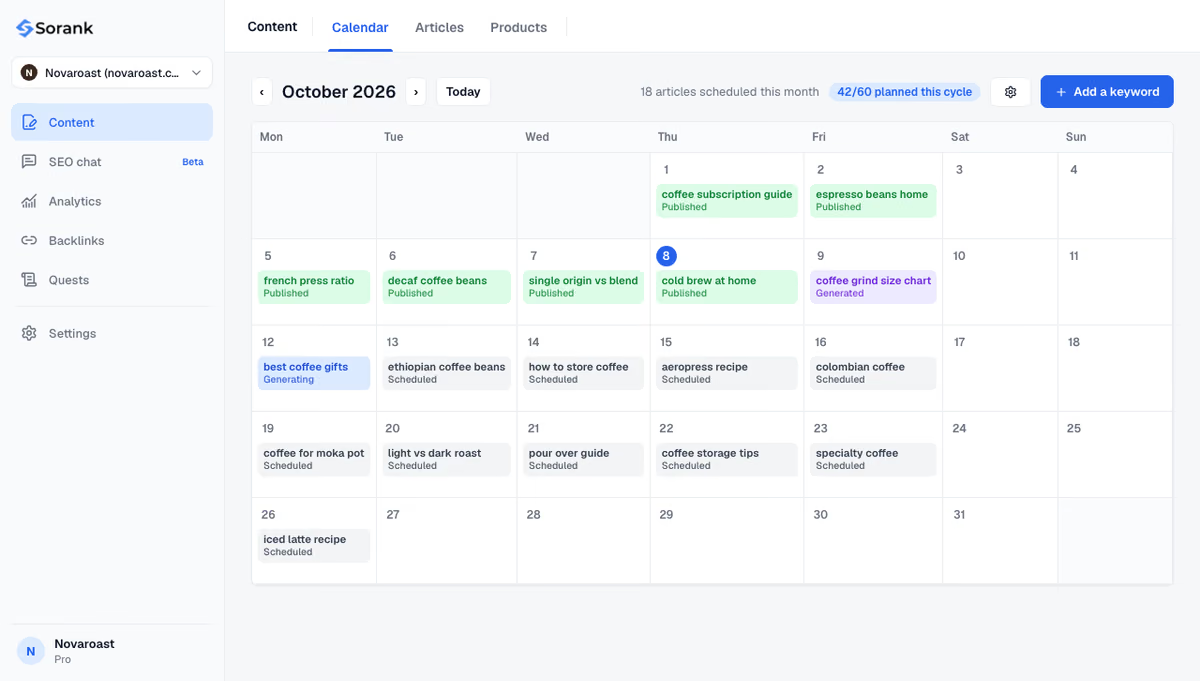
Product page rewrites and your own photos stay your job: they are the part that makes your catalog different. First effects on Google usually appear within 2 to 4 months.
Export your catalog, pick the 20 products that bring the most revenue, and rewrite their titles, descriptions and images. Then build or improve your five main category pages, and publish your first buying guide linking to them. A dropshipping store ranks when its pages say something the supplier page does not. To keep a steady flow of guides without writing them yourself, see the Sorank plans, from $49 per month (billed annually) with a 3-day free trial and a 90-day money-back guarantee.

Yes, but rarely on the exact product name, where marketplaces and hundreds of identical stores compete. Dropshipping stores rank on category searches, long-tail variants and buying questions, with rewritten product pages and guides that add information the supplier page lacks. Expect several months before organic traffic becomes significant.
AI can speed up drafts, but rewriting thousands of descriptions without adding facts creates pages Google may treat as scaled, low-value content. Focus on your best-selling products, add checked information such as real dimensions, use cases and delivery times, and review each text before publishing.
Paid ads bring sales within days and help test products, but the cost continues with every click. SEO takes 2 to 6 months to produce results, then keeps bringing visitors without paying per click. Most stores test products with ads, then invest in SEO for the categories that proved profitable.
We analyse your competitors, your website and your AI visibility to create a tailored content plan for free.
 AI Content Brief Generator
 FAQ Schema Generator
 AI Blog Post Ideas Generator
 Structured Data Validator (Schema Validator)
 Alt Text Checker
 Internal Link Analyzer
 Backlink Challenge
 AI Meta Description Generator
 AI Blog Title Generator
 Google Indexability Checker
 AI Blog Outline Generator
 UTM Link Builder
 Keyword Clustering Tool
 Canonical Tag Checker
 XML Sitemap Generator
 Broken Link Checker
 AI SEO Title Generator
 Headline Analyzer
 SERP Preview Tool
 Redirect Checker
 Hreflang Tag Generator
 Heading Structure Analyzer
 HTTP Headers Checker
 Favicon Extractor
 SERP CTR Calculator
 SEO vs Paid Search Savings Calculator
 SEO Share of Voice Calculator
 SEO ROI Calculator
 SEO Traffic and Revenue Forecast Calculator
 SEO Budget Calculator
 SEO Break-Even Calculator
 SaaS SEO ROI Calculator
 ROAS Calculator
 Reading Time Calculator
 Ranking Gain Simulator
 Organic Traffic Value Calculator
 Organic Traffic Estimator and Website Traffic Checker
 LTV to CAC Ratio Calculator
 Local SEO ROI Calculator
 Link Building Cost Calculator
 Keyword Value Calculator
 Keyword Opportunity Score Calculator
 Keyword Density Calculator
 GEO ROI Calculator
 GEO Content Investment Calculator
 Ecommerce SEO ROI Calculator
 Customer Lifetime Value Calculator
 Customer Acquisition Cost Calculator
 CTR Calculator
 Cost Per Article Calculator
 Conversion Rate Calculator
 Content Marketing ROI Calculator
 ChatGPT Referral Traffic Estimator
 Bounce Rate Calculator
 Backlink ROI Calculator
 AI Visibility Score Calculator
 AI Traffic Value Calculator
 AI Share of Voice Calculator
 Cost of AI Invisibility Calculator
 AI Citation Rate Calculator
 llms.txt Validator
 AI Overview Checker and AI Overviews Rank Checker
 Robots.txt Checker
 AI SEO Audit
 LLM Readability Checker
 SearchGPT Readiness Checker
 Structured Data LLM Audit
 Website Crawlability AI Audit
 Why ChatGPT Is Not Recommending My Website
 Gemini Ranking Tool
 Perplexity Ranking Checker
 LLM Citation Checker
 Answer Engine Optimization Audit
 GEO Audit
 AI Search Visibility Test
 ChatGPT Visibility Checker
 llms.txt Generator
 URL Extractor
 Webpage to Markdown
 Sitemap Checker
 SERP Volatility Sensor
 Page Size Checker
 Word Counter
 Slug Generator
 Schema Generator
 Robots Generator
 OG Preview
 Meta Tags Generator
 Image Compressor
 Favicon Generator
 On-Page SEO Audit: SEO Checker and SEO Analyzer
 Backlink Analysis Tool
 Keyword Research Tool
 Domain Authority Checker
THEY TRIED SORANK BEFORE YOU
 “I tested Sorank on a real client site and it's insane. It does everything an agency would bill you $1500 a month for. It's going into production on that client now.”

 Guillaume Guersanguersanguillaume.com“We are an Ads agency and we wanted to get our SEO back on track once and for all. Sorank gave us a clear view of our site, helped us prioritize optimizations, and properly structure our content. The tool is easy to use, well designed for a team, and very practical for centralizing tracking without having to juggle multiple platforms. A very solid foundation to start fresh with our SEO.”
 Gaspard MadouiAds Agency
 “I just let the Sorank software do its thing, and now my DR is 25 and my page is ranking higher.”
 Lucas Flandrefoundertrace.fr“I specialized in GEO thanks to Sorank. The GEO Leaderboard allows me to show my clients their position vs competitors on ChatGPT. It’s a real commercial differentiator.”
 MélanieSEO Freelance“Great service, works well for our website and helps us understand how to improve it to rank better on Google and elsewhere. Congrats, keep going, I recommend it.”
 Hugo T.E-commerce merchant