




Summary
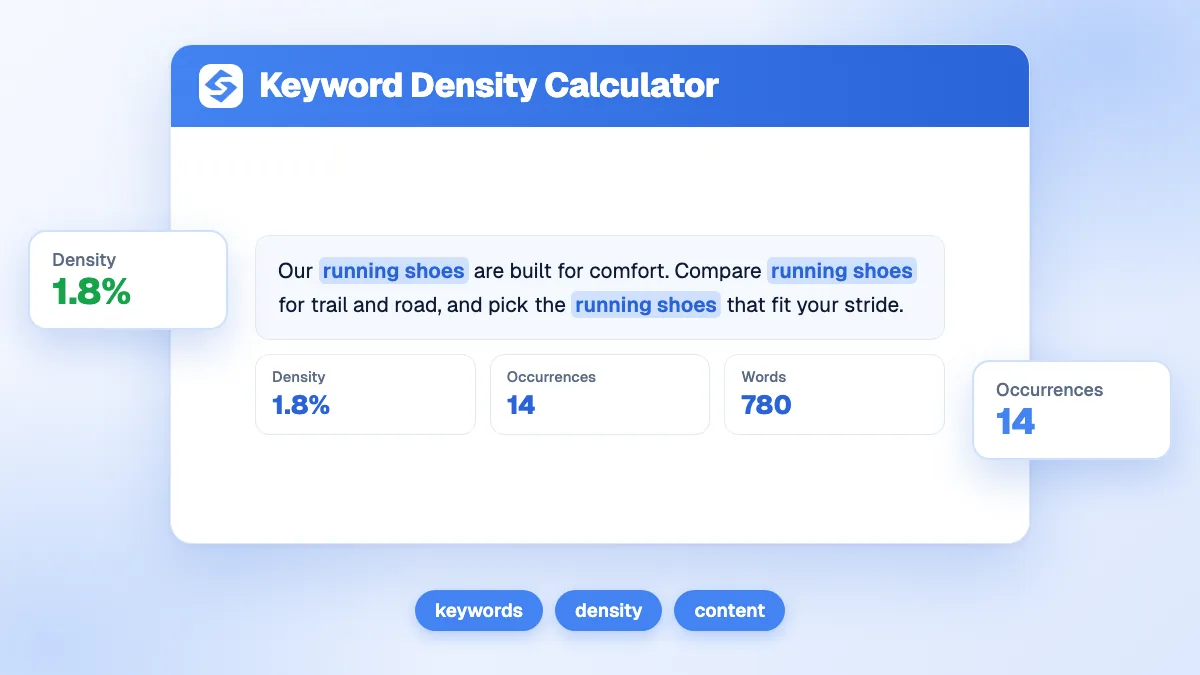
Keyword density is the number of times a term appears divided by the total number of words, times 100. Paste your text into the calculator and it finds, on its own, the 15 terms your text leans on most, with their occurrences and density, after removing stop words. A term colored red is used more than twice your target density. There is no density that makes a page rank; the useful signal is a word repeated so often the text stops reading naturally, or a target keyword missing from the top of the list.
Want to go further? Ask


A keyword density calculator shows what your text is actually about, word by word. Writers rarely see their own repetitions: the same term comes back in every paragraph, or the keyword the page targets barely appears. Google is clear about the first case: excessively repeating the same words, even in variations, is tiring for users, and keyword stuffing is against its spam policies (Google Search Central, SEO starter guide). The calculator makes both problems visible in a few seconds.
How does the keyword density calculator work?
Paste the full text, set a target density if you want one other than the default 1.5%, and the results appear. There is no keyword to type: the tool ranks every term by frequency.
- Cleaning. The text is converted to lowercase and punctuation is removed. Letters, digits, apostrophes and hyphens are kept, so "e-commerce" stays one word.
- Counting. Every word separated by a space counts in the total, stop words included.
- Filtering. Stop words of the page language ("the", "and", "with", "your" in English) and words of two letters or fewer are left out of the ranking.
- Ranking. The remaining terms are sorted by number of occurrences, and the top 15 are shown with a bar, their count and their density.
Above the table, four figures summarize the text: the most frequent term with its density, the total number of words, the number of distinct terms and the occurrences of the top term. On Chinese, Japanese and Korean pages, the tool counts pairs of characters instead of words, because a meaningful word often spans two characters.

How is keyword density calculated?
One formula, applied to each term: density = occurrences of the term ÷ total words × 100.
| Text | Total words | Occurrences of "pricing" | Density |
|---|---|---|---|
| Short product page | 400 | 6 | 6 ÷ 400 × 100 = 1.50% |
| Blog article | 1,500 | 12 | 12 ÷ 1,500 × 100 = 0.80% |
| Over-optimized page | 600 | 25 | 25 ÷ 600 × 100 = 4.17% |
Because stop words stay in the total but leave the ranking, densities look lower than in tools that divide by content words only. Keep the same tool when you compare two versions of a text.
The calculator counts single words. A phrase such as "project management" shows up as two lines, "project" and "management". To check a phrase, look at both words: if they have close counts, the phrase is probably used as a block. For the full count of words, characters and reading time, use the word counter.
How do you read the colors in the table?
The target density is only a reference point for coloring the table. Each term's density is compared to it.
| Density of the term | Color | With the default target of 1.5% | What to do |
|---|---|---|---|
| Above twice the target | Red | Above 3% | Read the passages: the word probably repeats too often. Replace some occurrences with synonyms or pronouns. |
| Between half and twice the target | Green | 0.75% to 3% | Normal use for a main topic. |
| Below half the target | Neutral | Below 0.75% | Secondary terms. Fine, unless your main keyword is among them. |
In practice, at a 1.5% target, a 1,000-word article turns a term red once it appears more than 30 times. If your target keyword is not in the top three terms at all, the page is probably about something else than you think.
Is there an ideal keyword density for SEO?
No. Google does not publish a density target, and its ranking systems understand language well beyond counting words. What it does publish is the opposite case: its spam policies list "repeating the same words or phrases so often that it sounds unnatural" among the examples of keyword stuffing (Google Search Central, spam policies).
Google also encourages writers to anticipate different wordings. Its starter guide gives the example of readers who search for "charcuterie" while others search for "cheese board", and suggests writing with both in mind. A page that covers a topic well naturally uses the main term, its synonyms and related entities. That variety is what the "Distinct terms" figure reflects, and it matters more than any single percentage. For a deeper explanation, see our glossary entry on keyword density.

How do you use the result to improve a text?
Use the table as an editing checklist, not as a score to hit.
- Check the top three terms. They should describe the subject of the page. If they are generic ("service", "company", "solution"), the text talks about you more than about the reader's question.
- Fix the red lines. Read every paragraph that contains the term and remove the repetitions that do not help understanding.
- Look for missing terms. If the main keyword is absent from the table, add it where it belongs: the title, the first paragraph and at least one heading. The heading analyzer shows your current outline.
- Read the terms you did not plan for. They point to related queries the page could pick up with a heading or two. The keyword suggestions tool shows their search volume.
- Place words where readers look. Users have time to read at most 28% of the words on an average page, and 20% is more likely (Nielsen Norman Group). Headings, the first sentence of each section and lists carry more weight for readers than repetition does.
What does a balanced table look like?
Take a 1,200-word guide to choosing running shoes. A balanced result shows "shoes", "running" and "runners" at the top in green, between 0.8% and 2.5%, followed by terms such as "cushioning", "drop", "trail", "pronation" and "size" in neutral. The vocabulary tells you the page covers the subject from several angles. An unbalanced version of the same guide shows "shoes" in red at 4%, then generic words like "best", "great" and "products". Same topic, same length, but the second text repeats instead of informing, and readers notice it before any algorithm does.
Does keyword density matter for AI answers?
Not as a number. Assistants such as ChatGPT and Perplexity retrieve passages that answer a question and then rewrite them. A passage gets used when it states the answer clearly, with the terms of the question and concrete facts, not when it repeats a keyword. A short, self-contained paragraph that names the topic once and answers it fully serves both Google and AI assistants. The LLM readability checker scores how easily a model can extract answers from your page.
At site level, the risk is not density but overlap: two pages that lean on the same terms compete for the same queries. The topical cluster generator groups your keywords into clusters and catches cannibalization before two pages compete, and the blog article generator writes structured, sourced articles around each cluster.
Use keyword density to catch repetition and gaps, never as a target to reach. Paste your text above, then see the Sorank plans to plan and publish content that ranks, on autopilot.