Summary
The ChatGPT traffic estimator calculates how many visits ChatGPT could send you each month: questions asked in your market × your citation rate × the share of readers who click, adjusted for where you appear in the answer. With the default inputs (15,000 questions, 18% citation rate, 12% click-through, named in the first three), you get 2,700 citations and about 324 visits a month. Treat the result as an order of magnitude, then measure the real figure in your analytics.
Want to go further? Ask


A ChatGPT traffic estimator answers a planning question: if ChatGPT recommended you more often, how much traffic would it be worth? The audience is large. In October 2025, OpenAI's CEO said ChatGPT had reached 800 million weekly active users (TechCrunch, 2025). But being mentioned is not the same as being visited, and this calculator separates the two steps so you can see which one to work on.

How does the ChatGPT traffic estimator work?
Fill in four fields. The results update as soon as you change a value.
- Monthly questions in your market: the number of prompts about what you sell, all phrasings combined.
- Your citation rate: the share of those answers in which ChatGPT names or cites you.
- Click-through from a citation: the share of readers who click your link after seeing it.
- Where you appear in the answer: first named, in the first three, or further down.
The tool returns four figures: monthly visits, number of citations, annual visits and visits per day. It is free, has no limit and runs in your browser.
What formula does the calculator use?
Two multiplications and one position coefficient. The coefficient reflects a simple observation: a brand named first in an answer gets read and clicked more than one named at the end of a list.
| Result | Formula | Default example |
|---|---|---|
| Citations per month | Questions × citation rate | 15,000 × 18% = 2,700 |
| Monthly visits | Citations × click-through × position coefficient | 2,700 × 12% × 1.0 = 324 |
| Annual visits | Monthly visits × 12 | 3,888 |
| Visits per day | Monthly visits ÷ 30 | 11 |
The position coefficient is 1.6 when you are named first, 1.0 when you are in the first three and 0.55 when you are named further down. These coefficients are modelling assumptions of the calculator, not published click curves: no AI platform shares click data by position yet.
How much does position and citation rate change the result?
A lot. With the same 15,000 questions and a 12% click-through, here is how the monthly visits move.
| Citation rate | Named further down | In the first three | Named first |
|---|---|---|---|
| 5% | 50 | 90 | 144 |
| 18% | 178 | 324 | 518 |
| 35% | 347 | 630 | 1,008 |
Moving from "further down" to "first" almost triples the traffic at the same citation rate. That is why the order in which ChatGPT lists brands matters as much as being listed.
Where do you find each input?
None of the inputs is published by OpenAI, so each one is an estimate. Use the most defensible source you have and keep a note of it.
- Questions per month. There is no public prompt volume database. A reasonable proxy is the Google search volume of your main topics, since people ask AI assistants about the same needs they search for. Start low, then adjust.
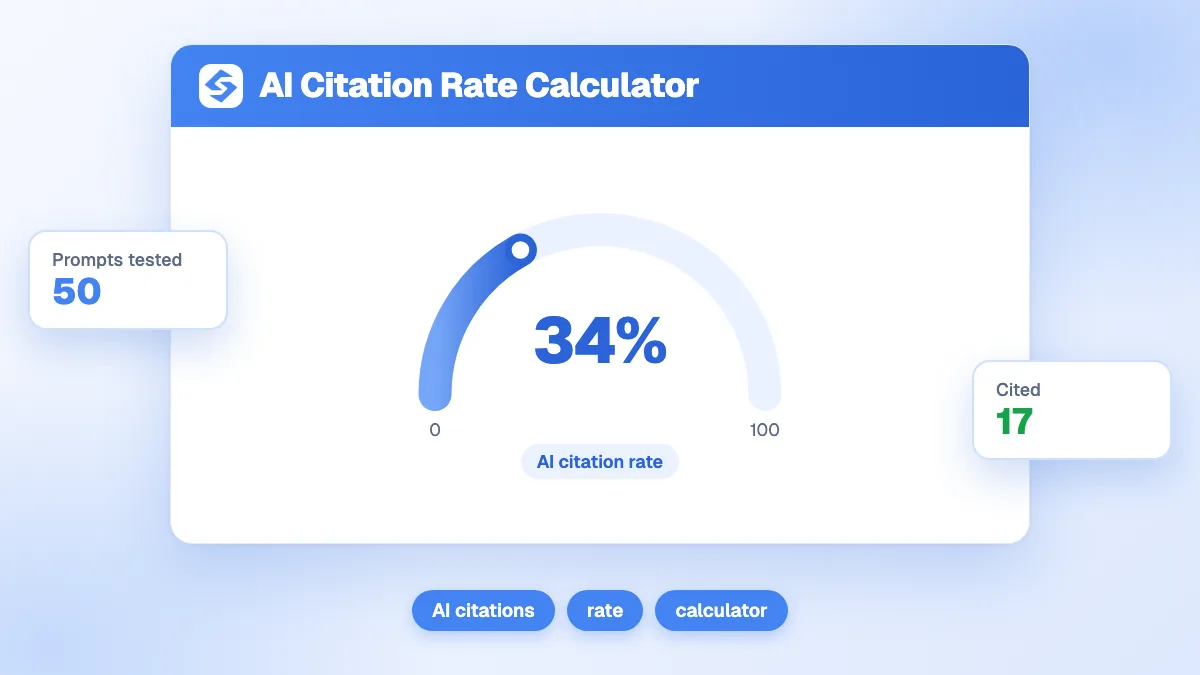
- Citation rate. Measure it: run a panel of 20 to 50 real customer questions and count how often you are cited. The AI citation checker tests one question at a time, and the AI citation rate calculator turns your panel into a rate.
- Click-through. The default of 12% is a working assumption. Independent data on AI answers points to low click rates: on Google, users clicked a link inside an AI summary in just 1% of visits to pages showing one (Pew Research Center, 2025). ChatGPT conversations differ, since people often ask for a recommendation to act on, but test a low scenario too.
- Position. Read the answers of your panel and note where you appear most often.

Which scenario should you present?
Show a range rather than a single number. Three scenarios for the same 15,000 monthly questions make the uncertainty visible and keep the discussion on the inputs.
| Scenario | Citation rate | Click-through | Position | Monthly visits |
|---|---|---|---|---|
| Cautious | 8% | 3% | Further down | 20 |
| Base (defaults) | 18% | 12% | First three | 324 |
| Ambitious | 30% | 15% | First | 1,080 |
The gap between 20 and 1,080 visits is the honest size of the uncertainty today. Your own measurements will narrow it month after month.
How do you measure real ChatGPT traffic?
Compare the estimate with your analytics after a few weeks. Visits from ChatGPT links usually arrive as a referral from chatgpt.com. Google Analytics 4 now groups them in a dedicated default channel: AI Assistant, for users who arrive "from sources like ChatGPT, Gemini, Deepseek, Copilot, or Grok", which excludes Google's AI Overviews and AI Mode (Google Analytics Help, default channel group).
Part of the effect stays invisible. A reader who sees your brand in an answer and types your name in Google later shows up as branded search, not as ChatGPT traffic. Watch your branded queries in Search Console alongside the AI Assistant channel. Our guide on measuring AI citations with Google Analytics details the setup, and the glossary explains AI-referred traffic and AI dark traffic.
Is ChatGPT traffic worth the effort?
The volumes are still smaller than Google's, but they grow fast and the visitors are engaged. Adobe measured that traffic from generative AI sources to US retail sites grew 1,200% between July 2024 and February 2025. Compared with other channels, those visitors stayed 8% longer, viewed 12% more pages and bounced 23% less (Adobe Analytics, 2025). In the same study, 39% of surveyed US consumers had already used generative AI for online shopping.
To put a money value on the visits, use the AI traffic value calculator; to compare the cost of a GEO program with its return, the GEO ROI calculator.
How do you increase your ChatGPT traffic?
Work on the two levers the formula shows: being cited more often, and being cited higher.
- Answer the real questions. Publish pages whose first lines answer the questions of your panel, with figures and sources.
- Appear on the sources ChatGPT reads. Comparisons, review sites and media in your niche feed its answers. If you are absent there, you are absent from the answer.
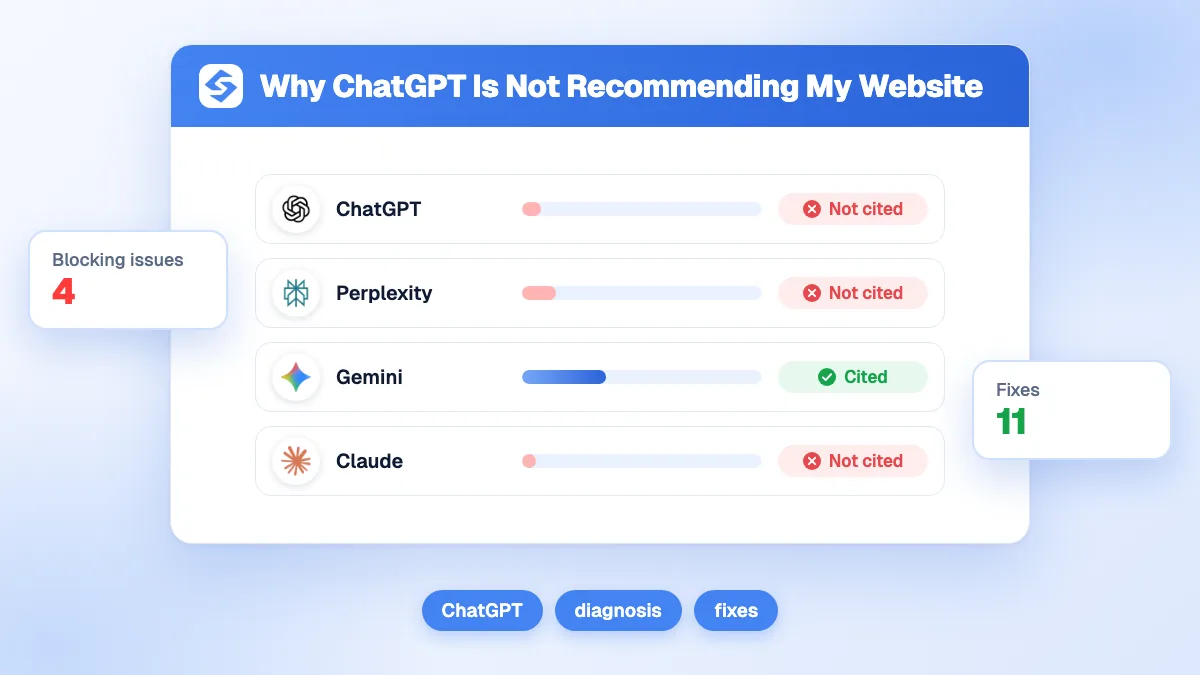
- Keep OpenAI's search crawler allowed. If your site does not appear at all, start with why ChatGPT is not recommending your website.
- Give a reason to click. A free tool, a price list, a comparison table or a template earns more clicks than a page that the answer already summarizes.
What are the limits of the estimate?
- Every input is an estimate. The calculator multiplies uncertainties: an input off by half gives a result off by half.
- Answers vary. ChatGPT can name different brands for the same question from one day to the next, so a citation rate is an average over time.
- Clicks are not the whole value. A citation that is never clicked can still make a reader remember your brand.
- ChatGPT only. Perplexity, Gemini or Claude have their own audiences and click behaviors.
From an estimate to tracked results
ChatGPT traffic = questions × citation rate × click-through, and your position in the answer can triple it. Use the estimate to set a target, then track the real inputs. Sorank AI mention tracking measures your citation rate prompt by prompt every week, the query fan-out tracker shows the searches ChatGPT runs before answering, and the GEO and SEO dashboard puts the visits AI assistants send you next to your Google traffic. See the Sorank plans to grow that traffic on autopilot.