
Preferences
Privacy is important to us, so you have the option of disabling certain types of storage that may not be necessary for the basic functioning of the website. Blocking categories may impact your experience on the website. More information
Privacy is important to us, so you have the option of disabling certain types of storage that may not be necessary for the basic functioning of the website. Blocking categories may impact your experience on the website. More information

AI dark traffic is AI-driven visits that GA4 files as direct traffic. Learn why it happens, how to spot it, and how to measure it.







Founder Sorank, 7+ years in SEO.
Summary
AI dark traffic is the share of visits that AI assistants such as ChatGPT send to your site without a usable referrer, so analytics tools record them as direct traffic or other untagged sources. The visitor is real, but the source is lost before the session reaches your analytics.
Want to go further? Ask
AI dark traffic is the part of your visits that comes from an AI assistant but cannot be attributed to it in your analytics. When a person copies your link from an answer, opens it in an app, or follows a link that does not pass its origin, the session loses the information that it came from an assistant. The visit then looks like a typed address, a saved bookmark, or other direct traffic. The word "dark" means the source exists but stays hidden from your reports.
This matters because you cannot optimize what you cannot see. As more discovery happens inside AI assistants, a growing share of your most useful visits can hide inside the direct channel. Teams that read only their clearly attributed referrals tend to underestimate AI as a source and misread where their growth comes from.
AI dark traffic is AI influenced visits that arrive without identifying referrer information, so tools like Google Analytics 4 file them under other channels. It is a specific slice of AI referred traffic. Where some AI referrals pass a clean source, dark traffic is the part that does not, and it blends into the channels you already have.
Three mechanisms explain most of the gap. The first is copy and paste: a user who copies a URL from an AI answer and pastes it into a new tab sends no referrer. The second is the way apps open links. An app may open a page without passing the address it came from, so the same person can appear as direct traffic on one device and as referral traffic on another.
The third is browser policy. The W3C Referrer Policy specification explains that browsers apply a default policy when a site sets none, and that under the no-referrer value the header is "omitted entirely". The result is the same in every case: a real person lands on your page, and your analytics has no record of the assistant that sent them.
Google Analytics 4 sorts sessions into default channels using rules, and those rules decide where a visit without a source ends up. According to the default channel group definitions in Google Analytics Help, Referral is the channel for users who arrive "via non-ad links on other sites/apps", while Direct is the channel for users who arrive "via a saved link or by entering your URL". A visit that loses its origin matches the second description, which is why it lands in Direct.
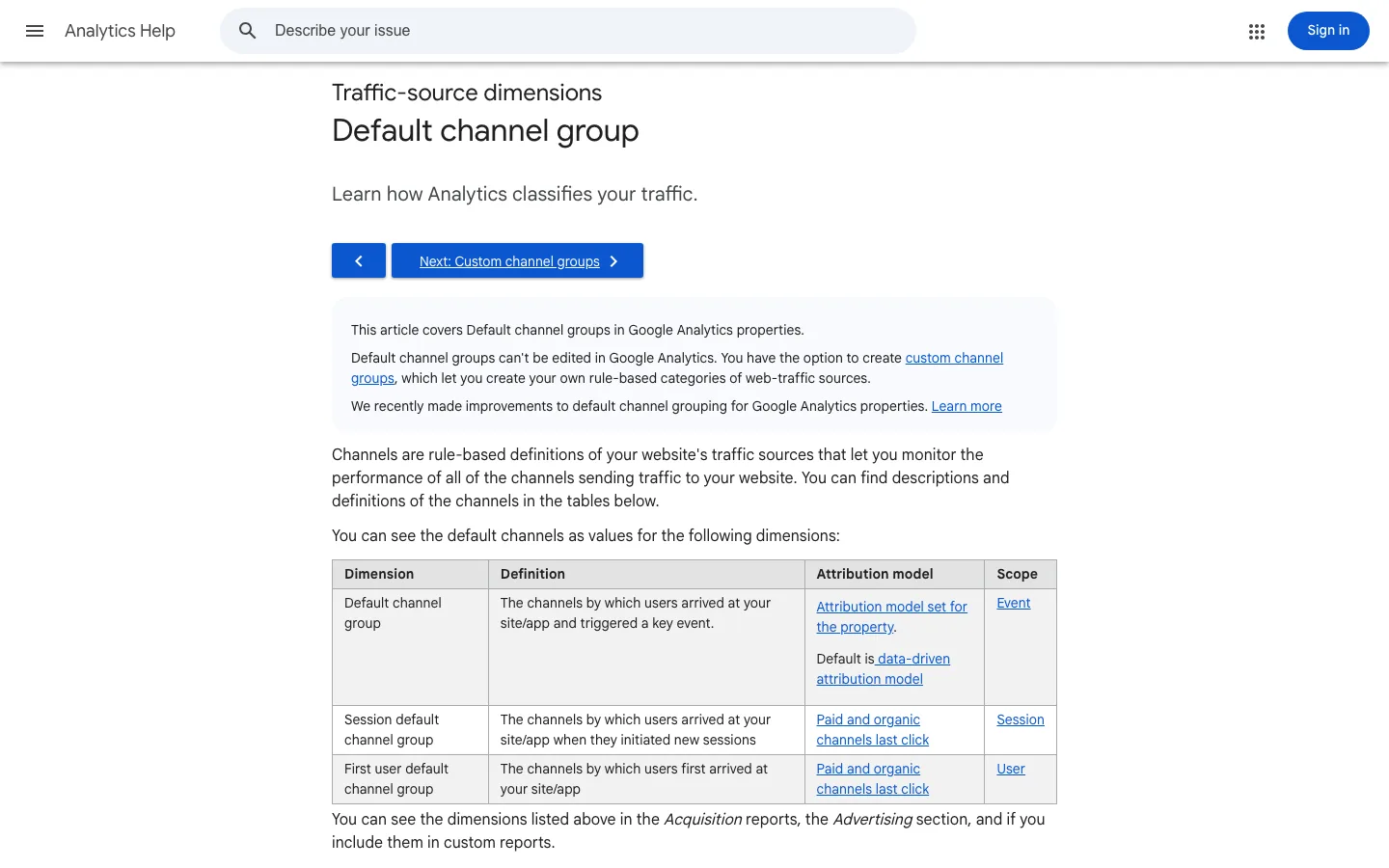
The table below shows where the most common AI visit types usually land.
| Visit type | What your analytics usually shows | Why |
|---|---|---|
| Click on a link in an AI answer that passes its origin | Referral | The source is sent with the request. |
| Copied and pasted URL | Direct | No referrer is sent. |
| Link opened in an app that drops its origin | Direct | The app does not pass the source. |
| Visit made later from a saved bookmark | Direct | The assistant that led to the visit is no longer visible. |
You cannot recover what was never sent, but you can capture the AI visits that do arrive with a source. Start by building a custom channel group in GA4 that matches the domains of AI assistants. The pattern below is a starting point, and you should check it against the sources that appear in your own reports before you rely on it.
chatgpt\.com|perplexity\.ai|claude\.ai|gemini\.google\.com|copilot\.microsoft\.comThen compare the custom group with the direct channel over time. A rise in direct sessions that follows a spike in AI mentions is a useful signal, even when it cannot be proven. For a full walkthrough, read our guide to measuring AI citations with Google Analytics. To follow brand mentions that never produce a click, you can use Sorank's AI mention tracking.
Server logs record each request before any script runs, so they can show visits that client side analytics misses. OpenAI's crawler documentation lists ChatGPT-User and states that OpenAI uses it "for certain user actions in ChatGPT and Custom GPTs". These are visits started by a person, not background crawling.
A hit from that agent in your AI crawler logs therefore shows that someone asked a question that led to a fetch of your page. Filter on the full user agent string from the documentation before you count the hits, because similar names exist. Logs will not tell you whether the person later converted, so pair them with your analytics.
AI dark traffic is about visits that happen but are misattributed, while zero-click visibility is about brand exposure that never produces a visit. Both are invisible in standard analytics, but for different reasons. A person may see your brand cited, never click, and later search for your name, a visit that analytics credits to organic search. The assistant did part of the work, yet the credit lands elsewhere. That is why measuring AI needs a wider view than the last click, and it is the domain of zero-click attribution.
Perfect attribution is impossible. Referrer stripping happens before a request reaches your site, so no GA4 setting can restore a source that was never sent. Channel groups miss app traffic, server logs cannot show the full path of a visitor, and citation tools cannot see the visits themselves. Every method is partial, so the honest goal is a defensible estimate that you track over time.
There is also a risk of over correction. Not all direct traffic comes from AI, and attributing every direct session to an assistant is as misleading as ignoring the channel. Treat dark traffic as one signal to combine with others, not as a number to report on its own.
If you only count clearly attributed referrals, you will likely underinvest in the pages that AI assistants cite. Recognizing dark traffic changes AI from a small line in your reports into a channel you measure with several signals. For generative engine optimization, this means judging success by combined evidence, which is the practical work of AI search analytics. It also protects budget for the content that earns citations and grows your AI search visibility.
AI dark traffic is real visitor traffic that AI assistants send without a visible source, and most of it lands in Direct because the referrer is stripped by copy and paste, by apps, or by browser policy. You will never see all of it. You can still estimate it by combining GA4 channel groups, server logs, and mention tracking into one defensible view, and that view keeps AI from being undervalued in your reports.
Sources
Because the source is removed before the visit reaches your analytics. Many users copy a URL from an AI answer and paste it into a browser, which sends no referrer. Some apps open links without passing the address they came from, and browser policies can omit the header as well. With no source recorded, Google Analytics 4 files the session under Direct.
No. A referrer that was never sent cannot be recovered by any analytics setting. You can recover a meaningful share with GA4 custom channel groups that match AI domains, add server log analysis to catch user-initiated agents such as ChatGPT-User, and track mentions in AI answers. Combined, these give a defensible estimate rather than a precise count.
It can be, because visitors who arrive after reading an AI answer often already know what they want. You should not assume it is valuable without measuring it, though. Compare the landing pages, the timing and the conversions of direct sessions that follow AI mentions before you draw a conclusion, and treat the result as a signal rather than a fact.
 “I tested Sorank on a real client site and it's insane. It does everything an agency would bill you $1500 a month for. It's going into production on that client now.”

 Guillaume Guersanguersanguillaume.com“We are an Ads agency and we wanted to get our SEO back on track once and for all. Sorank gave us a clear view of our site, helped us prioritize optimizations, and properly structure our content. The tool is easy to use, well designed for a team, and very practical for centralizing tracking without having to juggle multiple platforms. A very solid foundation to start fresh with our SEO.”
 Gaspard MadouiAds Agency
 “I just let the Sorank software do its thing, and now my DR is 25 and my page is ranking higher.”
 Lucas Flandrefoundertrace.fr“I specialized in GEO thanks to Sorank. The GEO Leaderboard allows me to show my clients their position vs competitors on ChatGPT. It’s a real commercial differentiator.”
 MélanieSEO Freelance“Great service, works well for our website and helps us understand how to improve it to rank better on Google and elsewhere. Congrats, keep going, I recommend it.”
 Hugo T.E-commerce merchant



















