Summary
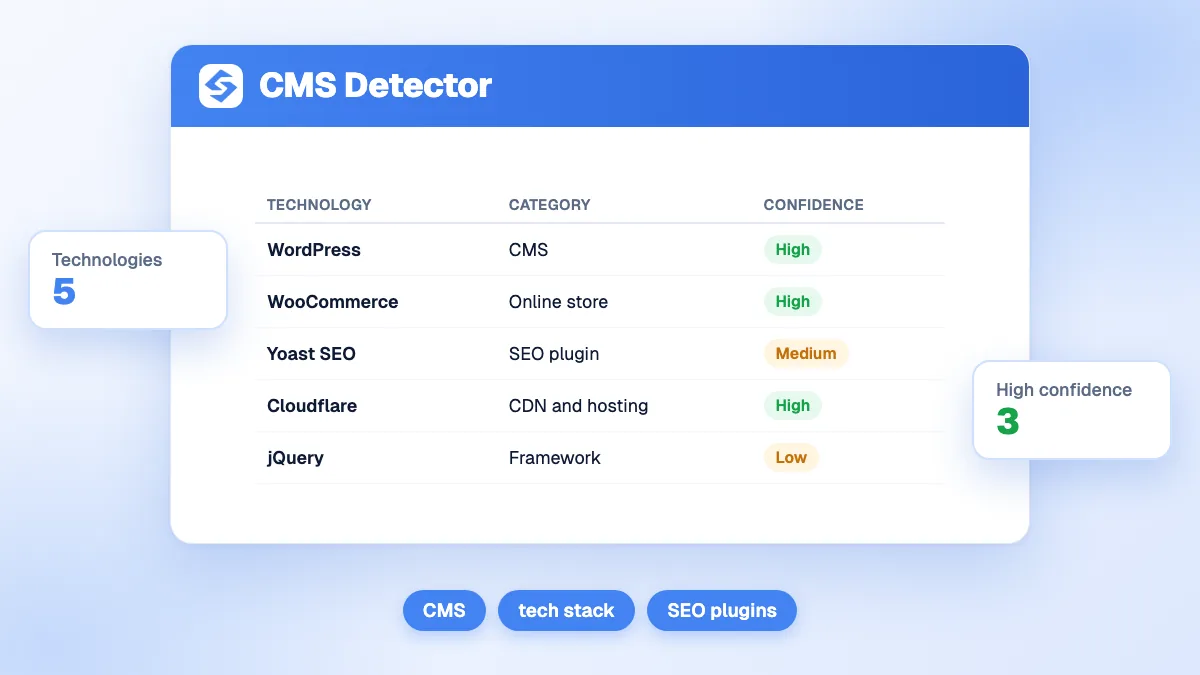
The CMS detector reads one page and lists the technologies it recognizes: content management system, online store, website builder, framework, and CDN or hosting. Each line shows its evidence (HTML code, generator tag, HTTP header or cookie) and a high, medium or low confidence. It also lists the SEO plugins visible in the page code.
Want to go further? Ask


What does the CMS detector do?
It tells you what a website is built with, and why it thinks so. You enter a page address, the tool fetches that page once, and it looks for known signatures in three places: the HTML code, the HTTP response headers and the cookies the server sets. Every match becomes a line in the report, grouped by category.
A content management system is the software you use to write and publish pages without coding each one. Knowing which one a site uses is useful before a migration, a competitor review, a sales call or an SEO audit, because each platform has its own strengths, limits and settings. Google's own beginner guide notes that most CMSes can turn the titles you write into a title element, so you might not need to do anything technical beyond writing good titles (Google Search Central, SEO Starter Guide). What you can fix, and how, depends on the platform.
The report contains:
- A verdict: how many technologies were identified, or a clear message when no known signature was found.
- Four counters: the total, then the number of high, medium and low confidence findings.
- The generator tag, when the page declares one.
- The technologies by category: content management system, online store, website builder, framework, CDN and hosting.
- The SEO plugins visible on the page, each with its own evidence.
- Two exports: copy the list, or download it as a TXT file.
How do you use the CMS detector?
- Paste the full address of the page, for example https://example.com. A partial address returns an error asking for a full URL.
- Complete the anti-bot check under the field. It protects the free service from automated abuse.
- Click "Detect the technology", or press Enter. The tool shows the page it is reading.
- Open each line to see the evidence it rests on: the source and the exact extract found.
- Copy or download the list if you want to keep it in a document or a spreadsheet.
The number of free detections per day is limited, and the counter under the field shows how many you have left. The page you test is read as it is served to a visitor, so you can check any public site, not only your own.
How do you read the result?
Start with the confidence badge, then open the line to read the proof. A technology backed by several strong clues is more reliable than one backed by a single file name in the code.
| Evidence source | What it looks like | How far to trust it |
|---|---|---|
| Generator tag | A meta tag in the page head that names the software, sometimes with its version | Strong when present, but many sites remove it |
| HTTP header | A line in the server response, such as Server or a header added by a platform | Strong for hosting and CDN, can be hidden or rewritten by a proxy |
| Cookie | A cookie name that a platform sets by default | Good, but some cookies only appear after a login or a cart action |
| HTML code | Folder paths, script names or class names typical of a platform | Useful, but a copied theme or a script can mislead |
The generator tag is defined in HTML as "the identifier of the software that generated the page" (MDN, standard metadata names). When the tool finds one, it prints it above the categories, because it is often the most direct clue.
The Server header "describes the software used by the origin server that handled the request" (MDN, Server header). To see every header a page returns, not only the ones the detector recognizes, use the HTTP headers checker.
What can you learn from it? Concrete examples
- Before a migration: you inherit a site and nobody knows what it runs on. The report shows a CMS, a store extension and a CDN in front of it. You now know which exports and redirects to plan.
- Competitor review: a competitor ranks above you on every product page. The detector shows their store platform and an SEO plugin. You can compare their setup with yours instead of guessing.
- Prospecting: an agency that works with one platform checks a list of prospects and keeps the sites that run on it.
- Audit prep: the report shows a JavaScript framework. Before your audit, read how search engines and AI crawlers handle rendering in the JavaScript SEO guide.
- Plugin check: you see two SEO plugins on the same page. Two plugins can print duplicate tags, so check your settings. The comparison of the best WordPress SEO plugins helps you keep only one.
What are the common mistakes?
- Testing the wrong page: a landing page can run on a builder while the blog runs on another CMS. Test each section that matters.
- Reading "nothing found" as "no CMS": it only means no known signature was visible. Custom builds and well hidden setups look the same in the report.
- Trusting a low confidence line alone: open it and read the extract. One file name is a hint, not a proof.
- Taking the CDN for the host: a CDN sits in front of the server. The real hosting can be somewhere else.
- Expecting every plugin: the tool only lists SEO plugins that leave a trace in the page code. Plugins that work only in the admin area stay invisible.
What are the limits of the tool?
The detector reads the visible evidence; it does not log into the site or scan the server. Keep these limits in mind:
- One page only: the tool reads the page you enter, not the whole site.
- Hidden signatures: many sites remove the generator tag or rewrite headers. MDN itself warns that a detailed Server header can make known vulnerabilities easier to detect, so administrators often trim it.
- Proxies and caches: a CDN or a cache can replace the original headers and cookies with its own.
- Unreadable pages: a page that is offline, too slow, or that blocks robots returns an error instead of a report.
- Known technologies only: a platform without a known signature will not appear, even if it powers the site.
- No versions or settings: beyond what the generator tag declares, the tool does not tell you which version or configuration runs.
When should you move to Sorank?
Knowing the platform is the first step; growing the traffic is the next one. Once you know which CMS a site runs on, the work is to publish and improve pages that rank on Google and get cited by AI answers. Sorank connects to your CMS and does that work on autopilot: see how it works on WordPress, compare platforms in the best CMS for SEO guide, and let content optimization rewrite your old pages for you.