Summary
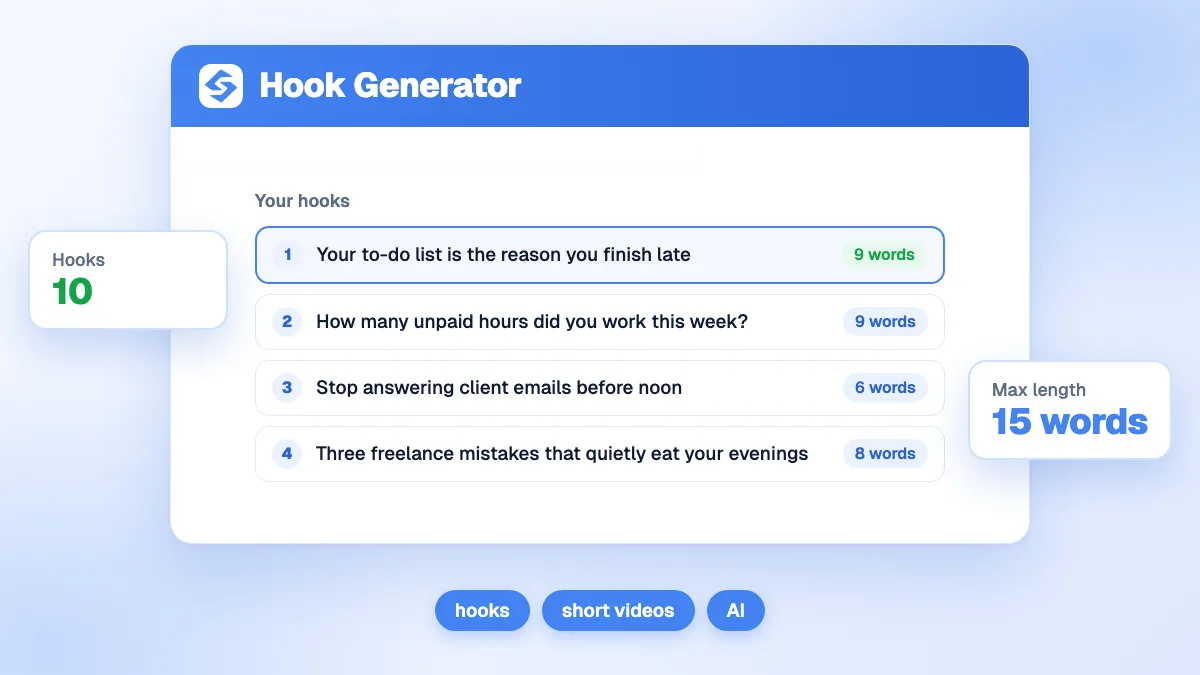
The hook generator writes 10 opening lines for a video or a post. Type your topic, add a keyword if you have one, pick one of four tones and click "Write my hooks". Each line is asked to stay within 15 words and has its own copy button, so you can compare several openings quickly.
Want to go further? Ask


A hook is the first thing people hear or read: the opening sentence of a video, or the first line of a post. Its job is small and precise. It gives one reason to stay for the next sentence.
What does the hook generator do?
It turns one topic into 10 different first lines, written by an AI in about ten seconds. You read them side by side and keep the one that fits what you are about to say.
The tool has three inputs. The topic is the only required one. The keyword is optional and gives the AI a term to work with. The tone changes the voice: clear and professional, persuasive, friendly or expert.
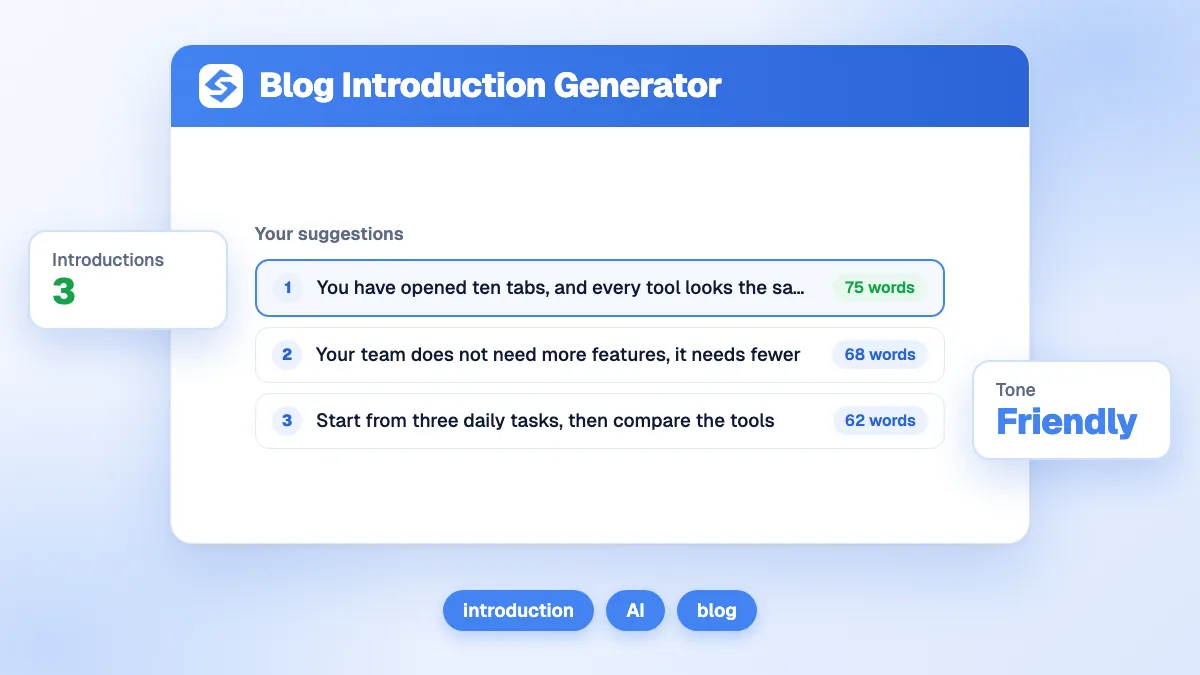
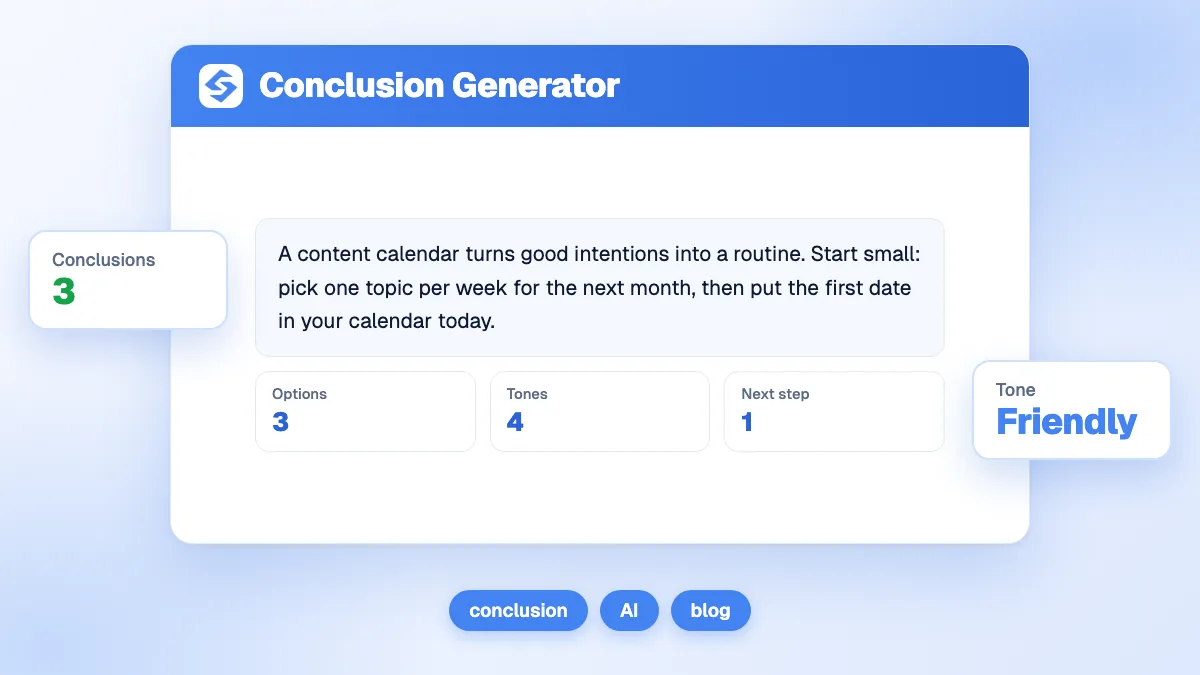
Use it for short videos, long videos, social posts and carousels. It writes the opening line only, not the script. For a full post, start with the LinkedIn post generator. For the first paragraph of an article, use the blog introduction generator.
How do you use the hook generator step by step?
- Write the topic in one phrase. You have 3 to 300 characters. "Mistakes that waste a freelancer's time" works better than "productivity".
- Add a keyword if it matters. Leave the field empty when you do not need one.
- Choose a tone. The default is clear and professional.
- Complete the anti-bot check and click "Write my hooks".
- Read all 10 lines before you pick. Say each one out loud if it is for a video.
- Copy one line, or use "Copy all" to paste the full list into your notes, one hook per line.
- Edit the winner. Swap a vague word for a real detail from your own work.
You do not need an account. A counter next to the button shows how many generations you have left today.
How do you choose between the 10 hooks?
Keep the line that makes a promise your content keeps in full. A hook that your video cannot pay off costs you the viewer a few seconds later. Run the list through these four questions:
- Is it true? If the line contains a number or a claim, you must be able to prove it.
- Is it specific? One situation, one person or one mistake beats a general statement.
- Does it speak to your audience? A freelancer should recognise their own day.
- Can you say it in one breath? A video hook is spoken, so long clauses hurt it.
Then shortlist two lines that are really different, for example a question and a direct warning. Testing two near copies teaches you nothing.
Which types of hook can you recognise in the results?
Most opening lines follow one of seven patterns. Naming the pattern helps you vary your posts and spot what works for your audience. The examples below are ours, written for the topic "mistakes that waste a freelancer's time".
| Hook type | Example | Use it when |
|---|---|---|
| Question | How many unpaid hours did you work this week? | Your audience already feels the problem |
| Warning | Stop sending quotes before you ask this question. | You correct a common habit |
| Confession | I worked every Sunday until I deleted one app. | You tell a true personal story |
| Contradiction | Your to-do list is the reason you finish late. | You challenge usual advice |
| List | Three freelance mistakes that quietly eat your evenings. | Your content has clear steps |
| Result | This one email template saves me a call every week. | You show proof on screen |
| Direct address | Freelancers: read this before you accept another small change. | You target one precise group |
The same patterns work for article titles. The guide to headline formulas covers eight of them with a test method, and the headline analyzer scores a title before you publish it.
How does a vague topic become a strong hook?
Precision in the topic field decides most of the quality. The AI only knows what you type. Compare these inputs:
- Weak: "email marketing". The AI has no angle, so the lines stay general.
- Better: "why nobody opens your newsletter". There is a problem and a person.
- Strong: "why subscribers of a small online shop ignore the welcome email". There is a problem, a person and a situation.
You can also ask for an angle inside the topic. Write "told as a personal mistake" or "for beginners who fear the camera" at the end of the phrase. If you are short on subjects, pick one from these social media content ideas first, then generate the opening.
Why do the first seconds matter, and how do you measure them?
The opening decides who stays, and the platforms give you numbers to check it. TikTok advises advertisers to introduce the content proposition in the first 3 seconds and to prioritize the hook in the first 6 seconds (TikTok Business Help Center).
On YouTube, the intro metric shows the share of your audience still watching after the first 30 seconds. A high figure can mean that the opening matched what the title and thumbnail promised, or that it kept people interested (YouTube Help, key moments for audience retention). For Shorts, "Stayed to watch" is the percentage of times viewers stayed past the initial seconds (YouTube Help, content performance).
Compare hooks on videos of similar length and topic, and change only the opening. For posts, look at comments, saves and clicks rather than impressions alone. Our definition of engagement metrics explains which ones to follow.
What mistakes weaken a hook?
The most common one is a promise without a payoff. These five come up again and again:
- Starting with yourself: a greeting, your name and your job use up the seconds you need for the hook.
- Inventing a figure: an AI can write a convincing number. Remove it if you have no source.
- Repeating one pattern: ten videos that open with the same question become background noise.
- Copying the line unchanged: one detail from your own experience makes it yours.
- Saying something else on screen: the spoken hook, the on-screen text and the title should point to the same promise.
What are the limits of this hook generator?
It writes ideas, not proof. The tool does not read your video, your profile or your past results, so it cannot predict which line will perform.
- No fact check: read each line before you publish. Google gives the same advice for websites and asks you to manually review AI content for accuracy (Google Search Central).
- No score or word counter: the 10 lines are not ranked, and the 15 word limit is an instruction to the AI. Check the length yourself.
- A daily limit: the free AI has a daily quota per visitor and a shared daily budget.
- No history: the tool keeps no list of your past results, so copy the lines you like before a new run.
- Four fixed tones: you cannot load your own brand voice here.
When should you move from hooks to Sorank?
Move on when you need whole pages in your voice, not single lines. Hooks win attention on social networks. Articles bring people who search on Google or ask an AI assistant. The Sorank blog article generator writes and publishes articles on your site, and the brand voice settings keep the same tone, words and rules on each one, on autopilot.