Summary
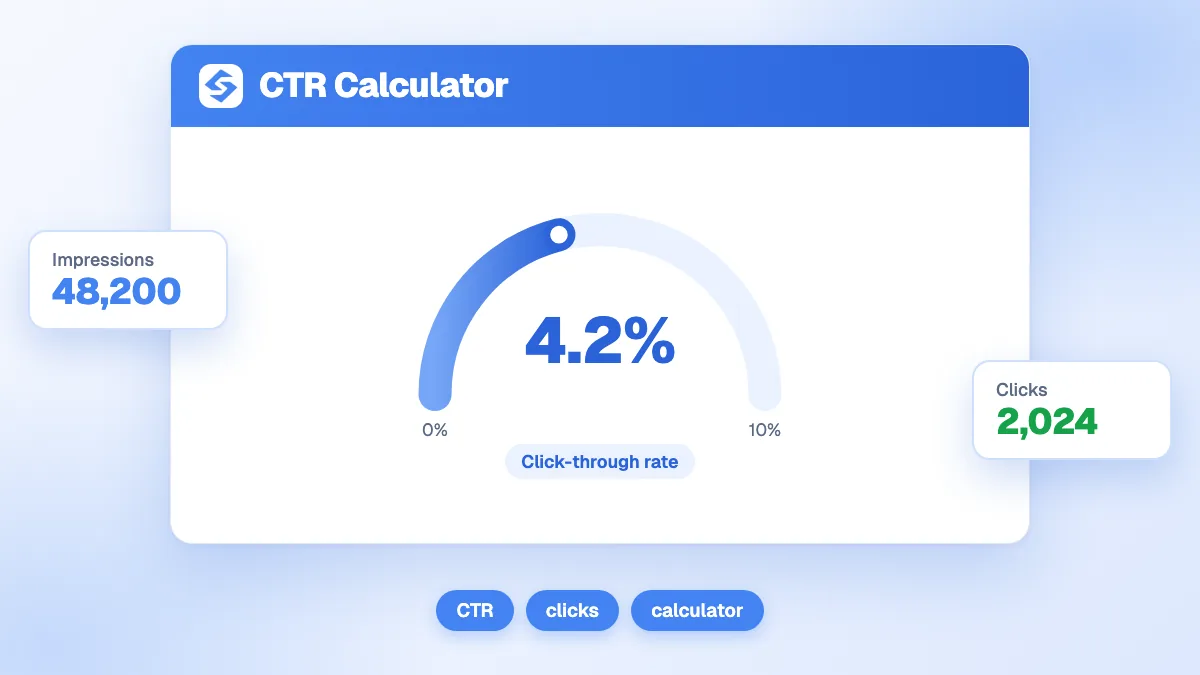
The CTR calculator divides your clicks by your impressions to give your click-through rate, then shows how many impressions ended without a click and how many clicks you would get at a 5% CTR. With 420 clicks for 18,000 impressions, the CTR is 2.33%: 17,580 impressions brought no visit, and a 5% CTR would bring 900 clicks. Compare the result with your average position before deciding what to fix.
Want to go further? Ask


A CTR calculator turns two numbers from your reports into the one that shows whether your result attracts people once it is seen. Google defines it the same way in Search Console and in Google Ads: the click count divided by the impression count (Search Console Help, Performance report). A page can rank well and still lose most of its potential traffic if its title and snippet do not convince; CTR is where that loss shows up.

How do you calculate CTR?
CTR = clicks ÷ impressions × 100. Google Ads gives the simplest example: 5 clicks for 100 impressions is a CTR of 5% (Google Ads Help, clickthrough rate). The calculator adds two results that make the rate easier to act on.
| Result | Formula | Example (420 clicks, 18,000 impressions) |
|---|---|---|
| Click-through rate | Clicks ÷ impressions × 100 | 2.33% |
| Impressions without a click | Impressions − clicks | 17,580 |
| Clicks at a 5% CTR | Impressions × 5% | 900 |
The last line is the useful one in a meeting: at the same rankings, a better snippet could more than double the visits of this page, from 420 to 900 a month.
How do you use the CTR calculator?
- Open the Performance report in Search Console, pick a period of at least 28 days and filter one page or one query.
- Copy the total clicks and impressions into the calculator.
- Read the gauge: under 1% is weak, 1 to 3% average, 3 to 8% good, 8% and above excellent.
- Compare with the average position shown in the same report, since the expected CTR depends on it.
- Repeat for your top pages and list those with many impressions and a low rate: they are your fastest wins.
The calculator works for ads too. Use the clicks and impressions of a campaign, an ad group or an ad.
What is a good CTR for organic search?
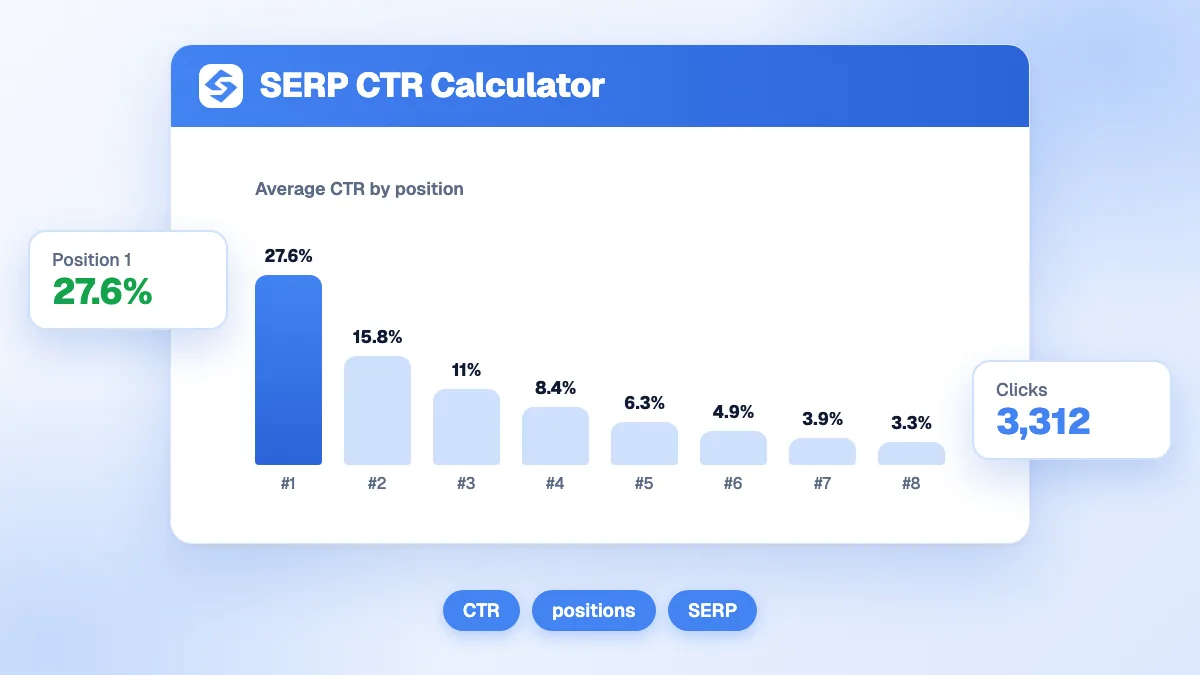
It depends on the position first. A result in position 1 naturally earns far more clicks than one in position 9, so a single target for every page makes little sense. The reference curve below is the one Sorank's position calculators use to estimate clicks; read it as an order of magnitude, not as a rule.
| Position | Reference CTR | Position | Reference CTR |
|---|---|---|---|
| 1 | 27.6% | 6 | 4.6% |
| 2 | 15.3% | 7 | 3.6% |
| 3 | 10.2% | 8 | 2.7% |
| 4 | 7.8% | 9 | 2.2% |
| 5 | 5.9% | 10 | 1.8% |
A 2% CTR in position 9 is in line; the same 2% in position 2 points to a title or snippet problem. To estimate the clicks a specific position should bring, use the SERP CTR calculator, and to see what those clicks are worth, the keyword value calculator.
A worked example shows the size of the gap. A page in position 3 with 40,000 impressions a month and a 4% CTR gets 1,600 clicks. At the 10.2% reference for that position, it would get about 4,080, almost 2,500 more visits without moving up a single place. That is why snippet work on high-impression pages often pays faster than new content.
What is a good CTR for Google Ads?
Higher than most organic results, because ads sit at the top and match commercial intent. Across industries, the average CTR of search ads was 6.64% in 2026, ranging from 5.56% for automotive repair to 12.75% for arts and entertainment (LocaliQ search advertising benchmarks). Compare your campaigns with the benchmark of your own industry, not with the overall average.
Why is my CTR low even though I rank well?
Usually for one of four reasons, and only the first one is fully in your hands.
- The title and description do not match the query. Google uses the title element in most cases but rewrites it when it is vague or stuffed with keywords (Google Search Central, title links). Rewrite the title with the AI SEO title generator and the description with the meta description generator.
- An AI summary answers before your link. Pew Research Center found that Google users clicked a traditional result in 8% of visits when an AI summary appeared, against 15% without one (Pew Research Center, 2025).
- Many searches end without any click. In 2024, 58.5% of US Google searches ended with zero clicks (SparkToro and Datos, 2024).
- The average hides the details. Brand queries pull the average up, and impressions on pages ranked beyond the first page pull it down. Filter both before concluding.

How do you improve your click-through rate?
Start with the pages that have the most impressions and a CTR under the reference for their position. Each change below works on what the searcher sees before deciding.
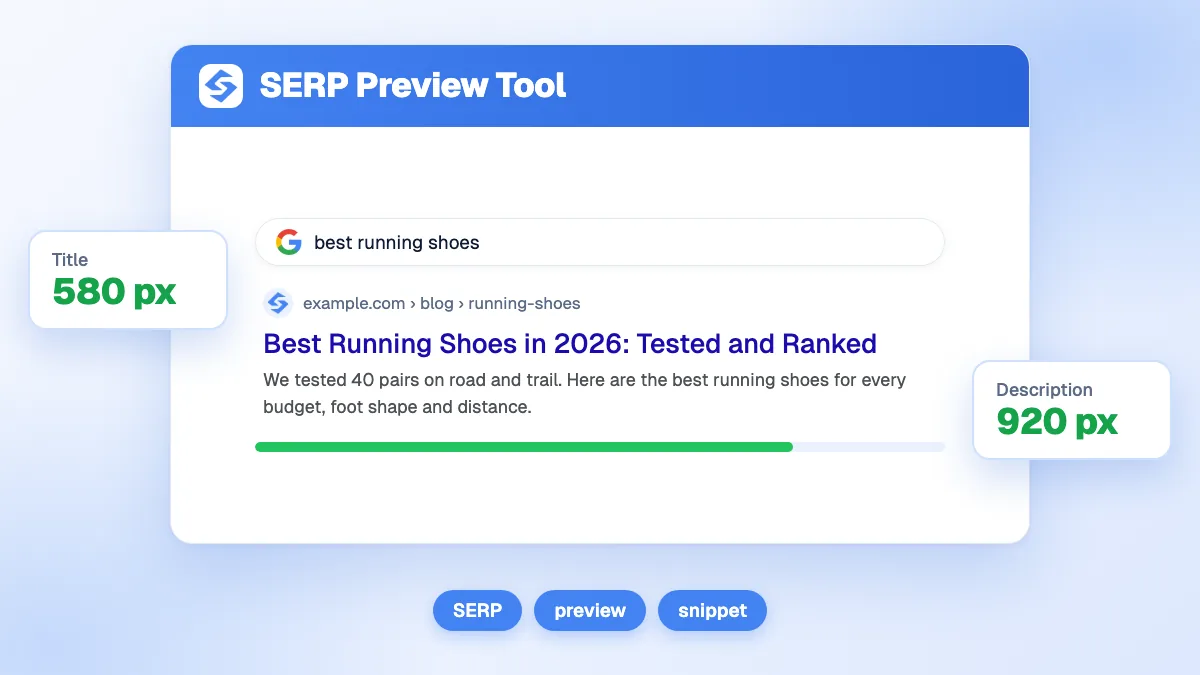
- Put the main keyword and the benefit in the first 50 characters of the title. Preview the result with the SERP preview tool.
- Answer the query in the description, with a number or a concrete detail when it is true.
- Add the year or "updated" only when the content is really current.
- Match the format of the intent: a list for "best", steps for "how to", a price for "cost".
- Measure after four weeks, on the same period length, and keep the version that wins.
Our glossary entry on the click-through rate covers the related terms.
Can you measure CTR in AI answers?
Not in the same way yet. Search Console now has a Generative AI performance report that shows how often your pages appear in AI Overviews and AI Mode, by page, device and country (Search Console Help, Generative AI performance report). It reports impressions, so there is no click-through rate to calculate from it alone. Assistants such as ChatGPT or Perplexity publish no impression data at all.
| Channel | Impressions available | Clicks available | CTR you can calculate |
|---|---|---|---|
| Google organic results | Yes, Search Console | Yes, Search Console | Yes |
| Google Ads | Yes | Yes | Yes |
| AI Overviews and AI Mode | Yes, Generative AI report | Counted with organic search | Not separately |
| ChatGPT, Perplexity, Gemini app | No | Referral visits in analytics | No |
For assistants, track citations and referral visits instead, and value them with the AI traffic value calculator.
What are the limits of a CTR calculation?
The calculation is exact, but the inputs have quirks. Search Console counts an impression when your result is shown, and its position is the average of the topmost result from your site (Search Console Help, impressions, position and clicks). A page that appears for hundreds of queries mixes very different rates into one number. Analyze CTR query by query for your main pages, and keep the site-wide figure for trends over time.
From CTR to more clicks every month
CTR tells you whether your result convinces once it is seen; the position tells you whether it is seen at all. Fix the snippets of your high-impression pages first, then work on rankings. The Sorank GEO and SEO dashboard shows clicks, impressions and positions page by page, next to your visibility in AI answers, and the blog article generator writes every new article with an optimized title and description. See the Sorank plans to grow your clicks on autopilot.