Summary
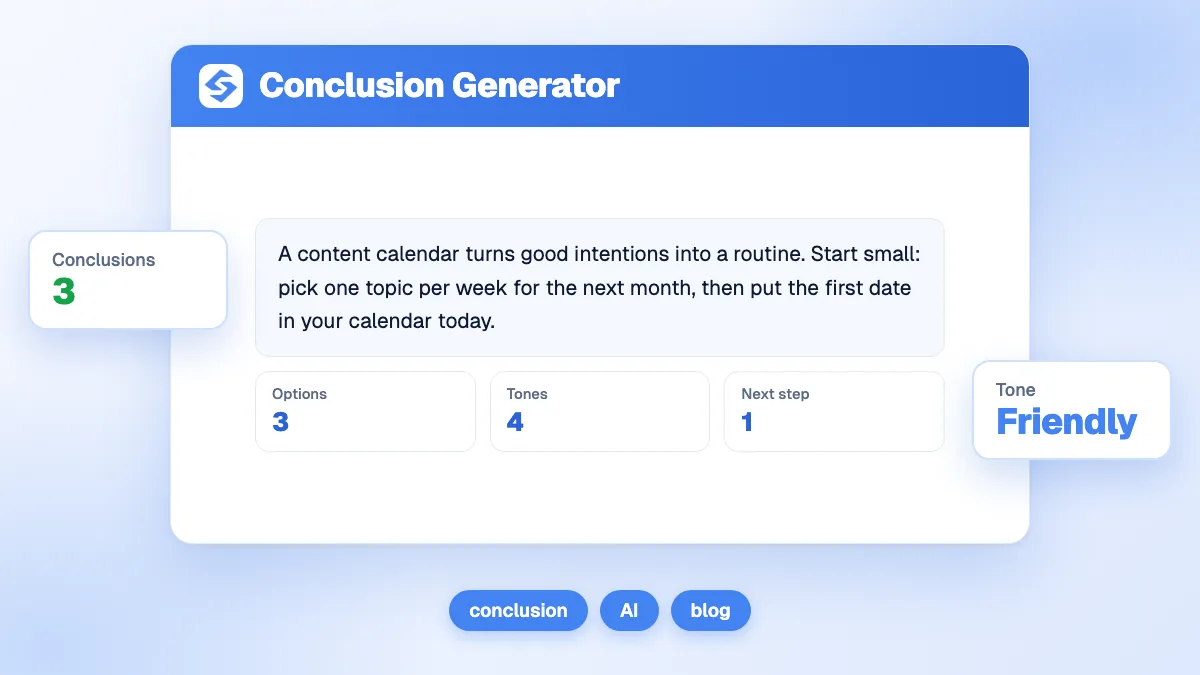
The conclusion generator writes 3 closing paragraphs for an article from its topic. Add a target keyword if you have one, pick one of 4 tones, and copy the version you prefer. Each paragraph is meant to sum up the key takeaway and end with a clear next step. It is free, with a daily limit.
Want to go further? Ask


What does the conclusion generator do?
It turns a one-line topic into 3 different endings for your article. You type what the article is about, and the AI returns 3 short paragraphs in a numbered list. Each one has its own Copy button, and a Copy all button takes the 3 together.
The goal of each paragraph is the same: remind the reader of the main point, then tell them what to do next. The angle changes from one to the other, so you can compare them instead of fixing a single draft. You do not need an account.
It writes the last paragraph only. For the first one, use the blog introduction generator.
How do you use the conclusion generator?
- Describe the article topic. You have 3 to 300 characters. Include the main point, not only the subject.
- Add a target keyword if the article has one. This field is optional and takes up to 80 characters.
- Choose a tone: clear and professional, persuasive, friendly or expert.
- Complete the anti-bot check, then click "Write my conclusions". The answer takes about ten seconds.
- Copy the best version before you start again. A new run replaces the previous list.
- Edit it with the details of your article, then paste it into your page.
The counter next to the button shows how many free generations you have left for the day. The tool works in 11 languages: English, French, German, Spanish, Italian, Portuguese, Hebrew, Arabic, Chinese, Japanese and Korean.
What should you type in the topic field?
Type the point your article proves, because the topic line is almost everything the AI knows. The tool does not read your draft. A vague topic gives a conclusion that could close any article. A precise one gives a conclusion that belongs to yours.
| Vague topic | Better topic | Why it works |
|---|---|---|
| content calendar | why a small blog needs a content calendar to publish every week without rushing | Gives the reader, the benefit and the problem solved |
| email marketing | how a local shop can write its first welcome email, with a free template in the article | Names the next step the AI can point to |
| running shoes | how to choose running shoes for flat feet: support matters more than cushioning | States the takeaway to repeat |
| SEO audit | the 5 checks to run before paying for an SEO audit, for founders with no SEO team | Sets the audience and the level |
A simple formula works well: subject, then main takeaway, then the action you want from the reader. If you cannot fill in the takeaway, your article may not have one yet. The guide to writing a blog post helps you set it before you draft.
How do you read the 3 results?
Judge each paragraph on three parts: the takeaway, the value for the reader and the next step. Keep the one where all three match your article, or combine the best sentence of each.
- Takeaway: the first sentence says the main point in new words. If it repeats your introduction, rewrite it.
- Value: the reader understands why the point matters to them. The writing center of the University of North Carolina calls this the "So What" game, and it advises you to synthesize rather than summarize.
- Next step: one action, easy to do now. Our glossary entry on the call to action explains what makes a reader click.
Then check the facts. The text comes from an AI that has not seen your page, so it may mention a tip, a benefit or a resource your article does not contain. Remove anything the article does not support.
Which tone should you choose?
Choose the tone of the article above it, since a sudden change at the end sounds odd. The table shows how the same topic, a content calendar for a small blog, could close in each tone. These lines are examples we wrote, not saved results of the tool.
| Tone | Good for | Example ending |
|---|---|---|
| Clear and professional | Guides, company blogs, help pages | A content calendar turns good intentions into a routine. Start with the next four weeks and one topic per week. |
| Persuasive | Comparisons, product articles, landing pages | Every week without a plan is a week your readers hear from someone else. Open a calendar today and fill in the first date. |
| Friendly | Personal blogs, newsletters, communities | You do not need a perfect plan, just the next topic. Grab a notebook, write it down and give it a date. |
| Expert | Technical articles, studies, reports | The calendar is less about dates than about coverage. Map your topics first, then assign the gaps to the next quarter. |
What mistakes weaken a conclusion?
The most common one is to repeat the article without adding anything. The University of North Carolina page cited above also warns against opening with "in conclusion", stating your thesis for the first time at the end, and adding a new idea there. Watch for these as well:
- Two or three calls to action. Pick one. If you need more ideas for that line, the CTA generator writes them separately.
- A next step with no link. The tool returns plain text, so add the link yourself. Google describes good anchor text as descriptive, reasonably concise and relevant to both pages. Avoid "click here".
- A forced keyword. Use it once if it reads well. Otherwise, leave it out.
- Padding to look complete. Google has no preferred word count. Three useful sentences are enough to close most articles.
- An invented promise. Delete any figure or guarantee that you cannot prove.
What are the limits of this tool?
It writes a draft from a short topic, and it cannot replace your reading of the article. Keep these limits in mind:
- It does not see your text. You cannot paste the full article. The topic field stops at 300 characters.
- It does not know your brand. There are 4 tones, and no field for your vocabulary or your offer.
- It can be wrong. Google says you should check AI-generated content for accuracy before you publish it, and that using generative AI to make many pages without adding value may violate its spam policies. Our method to fact-check AI content takes you through the review.
- It has a daily quota. Each visitor gets a limited number of free runs, and the tool also has a shared AI budget for the day.
- It does not rank a page. A good ending helps the reader act. The search result depends on the whole page.
- It is not made for graded work. It targets web articles. For an essay, follow the rules of your school, and treat the result as an example to learn from.
When should you move to Sorank?
Move to Sorank when the conclusion is no longer the only part you need to write. This tool fits one article you have already drafted. If you publish every week, the topic, the outline, the body, the links and the ending all have to agree with each other.
The Sorank AI blog article generator writes the full article for Google and AI search, with its ending. The brand voice feature makes it use your tone and your words, and the AI content calendar plans and publishes on autopilot. Keep the free tool for the articles you write by hand.