




Summary
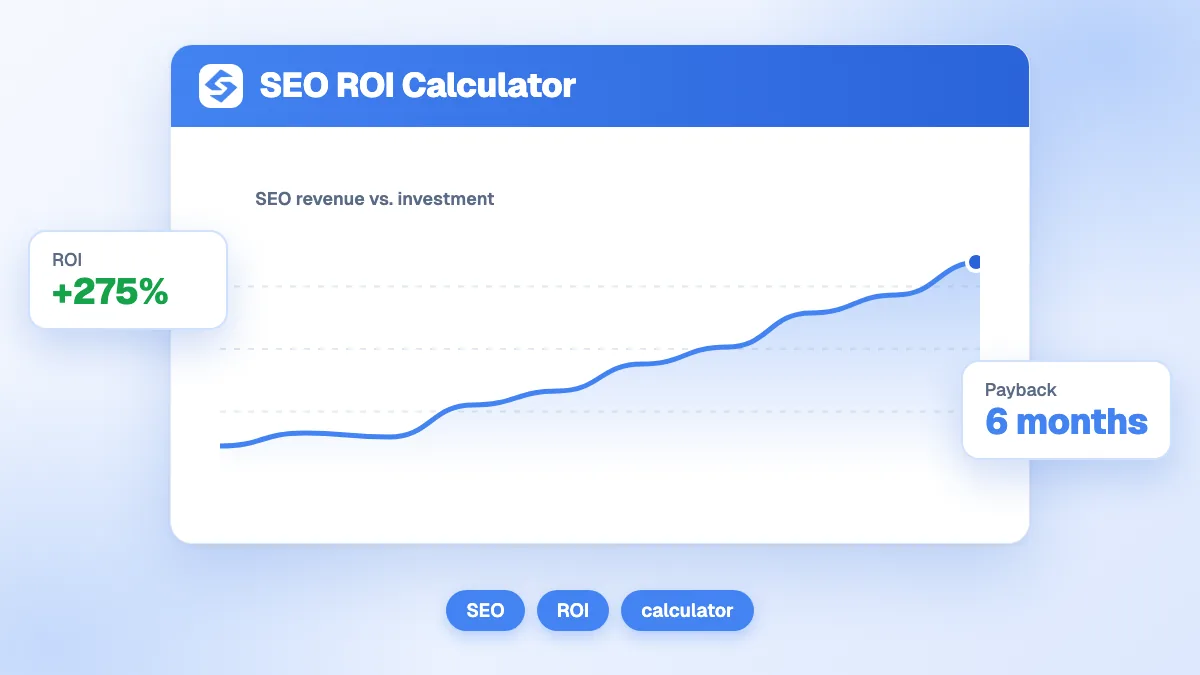
SEO ROI compares what your organic traffic earns with what your SEO costs: (revenue from organic conversions − SEO spend) ÷ SEO spend × 100. The calculator needs four inputs: monthly SEO spend, monthly organic visits, conversion rate and value per conversion. With the defaults (2,500 spend, 8,000 visits, 2%, 120), it shows 160 conversions, 19,200 of revenue and a 668% return. The result is only as honest as its inputs: count the visits SEO added and the profit of each sale.
Want to go further? Ask


An SEO ROI calculator answers the question a budget owner asks before signing: what does each unit spent on SEO bring back? Return on investment is the standard way to put SEO next to ads, events or sales hires in the same table. The traffic side comes from the clicks Google Search Console reports for your pages (Search Console Help, Performance report), the conversion side from your analytics or CRM.

How does the SEO ROI calculator work?
Enter four values and choose the currency (dollar, euro or pound). The results and the bar chart update as you type.
- Monthly SEO spend: agency, tools, content and the time your own team puts in (default 2,500).
- Monthly organic visits: visits from unpaid search results (default 8,000).
- Conversion rate: the share of those visits that become a sale or a qualified lead (default 2%).
- Value per conversion: what one conversion is worth to you (default 120).
You get the ROI with a colored verdict, the monthly revenue, the monthly profit, the number of conversions and the annual revenue. A chart puts revenue, spend and profit side by side; the profit bar turns red when spending wins. The tool is free, has no limit and runs in your browser.
What formula does the calculator use?
| Result | Formula | Default example |
|---|---|---|
| Conversions | Visits × conversion rate | 8,000 × 2% = 160 |
| Monthly revenue | Conversions × value per conversion | 160 × 120 = 19,200 |
| Monthly profit | Revenue − SEO spend | 19,200 − 2,500 = 16,700 |
| ROI | (Revenue − spend) ÷ spend × 100 | 668% |
| Annual revenue | Monthly revenue × 12 | 230,400 |
The verdict follows four bands: below 0% you are losing money, 0 to 100% is "watch this", 100 to 300% is healthy, and 300% or more is excellent.
Why can the same SEO show 668% or 15%?
Because of two inputs. The default example counts all organic visits and the full sale value. A stricter calculation counts only the visits SEO added and the gross profit of each sale. Same spend, very different answer:
| Scenario | Visits counted | Value per conversion | Monthly revenue | ROI |
|---|---|---|---|---|
| Default | 8,000 (all organic) | 120 (sale value) | 19,200 | 668% |
| Added traffic only | 3,000 (non-branded growth) | 120 | 7,200 | 188% |
| Added traffic and gross profit | 3,000 | 48 (40% margin) | 2,880 | 15% |
The third line is the one a finance team will trust. Present it, and keep the first as the ceiling.
What belongs in the monthly SEO spend?
Everything the program costs, including the hours of your own team. An ROI that leaves out internal time looks better than it is.
| Cost item | Examples | Often forgotten |
|---|---|---|
| Content | Writers, editors, images, translations | Expert review time |
| Technical | Developer time, hosting, fixes after audits | Time spent on migrations |
| Authority | Digital PR, partnerships, link building | Free products sent to reviewers |
| Tools and services | SEO software, agency or freelancer fees | Annual licenses spread over 12 months |
| Internal team | Hours of the marketing manager on SEO | Meetings and approvals |
One-off costs, such as a site redesign, can be spread over the months they serve.
Which visits should you count?
The visits your SEO work created, not your whole organic traffic. People who type your brand name would find you anyway. Since late 2025, Search Console has a branded queries filter that splits the Performance report into branded and non-branded queries; Google notes that non-branded queries "offer organic growth, as they show how new users find your content" (Google Search Central Blog, branded queries filter).
- Use non-branded clicks as the base, or the increase in non-branded clicks since the SEO program started.
- Average three months to smooth seasonality and one-off peaks.
- Use clicks, not impressions. Only clicks are visits.
Our glossary explains branded queries and non-branded queries.
How do you set the conversion rate and the value?
Take both from your own tracking. In Google Analytics 4, the actions that matter to your business are recorded as key events, defined as an event "that measures an action that's particularly important to the success of your business" (Analytics Help, conversions vs key events). Filter them on the organic search channel.
- E-commerce: orders from organic sessions ÷ organic sessions; value = average order value × gross margin.
- Lead generation: qualified leads ÷ organic sessions; value = average deal value × close rate × margin.
- No tracking yet? Use the conversion rate calculator on a sample period, and label the result as an estimate.
Industry versions of the same logic exist for e-commerce, SaaS and local businesses.

When does SEO break even?
When monthly revenue covers monthly spend. The break-even traffic is spend ÷ (conversion rate × value per conversion): with the defaults, 2,500 ÷ (2% × 120) = about 1,042 visits a month. Below that, ROI is negative.
A negative ROI in the first months is common. SEO spend starts on day one, while rankings, and the traffic they bring, build over months; content published this quarter keeps bringing visits next year without new spend. Judge the program on a 12 to 24 month view: the SEO break-even calculator finds the month where cumulative revenue overtakes cumulative cost, and the SEO forecast calculator projects traffic growth month by month.
How do AI answers affect SEO ROI?
They lower the clicks available on some queries. In a 2025 study, Google users who saw an AI summary clicked a traditional result in 8% of visits, against 15% when no summary appeared (Pew Research Center, 2025). Informational pages lose the most clicks; commercial queries, where people compare and buy, keep more.
Two adjustments follow. Weight your SEO budget toward pages that convert, since they hold their clicks better. And count the visits AI assistants send: in Google Analytics 4 they appear in the AI Assistant channel, and the AI traffic value calculator puts a value on them.
How does SEO ROI compare with paid search?
Ads stop bringing visits the day you stop paying: with cost-per-click bidding, "you pay for each click on your ads" (Google Ads Help, cost per click). SEO costs are mostly upfront and the traffic persists. To compare both on equal terms, value your organic traffic at the price you would pay in ads with the organic traffic value calculator, then set the budget with the SEO budget calculator.
What are the limits of the calculator?
- One month, no time effect. It does not model ramp-up or compounding growth.
- Revenue, not profit, unless you say so. Enter a margin-based value per conversion for a true ROI.
- Last-click logic. A customer who first found you through an article and bought later through an ad is not counted here.
- Total traffic by default. Subtract branded traffic yourself.
Raise your SEO ROI on autopilot
A credible SEO ROI counts the visits SEO added and the profit they bring, over at least a year. To raise it, lower the cost per page and target queries that convert. The Sorank blog article generator writes and publishes sourced articles at a fraction of agency cost, the backlink network builds authority without outreach, and the GEO and SEO dashboard tracks Google and AI traffic in one view. See the Sorank plans to grow your organic return on autopilot.