Summary
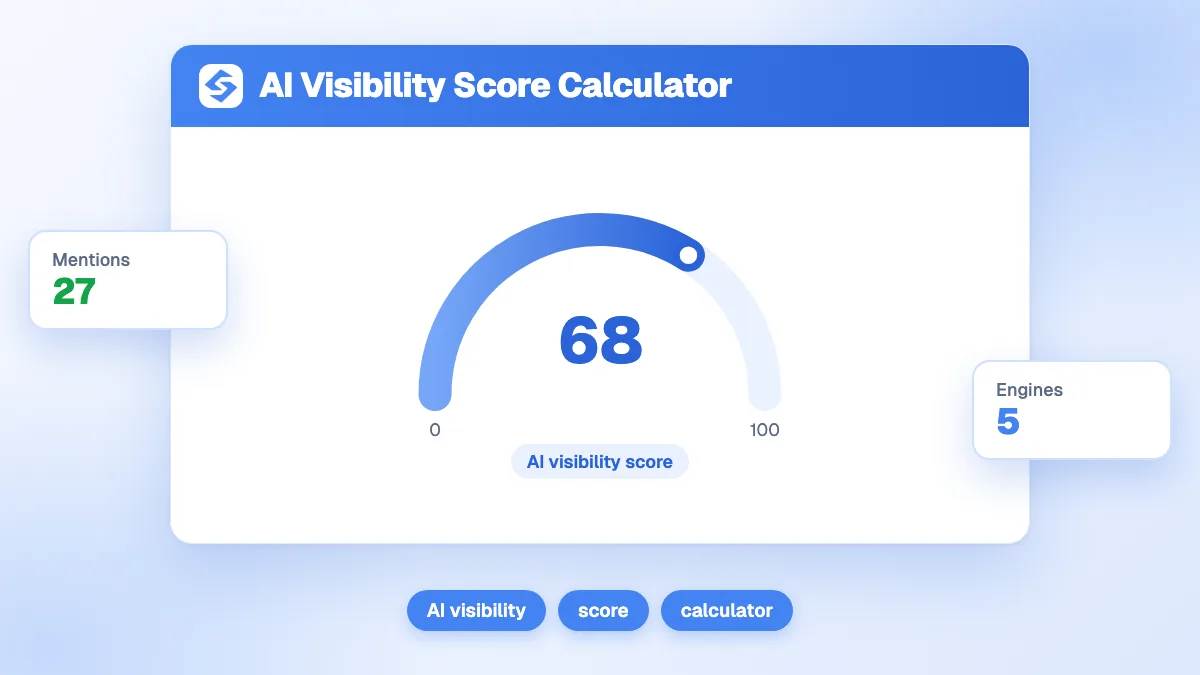
The AI visibility score combines how often your brand appears in AI answers with how high it appears. Formula: appearance rate × position weight, where the appearance rate is prompts with your brand ÷ prompts tracked, and the position weight is (6 − average position) ÷ 5, capped between 0 and 1. Appearing in 18 of 50 prompts at an average position of 2 gives 36% × 0.8 = a score of 29 out of 100. The calculator also shows the prompts where you are missing and the score you would have in first place.
Want to go further? Ask


The AI visibility score calculator turns a prompt-tracking spreadsheet into one number you can follow month after month. It matters because AI answers name only a handful of brands. In a Pew Research Center study, 88% of Google AI summaries cited three or more sources, while users clicked a link inside the summary in just 1% of visits (Pew Research Center, 2025). Being named in the answer is often the only exposure you get.

How is the AI visibility score calculated?
The calculator takes three inputs and returns five results. Every result can be checked by hand with the formulas below.
| Result | Formula | Example (18 appearances, 50 prompts, position 2) |
|---|---|---|
| Appearance rate | Prompts where you appear ÷ prompts tracked × 100 | 36.0% |
| Position weight | (6 − average position) ÷ 5, between 0 and 1 | 0.80 |
| AI visibility score | Appearance rate × position weight | 29 out of 100 |
| Prompts without you | Prompts tracked − prompts where you appear | 32 |
| Score if you ranked first | Appearance rate × 1 | 36 |
Two rules keep the result honest. The number of appearances cannot exceed the number of prompts, and the position weight stops at zero: a brand that only appears in sixth place or lower scores 0, however often it shows up. Count an appearance once per prompt, even if the answer names you twice.
How much is each position worth?
The weight falls by a fifth for every place you lose. First place carries the full appearance rate, fifth place a fifth of it.
| Average position | Position weight | Score with a 40% appearance rate |
|---|---|---|
| 1 | 1.0 | 40 |
| 1.5 | 0.9 | 36 |
| 2 | 0.8 | 32 |
| 3 | 0.6 | 24 |
| 4 | 0.4 | 16 |
| 5 | 0.2 | 8 |
| 6 or more | 0 | 0 |
This is why the score rewards depth as much as reach. Appearing in every answer in last place scores about the same as appearing rarely in first. The last result of the calculator, the score if you ranked first, shows how much better positioning alone would be worth.
Two brands tracked on the same 50 prompts show how the trade-off works. Brand A appears in 40 answers at an average position of 4: 80% × 0.4 = 32. Brand B appears in only 15 answers, but at an average position of 1.2: 30% × 0.96 = 28.8, rounded to 29. Brand A is seen more often, Brand B is recommended first when it is seen; the scores end up close, and the right next step is different for each. Brand A needs better positioning in the answers where it already appears, Brand B needs to appear in more of them.
How do you read your score?
The main result is coloured by band, so you can see at a glance where you stand.
| Score | Label | What it usually means |
|---|---|---|
| Below 10 | Below par | The AIs rarely name you, or only at the bottom of their lists |
| 10 to 24 | Watch this | You are in the consideration set on some prompts, not yet a regular answer |
| 25 to 49 | Healthy | You appear often and fairly high on your core topics |
| 50 and above | Excellent | You are one of the default answers for most of your prompts |
A score of 50 requires, for instance, an appearance rate of 50% in first place or 63% in second. Few brands get there outside their own name, so compare yourself with your direct competitors on the same prompts rather than with an absolute target.
How many prompts should you track?
Thirty to fifty per topic cluster. Fewer than that and the score jumps from one month to the next for reasons that have nothing to do with your work.
The variability is large. SparkToro had 600 volunteers run 12 prompts through ChatGPT, Claude and Google's AI 2,961 times, and found less than a 1 in 100 chance that two answers give the same list of brands, and about 1 in 1,000 that they give it in the same order (SparkToro, January 2026). The same study concludes that the share of answers where a brand appears is a reasonable measure, while a single ranking position is not.
- Average over many prompts and runs. The appearance rate is stable when the sample is large; the average position needs even more answers to settle.
- Fix the prompt set. Changing the prompts changes the score without anything changing on your site.
- Mix the intents. Include category questions, problem questions and comparisons, written the way buyers phrase them to an assistant.
To build that list from the sub-queries assistants really run, use the Sorank query fan-out tool. To test a single question live on ChatGPT, Perplexity, Gemini or Claude, run the LLM citation checker.

How do you collect the inputs?
- Write the prompts in a sheet, one per line, grouped by topic.
- Run each prompt in the assistants that matter for your market, in a clean session, and paste the answers.
- Mark each answer: does your brand appear (yes or no), and at which position among the brands named?
- Count the prompts with an appearance, and average your position across those prompts only.
- Enter the three numbers in the calculator and note the score with the date.
Do it per assistant if you can. A brand can be a regular answer in Perplexity and absent from ChatGPT, and a single blended score hides that gap.
How do you improve your AI visibility score?
Raise the appearance rate first, then the position. Both depend on what the assistants read about you, on your site and elsewhere.
- Let the assistants' search crawlers in. OpenAI notes that a site can allow OAI-SearchBot to appear in ChatGPT search results while blocking GPTBot for training (OpenAI, overview of crawlers).
- Answer the prompt on a page. A direct answer in the first lines, figures with their sources and a comparison table give the assistant something to quote.
- Earn mentions on the sites they cite. Reviews, comparisons, directories and press articles on your topic shape which brands an assistant lists, and in what order.
- Keep your brand consistent. The same name, description and category everywhere helps the assistant recognise you as one entity.
Our glossary entries on the AI visibility score and share of model explain how these metrics relate. To compare yourself with competitors on the same prompts, use the AI share of voice calculator.
How do you track the score over time?
Recalculate it every month on the same prompts, and look at the trend over three months rather than one move. Tracking by hand works for a few dozen prompts; beyond that, Sorank AI mention tracking sends your prompts to ChatGPT, Claude, Gemini and other assistants every week and records where you appear, and the GEO leaderboard shows which brands the AIs recommend instead of you.
Your AI visibility score is your appearance rate, weighted by how high you appear. Calculate it now with your own prompts, then see the Sorank plans to measure and grow it on autopilot.