




Summary
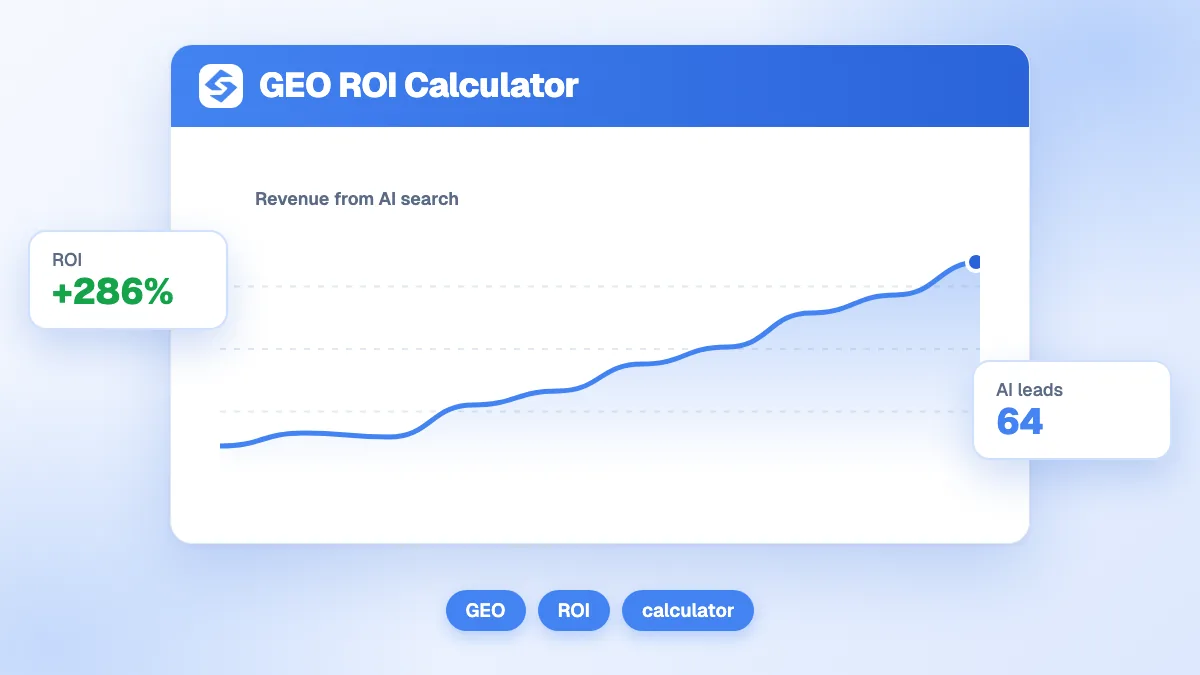
The cost of AI invisibility is the revenue you miss because AI assistants name your competitors instead of you. The calculator prices the gap between your citation rate today and the rate a well-covered competitor reaches: questions × citation gap × click-through × conversion rate × value per conversion. With 12,000 monthly questions, a citation rate of 8% against 35% possible, 12% click-through, 3.5% conversion and a value of 160, the gap costs about 2,177 a month, or 26,127 a year.
Want to go further? Ask


The cost of AI invisibility calculator turns a visibility problem into a budget line. Buyers now ask assistants for advice before they ever reach a search results page: Practical Guidance, Seeking Information and Writing together account for nearly 80% of ChatGPT conversations (NBER working paper, How People Use ChatGPT). When the answer names three brands and yours is not one of them, the question is lost before it becomes a visit. This calculator shows what that absence is worth.
How is the cost of AI invisibility calculated?
The calculator works in four steps, all monthly, then multiplies by 12 for the year.
| Step | Formula | Example (default values) |
|---|---|---|
| Citations not earned | Monthly questions × (target citation rate minus current rate) | 12,000 × (35% minus 8%) = 3,240 |
| Visits not earned | Citations not earned × click-through from a citation | 3,240 × 12% = 389 |
| Customers not earned | Visits not earned × conversion rate | 389 × 3.5% = 14 (13.6 before rounding) |
| Missed every month | Customers not earned × value per conversion | 13.6 × 160 = 2,177 |
| Missed every year | Missed every month × 12 | 26,127 |
If you enter a target rate lower than your current rate, the calculator treats the gap as zero: you are already ahead, and the result shows nothing missed. Pick the currency (dollar, euro or pound) in the tool; the formulas do not change.

Which numbers should you enter?
Six inputs drive the result. Two come from your own data, three from measurement and one from your market.
- Monthly AI questions in your market: how many times a month buyers ask an assistant about what you sell. No tool publishes this per topic. A workable proxy is the monthly Google search volume of your buying questions ("best X for Y", "X vs Y", "X price") from Keyword Planner, multiplied by a share you judge realistic for AI use in your audience. State the assumption next to the result.
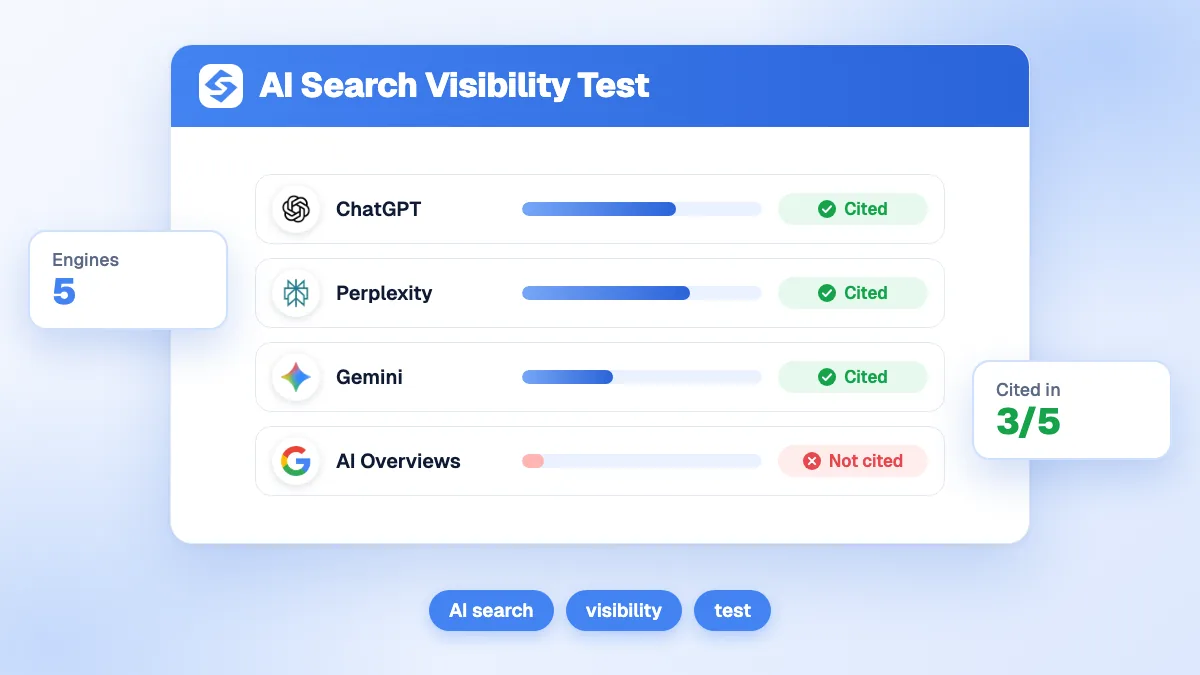
- Your citation rate today: the share of answers that name you. Ask a fixed list of 20 to 50 buying questions to ChatGPT, Perplexity and Gemini and count how often you appear. The AI search visibility test checks one question at a time; the AI citation rate calculator turns your counts into a rate.
- Citation rate you could reach: what a well-covered competitor achieves on the same questions. Run the same list for your top competitor and use their rate.
- Click-through from a citation: the share of readers who follow the link after seeing you named. Your analytics show AI referrals; divide them by your estimated citations.
- Conversion rate and value per conversion: from your analytics or CRM. For lead generation, use the average deal value multiplied by your close rate.
What does the result look like for different businesses?
The same formula gives very different answers depending on the value of a customer. These scenarios use the calculator with illustrative inputs.
| Scenario | Questions / month | Rate today → target | Click-through | Conversion | Value | Missed per year |
|---|---|---|---|---|---|---|
| Default example | 12,000 | 8% → 35% | 12% | 3.5% | 160 | 26,127 |
| Same, closing half the gap | 12,000 | 8% → 21.5% | 12% | 3.5% | 160 | 13,064 |
| Same, cautious click-through | 12,000 | 8% → 35% | 3% | 3.5% | 160 | 6,532 |
| B2B software | 3,000 | 5% → 40% | 15% | 2% | 5,000 | 189,000 |
| Online store | 40,000 | 15% → 30% | 8% | 2.5% | 70 | 10,080 |
| Local service | 1,500 | 0% → 25% | 20% | 10% | 300 | 27,000 |
Two lessons stand out. Value per conversion moves the result more than volume: a few thousand B2B questions can be worth more than forty thousand retail ones. And the click-through assumption deserves care, because it scales the whole result.
How realistic is the click-through from a citation?
It is the most uncertain input, so test it low. Measurements on Google's own AI summaries show how few readers click. In a 2025 study of real browsing data, users who saw an AI summary clicked a link inside it in just 1% of visits, and clicked a traditional result in 8% of visits against 15% without a summary (Pew Research Center, 2025).
Chat assistants behave differently, because the user is in a conversation and often asks for a recommendation, but the direction is the same: many readers take the answer and never visit. That does not make the citation worthless. A brand named in the answer can be searched by name later, which shows up as branded search or direct traffic rather than as an AI referral. Run the calculator twice, once with your measured click-through and once with a cautious 3%, and present the range.

Why does AI invisibility cost more than a lower Google ranking?
Because AI answers concentrate the choice. A search results page shows ten links and a user can scroll to the sixth. An assistant writes one answer and names a handful of options. If you rank eighth on Google, you still get a few clicks; if you are not in the answer, that conversation sends you nothing. The calculator's own advice puts it plainly: an AI citation is winner-takes-most.
The same logic explains why the gap often persists. Assistants rely on the pages they can retrieve and on the sites that mention brands. A competitor who appears in comparison articles, review sites and forums is named again and again, while a brand absent from those sources stays absent. Read the result as the price of that difference.
How do you reduce the cost of AI invisibility?
Close the gap question by question, starting with the ones closest to a purchase.
- Find where competitors are named and you are not. The GEO leaderboard ranks every site the assistants cite in your market, and AI mention tracking shows, prompt by prompt, who appears in each answer.
- Publish the page that answers each question directly, with a clear verdict, figures and comparisons. AI query fan-out reveals the sub-queries assistants run before answering, which tells you which sections that page needs.
- Get mentioned on the sources they cite: comparison articles, directories, review sites and industry media.
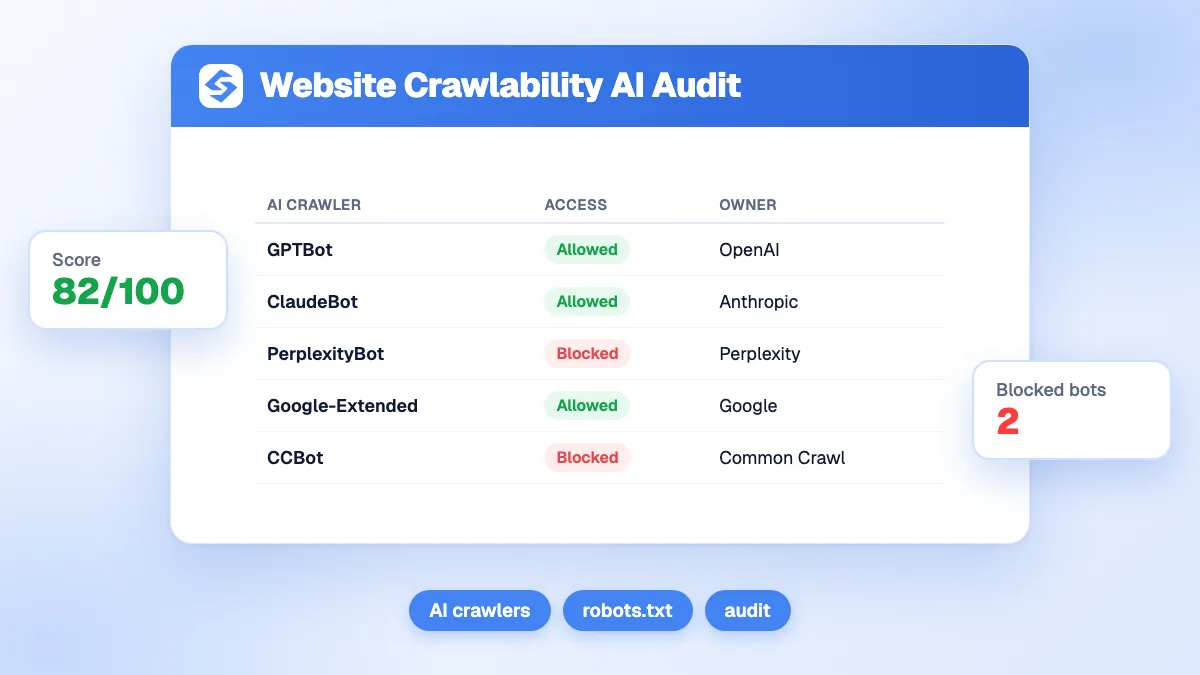
- Make sure the assistants can read you. Allow their search crawlers in robots.txt; the AI crawlability audit checks it in one run.
- Measure again every month and rerun the calculator with your new citation rate.
Once you are cited, the AI traffic value calculator prices the visits you do receive, the mirror image of this calculator.
What are the limits of this estimate?
It is a gap calculation, not a forecast. Closing the gap entirely is rare, and the input with the most weight, the number of AI questions in your market, is an assumption. Use it to compare scenarios and to justify a test budget, not to promise a revenue figure. A conservative number that survives questions is worth more than an impressive one that does not.
Every month you stay out of AI answers has a price, and you can put a number on it. Run the calculator with your own data, then see the Sorank plans to track your citations and close the gap on autopilot.