Summary
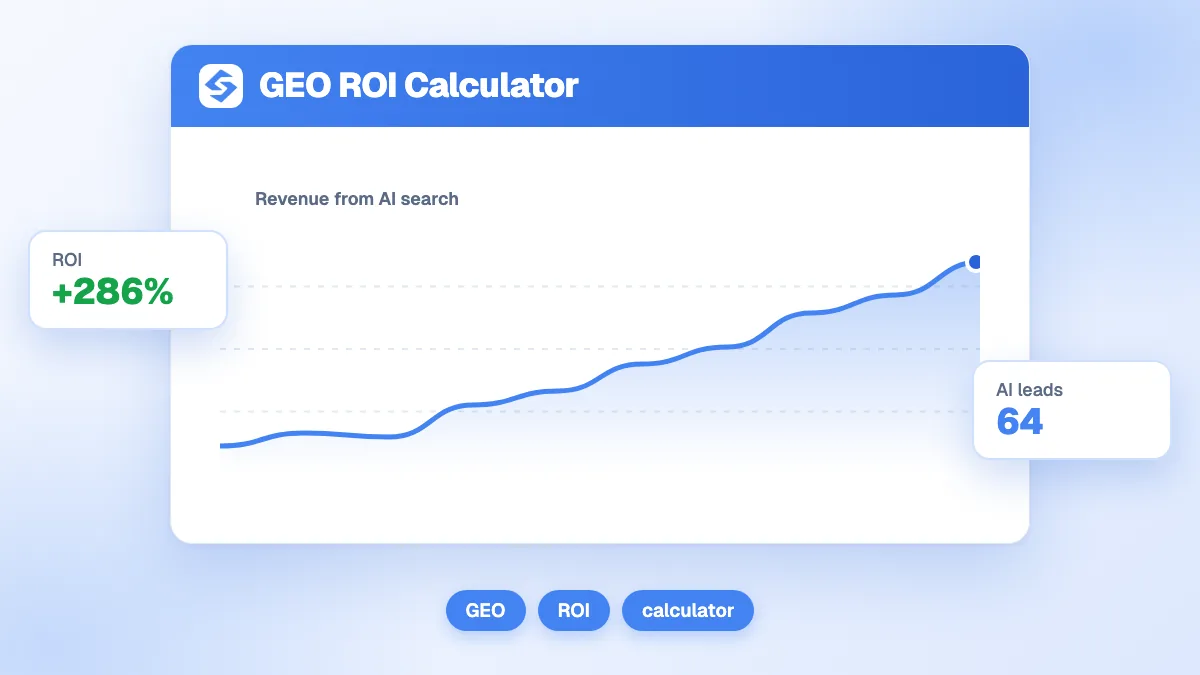
GEO ROI = (monthly revenue from the AI citations you gain − monthly GEO spend) ÷ monthly GEO spend × 100. The calculator starts from the AI questions asked in your market each month, applies the rise in your citation rate, the share of citations that bring a click, your conversion rate and the value of a conversion. It returns the citations and visits gained, the monthly revenue, the monthly profit and how many months of revenue cover one month of spend.
Want to go further? Ask


A GEO ROI calculator turns a generative engine optimization programme into a business case. GEO aims to get your brand cited in the answers of ChatGPT, Perplexity, Gemini and Google AI Overviews, which now reach a very large audience: Google reports over 2 billion monthly users for AI Overviews (Alphabet Q2 2025 earnings remarks). The question for a budget owner is narrower: does the extra visibility pay for the work? The calculator gives a first answer in one screen.

How is GEO ROI calculated?
The model follows the path from a question to a sale. Each line below shows the formula and the result with the default values: 3,000 spent per month, 15,000 AI questions per month in your market, a citation rate rising from 8% to 26%, 12% of citations bringing a click, 4% of visits converting and 180 per conversion.
| Result | Formula | Default example |
|---|---|---|
| Citations gained | Questions × (rate after − rate before) | 15,000 × 18% = 2,700 |
| Visits gained | Citations gained × click-through from a citation | 2,700 × 12% = 324 |
| Monthly revenue | Visits × conversion rate × value per conversion | 324 × 4% × 180 = 2,333 |
| Monthly profit | Revenue − monthly spend | 2,333 − 3,000 = −667 |
| Return on investment | Profit ÷ spend × 100 | −22% |
| Payback period | Monthly spend ÷ monthly revenue | 1.3 months |
The default example loses money, and that is useful: it shows how demanding the click-based model is. A payback period above one month means that one month of revenue does not cover one month of spend, so the programme does not pay for itself at this level. If the "after" rate is lower than the "before" rate, the calculator counts no gain rather than a negative one.
Which input changes the result the most?
The volume of questions and the value of a conversion. The table changes one input at a time from the default example.
| Scenario | Visits gained | Monthly revenue | ROI |
|---|---|---|---|
| Default example | 324 | 2,333 | −22% |
| Citation rate rising to 40% instead of 26% | 576 | 4,147 | 38% |
| Conversion rate of 8% instead of 4% | 324 | 4,666 | 56% |
| Value per conversion of 500 instead of 180 | 324 | 6,480 | 116% |
| 50,000 questions per month instead of 15,000 | 1,080 | 7,776 | 159% |
| Click-through from a citation of 1% instead of 12% | 27 | 194 | −94% |
GEO pays most clearly in markets with many questions and high-value sales: B2B software, professional services, finance, health, travel. For a low-ticket product, count the brand effect too, not only the clicks.
How do you estimate each input?
- Monthly GEO spend: content, tools and time dedicated to the programme.
- AI questions in your market: no AI company publishes prompt volumes. Use the Google search volume of your main topics as a ceiling, then apply the share of your audience that uses AI assistants. Pew Research Center found that 34% of US adults had used ChatGPT in 2025, and 58% of those under 30 (Pew Research Center, 2025).
- Citation rate before and after: measure it on the same fixed set of questions, before and after the work. The AI citation rate calculator turns your tests into a rate.
- Click-through from a citation: the most uncertain input. Pew observed that Google users clicked a link inside an AI summary in just 1% of visits to pages showing one (Pew Research Center, 2025). Chat assistants display their sources differently, so replace this input with your own figure as soon as your analytics show referrals from chatgpt.com or perplexity.ai.
- Conversion rate and value: take them from your analytics and CRM for visitors coming from AI assistants, or from organic search if you have no AI data yet.

Where do AI visits show up in your analytics?
Google Analytics 4 now has a dedicated AI Assistant channel for visits from sources such as ChatGPT, Gemini, Deepseek, Copilot or Grok. Visits from Google's AI Overviews and AI Mode are not in it: they stay in Organic Search, together with the classic results (Analytics Help, default channel group).
- Visits gained: compare the AI Assistant channel before and after the programme to check the calculator's visit estimate.
- Conversion rate: read it on the same channel, as a key event rate, rather than borrowing your site average.
- AI Overviews: they cannot be isolated in Analytics; watch the impressions and clicks of your informational queries in Search Console instead.
Once a few months of data exist, replace the click-through and conversion assumptions with these measured figures and rerun the calculator.
How do you read the result?
The ROI is colored by band: below 0% "Losing money", 0% to 99% "Watch this", 100% to 299% "Healthy", 300% and more "Excellent". The chart under the calculator puts the monthly revenue, the monthly spend and the profit side by side, in red when the spend wins.
Read a negative result as a question, not a verdict. Is the click-through realistic? Is the question volume complete? Is the value per conversion the real one? If the answer is yes and the ROI stays negative, the programme needs a cheaper execution or a market with more questions.
What does the calculator not count?
The brand effect. Being named in an answer influences the decision even when nobody clicks, and the calculator only counts clicks. Three other effects are left out as well.
- SEO gains: the pages written for AI answers also rank in Google. Count them with the SEO ROI calculator.
- Branded searches: people who read your name in an answer may search for it later. Watch your branded clicks in Search Console.
- Time: the model compares one month of spend with one month of revenue once the new rate is reached. Count the months needed to get there.
To price the opposite case, what invisibility costs you, use the AI invisibility cost calculator.
How fast can a GEO programme move the citation rate?
Faster than a classic ranking in many cases, because AI assistants that search the web read new pages as soon as their crawlers do. OpenAI notes, for instance, that a change to robots.txt takes about 24 hours to be reflected in ChatGPT search (OpenAI, overview of OpenAI crawlers). The content itself matters most: the Princeton study that defined Generative Engine Optimization found that adding statistics, quotations and cited sources can increase visibility in generative answers by up to 40% (Aggarwal et al., GEO, KDD 2024).
- Measure the "before" rate on 25 to 50 questions across several AIs.
- Fix access for the AI search crawlers, then publish or rewrite the pages that answer the missing questions.
- Earn mentions on the sources the AIs already cite for those questions.
- Measure the "after" rate on the same questions after a few weeks, then rerun the calculator.
From a business case to a measured programme
GEO pays when enough questions, a real citation gain and a valuable conversion line up; the calculator shows which of the three is missing. The Sorank AI mention tracking measures your citation rate before and after on ChatGPT, Perplexity, Gemini and Claude, the GEO and SEO dashboard follows the visits from AI assistants, and the blog article generator publishes the pages that earn citations. See the Sorank plans to run the programme on autopilot.