Summary
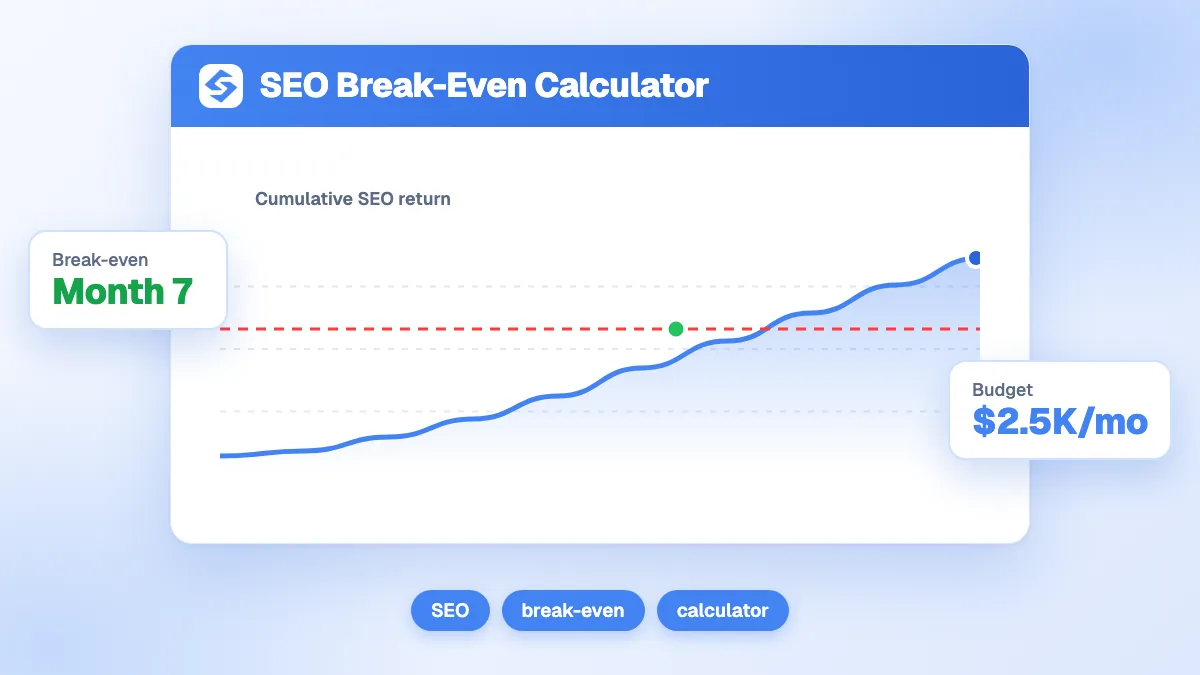
SEO breaks even when the value of your organic visits covers what you spend on SEO each month. The calculator finds the value of one visit (conversion rate × value per conversion), then the visits needed (monthly spend ÷ value per visit). With 2,500 a month, a 2% conversion rate and 150 per conversion, each visit is worth 3.00 and you need 834 visits, or 17 conversions, a month. Enter your current visits to see the share of the target you already reach and the visits still missing.
Want to go further? Ask


The SEO break-even calculator turns a monthly budget into a traffic target. It answers the question asked before every SEO contract: how many visitors do we need before this stops costing us money? Use your organic clicks from Google Search Console, where a click is counted each time a user goes from Google Search results to your site (Search Console Help, Performance report), and the conversions you track in your analytics.

How is the SEO break-even point calculated?
Four inputs, five results. The formulas are short enough to check by hand.
| Result | Formula | Example (2,500 spend, 2%, 150 per conversion, 4,000 visits) |
|---|---|---|
| Value per visit | Conversion rate × value per conversion | 3.00 |
| Visits needed | Monthly SEO spend ÷ value per visit, rounded up | 834 |
| Conversions needed | Monthly SEO spend ÷ value per conversion, rounded up | 17 |
| Visits still missing | Visits needed − current visits (never below 0) | 0 |
| Share of the target reached | Current visits ÷ visits needed × 100 | 480% |
A chart sets the visits you need next to the visits you have: green when you are above break-even, orange when you are not. With only 500 visits a month, the same site would reach 60% of its target and miss 334 visits.
Which value per conversion should you enter?
Use the profit a conversion brings, not the revenue. If a sale of 150 costs you 90 to deliver, the value that pays for SEO is 60, and the visits needed rise from 834 to 2,084. Entering revenue makes SEO look profitable long before it is.
- E-commerce: average order value × gross margin.
- Lead generation: average deal margin × the share of leads that become customers. A lead worth 2,000 of margin with a 10% close rate is worth 200 per lead.
- Subscriptions: the margin over a realistic customer lifetime, which the customer lifetime value calculator estimates.
Count only the conversions you can track. In Google Analytics, you mark the events that matter to your business as key events to measure them and see which channels lead to them (Analytics Help, key events).
How much traffic do you need to break even?
It depends far more on the value of a visit than on the budget. The table keeps a monthly spend of 2,500 and changes the conversion rate and the value per conversion.
| Conversion rate | Value 50 | Value 150 | Value 500 |
|---|---|---|---|
| 1% | 5,000 visits | 1,667 visits | 500 visits |
| 2% | 2,500 visits | 834 visits | 250 visits |
| 4% | 1,250 visits | 417 visits | 125 visits |
Read the table in both directions. A shop selling 50 items at 1% needs ten times the traffic of a service business converting a 500 lead at 1%. And doubling the conversion rate halves the traffic you need, which is usually cheaper than doubling the traffic. To find the right rate, use the conversion rate calculator.

How long does SEO take to break even?
Longer than paid advertising, because organic traffic builds up gradually while the spend starts on day one. Plan for a period below break-even, and budget for it. Google itself warns that no one can guarantee a first place in its results and that an SEO audit should give realistic estimates of improvement (Google Search Central, do you need an SEO).
- Find your target with this calculator.
- Project your traffic month by month with the SEO forecast calculator, which shows the month when cumulative revenue overtakes cumulative spend.
- Check the gap each month: the "visits still missing" result should shrink.
Here is how the monthly check reads for the example site (break-even at 834 visits, each visit worth 3.00), as its organic traffic grows.
| Month | Organic visits | Value of the visits | Share of the target | Result for the month |
|---|---|---|---|---|
| Month 2 | 250 | 750 | 30% | −1,750 |
| Month 4 | 500 | 1,500 | 60% | −1,000 |
| Month 6 | 750 | 2,250 | 90% | −250 |
| Month 8 | 1,000 | 3,000 | 120% | +500 |
| Month 12 | 1,600 | 4,800 | 192% | +2,300 |
The traffic figures are an illustration, not a forecast. The point is the shape: monthly break-even comes before the money spent in the first months is recovered, so keep a cumulative view next to the monthly one.
Break-even is a floor, not a goal. Everything above it is what pays for the programme, and the same pages keep bringing visits after you stop paying for them, unlike ads.
Why are clicks harder to win than before?
Because a growing share of searches end without a visit. In 2024, for every 1,000 Google searches in the US, only 360 clicks went to the open web, and 58.5% of searches ended without any click (SparkToro and Datos, 2024). When AI summaries appear, users click a traditional result in 8% of visits against 15% without one (Pew Research Center, 2025).
Two consequences for your break-even. Target queries with buying intent, where visitors convert well enough to lower the traffic you need. And count the visits that now come from AI assistants such as ChatGPT or Perplexity as part of your organic traffic: the AI traffic value calculator puts a value on them.
Which mistakes give a wrong break-even?
- Revenue instead of margin, as explained above.
- Branded traffic counted as SEO. People searching your name would often find you anyway. Exclude branded queries in Search Console for a stricter test.
- A one-off setup fee left out. Spread an audit or a migration over twelve months and add it to the monthly spend.
- Site-wide conversion rate. Blog visitors convert less than visitors on product or service pages. Use the rate of organic visitors, not the average of all channels.
- One month of data. Use a three-month average of visits and conversions.
- Ignoring assisted conversions. Many buyers read an article, leave, and come back later through another channel. A last-click report gives SEO none of that credit, so your real break-even is often a little lower than the calculator shows. Compare attribution models in your analytics before you cut a budget that seems short of its target.
How do you reach break-even faster?
- Lift the value per visit first: better offers, proof and calls to action on the pages that already rank.
- Target keywords with buying intent. The Sorank keyword research finds the queries you can win without cannibalizing your existing pages.
- Publish steadily on those queries with the blog article generator, which writes sourced articles and publishes them on your site.
- Watch the result in the GEO and SEO dashboard, with Google and AI traffic in one view.
Once you are above break-even, measure the profit with the SEO ROI calculator.
SEO breaks even when visits × conversion rate × value per conversion covers the monthly spend. Find your number now, then see the Sorank plans to reach it with content published on autopilot.