




Summary
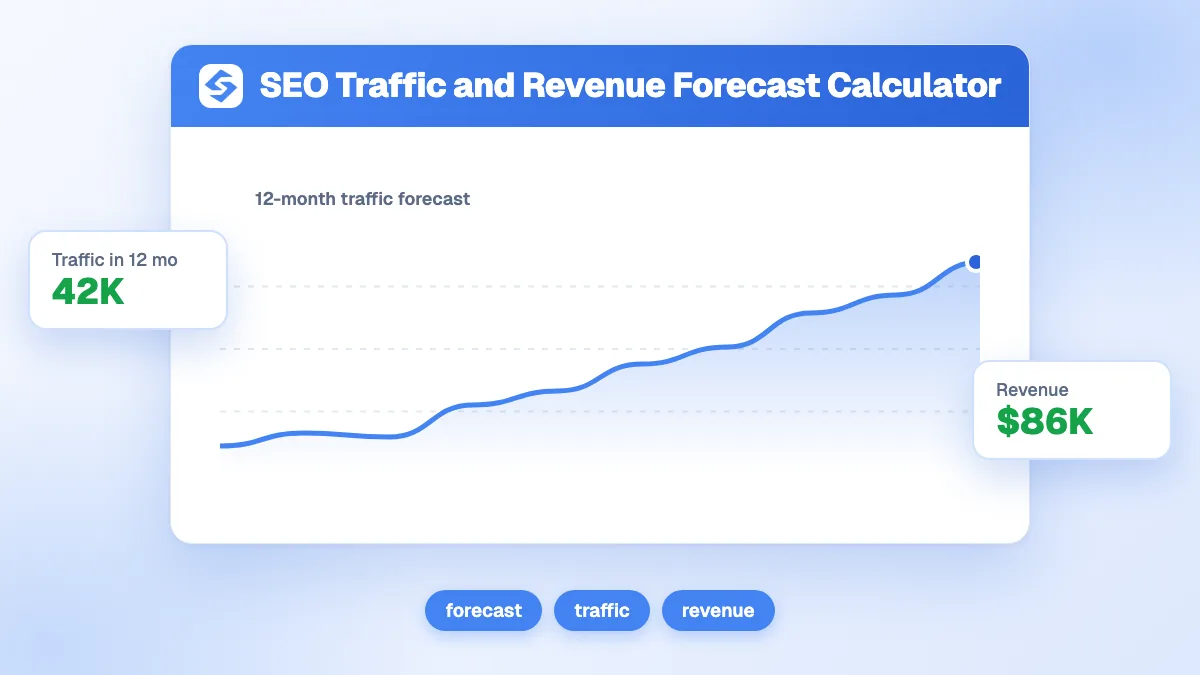
The SEO forecast calculator projects organic traffic month by month with compound growth, then turns it into cumulative revenue, total spend and profit over the period you choose (1 to 36 months). With 3,000 visits today, 8% monthly growth, a 2% conversion rate, 120 per conversion and 2,500 of monthly spend, traffic reaches 7,555 visits in month 12, a 2.5 times multiple. To isolate what the SEO budget adds, run the same forecast at 0% growth and compare the two.
Want to go further? Ask


An SEO forecast calculator gives a budget discussion a shape: when the traffic arrives, and when it pays for itself. Forecasts are assumptions, and Google warns that third-party predictions "may not happen" (Google, guidance on third-party SEO tools). The value of a forecast is to make the assumptions explicit, compare scenarios and set a date to check reality against the plan.

How does the SEO forecast calculator work?
Each month, traffic grows by the same percentage of the previous month: visits in month m = current visits × (1 + growth)m. The calculator adds up the months, converts them into revenue and compares the total with your spend.
| Result | Formula | Example (3,000 visits, 8%, 12 months, 2%, 120, 2,500) |
|---|---|---|
| Visits in the final month | Visits × (1 + growth)months | 7,555 |
| Growth multiple | Final month ÷ current visits | 2.5 |
| Cumulative visits | Sum of the visits of each month | 61,486 |
| Cumulative revenue | Cumulative visits × conversion rate × value | 147,566 |
| Total spend | Monthly spend × months | 30,000 |
| Profit over the period | Cumulative revenue − total spend | 117,566 |
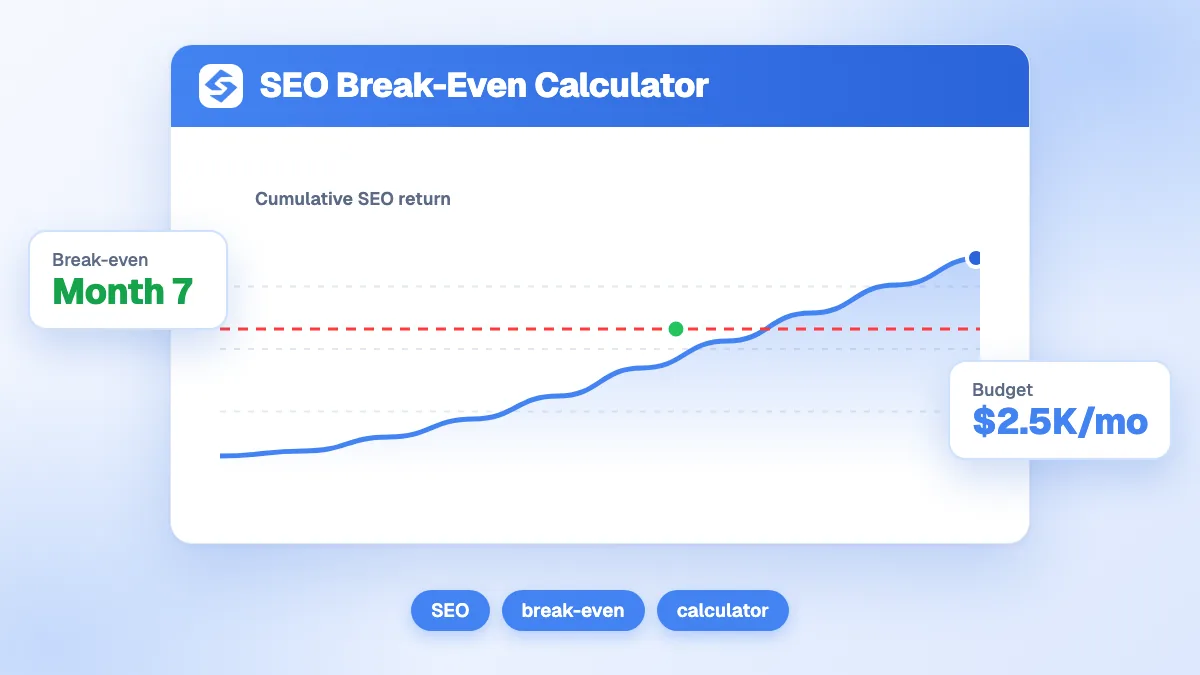
A chart draws cumulative revenue and cumulative spend month by month. The month where the revenue curve crosses the spend curve is the month the program becomes profitable. Choose the currency in the tool; the formulas stay the same.
How do you separate the SEO gain from the traffic you already have?
Run the forecast twice. The revenue line counts every visit, including the 3,000 a month you would keep without new work, so even 0% growth shows a profit in the example. The difference between the two runs is what the budget buys.
| Month | Extra revenue vs 0% growth (cumulative) | SEO spend (cumulative) |
|---|---|---|
| 3 | 3,644 | 7,500 |
| 6 | 13,844 | 15,000 |
| 7 | 18,984 | 17,500 |
| 12 | 61,166 | 30,000 |
In this example, the extra revenue overtakes the spend in month 7 and doubles it by month 12. That is the incremental view to present to a finance team. For the same logic on a single budget figure, use the SEO ROI calculator and the SEO break-even calculator.
Why does the forecast use compound growth?
Because organic traffic tends to build on itself: new pages earn links and rankings that also lift older pages, and a site that covers a topic well gains trust on the next query. Compounding also explains the shape every SEO program shows: a flat start, then a steep curve. That flat start is where many programs get cancelled.
Compounding is powerful and easy to overstate. A sustained 8% per month multiplies traffic by 2.5 in a year, and by about 16 in three years, which few sites achieve. Use the 36-month horizon to see the long-term shape, not to promise a number.

What monthly growth rate should you use?
Your own, measured over the last six to twelve months in Search Console, then a pessimistic and an optimistic variant around it. Without history, compare scenarios rather than picking one.
| Monthly growth | Multiple after 12 months | Visits in month 12 (from 3,000) | Cumulative revenue |
|---|---|---|---|
| 0% | 1.0 | 3,000 | 86,400 |
| 2% | 1.3 | 3,805 | 98,498 |
| 4% | 1.6 | 4,803 | 112,513 |
| 8% | 2.5 | 7,555 | 147,566 |
| 12% | 3.9 | 11,688 | 194,610 |
Base the decision on the pessimistic case. If the program is still worth it at 4%, an 8% result is a bonus; if it only works at 12%, the plan depends on luck.
How long does SEO take to show results?
Months rather than weeks. Google explains that some changes "can take effect in a few days, but it could take several months" for its systems to confirm that a site produces helpful content over the long term, and that it makes broad core updates "several times a year" (Google, core updates). New sites start from a lower base, so the same growth rate produces fewer extra visits at first. With 500 visits a month instead of 3,000, the example program only becomes profitable around month 17.
What can make a forecast wrong?
Four factors break the straight compounding line, and each deserves a sentence in the plan you present.
- Seasonality: a December peak or a summer dip looks like growth or decline. Compare each month with the same month of the previous year.
- Algorithm updates: core updates can move rankings up or down for weeks.
- Fewer clicks per search: SparkToro, using Similarweb data, found that 68.01% of Google searches in the first four months of 2026 ended without a click (SparkToro, 2026). Traffic can stall even when rankings rise.
- Content decay: pages lose positions as they age; read our glossary entry on content decay.
Visits from AI assistants also count. Measure them apart from Google traffic so you can see whether a flat Google curve hides a growing AI channel.
How do you build a forecast you can defend?
Build it bottom-up, from keywords, then check it top-down with the growth rate.
- List the pages you will publish and their target keywords.
- Estimate each page's visits with the organic traffic estimator, at a realistic position.
- Spread them over the months when they will be published and start to rank.
- Convert the total into a monthly growth rate and enter it in the forecast calculator.
- Check monthly against Search Console and adjust the rate after three months of data.
For the vocabulary, see our glossary entry on organic traffic.
What should the monthly spend include?
Everything the program costs, so that the break-even month is honest: agency or freelance fees, content production, links and digital PR, tools, and the development time for technical fixes. If the budget changes during the period, for example a heavier first quarter, enter the average monthly figure over the whole period. The SEO budget calculator helps you size that figure from your goals.
How do you present an SEO forecast?
Show three lines rather than one number. The pessimistic case, the expected case and the optimistic case each get their final-month traffic, cumulative revenue and break-even month. Add the 0% run so that everyone sees what the existing traffic already brings, and the date of the first review, usually three months after the start. A forecast presented this way survives the first flat months, because everyone agreed in advance on what flat looks like.
How do you hit the growth rate you forecast?
By publishing on schedule, on keywords you can win. The Sorank keyword research selects the keywords within your reach, the blog planner places them in an editorial calendar and publishes on autopilot, and the GEO and SEO dashboard compares real traffic from Google and AI assistants with your plan every week.
A good SEO forecast is a range, checked every month, not a promise. Run your pessimistic and optimistic scenarios now, and see the Sorank plans to keep the growth rate on track.