




Summary
The GEO content investment calculator estimates what it costs to publish pages that answer the questions buyers ask AI assistants, and how fast that content pays back. It multiplies the questions you will cover by the cost per page, then estimates the citations, monthly visits and monthly value those pages bring. With the defaults, 24 pages cost 5,280; with a realistic 48 visits per cited question, they pay back in about 5.2 months.
Want to go further? Ask


A GEO content investment calculator turns a content plan for AI visibility into a budget line. GEO (generative engine optimization) means writing pages that ChatGPT, Perplexity or Google's AI features can find, understand and cite. Google explains that AI Overviews and AI Mode may issue "multiple related searches across subtopics and data sources" to build one answer (Google Search Central, AI features and your website). Each buyer question therefore needs a page that answers it directly, and each page has a cost.

How does the GEO content investment calculator work?
Enter six values and pick your currency (dollar, euro or pound). The results and the payback chart update as you type.
- Buyer questions identified: the prompts your buyers type into an AI before choosing (default 60).
- Cost per page: what one complete, sourced page costs you, written in-house or outsourced (default 220).
- Share you will cover: the percentage of those questions you plan to answer with a page (default 40%).
- Expected citation rate: the share of covered questions where an AI ends up citing you (default 25%).
- Monthly volume per question: the visits one cited question brings each month (default 400, see below).
- Value per visit: what an average visit is worth to you (default 3.5).
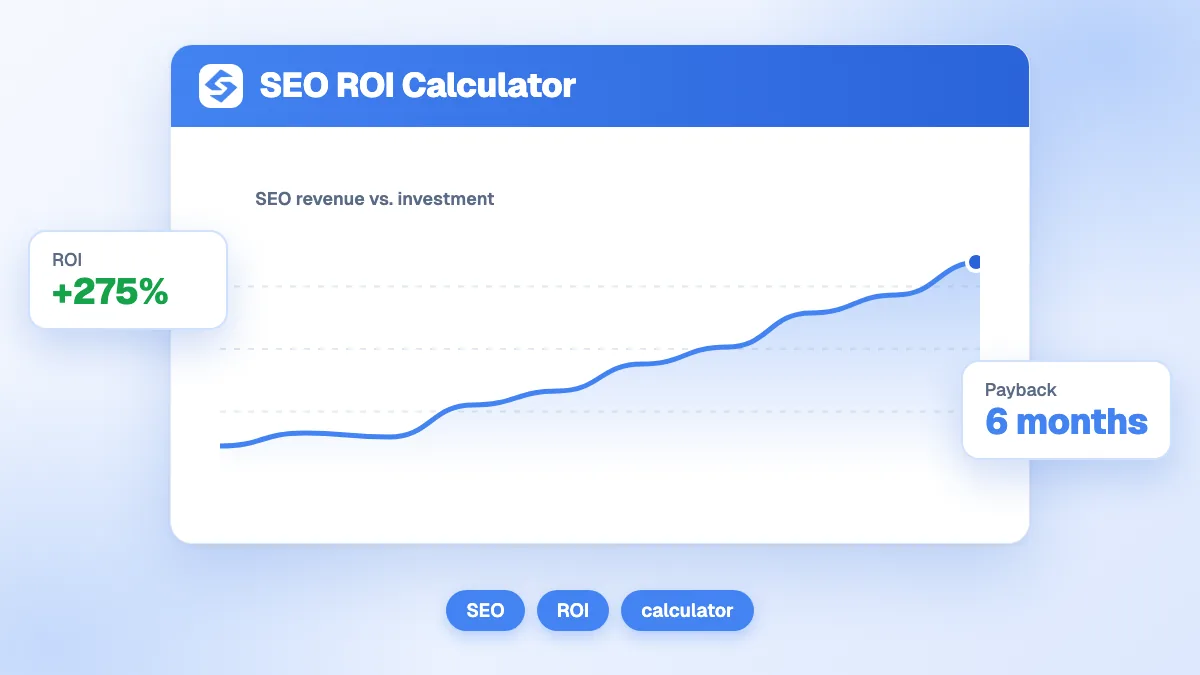
The calculator returns the investment, the number of pages to produce, the questions where you get cited, the monthly visits, the monthly value and the payback period, with a chart that shows when the cumulative value crosses the investment.
What formula does the calculator use?
| Result | Formula | Default example |
|---|---|---|
| Pages to produce | Questions × share covered | 60 × 40% = 24 |
| Investment | Pages × cost per page | 24 × 220 = 5,280 |
| Questions where you get cited | Pages × citation rate | 24 × 25% = 6 |
| Monthly visits | Cited questions × monthly volume per question | 6 × 400 = 2,400 |
| Monthly value | Visits × value per visit | 2,400 × 3.5 = 8,400 |
| Payback period | Investment ÷ monthly value | 0.6 months |
The investment is paid once; the value comes back every month. The chart draws both lines over time, so the crossing point is your break-even month.
Why should you enter visits, not raw prompt volume?
Because the calculator applies no click-through rate. It multiplies cited questions directly by the "monthly volume per question", so every person who asks that question is counted as a visit. In reality, most people read the AI answer and stop there. On Google, users clicked a link inside an AI summary in only 1% of visits to pages that showed one (Pew Research Center, 2025).
So enter the visits you expect, not the number of prompts: prompt volume × the click-through you assume. With 400 prompts and a 12% click-through, enter 48.
| Input for "monthly volume per question" | Monthly visits | Monthly value | Payback |
|---|---|---|---|
| 400 (raw prompts, default) | 2,400 | 8,400 | 0.6 months |
| 48 (400 prompts × 12% click-through) | 288 | 1,008 | 5.2 months |
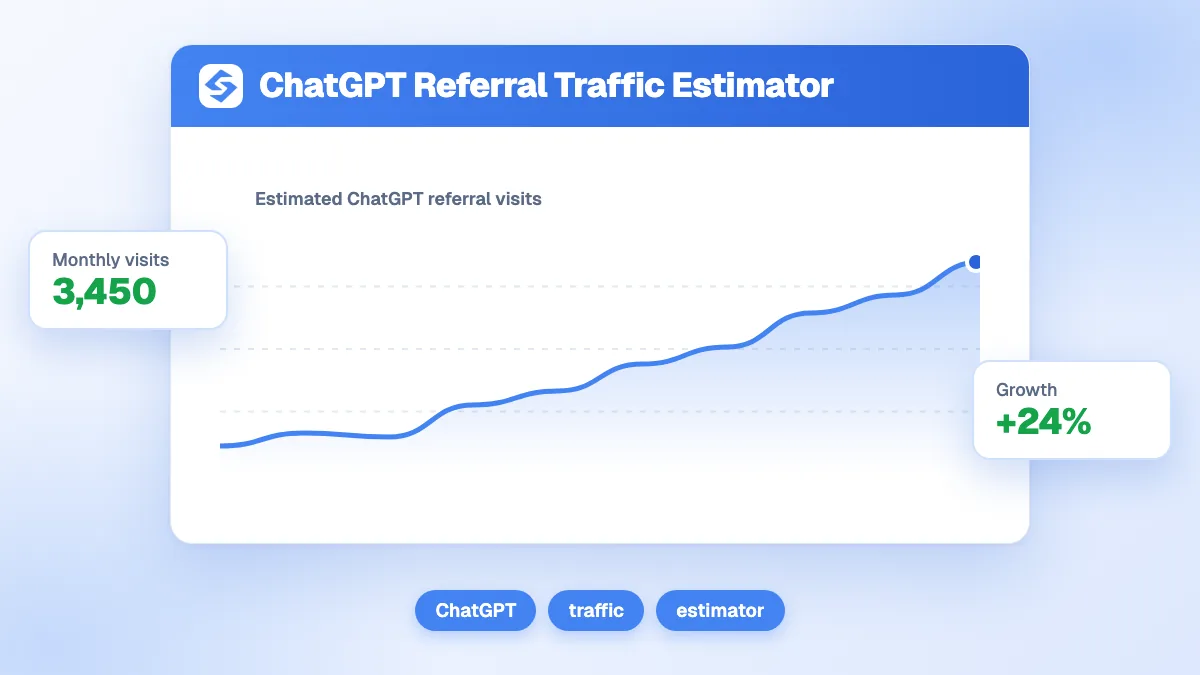
The second line is the one to show in a budget meeting. If you need to estimate the click-through, the ChatGPT traffic estimator walks through the same logic for one assistant.
How much does the citation rate change the payback?
It is the input that moves the result most, and the one you control through quality. Same plan (60 questions, 40% covered, 220 per page, 48 visits per cited question, 3.5 per visit):
| Citation rate | Cited questions | Monthly visits | Monthly value | Payback |
|---|---|---|---|---|
| 10% | 2 | 115 | 403 | 13.1 months |
| 25% | 6 | 288 | 1,008 | 5.2 months |
| 40% | 10 | 461 | 1,613 | 3.3 months |
Note a property of the formula: the share you cover changes the budget and the value in the same proportion, so it does not change the payback. Covering 20% or 100% of the questions gives the same 5.2 months here. Payback depends only on cost per page, citation rate, visits per cited question and value per visit.
How do you estimate each input?
- Buyer questions. Collect the questions your sales and support teams hear, the question-type queries in the Performance report of Search Console (Search Console Help), and the sub-queries AI assistants run on your topic.
- Cost per page. Add research, writing, editing, images and expert review. A page that quotes sources and answers completely costs more than a generic article, and is the only kind worth counting here.
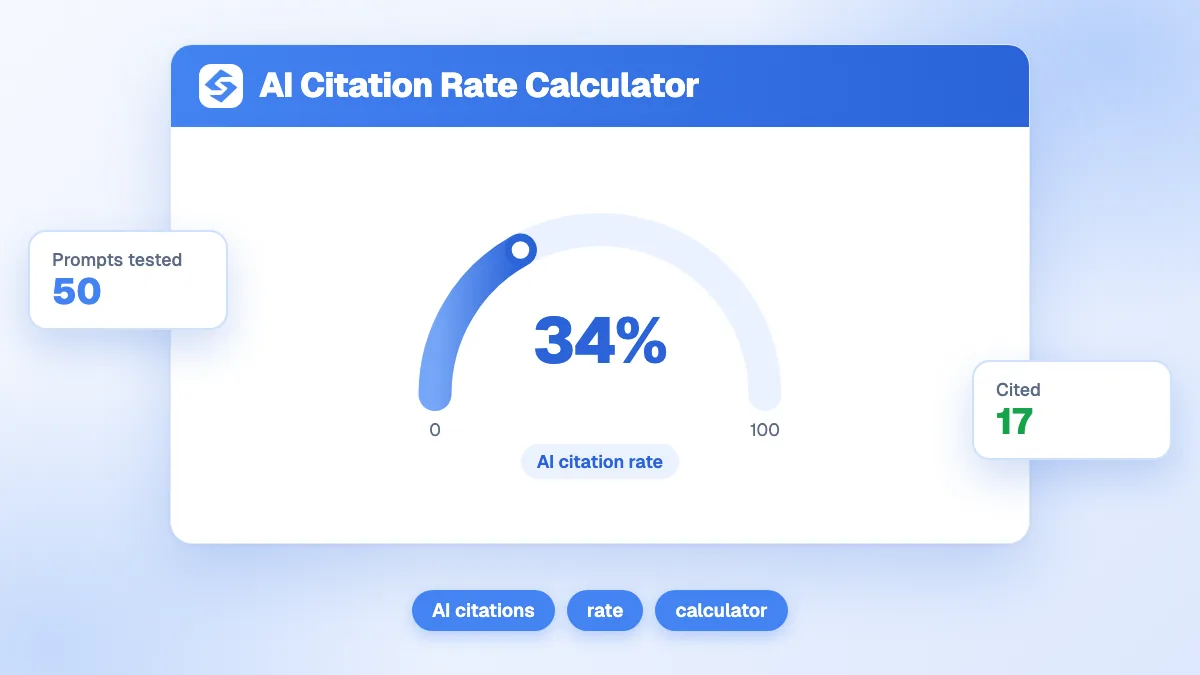
- Citation rate. Measure it on the same panel of questions before and after publishing. The AI citation rate calculator turns a test panel into a rate.
- Value per visit. Conversion rate × value of a conversion. The AI traffic value calculator helps you set it.

Which questions should you cover first?
The ones closest to a purchase. They cost the same to answer and bring more value per visit.
| Stage | Example question | Priority |
|---|---|---|
| Decision | "Is [your product] worth the price for a team of five?" | First |
| Comparison | "Best accounting software for freelancers" | First |
| Solution | "How to automate invoicing for a small business" | Second |
| Discovery | "What is double-entry bookkeeping?" | Later |
Group close questions on one page when they share the same answer. Two pages that answer the same question compete with each other and double the cost for one citation.
What makes a GEO page worth its cost?
A page gets cited when it contains the passage the AI needs. The GEO study published at KDD 2024 found that adding citations of reliable sources, quotations and statistics raised visibility in AI answers by 30 to 40% in relative terms, while keyword stuffing did not perform well (Aggarwal et al., GEO: Generative Engine Optimization). Google's own quality questions point the same way: does the content "provide original information, reporting, research, or analysis"? (Google, creating helpful content).
- The answer in the first lines, in two to four sentences.
- One question per section, with a heading that states it.
- Figures with their source, and a table when options can be compared.
- A clear author and an update date.
What are the limits of the calculator?
- No click-through in the formula. Enter expected visits, as explained above, or the result will be far too optimistic.
- Citation is not immediate. Pages need to be crawled, found and trusted. Plan for several months before the rate stabilizes.
- Value is counted from the first month. The payback assumes the citations start right away; add the ramp-up time to the result.
- Answers vary. A citation rate is an average over time, not a fixed position.
- Indirect value is ignored. A brand named without a click can still win the sale later.
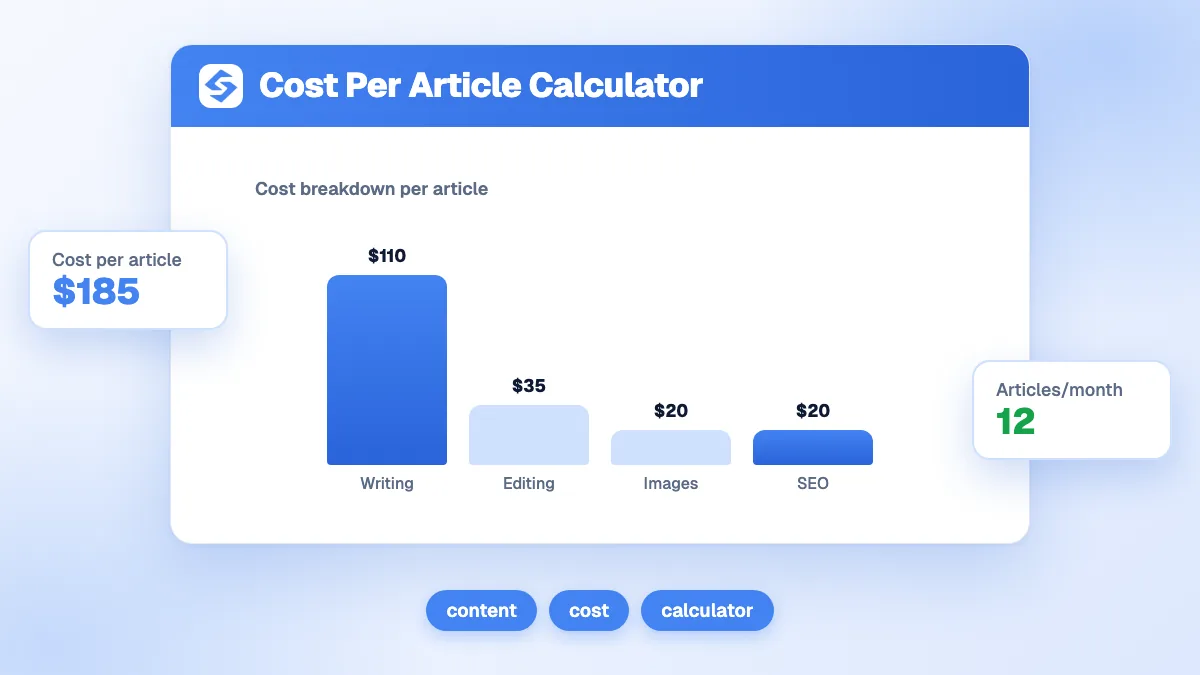
For a full return on investment including your monthly costs, use the GEO ROI calculator; for production costs in detail, the cost per article calculator.
From budget to published pages
A GEO content budget pays back when each page answers a real buyer question well enough to be cited. Size it here with realistic visits, then lower the cost per page and raise the citation rate. The Sorank query fan-out tracker records the questions AI assistants really search, the blog article generator writes and publishes sourced, answer-first pages, and AI mention tracking measures your citation rate every week. See the Sorank plans to produce that content on autopilot.