




Summary
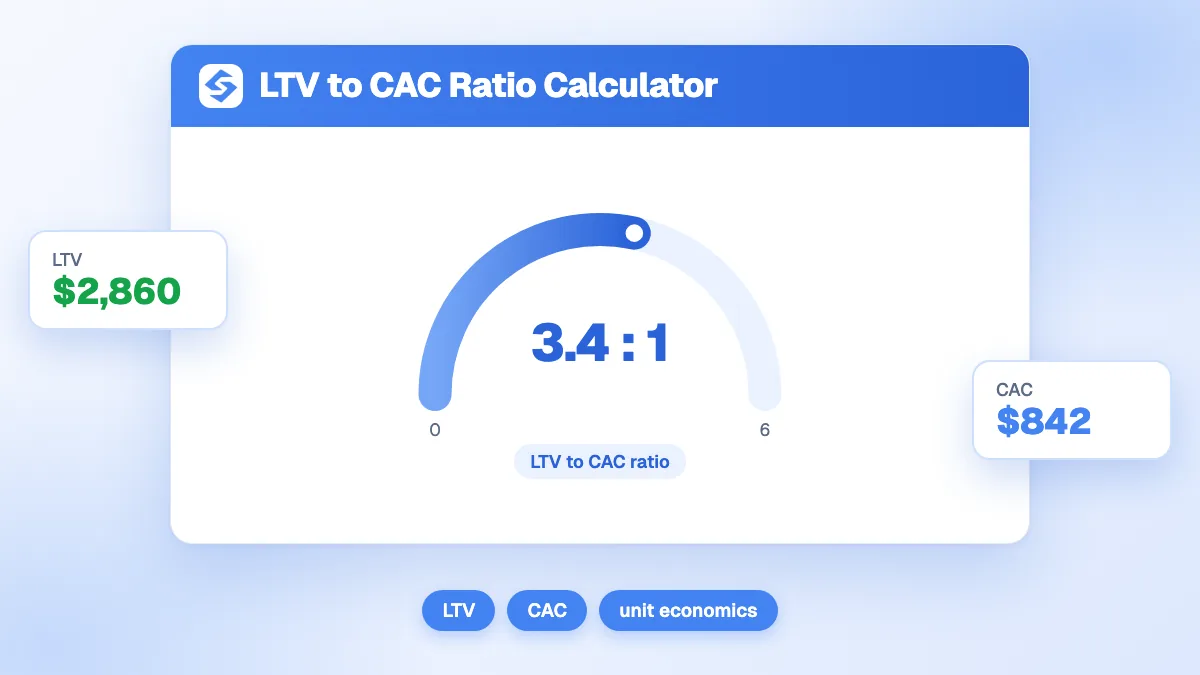
The LTV to CAC ratio divides what a customer brings over their lifetime by what it cost to acquire them. The calculator gives that ratio, the lifetime value after gross margin, the payback period in months and the highest acquisition cost that keeps a 3x ratio. With an LTV of 1,200, a CAC of 300 and a 75% margin, the ratio is 4.0, healthy, and the CAC is recovered in 4 months.
Want to go further? Ask


The LTV to CAC ratio calculator checks the one question every growth plan depends on: does a new customer pay back what you spent to win them, and by how much? Investors use it to judge whether a company can grow by spending more on acquisition. Venture capitalist David Skok observed that the best SaaS businesses have "a LTV to CAC ratio that is higher than 3, sometimes as high as 7 or 8" (For Entrepreneurs, SaaS Metrics 2.0). The ratio is not reserved for software: any business that pays to acquire customers can use it.

How does the LTV to CAC calculator work?
Enter three values and choose your currency (dollar, euro or pound). The results update as you type.
- Lifetime value: the revenue an average customer brings over the whole relationship (default 1,200).
- Acquisition cost: what you spend on average to win one new customer (default 300).
- Gross margin: the share of revenue left after the direct cost of serving the customer (default 75%).
The calculator returns four figures, with a colored verdict on the ratio. It is free, has no limit and runs in your browser. If you do not know your LTV or CAC yet, start with the customer lifetime value calculator and the customer acquisition cost calculator.
What formulas does the calculator use?
| Result | Formula | Default example |
|---|---|---|
| LTV to CAC ratio | Lifetime value ÷ acquisition cost | 1,200 ÷ 300 = 4.0 |
| Lifetime value after margin | Lifetime value × gross margin | 1,200 × 75% = 900 |
| Payback period | CAC ÷ (LTV after margin ÷ 12) | 300 ÷ 75 = 4.0 months |
| Acquisition ceiling at 3x | Lifetime value ÷ 3 | 400 |
Two points to read carefully. The ratio uses the lifetime value as you enter it: if you enter revenue, the ratio is revenue-based; the margin-based ratio here would be 900 ÷ 300 = 3.0. And the payback spreads the margin-adjusted LTV over 12 months, so it is exact only when your LTV covers about one year of customer life (see below).
What is a good LTV to CAC ratio?
The calculator colors the ratio in four bands.
| Ratio | Verdict | What it means |
|---|---|---|
| Below 1 | Losing money | Each new customer costs more than they will ever bring in |
| 1 to under 3 | Below par | Growth is fragile: margin and overheads eat what is left |
| 3 to under 5 | Healthy | Acquisition pays back with room for the rest of the business |
| 5 and above | Watch this | Often a sign of under-investment: you could spend more to grow faster |
The 3x benchmark comes from SaaS investors, and it assumes a margin-based LTV. Use the stricter version when you present the number: a revenue-based ratio of 4 can hide a margin-based ratio of 3 or less.
How long should it take to recover CAC?
As short as possible, because cash spent on acquisition comes back only month after month. Skok's original guideline was to recover CAC in less than 12 months, and enterprise companies with a land-and-expand model can work with about 20 months (For Entrepreneurs, SaaS Metrics 2.0 definitions). He also notes that many of the best SaaS businesses recover their CAC in 5 to 7 months.
Check how the calculator's payback fits your case. It divides the LTV after margin by 12, as if a customer's whole value arrived within one year. If your customers stay three years, compute the monthly margin yourself: 900 ÷ 36 months = 25 per month, so a CAC of 300 takes 12 months to recover, not 4. Same ratio, very different cash needs.
| Customer lifetime | Monthly margin per customer | Months to recover a CAC of 300 |
|---|---|---|
| 12 months | 75 | 4 |
| 24 months | 37.5 | 8 |
| 36 months | 25 | 12 |
How do you calculate LTV and CAC correctly?
Most wrong ratios come from the inputs. Two definitions from investors help keep them honest.
- LTV is profit, not revenue. Andreessen Horowitz defines lifetime value as "the present value of the future net profit from the customer" and lists using revenue or gross margin instead as a common mistake (a16z, 16 startup metrics). At minimum, apply your gross margin, which is what the second line of the calculator does.
- CAC includes every acquisition cost. Ads, sales salaries, tools, agencies, referral fees, discounts and free credits, divided by the new customers of the same period.
- Blended or paid CAC? The same source warns that a blended CAC, which includes customers who came for free, hides whether paid campaigns are profitable. Calculate both: blended for the business, paid for the ad budget.
- Use the same period and segment. A CAC from last quarter's campaign does not match an LTV averaged over five years of customers.

How do you improve your LTV to CAC ratio?
Raise the top, lower the bottom, or both.
| Lever | Acts on | Example |
|---|---|---|
| Retention | LTV | Onboarding, support and product updates that keep customers longer |
| Price and upsell | LTV | Annual plans, higher tiers, add-ons |
| Conversion rate | CAC | Better landing pages: the same spend wins more customers |
| Organic acquisition | CAC | SEO and AI visibility bring customers without a cost per click |
Retention deserves attention first. Harvard Business Review notes that, depending on the study and the industry, acquiring a new customer is "anywhere from five to 25 times more expensive than retaining an existing one", and cites Bain research showing that a 5% increase in retention raises profits by 25% to 95% (Harvard Business Review, 2014).
How does SEO change the ratio?
SEO lowers the blended CAC because each new article keeps bringing visitors without paying per click. The cost is real, but it is spread over months and years instead of being spent again every day. A page that ranks for a buying query can acquire customers for a fraction of a paid campaign's CAC.
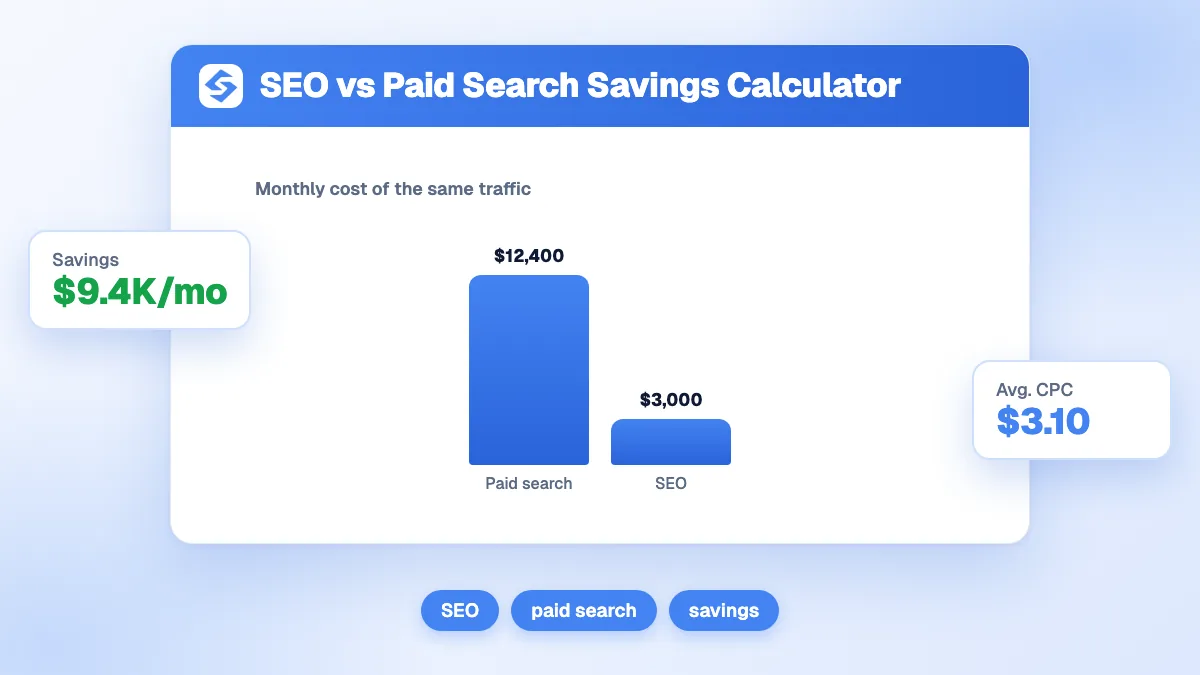
Measure it rather than assume it: compare the CAC of your organic customers with your paid CAC, and the payback of each channel. The SEO ROI calculator and the SEO vs paid savings calculator give you both sides; for subscription businesses, the SaaS SEO ROI calculator works with recurring revenue.
What are the limits of the calculator?
- The ratio follows your LTV input. Enter a margin-based LTV if you want the investor definition.
- The payback assumes a one-year LTV. Recalculate it from your monthly margin when customers stay longer.
- No discount rate. Money earned in year three is worth less than money today; long lifetimes overstate LTV.
- Averages hide segments. Calculate the ratio per channel and per customer type to see where to invest.
Lower your CAC with organic growth
A healthy business wins customers for less than a third of what they bring, and recovers that cost within a year. Organic acquisition is the lever that improves the ratio over time. The Sorank blog article generator publishes the pages that bring buyers from Google and AI assistants, keyword research picks the queries that lead to sales, and the GEO and SEO dashboard tracks the traffic they bring. See the Sorank plans to grow organic acquisition on autopilot.