




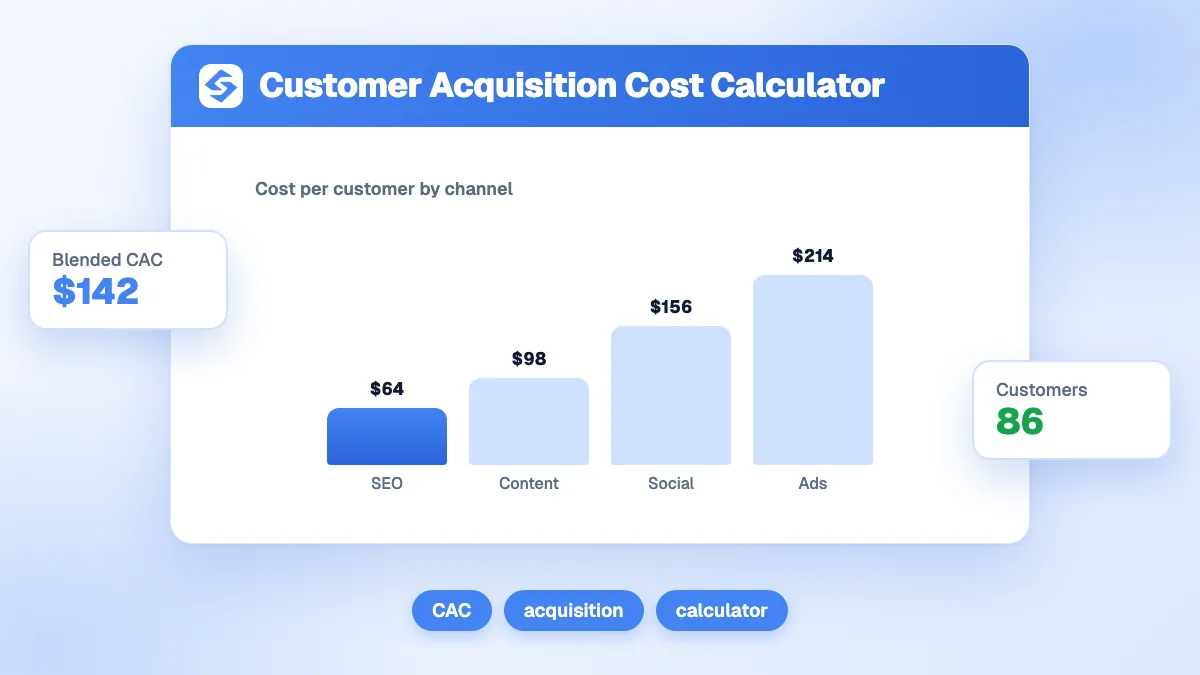
Summary
Customer acquisition cost (CAC) is what you spend to win one new customer: (marketing spend + sales spend) ÷ new customers over the same period. With 8,000 in marketing, 4,000 in sales and 40 new customers, CAC is 300. The calculator also shows the total spend, the share of the first order that acquisition eats (33% on a 900 order) and what is left after acquisition (600). Calculate it per channel and compare it with customer lifetime value.
Want to go further? Ask


The customer acquisition cost calculator answers the question every growth plan depends on: how much does a new customer really cost? Getting it right matters because winning customers is usually the expensive part of the business. Depending on the study and the industry, acquiring a new customer is anywhere from five to 25 times more expensive than retaining an existing one (Harvard Business Review, 2014). A CAC you understand tells you which channels to grow and which to cut.

How is customer acquisition cost calculated?
Add everything you spent to win customers in a period, then divide by the number of new customers won in that same period. The calculator splits the spend in two so that sales costs are never forgotten.
| Result | Formula | Example (marketing 8,000, sales 4,000, 40 customers, first order 900) |
|---|---|---|
| Cost per customer (CAC) | (Marketing + sales) ÷ new customers | 300 |
| Total spend | Marketing + sales | 12,000 |
| Share of first order | CAC ÷ average first order × 100 | 33.3% |
| Left after acquisition | Average first order − CAC | 600 |
The currency can be switched to dollars, euros or pounds; the formulas stay the same. If you sell subscriptions, enter the first payment or the first year of revenue as the first order, so the last two results stay meaningful.
What should you include in acquisition spend?
Every cost you would not have paid if you had stopped looking for new customers. A CAC that counts only ad spend looks good on a slide and cannot be used for any decision.
| Include | Exclude |
|---|---|
| Advertising: search, social, display, sponsorships | Customer support and success |
| Content and SEO: writers, tools, agency fees | Upsell and renewal campaigns aimed at existing customers |
| Salaries and commissions of marketing and sales staff, pro rata of their time on new business | Product development |
| Sales and marketing software: CRM, email, analytics | Fulfilment and delivery costs (they belong in gross margin) |
| Events, trade shows, free trials and samples | One-off brand projects with no acquisition goal, if you track them separately |
Use the same window for spend and customers. One month works for short sales cycles; for B2B deals that take a quarter to close, use a quarter, or compare spend with the customers won one cycle later.
What is a good customer acquisition cost?
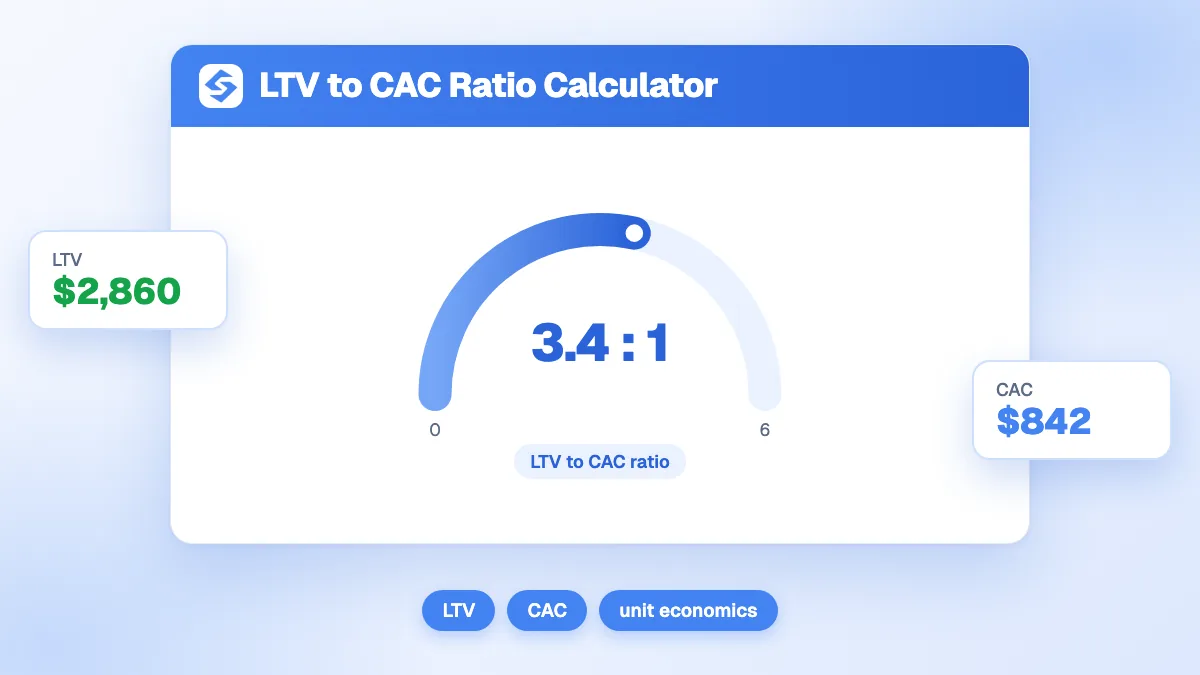
There is no universal figure: a good CAC is one your customers pay back. Two guidelines are widely used for recurring revenue businesses. David Skok, a venture capitalist who formalised them, notes that the best SaaS businesses have a ratio of lifetime value to CAC higher than 3 and that profitability is anemic when the time to recover CAC goes beyond 12 months (For Entrepreneurs, SaaS Metrics 2.0).
- Compare CAC with lifetime value. If a customer brings 1,200 of gross margin over their life and costs 300 to acquire, the ratio is 4. Check yours with the LTV to CAC ratio calculator, and estimate the lifetime value with the customer lifetime value calculator.
- Compare CAC with the first order. When acquisition eats more than a third of the first order, the model only works if customers come back. The share of first order in the calculator flags it.
- Compare CAC across channels. The blended figure hides the channel that quietly pays for the others.
What does a customer cost by industry?
Paid search gives a useful floor. LocaliQ measured an average cost per lead of $66.69 for search advertising in 2026, from about $27 to more than $130 depending on the industry (LocaliQ search advertising benchmarks). A lead is not a customer: divide the cost per lead by your close rate. The last column assumes one lead in five becomes a customer, for illustration only.
| Industry | Average cost per lead (2026) | Ad cost per customer at a 20% close rate |
|---|---|---|
| Attorneys and legal services | $131.63 | $658 |
| Furniture | $106.70 | $534 |
| Real estate | $102.51 | $513 |
| Business services | $93.69 | $468 |
| Home and home improvement | $90.92 | $455 |
| Dentists and dental services | $72.97 | $365 |
| All industries (average) | $66.69 | $333 |
| Restaurants and food | $30.57 | $153 |
| Arts and entertainment | $26.84 | $134 |
These figures cover only the ad cost of a lead. Add sales time, tools and the leads that never close, and the real CAC is higher. Measure your own close rate with the conversion rate calculator before you compare.

How do you calculate CAC per channel?
- Split the spend by channel: paid search, paid social, SEO and content, partnerships, outbound sales. Shared costs, such as a CRM, can be split in proportion to the customers each channel brings.
- Attribute each new customer to a channel. Google Analytics offers data-driven attribution and last click models, which assign the credit for a conversion to the touchpoints along the path (Google Analytics Help, attribution). Pick one model and keep it.
- Run the calculator once per channel, then once for the whole business, and compare.
Expect large gaps. Paid channels show a stable CAC that rises with competition. SEO and content look expensive in the first months, then their CAC falls as the same pages keep bringing customers without new spend. To compare the two over time, use the SEO vs paid savings calculator, and to check the return of your content, the SEO ROI calculator.
Which mistakes distort CAC?
- Counting ad spend only. Salaries and tools are often half of the real cost.
- Mixing new and returning customers. Only first purchases belong in the denominator.
- Mismatched periods. January spend divided by January customers misleads when deals close in March.
- Ignoring free and organic customers. Including them in a blended CAC is fine, as long as you also calculate the paid CAC on its own.
- Looking at one month. Track a rolling three-month average to smooth seasonality.
How do you lower your customer acquisition cost?
Raise conversion before you raise spend. Doubling the close rate halves the CAC without a single extra click, while doubling the budget usually raises the cost of each customer as you reach less qualified audiences.
- Improve the pages that convert: clear offer, proof, and a short form.
- Build channels that compound. Organic search keeps bringing customers after the content is paid for. The Sorank keyword research finds the buying-intent queries you can rank for, and the blog article generator publishes sourced articles on them.
- Measure where customers come from, including AI assistants: the GEO and SEO dashboard follows Google and AI traffic in one view.
For ideas on which channels to test next, read our list of the 50 best customer acquisition channels.
Your CAC is total acquisition spend divided by new customers, and it only means something next to what those customers are worth. Run the calculator for each channel, then see the Sorank plans to grow the organic channel that lowers it month after month.