Summary
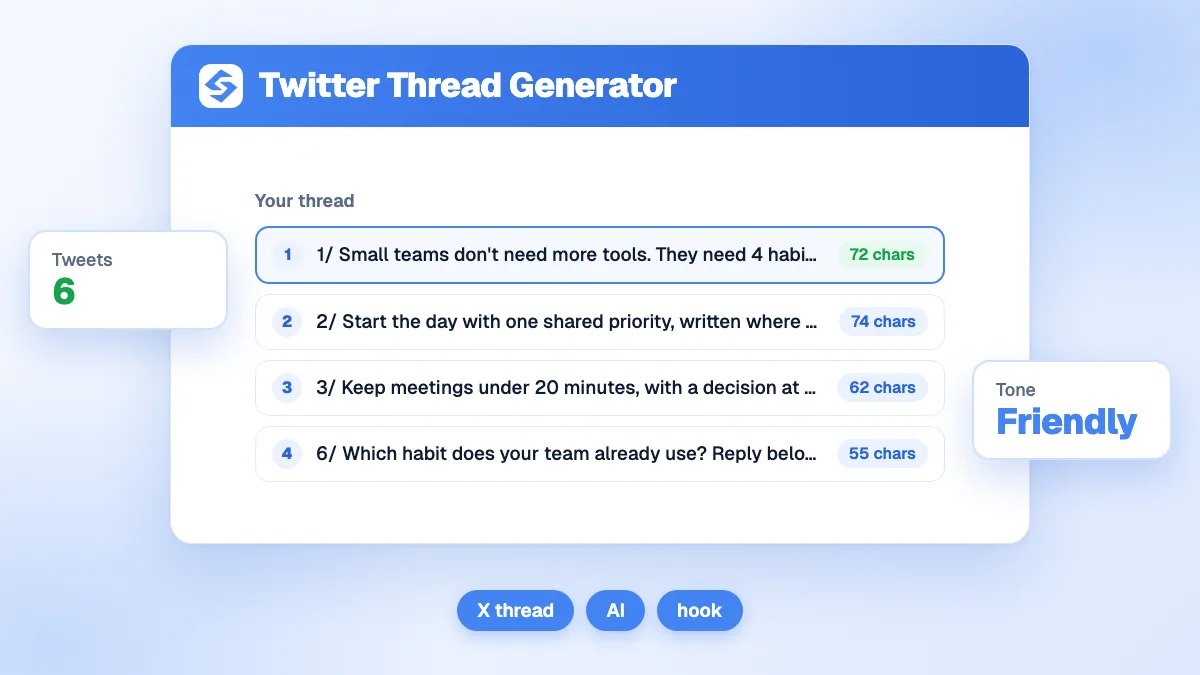
This Twitter thread generator writes a full X thread of 6 tweets from a short topic. You get a hook, four tweets with one idea each and a closing tweet that invites replies. Pick a tone, add a keyword if you want, then copy one tweet or the whole thread and post it from your own X account.
Want to go further? Ask


What does the Twitter thread generator do?
It turns one topic into a thread you can post on X in a few minutes. You describe what the thread is about, and the AI returns 6 tweets in order: an opening hook, four tweets that each carry one idea, and a last tweet that ends the thread and asks readers to reply.
On X, a thread is a chain of posts where each new post is a reply to the previous one. The X developer documentation describes this with the in_reply_to_tweet_id field, "the ID of the tweet being replied to" (X API documentation, create a post). The generator writes the text of that chain. It does not connect to your account and it does not post anything for you.
- Input: a topic of 3 to 300 characters, an optional target keyword and a tone.
- Tones: clear and professional, persuasive, friendly or expert.
- Output: 6 tweets in a numbered list, each with its own Copy button, plus a Copy all button.
- Cost: free, with a daily number of generations. The counter under the form shows how many you have left.
How do you write a thread with the generator?
- Describe the topic in a few words or one sentence. A precise angle works better than a broad theme: "five habits that make a small team more productive" gives sharper tweets than "productivity".
- Add a target keyword if you want a word or phrase to appear in the thread, such as a product category people search for on X. Leave it empty otherwise.
- Choose the tone that matches your account. Expert suits a technical audience; friendly suits a personal or community account.
- Complete the anti-bot check, then click Write my thread. The AI takes about ten seconds.
- Read the 6 tweets, edit what does not sound like you, then copy them one by one into the X composer, each as a new post of the thread.
The thread is written in the language of the page you use. If the result misses the point, change the angle of the topic rather than the tone: the topic drives the content, the tone drives the wording.
How do you read the result?
Each of the 6 tweets has a job. Check that each one does its job before you post, because the AI writes plausible text, not text that knows your audience.
| Tweet | Its job | What to check |
|---|---|---|
| 1 | The hook: makes people stop scrolling and open the thread | It promises something concrete and the rest of the thread delivers it |
| 2 to 5 | One idea per tweet | Each tweet makes sense on its own and adds something new |
| 6 | The closing tweet: sums up and invites replies | The question is easy to answer and fits your audience |
A warning under the result reminds you that the text is written by an AI. Check every fact, figure and name before publishing, and add your own example where a tweet stays generic.
How many characters fit in each tweet?
A post on X holds up to 280 characters, but not every character counts the same. The generator does not count characters for you, so check long tweets in the X composer, which shows the counter as you type.
| What you type | How X counts it |
|---|---|
| Latin letters, digits, punctuation | 1 character each |
| Any link | 23 characters, whatever its real length |
| Emoji | 2 characters each |
| Chinese, Japanese or Korean characters | 2 characters each, so 140 per post |
These rules come from the X developer guide on counting characters. In practice, a link and two emojis already use 27 of the 280 characters, so keep the link for the last tweet when you can.
What do good topics look like?
The best topics name an audience, a promise and a number or a constraint. Here are three examples and what to expect.
- "Four habits that make a small team more productive", friendly tone: a hook that promises the four habits, one habit in each of tweets 2 to 5, and a closing question asking readers which habit they already use.
- "Why most product launches get no traffic in the first week", expert tone, keyword "product launch": a hook built on the problem, four causes, and a closing tweet asking readers about their last launch.
- "What we learned after rewriting our pricing page", persuasive tone: a story thread with one lesson per tweet. Replace the generic lessons with your real numbers before posting.
If you only need a single post, the tweet generator is faster. If the first tweet is the weak point, test openings with the hook generator and paste the best one as tweet 1.
Which mistakes make a thread fall flat?
- A topic that is too broad: "marketing" gives generic tweets. Name who the thread is for and what they will get.
- Posting the text as is: the AI cannot know your results, your clients or your voice. One real detail per tweet makes the difference.
- A hook the thread does not keep: if tweet 1 promises five tips, the thread must give five tips.
- Links in every tweet: each link costs 23 characters and pulls readers away. Put your link in the last tweet and tag it with the UTM link builder so you can see the visits it brings in Google Analytics.
- Posting tweets as separate posts: add each tweet as a reply in the same chain, otherwise readers see six unrelated posts instead of one thread.
For the wider picture on profile, posting rhythm and measurement, read the guide to Twitter marketing.
What are the limits of the tool?
- Fixed format: you always get 6 tweets. For a longer thread, run the tool again with a second angle and merge the best tweets.
- No character check: the tool does not count characters or cut tweets to 280. Check long tweets in the composer.
- No posting, no scheduling: you copy the tweets and post them yourself from X or your social media tool.
- No images: the thread is text only. Add visuals yourself if your topic needs them.
- No facts from your business: the AI writes from your topic only. Figures, client names and results must come from you.
- Daily limit: the free generations reset each day. When the quota is used up, the tool tells you to come back tomorrow.
Engagement on X can matter for visibility beyond the network itself. The glossary entry on social signals explains what social activity does and does not do for SEO.
When should you move from threads to Sorank?
Use the generator when you need one thread now; use Sorank when you want the content behind your threads published every week. A good thread often comes from a good article: you write the long version once, then turn it into a thread, a newsletter and posts, as the guide to content repurposing shows. Sorank writes and publishes those articles on your site on autopilot, with the brand voice feature keeping your tone and words, so every thread you share points to a page that can rank on Google and be cited by AI assistants.