Summary
The real cost of an article is the writing fee plus the visuals, the editing time valued at your hourly rate, and a share of your monthly tools. The calculator adds them up for the month and divides by the number of articles. With 8 articles at 150 each, one hour of editing at 50 an hour, 25 of visuals and 200 of tools, each article costs 250, or 24,000 a year. Compare that figure with what one ranking article brings in.
Want to go further? Ask


A cost per article calculator shows what your content really costs, not just what the writer invoices. The writing fee is the visible part; editing, images and software are the part most budgets forget. Writing a post is not a quick job either: bloggers report spending 3 hours and 20 minutes on an average article of 1,312 words (Orbit Media, 2026 blogging statistics). Price every hour, and you can decide what to produce, outsource or automate.

How is the cost per article calculated?
The calculator builds your monthly content bill in four lines, then divides it by the number of articles.
| Line | Formula | Example (default values) |
|---|---|---|
| Writing | Articles × writing cost | 8 × 150 = 1,200 |
| Cost of editing | Articles × editing hours × hourly rate | 8 × 1 × 50 = 400 |
| Visuals | Articles × visuals cost per article | 8 × 25 = 200 |
| Tools | Monthly tools, spread across the articles | 200 |
| Monthly total | Sum of the four lines | 2,000 |
| Cost per article | Monthly total ÷ articles | 250 |
| Annual total | Monthly total × 12 | 24,000 |
| Articles per year | Articles × 12 | 96 |
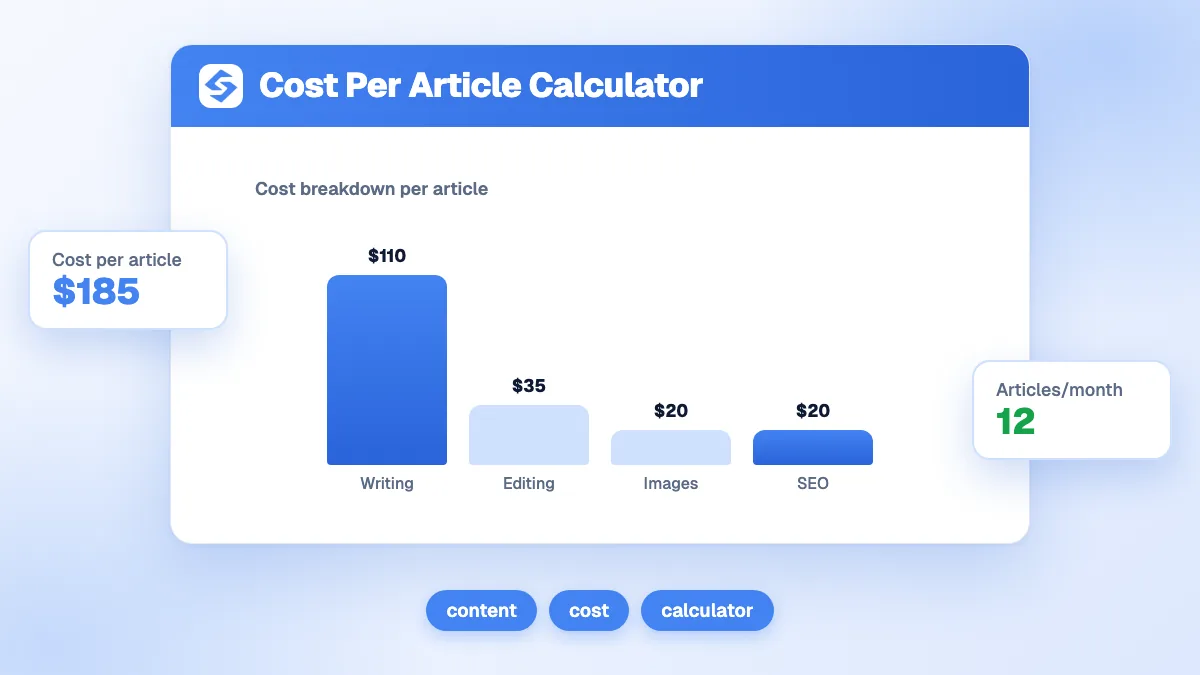
A chart splits the monthly bill by line, so you see at once which cost to work on. Choose your currency in the tool; the formulas do not change.
What should you include in each input?
Enter what you really pay, all in. An underestimated input gives a flattering cost that will not survive the first budget review.
- Writing cost: the freelance or agency fee per article, including platform fees and non-recoverable taxes. For in-house writing, multiply the writing time by the loaded hourly cost of the writer.
- Editing hours per article: proofreading, fact-checking, SEO optimisation, formatting in the CMS and internal links. Count the time of everyone who touches the article.
- Hourly rate: the cost of an hour of the person who edits, salary and charges included, or their freelance rate.
- Visuals cost per article: stock photos, illustrations, charts, or the design time to make them.
- Monthly tools: keyword research, writing assistants, image tools and plagiarism checkers, for the share used for content.
How much does an article cost in different setups?
The same calculator compares very different production models. The inputs below are illustrations to adapt with your own rates.
| Setup | Inputs | Cost per article | Monthly total |
|---|---|---|---|
| Generalist freelancer | 8 articles, 150 writing, 1 h editing at 50, 25 visuals, 200 tools | 250 | 2,000 |
| In-house writer | 8 articles, 167 writing (3 h 20 at 50), 0.5 h editing at 50, 25 visuals, 200 tools | 242 | 1,936 |
| Specialist expert writer | 4 articles, 400 writing, 1.5 h editing at 60, 40 visuals, 200 tools | 580 | 2,320 |
| AI draft, human editing | 20 articles, 15 writing, 1.5 h editing at 50, 10 visuals, 300 tools | 115 | 2,300 |
Two lessons stand out. Similar monthly budgets can buy 4 articles or 20. And in the AI-assisted setup, editing becomes the main cost: that is where the quality is decided.
Why is editing the cost people leave out?
Because it is spread across several people and never appears on an invoice. Yet an article bought cheaply and rewritten in-house is not a cheap article. In the default example, editing represents 400 of the 2,000 monthly total, a fifth of the budget.
Editing is also what keeps AI-assisted content on the right side of Google's guidelines. Google says appropriate use of AI is not against its guidelines, but generating content with the primary purpose of manipulating rankings is spam (Google Search Central, AI-generated content). Its quality guidance adds that using generative AI to produce large amounts of text "without manual oversight or curation represents little to no effort" (Google, creating helpful content). Budget the human review; it is part of the product.

How do you know if an article is worth its cost?
Compare the cost per article with what one article brings in once it ranks. Below that value, publishing more is worth it; above it, put the money into fewer, better pieces.
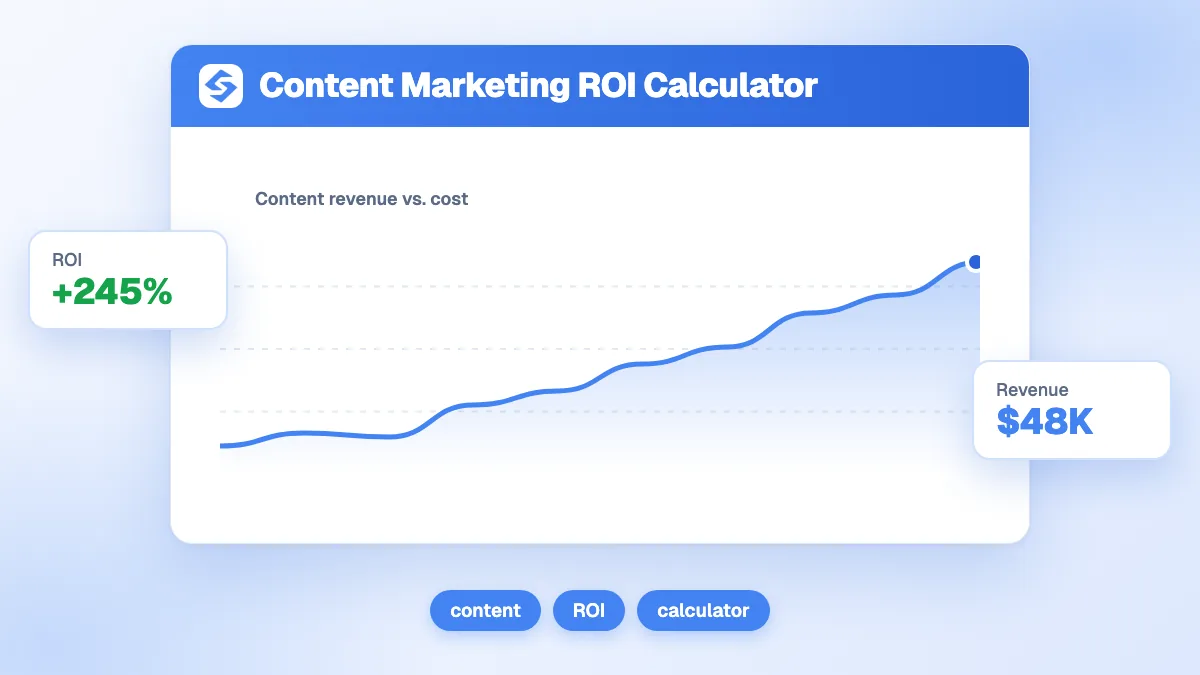
A simple test uses traffic value. An article that brings 300 visits a month on keywords that cost 1.90 per click in ads is worth 570 a month in equivalent ad spend. At 250, it pays for itself in less than a month of traffic, once it ranks. Calculate your own figure with the organic traffic value calculator, and the full return with the content marketing ROI calculator.
Quality has a price for a reason. In the same Orbit Media survey, only 13.9% of bloggers say their blog delivers strong results, an all-time low, while 92.4% now use AI for blogging. Producing more is easy; producing articles that rank and convert is what the budget should buy.
How do you lower the cost per article without losing quality?
Cut the costs that do not make the article better, and keep those that do.
- Prepare a brief before writing. A clear outline cuts rewriting time; the AI blog outline generator builds one in seconds.
- Spread fixed costs over more articles. Tools are a fixed monthly cost: 200 of tools add 25 per article at 8 articles, and 50 at 4.
- Set the right length. Longer is not always better; our guide on how long an article should be helps you match the length to the query.
- Refresh before you rewrite. Updating an article that is losing traffic costs less than writing a new one; see content decay.
- Automate the repetitive steps: research, formatting, images and publishing.
In-house writer, freelancer or automation?
Use the calculator three times, once per option, with the same number of articles. Then compare more than the cost.
| Option | Strength | Watch out for |
|---|---|---|
| In-house writer | Knows the product and the customers; fast feedback | Fixed cost even in slow months; limited capacity |
| Freelancer or agency | Flexible volume; specialised expertise on demand | Briefing and editing time; uneven quality between writers |
| Automation with human review | Lowest cost per article; consistent publishing rhythm | Review time is essential; facts and examples need checking |
Many teams mix them: automation for the volume of informational articles, experts for the pages that sell.
What does the calculator not include?
It measures production cost, not everything around it. Add these separately if they apply to you.
- Strategy and keyword research time, unless you count it in editing hours.
- Promotion: newsletters, social media, link building.
- Updates over the life of the article, which add cost after publication.
- Expert interviews or original data, which raise the cost of some articles and often their value too.
To plan the whole budget, use the SEO budget calculator.
How do you produce more articles at a lower cost?
Automate the production and keep human time for review and expertise. The Sorank blog article generator writes sourced, illustrated articles and publishes them on your site, and the blog content planner fills your editorial calendar with topics that do not overlap. Your cost per article then comes down mainly to the editing time you choose to give each piece.
The true cost of an article is writing plus editing plus visuals plus tools, divided by what you publish. Calculate yours with the tool above, then see the Sorank plans to publish quality articles on autopilot.