Summary
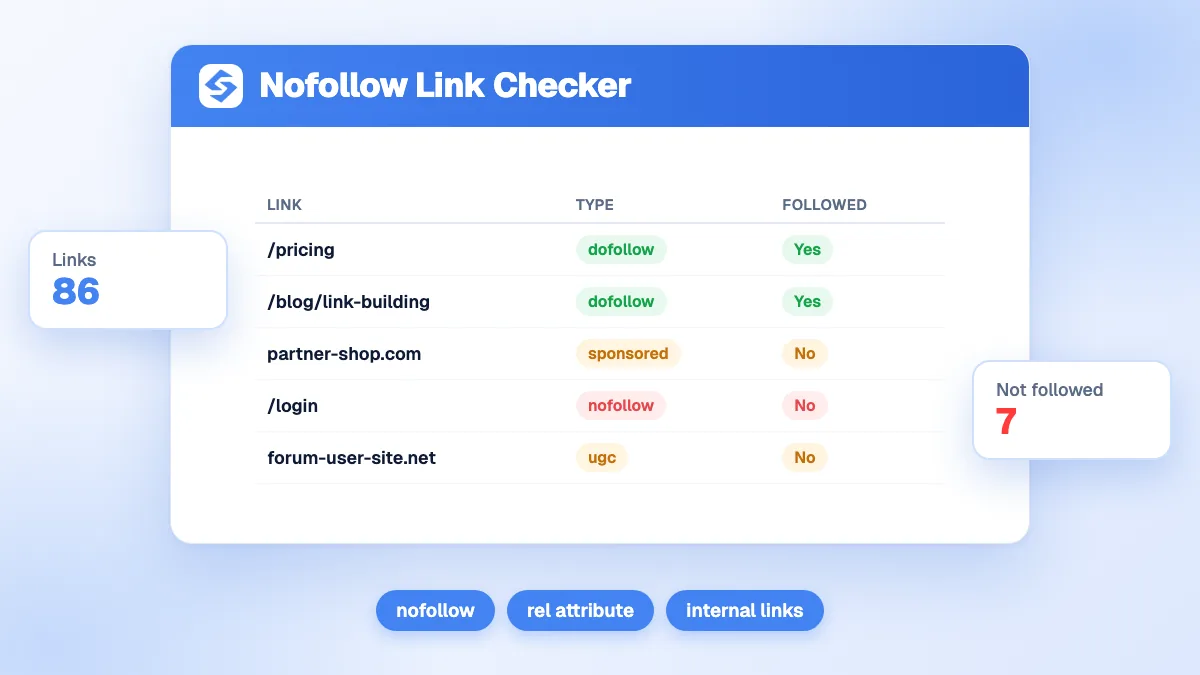
The nofollow link checker lists every link in the HTML of a page and shows which ones Google is asked not to follow. Paste a URL and you get each link's rel value (dofollow, nofollow, sponsored or ugc), whether it points inside or outside the site, how often it appears, and a warning if a nofollow covers the whole page.
Want to go further? Ask


A nofollow link checker answers one question: which links on this page pass on value, and which ones do not? The answer sits in the rel attribute of each link, and sometimes in a robots rule that applies to the whole page. Google added the sponsored and ugc values in 2019 and now treats all three as hints rather than strict orders (Google Search Central blog, Evolving nofollow). The glossary entry on what a nofollow link is covers the background. This page shows you how to audit one URL in a minute.
What does the nofollow link checker do?
It reads the page the way a robot receives it and sorts every link it finds. For each link you get:
- The type: dofollow (no restriction), nofollow, sponsored or ugc.
- Followed by Google: yes or no, based on the link's rel value and on any page-wide nofollow.
- The position: internal (same site) or external.
- The occurrences: how many times the same link appears on the page.
- The anchor text, shown under each link.
The checker also looks for a nofollow set on the whole page, either in the meta robots tag or in the X-Robots-Tag HTTP header. Google describes that rule as "Do not follow the links on this page" (Google Search Central, robots meta tag). When the checker finds it, every link on the page is marked as not followed, whatever its own rel value says.
How do you check a page for nofollow links?
- Paste the full address of the page, starting with https://.
- Complete the anti-bot check, then click "List the links".
- Read the verdict at the top, then the four counters: links, followed, not followed and external.
- Use the filters to show only dofollow, nofollow, sponsored, ugc, internal or external links. Each filter shows how many links it holds.
- Sort the table by any column. By default, the links that appear most often come first. Click "Show all" when the page has more than 50 links.
- Download the CSV to keep the list. It contains the link, anchor text, type, followed status, position, occurrences and the raw rel attribute of the links in the current filter.
A counter under the search bar shows how many free checks you have left today.
How do you read the result?
The verdict comes in four forms:
- "The links are followed normally": no internal link carries a restriction and no page-wide nofollow was found. External links may still carry nofollow or sponsored values; that is often intended.
- "Some internal links are not followed": links between your own pages carry nofollow, sponsored or ugc. Filter on Internal, then check each one is there on purpose.
- "This page stops its links from passing on value": a nofollow sits in the meta robots tag or the X-Robots-Tag header. The finding names the source. The robots meta tag glossary entry explains every value of that tag.
- "No link found": the HTML sent by the server holds no link. The page may build its links with JavaScript.
The "Followed by Google" column reflects what the code asks for. Google still decides: links with these values "will generally not be followed", and the linked page can be found another way, for example through a sitemap (Google Search Central, qualify your outbound links).
Which rel value should each link carry?
Google asks you to qualify outbound links by their nature. Pick the value that matches why the link exists.
| rel value | What it tells Google | Use it for | Example in the code |
|---|---|---|---|
| none (dofollow) | A normal link, no restriction | Sources you cite, your own pages, partners you vouch for | <a href="https://example.com"> |
| sponsored | The link is paid or advertising | Ads, paid placements, affiliate links | rel="sponsored" |
| ugc | The link was added by users | Comments, forum posts, reviews | rel="ugc" |
| nofollow | Do not associate the site with this page | Cases the two values above do not cover | rel="nofollow" |
| meta robots nofollow | Follow none of the links of this page | Rarely useful on a public page | <meta name="robots" content="nofollow"> |
You can combine values, such as rel="ugc nofollow"; Google accepts a list separated by spaces or commas. Existing nofollow links do not need to be rewritten: Google says there is "absolutely no need to change" them.
What do real checks look like?
- A blog post with a comment section: the article links are dofollow, the links left in comments are ugc. The verdict is "followed normally", which is the expected result.
- A product review with affiliate links: the Sponsored filter should hold every link to the merchant. A merchant link shown as dofollow is one to fix.
- A category page after a theme update: the verdict turns to "Some internal links are not followed". Filter on Internal: if the menu or the pagination carries nofollow, your products receive less internal value.
- A staging setting left in production: the verdict says the whole page is blocked by the X-Robots-Tag header. Remove the header from the server settings, not from the page.
To go further on internal links, the internal link analyzer audits the internal links of a page. To see which sites link to you and with which attributes, use the free backlink checker.
What are the common nofollow mistakes?
- Nofollow on internal links: it does not save crawl budget and it cuts the flow of value between your pages. For pages you do not want crawled, Google recommends the robots.txt disallow rule instead. The internal linking strategy guide shows which pages should receive links.
- Nofollow used to keep a page out of Google: since 1 March 2020, nofollow is only a hint for crawling and indexing. Use noindex on a page Google is allowed to crawl.
- Paid links left dofollow: mark them sponsored. Google prefers sponsored over nofollow for ads and paid placements.
- Nofollow on every outbound link: linking normally to good sources is fine. Keep the restrictions for links you cannot vouch for.
- Checking only the rel attribute: a single meta robots tag cancels every link on the page. The checker flags it first for that reason.
When you look for links on other sites, the dofollow backlinks guide explains how to check that a link you earned is really followed.
What are the limits of this checker?
- Only the server HTML is read: links that a script adds after the page loads are not in the list. On a site built with JavaScript, the count can be lower than what you see in the browser.
- One page per check: it does not crawl the whole site. Run it on your templates (home, category, article, product) to cover most cases.
- Long pages are cut: when a page holds a very large number of links, only the first ones are listed, and the report says so.
- It reads the markup, not Google's decision: nofollow, sponsored and ugc are hints, so "not followed" means "asked not to be followed".
- It does not judge the linked pages: it does not test whether they answer, redirect or rank.
- The page must be reachable: a page that is offline, too slow or blocking robots returns an error.
- A daily quota applies to the free checks.
When should you move to Sorank?
Check your templates once, fix the internal nofollow, and keep the restrictions for paid and user links. Auditing one page is a quick job; growing the links that point to you is a long one. Sorank's natural backlink acquisition earns contextual links from sites in your niche, and the GEO and SEO dashboard follows your traffic from Google and AI assistants in one view. Sorank grows both on autopilot.