Preferences
Privacy is important to us, so you have the option of disabling certain types of storage that may not be necessary for the basic functioning of the website. Blocking categories may impact your experience on the website. More information

Privacy is important to us, so you have the option of disabling certain types of storage that may not be necessary for the basic functioning of the website. Blocking categories may impact your experience on the website. More information

Dofollow backlinks explained for 2026: what the term means, how they differ from nofollow, sponsored and UGC links, and how to check and earn them safely.

Tools

In short
a dofollow backlink is a link from another site to yours that carries no nofollow, sponsored or ugc value in its rel attribute, so Google can count it as a ranking signal. "Dofollow" is a nickname for the default state of a link: no such HTML attribute exists. The links worth earning are editorial ones from relevant sites; paid or traded links that pass ranking credit break Google's spam policies.
Want to go further? Ask
Quick quiz
How should you get links from other websites?
Sorank matches your answers


Test it for 3 days on your own site and see where you stand on Google, ChatGPT and the other AIs.
Start 3-day free trial3 days free, then stop whenever you want. 90-day results-or-refund guarantee.
Google says it uses links as a signal when it judges how relevant a page is and to find new pages to crawl. That is why dofollow backlinks remain the part of a backlink profile that site owners care about most. This guide explains what the term covers, how each rel value changes a link, how to check a link in under a minute, what a healthy mix looks like and the safe ways to earn followed links, with the methods compared in a table.
A dofollow backlink is a standard HTML link, written as <a href="https://example.com">, placed on another website and pointing to yours, with no rel value that asks search engines to hold back. Because nothing restricts it, Google can follow it, crawl the target page and pass part of the linking page's authority, the value that PageRank was built to measure.
The word itself is SEO jargon. Google's documentation on qualifying outbound links lists three rel values (sponsored, ugc and nofollow) and nothing else: a regular link needs no attribute at all. The HTTP Archive's Web Almanac 2024 still found rel="dofollow" on about 0.4% of pages, and notes that "dofollow" and "follow" are not real attributes and are ignored by search engines. Adding them changes nothing.
Note
Some tools call these links "followed" instead of "dofollow". Both words describe the same thing: a link without nofollow, sponsored or ugc.
Since 2019 Google offers three values to qualify a link, and they can be combined (for example rel="ugc nofollow"). The nofollow value dates back to 2005, when it was introduced to fight comment spam on blogs; sponsored and ugc were added to describe paid and user-generated links more precisely.
| Link type | HTML | When it is used | Ranking effect |
|---|---|---|---|
| Dofollow (followed) | <a href="..."> | Editorial links, citations, resource lists, partner pages | Can pass ranking credit |
| Nofollow | rel="nofollow" | Links the site does not want to vouch for | Treated as a hint, usually not counted |
| Sponsored | rel="sponsored" | Ads, paid placements, affiliate links | Treated as a hint, usually not counted |
| UGC | rel="ugc" | Comments, forum posts, user profiles | Treated as a hint, usually not counted |
The word hint matters. In its September 2019 announcement, Google moved from treating nofollow as a strict rule to treating all three values as hints, and extended this to crawling and indexing on March 1, 2020. Google may therefore still use a nofollow link in some cases, but you cannot count on it. A followed link is the only type designed to pass ranking credit.
Yes. Links remain one of the signals Google uses to rank pages, and followed links from relevant, trusted sites are the ones that carry that signal. Their weight depends on the linking page far more than on the attribute alone. Three factors make the difference:
Our guide to quality backlinks turns these criteria into a scoring grid. The practical conclusion: ten followed links from relevant sites usually do more than hundreds of followed links from weak pages.
Google has never published a target ratio, and any precise percentage you read is an estimate from a tool vendor. What matters is that the profile looks like the result of real activity. A site that people talk about naturally collects both kinds: followed links from articles and partners, nofollow or ugc links from forums, social networks, comments and some news sites that qualify all outbound links.
A profile made almost entirely of followed links from unknown blogs, with exact-match anchors, is a classic sign of bought links. Our list of types of backlinks shows which sources usually bring followed links and which do not. Use the ratio as a warning light rather than a goal: if your followed links come from pages nobody reads, review them with a toxic backlinks check.
Tip
Count referring domains rather than links. One site linking to you 200 times from its footer is still one site; ten different sites each linking once is a far stronger profile.
A link can look followed in the browser and still pass nothing. Check these points in order:
To check many links at once, browser extensions highlight followed and nofollow links on any page; our free SEO Chrome extension shows the SEO fixes of the page you are on. For your whole profile, Google Search Console lists the sites that link to you but does not separate followed from nofollow links, so a backlink analysis tool is the faster way to filter them.
Google's spam policies list "buying or selling links for ranking purposes" and excessive "link to me and I'll link to you" schemes as link spam, and accept paid links only when they carry rel="sponsored" or rel="nofollow". A paid link that is properly marked will therefore not be dofollow. The methods below earn followed links that respect those rules.
| Method | Effort | Chance of a followed link | Best for |
|---|---|---|---|
| Original data or study | High | High (journalists and bloggers cite sources) | Any site with data to share |
| Free tool or calculator | High | High (resource pages link to tools) | SaaS, finance, technical niches |
| Digital PR and expert quotes | Medium | Medium (some media qualify links) | Brands with a story or expertise |
| Guest articles on relevant sites | Medium | Medium (depends on the editor) | Expertise-led businesses |
| Unlinked brand mentions | Low | High (the site already likes you) | Known brands |
| Broken link replacement | Medium | Medium | Sites with strong guides |
| Partners, suppliers, associations | Low | High | Local and B2B businesses |
For the detailed steps, see our guides to digital PR, guest posting and backlink strategies, which compares eleven methods by effort and risk. Two habits raise the share of followed links in all of them: link to a page that deserves it (a guide, a study, a tool rather than a product page), and give the editor a precise sentence and source they can use as is.
Watch out
Offers of "100 dofollow backlinks" for a fixed price are the typical pattern Google describes as link spam. At best these links are ignored; at worst they trigger a manual action. Our page on buying backlinks covers the risks.
On Google, followed links from relevant sites help a page rank. In AI answers from ChatGPT, Gemini or Perplexity, what counts is being mentioned on the pages those assistants read and cite, whether the link is followed or not. A nofollow link in a widely read article or a forum thread can still put your brand in front of the AIs, and our study of the platforms the AIs cite most shows which sources matter. The best link sources serve both goals: a cited, relevant mention with a followed link.
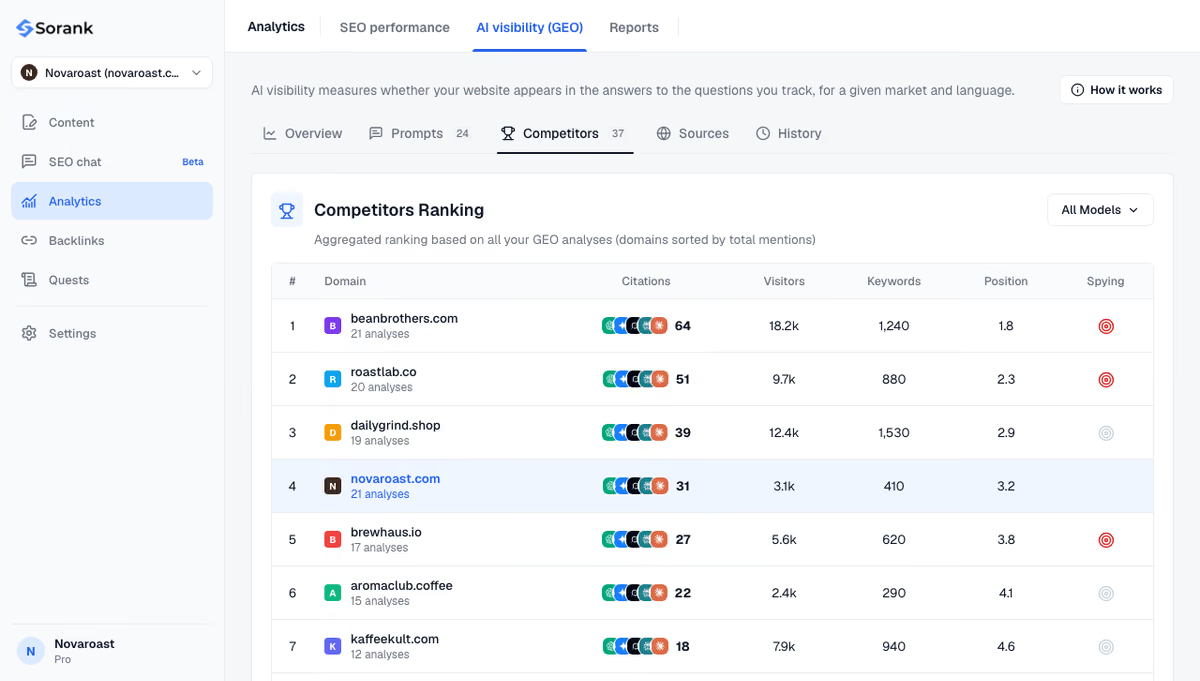
Sorank, our product, works on both sides. It writes and publishes optimized articles, obtains natural backlinks automatically from the sites of its 5,000+ users through its backlinks feature, and shows which competitors the AIs cite instead of you with SEO Competitor Spy.
A dofollow backlink is simply a link without nofollow, sponsored or ugc, and its value depends on the site that gives it. Check the attribute and the page directives, look at referring domains rather than raw counts, and earn links with assets other sites want to cite. To grow both your Google rankings and your presence in AI answers, see the Sorank plans, with a 3-day free trial.

For rankings, yes: a followed link can pass ranking credit, while nofollow links are hints that Google usually does not count. Nofollow links still bring referral traffic and brand visibility, and a natural profile contains both. A single followed link from a relevant site is worth more than many from unrelated pages.
Remove any nofollow, sponsored or ugc value from the link's rel attribute and check that the page has no meta robots nofollow directive. There is no dofollow attribute to add, since search engines ignore it. Only do this for links you vouch for: paid and affiliate links must keep rel="sponsored" or rel="nofollow".
Most large social networks and many forums add nofollow or ugc to the links users post, so they rarely pass ranking credit. They are still useful to get content discovered, to send visitors and to create brand mentions that the AIs can read. Check any specific link with your browser's Inspect tool.
We analyse your competitors, your website and your AI visibility to create a tailored content plan for free.
 AI Content Brief Generator
 FAQ Schema Generator
 AI Blog Post Ideas Generator
 Structured Data Validator (Schema Validator)
 Alt Text Checker
 Internal Link Analyzer
 Backlink Challenge
 AI Meta Description Generator
 AI Blog Title Generator
 Google Indexability Checker
 AI Blog Outline Generator
 UTM Link Builder
 Keyword Clustering Tool
 Canonical Tag Checker
 XML Sitemap Generator
 Broken Link Checker
 AI SEO Title Generator
 Headline Analyzer
 SERP Preview Tool
 Redirect Checker
 Hreflang Tag Generator
 Heading Structure Analyzer
 HTTP Headers Checker
 Favicon Extractor
 SERP CTR Calculator
 SEO vs Paid Search Savings Calculator
 SEO Share of Voice Calculator
 SEO ROI Calculator
 SEO Traffic and Revenue Forecast Calculator
 SEO Budget Calculator
 SEO Break-Even Calculator
 SaaS SEO ROI Calculator
 ROAS Calculator
 Reading Time Calculator
 Ranking Gain Simulator
 Organic Traffic Value Calculator
 Organic Traffic Estimator and Website Traffic Checker
 LTV to CAC Ratio Calculator
 Local SEO ROI Calculator
 Link Building Cost Calculator
 Keyword Value Calculator
 Keyword Opportunity Score Calculator
 Keyword Density Calculator
 GEO ROI Calculator
 GEO Content Investment Calculator
 Ecommerce SEO ROI Calculator
 Customer Lifetime Value Calculator
 Customer Acquisition Cost Calculator
 CTR Calculator
 Cost Per Article Calculator
 Conversion Rate Calculator
 Content Marketing ROI Calculator
 ChatGPT Referral Traffic Estimator
 Bounce Rate Calculator
 Backlink ROI Calculator
 AI Visibility Score Calculator
 AI Traffic Value Calculator
 AI Share of Voice Calculator
 Cost of AI Invisibility Calculator
 AI Citation Rate Calculator
 llms.txt Validator
 AI Overview Checker and AI Overviews Rank Checker
 Robots.txt Checker
 AI SEO Audit
 LLM Readability Checker
 SearchGPT Readiness Checker
 Structured Data LLM Audit
 Website Crawlability AI Audit
 Why ChatGPT Is Not Recommending My Website
 Gemini Ranking Tool
 Perplexity Ranking Checker
 LLM Citation Checker
 Answer Engine Optimization Audit
 GEO Audit
 AI Search Visibility Test
 ChatGPT Visibility Checker
 llms.txt Generator
 URL Extractor
 Webpage to Markdown
 Sitemap Checker
 SERP Volatility Sensor
 Page Size Checker
 Word Counter
 Slug Generator
 Schema Generator
 Robots Generator
 OG Preview
 Meta Tags Generator
 Image Compressor
 Favicon Generator
 On-Page SEO Audit: SEO Checker and SEO Analyzer
 Backlink Analysis Tool
 Keyword Research Tool
 Domain Authority Checker
THEY TRIED SORANK BEFORE YOU
 “I tested Sorank on a real client site and it's insane. It does everything an agency would bill you $1500 a month for. It's going into production on that client now.”

 Guillaume Guersanguersanguillaume.com“We are an Ads agency and we wanted to get our SEO back on track once and for all. Sorank gave us a clear view of our site, helped us prioritize optimizations, and properly structure our content. The tool is easy to use, well designed for a team, and very practical for centralizing tracking without having to juggle multiple platforms. A very solid foundation to start fresh with our SEO.”
 Gaspard MadouiAds Agency
 “I just let the Sorank software do its thing, and now my DR is 25 and my page is ranking higher.”
 Lucas Flandrefoundertrace.fr“I specialized in GEO thanks to Sorank. The GEO Leaderboard allows me to show my clients their position vs competitors on ChatGPT. It’s a real commercial differentiator.”
 MélanieSEO Freelance“Great service, works well for our website and helps us understand how to improve it to rank better on Google and elsewhere. Congrats, keep going, I recommend it.”
 Hugo T.E-commerce merchant