Preferences
Privacy is important to us, so you have the option of disabling certain types of storage that may not be necessary for the basic functioning of the website. Blocking categories may impact your experience on the website. More information

Privacy is important to us, so you have the option of disabling certain types of storage that may not be necessary for the basic functioning of the website. Blocking categories may impact your experience on the website. More information

Edu backlinks in 2026: what Google says about .edu links, 8 honest ways to earn them, search queries to find targets and the spam packages to avoid.

Tools

In short
edu backlinks are links from websites on the .edu domain, which is reserved for accredited US colleges and universities. Google has said several times that a link from a .edu site gets no extra credit for its extension: what counts is the page that links, its relevance and whether the link was given editorially. Earn them with resources, data, expertise and partnerships that students and staff use, and avoid every "edu backlink package" for sale.
Want to go further? Ask
Quick quiz
How should you get links from other websites?
Sorank matches your answers


Test it for 3 days on your own site and see where you stand on Google, ChatGPT and the other AIs.
Start 3-day free trial3 days free, then stop whenever you want. 90-day results-or-refund guarantee.
Edu backlinks have a reputation as the gold standard of link building. Universities are old, trusted institutions, their sites attract thousands of links of their own, and very few businesses ever get mentioned on them. That scarcity is real. The idea that the .edu extension itself boosts rankings is a myth, and it has created a whole market of spammy edu links. Only a narrow group can register the domain: since October 2001, a .edu name requires institutional accreditation from an agency recognized by the US Department of Education, as the Wikipedia entry on .edu summarizes. This guide explains what an edu link is worth, which ones to avoid, and eight honest ways to earn them.
An edu backlink is any link pointing to your site from a page hosted on a .edu domain or one of its subdomains (for example a department site, a library guide or a student blog). The registry is run by EDUCAUSE and holds a small pool of names: between 2004 and 2019 it counted more than 7,000 but fewer than 8,000 .edu domains at any time, according to the same Wikipedia entry. Each eligible institution may hold one .edu name, and domains registered before October 29, 2001 kept their name without meeting today's criteria.
Three details change how you should read the term:
No, not because of the extension. On January 29, 2008, Google's John Mueller wrote that backlinks from .edu domains generally do not get "additional credibility from Google", as reported by Search Engine Roundtable. Ten years later he went further: "Because of the misconception that .edu links are more valuable, these sites get link-spammed quite a bit", and he added that Google ignores many of those links (Search Engine Roundtable, September 3, 2018).
A good edu link still has value for the same reasons any good link does. A university page that recommends your guide in a course reading list is editorial, relevant, surrounded by expert content and visited by real readers. The same domain can also host a spam comment pointing to a casino. Google judges the page and the context, so the value sits in the linking page, never in the three letters of the extension. Use the criteria in our quality backlinks scoring grid on every edu opportunity.
| Type of .edu page | Who controls the link | SEO value | Risk |
|---|---|---|---|
| Course reading list, library guide, department resource page | Faculty or librarians | High when relevant | Low |
| Research article, faculty profile, lab page citing your data | Researchers | High | Low |
| Career center, internship or job board listing | Career services | Medium | Low |
| Student newspaper or student society site | Student editors | Medium | Low |
| Scholarship or student discount page | Financial aid or student services | Low to medium | Medium (pattern known to Google) |
| Blog comment, forum profile, open wiki, user-hosted page | Anyone | Close to zero (often ignored) | High |
Search for "edu backlinks" and some of the results are themselves spam pages hosted on university platforms. That tells you how the market works. Sellers of edu packages create accounts on open course tools, forums, wikis or abandoned student pages, then drop links in bulk. Google's spam policies (page updated August 28, 2026) list buying or selling links for ranking purposes, including "exchanging goods or services for links", as link spam. The same page describes site reputation abuse, with a direct example: "an educational site hosting a page about sponsored reviews of payday loans."
Watch out
An offer of "50 high authority edu backlinks" for a few dollars always means spam pages, comment links or hacked sections of university sites. They bring no lasting benefit and add a pattern Google knows well. Our guide on buying backlinks explains the risks in detail.
Avoid in particular:
Links you did not ask for and cannot control do not need action: Google ignores most of them. Check your profile with a free backlink analysis if you inherited a site that bought edu links in the past.
Every method below gives a university a reason to link: something useful for students, staff or researchers. Expect a lower reply rate than with ordinary sites, and longer delays around exams and holidays.
Librarians and teachers maintain lists of recommended tools, guides and datasets per subject. If you publish a genuinely useful free resource in their field (a glossary, a calculator, a step-by-step guide), propose it with one sentence explaining what students gain. Resource pages are the most common source of clean edu links.
Original data attracts citations from academic pages, theses and course material. Survey results, an annual index, an anonymized dataset or a sector study all work if the method is transparent. This is the same logic as digital PR, aimed at an academic audience.
Ask a professor or researcher for a comment on a topic in their specialty, cite their published work and link to their faculty profile. Many universities publish "in the media" pages that list these mentions with a link. The link comes as a consequence of a real collaboration, never as a condition.
Career centers list employers, internships and graduate programs. A real internship offer, a guide to entering your profession or a talk for students can earn a listing on the career services site.
Old resource pages are full of dead links. Find them with a broken link checker, check on the Internet Archive what the dead page offered, and propose your page only if it replaces it well.
If you or your founders graduated from a university, its alumni magazine or news section may feature your company, a launch or an award. It is one of the easiest edu links to obtain because the relationship already exists.
Guest lectures, hackathons, student competitions, conferences and student associations publish speaker and partner pages. Sponsored placements must be marked as sponsored, which Google's guidance on qualifying outbound links covers. Treat these as visibility: a nofollow or sponsored link still brings readers and brand recognition.
Community colleges and universities near you often list local employers, suppliers and partners. A training partnership, a discount for staff that serves them, or participation in a local program fits naturally here, and it supports your local visibility as well.
Google search operators find most targets in minutes. Replace "topic" with your subject.
| Goal | Search query |
|---|---|
| Resource pages | site:.edu "topic" "resources" |
| Library guides | site:.edu inurl:libguides "topic" |
| Useful links pages | site:.edu "topic" "useful links" OR "recommended sites" |
| Career services | site:.edu "career services" "employers" "topic" |
| Experts to interview | site:.edu "professor" "topic" "research" |
| Universities outside the US | site:.ac.uk "topic" "resources" |
Tip
Before writing to a university, check that the page is indexed (search its exact URL), was updated in the last two years and links to sites similar to yours. An old page nobody maintains rarely gets edited.
Write short, specific messages: who you are, which page you read, what your resource adds for their students, and the link. No templates sent to hundreds of addresses. Our guide to email outreach has message structures that work, and the overview of backlink strategies shows where edu links fit in a wider plan.
Use this checklist on each target page:
Universities also run their own marketing, as our page for universities and colleges shows: a department that works with you on a real project often links more than once, from news, events and resource pages.
Being mentioned by a university helps in two places. On Google, a relevant editorial link from a trusted page is a strong signal, as any quality link is. In ChatGPT, Gemini, Perplexity or Claude, educational sources weigh in the answers on many topics, and our education AI citation study shows which sites the AIs cite in that sector. A brand named in course material, research or university guides is more likely to appear in the sources the AIs rely on.
The practical consequence: measure where your brand stands in AI answers, see who is cited in your place, then target the institutions and pages behind those citations. Sorank's AI mention tracking follows the questions your buyers ask and lists the competitors cited instead of you.
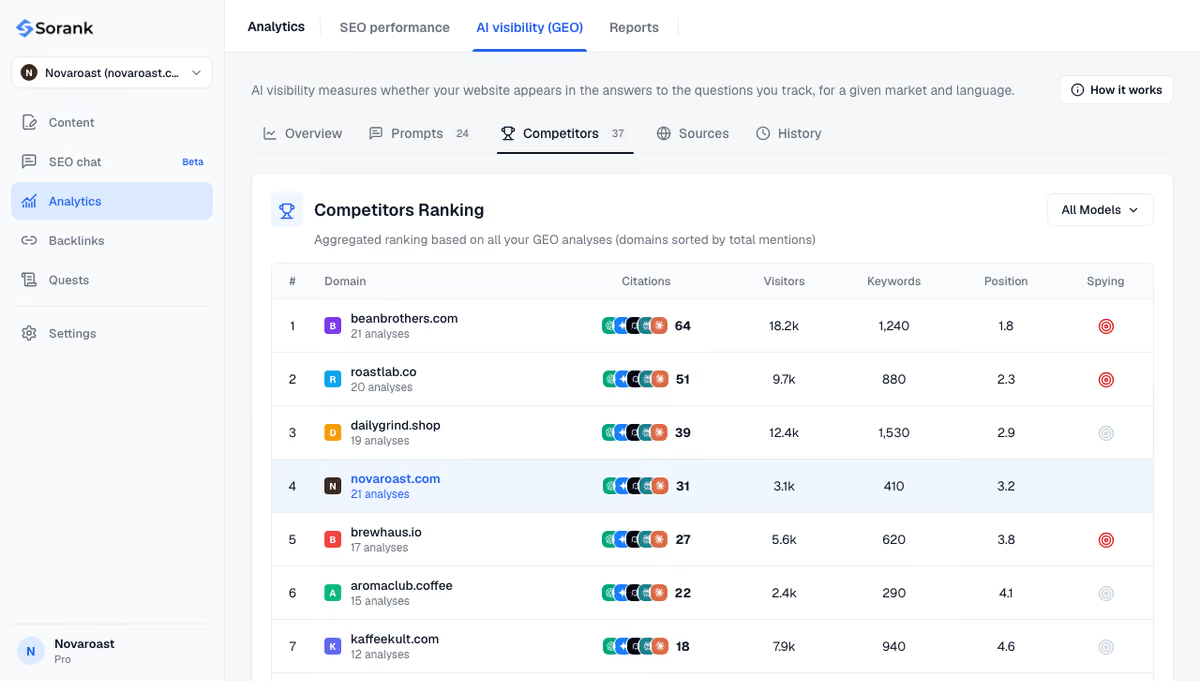
Edu links take time and come in small numbers. For the bulk of your profile, Sorank obtains natural backlinks automatically from the sites of its 5,000+ users, while its articles and AI tracking work on the content side.
An edu backlink is worth what the linking page is worth: relevance and editorial choice count, the .edu extension adds nothing on its own. Skip every package for sale, pick two or three methods that match what you can offer students and staff (data, expertise, internships, a free resource) and treat each university as a relationship. To build the rest of your link profile and track your visibility in the AIs on autopilot, see Sorank's plans, from $49 per month billed annually, with a 3-day free trial.

Yes. Any site can receive a link from a US university page if it offers something useful to its students or staff, such as data, a free resource or an internship. Universities in other countries use their own domains, such as .ac.uk or .edu.au, and links from them follow exactly the same logic.
Google has given no special status to any extension. Its statements on .edu links describe a general rule: the linking page, its relevance and whether the link was given editorially matter, the extension does not. A government page that links to you in context is a good link because of the page, and spam on government subdomains is treated like any other spam.
There is no target number. Many sites rank well without a single .edu link, and a handful of relevant ones from course pages, library guides or research is already a strong result. Focus on the quality and relevance of all your links rather than the share coming from universities.
We analyse your competitors, your website and your AI visibility to create a tailored content plan for free.
 AI Content Brief Generator
 FAQ Schema Generator
 AI Blog Post Ideas Generator
 Structured Data Validator (Schema Validator)
 Alt Text Checker
 Internal Link Analyzer
 Backlink Challenge
 AI Meta Description Generator
 AI Blog Title Generator
 Google Indexability Checker
 AI Blog Outline Generator
 UTM Link Builder
 Keyword Clustering Tool
 Canonical Tag Checker
 XML Sitemap Generator
 Broken Link Checker
 AI SEO Title Generator
 Headline Analyzer
 SERP Preview Tool
 Redirect Checker
 Hreflang Tag Generator
 Heading Structure Analyzer
 HTTP Headers Checker
 Favicon Extractor
 SERP CTR Calculator
 SEO vs Paid Search Savings Calculator
 SEO Share of Voice Calculator
 SEO ROI Calculator
 SEO Traffic and Revenue Forecast Calculator
 SEO Budget Calculator
 SEO Break-Even Calculator
 SaaS SEO ROI Calculator
 ROAS Calculator
 Reading Time Calculator
 Ranking Gain Simulator
 Organic Traffic Value Calculator
 Organic Traffic Estimator and Website Traffic Checker
 LTV to CAC Ratio Calculator
 Local SEO ROI Calculator
 Link Building Cost Calculator
 Keyword Value Calculator
 Keyword Opportunity Score Calculator
 Keyword Density Calculator
 GEO ROI Calculator
 GEO Content Investment Calculator
 Ecommerce SEO ROI Calculator
 Customer Lifetime Value Calculator
 Customer Acquisition Cost Calculator
 CTR Calculator
 Cost Per Article Calculator
 Conversion Rate Calculator
 Content Marketing ROI Calculator
 ChatGPT Referral Traffic Estimator
 Bounce Rate Calculator
 Backlink ROI Calculator
 AI Visibility Score Calculator
 AI Traffic Value Calculator
 AI Share of Voice Calculator
 Cost of AI Invisibility Calculator
 AI Citation Rate Calculator
 llms.txt Validator
 AI Overview Checker and AI Overviews Rank Checker
 Robots.txt Checker
 AI SEO Audit
 LLM Readability Checker
 SearchGPT Readiness Checker
 Structured Data LLM Audit
 Website Crawlability AI Audit
 Why ChatGPT Is Not Recommending My Website
 Gemini Ranking Tool
 Perplexity Ranking Checker
 LLM Citation Checker
 Answer Engine Optimization Audit
 GEO Audit
 AI Search Visibility Test
 ChatGPT Visibility Checker
 llms.txt Generator
 URL Extractor
 Webpage to Markdown
 Sitemap Checker
 SERP Volatility Sensor
 Page Size Checker
 Word Counter
 Slug Generator
 Schema Generator
 Robots Generator
 OG Preview
 Meta Tags Generator
 Image Compressor
 Favicon Generator
 On-Page SEO Audit: SEO Checker and SEO Analyzer
 Backlink Analysis Tool
 Keyword Research Tool
 Domain Authority Checker
THEY TRIED SORANK BEFORE YOU
 “I tested Sorank on a real client site and it's insane. It does everything an agency would bill you $1500 a month for. It's going into production on that client now.”

 Guillaume Guersanguersanguillaume.com“We are an Ads agency and we wanted to get our SEO back on track once and for all. Sorank gave us a clear view of our site, helped us prioritize optimizations, and properly structure our content. The tool is easy to use, well designed for a team, and very practical for centralizing tracking without having to juggle multiple platforms. A very solid foundation to start fresh with our SEO.”
 Gaspard MadouiAds Agency
 “I just let the Sorank software do its thing, and now my DR is 25 and my page is ranking higher.”
 Lucas Flandrefoundertrace.fr“I specialized in GEO thanks to Sorank. The GEO Leaderboard allows me to show my clients their position vs competitors on ChatGPT. It’s a real commercial differentiator.”
 MélanieSEO Freelance“Great service, works well for our website and helps us understand how to improve it to rank better on Google and elsewhere. Congrats, keep going, I recommend it.”
 Hugo T.E-commerce merchant