Preferences
Privacy is important to us, so you have the option of disabling certain types of storage that may not be necessary for the basic functioning of the website. Blocking categories may impact your experience on the website. More information

Privacy is important to us, so you have the option of disabling certain types of storage that may not be necessary for the basic functioning of the website. Blocking categories may impact your experience on the website. More information

11 backlink strategies that still work in 2026, compared by effort, cost and risk, with Google's link rules, the right mix per site type and a 90-day plan.

Tools

In short
a backlink strategy is a plan that picks two to four link building methods matched to your site, your budget and your niche, then runs them every month. The methods that still work are the ones that give another site a reason to link: original data, free tools, expert input, fixing broken links, reclaiming mentions and real partnerships. Paid or traded links that pass ranking credit break Google's spam policies and are the main risk to avoid.
Want to go further? Ask
Quick quiz
How should you get links from other websites?
Sorank matches your answers


Test it for 3 days on your own site and see where you stand on Google, ChatGPT and the other AIs.
Start 3-day free trial3 days free, then stop whenever you want. 90-day results-or-refund guarantee.
Most pages never earn a single link. Ahrefs' search traffic study (December 2023, about 14 billion pages) found that 96.55% of pages get no traffic from Google, and it names the lack of backlinks as one of the three main causes. Good backlink strategies fix that by turning link building from a series of random requests into a repeatable system. This guide compares 11 methods by effort, cost, speed and risk, shows which mix fits which type of site, and ends with a 90-day plan. For a quick list of tactics, see our guide on how to get backlinks; this page focuses on choosing and combining them.
A backlink strategy answers three questions: which pages need links, which methods will earn them, and how much time or money each month goes into it. A tactic is one action (sending a guest post pitch); a strategy is the selection, order and rhythm of tactics over several months.
Every method falls into one of three families:
Google's spam policies draw the line clearly: link spam is "creating links to or from a site primarily for the purpose of manipulating search rankings". A sound strategy stays inside the three families above and never pays for a followed link.
The 11 methods below are ranked from the most scalable to the most situational. All of them comply with Google's rules when done as described.
Surveys, benchmarks, price indexes and yearly studies are the assets journalists and bloggers cite most, because they need a number and a source. Backlinko's analysis of 912 million blog posts (2019) found that 94% of posts get no external links at all, and that long-form content over 3,000 words earns 77.2% more referring domains than content under 1,000 words. Data studies sit at the top of that long, link-worthy end.
Digital PR pitches a story to journalists: a data angle, a reaction to news, an expert comment. One article in a national outlet can be syndicated by dozens of regional sites. It needs a newsworthy hook, a short press list and fast replies to journalist requests.
Guest posting still works when the host site has a real audience in your niche and the article is genuinely useful. Google's spam policies target "large-scale article marketing or guest posting campaigns with keyword-rich anchor text links", so keep volume modest, anchors natural and topics close to your expertise.
Sites that already name your brand, product or founder without linking are the warmest prospects you have. Search for your brand name, list the mentions without a link and ask politely for one. Our guide to unlinked brand mentions covers the search operators and a message template.
Find pages in your niche that link to a dead resource, check that you have an equivalent or better page, and suggest it as a replacement. A free broken link checker scans a resource page in seconds. The pitch works because you are fixing a problem for the site owner.
Links disappear when you delete or move a page without a redirect, when a site redesigns, or when an editor removes a reference. Export the URLs on your site that return a 404 and still have backlinks, then add a 301 redirect to the closest live page. This is the fastest win in most audits because the links already exist.
A backlink gap analysis lists the sites that link to two or three competitors but not to you: directories, resource pages, comparison articles, podcasts. Tools like SEO Competitor Spy show who ranks and who gets cited in your space, and the big suites (Semrush, Ahrefs, Majestic) list their referring domains.
Curated lists ("best tools for X", "useful resources for Y") are built to link out. Search for intitle:resources or "best [category]" with your topic, check that the page is maintained, and send a short note explaining why your page deserves a place.
Manufacturers list their resellers, software tools list their integrations, event organizers list their sponsors and speakers. These links come from real relationships, so they are both safe and relevant. Make a list of every company you already work with and check whether they have a partner, client or integration page.
For a business that serves a city or region, the best links are local: chambers of commerce, local press, associations, schools, sponsored events, neighboring businesses. Our guide to local link building details these sources and how they support the map pack.
Journalist request platforms, podcasts and expert roundups need people with real experience. A precise quote with a number or an example gets picked up; a generic one does not. Each appearance usually comes with a link to your site or your bio page.
Tip
Pick the page that receives the link before you start outreach. A data study, a free tool or a guide earns links far more easily than a product or pricing page; internal links then pass that authority to the pages that sell.
The table below gives our estimates for a small to mid-sized site. Effort covers research, content and outreach; risk refers to Google's link spam policies when the method is done as described above.
| Strategy | Effort | Cost | Time to first links | Risk | Best for |
|---|---|---|---|---|---|
| Original data | High | Medium to high | 1 - 3 months | Very low | B2B, SaaS, media |
| Digital PR | High | Medium to high | 2 - 8 weeks | Very low | Brands with a story |
| Guest posts | Medium | Low (time) | 2 - 6 weeks | Medium at scale | Experts, consultants |
| Unlinked mentions | Low | Low | 1 - 3 weeks | Very low | Known brands |
| Broken link building | Medium | Low | 2 - 6 weeks | Very low | Sites with deep guides |
| Link reclamation | Low | Low | Days | None | Older sites, migrations |
| Competitor gap | Medium | Low to medium | 2 - 8 weeks | Low | Competitive niches |
| Resource pages | Low to medium | Low | 2 - 6 weeks | Low | Tools, guides |
| Partners and suppliers | Low | Low | 1 - 4 weeks | Very low | E-commerce, SaaS |
| Local links | Medium | Low to medium | 2 - 8 weeks | Very low | Local businesses |
| Expert input | Medium | Low | 2 - 8 weeks | Very low | Founders, specialists |
The pattern is clear: the cheapest and fastest wins (reclamation, unlinked mentions, partners) come from links you already deserve, while the most powerful links (data, digital PR) take the most work.
Google lists the practices it treats as link spam. The ones still sold as "strategies" today:
Paid placements are allowed when the link is qualified. Google's link best practices say: "If you were paid in some way for the link, qualify these links with sponsored or nofollow." Such links can bring traffic and visibility, but not ranking credit.
Watch out
Exact-match anchors repeated across many sites are one of the clearest signals of manipulation. Google describes good anchor text as "descriptive, reasonably concise, and relevant"; most of your anchors should be your brand name, the page title or a natural phrase.
No site needs all 11 methods. Pick two or three that match your assets and your market, then add one more once the first ones run smoothly.
| Type of site | Core strategies | Add later |
|---|---|---|
| New site, no brand yet | Partners and suppliers, resource pages, guest posts | Expert input |
| Local business | Local links, partners, unlinked mentions | Local press (digital PR) |
| SaaS or B2B | Original data, integrations and partners, competitor gap | Digital PR, podcasts |
| E-commerce store | Suppliers and brands, gift guides and "best of" lists, reclamation | Data on prices or trends |
| Publisher or blog | Original data, broken link building, expert input | Digital PR |
Two rules apply to every mix. First, relevance beats authority: a link from a smaller site in your niche helps more than a link from a large site with no topical connection. Second, keep the anchor text varied and natural, as described in the warning above.
Expect results on rankings in months rather than weeks: Google needs to crawl the linking pages, and one link rarely moves a competitive keyword alone. Consistency matters more than any single campaign.
Yes, indirectly. ChatGPT, Gemini, Perplexity and Claude draw on web pages that are well ranked, frequently cited and mentioned by trusted sources. The strategies that earn editorial links (data, digital PR, expert input, presence in "best of" lists) also create the brand mentions that these assistants pick up, linked or not. Our study of the platforms the AIs cite most shows which types of sites appear most often in their answers, which is a good list of targets for outreach.
To see whether your link building changes anything in AI answers, track the questions your buyers ask with AI mention tracking and watch which competitors are cited in your place.
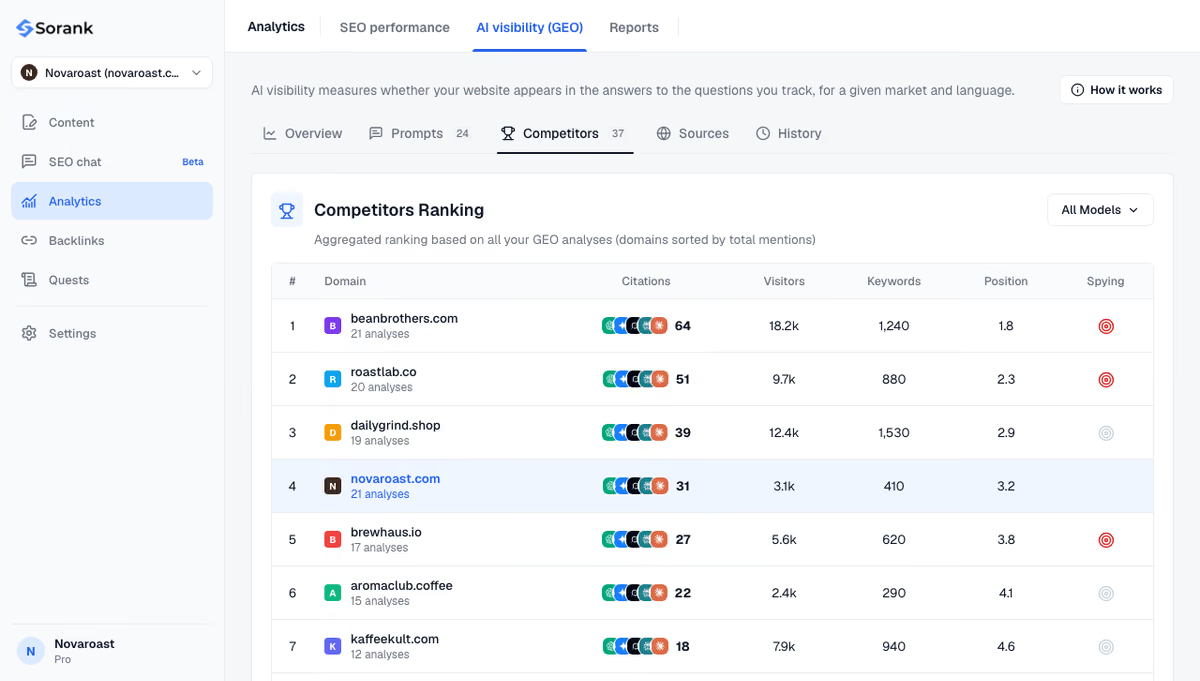
Sorank, our product, also handles part of the link work for you: it obtains natural backlinks automatically from the sites of its 5,000+ users, alongside keyword research and articles written for Google and the AIs. You keep your own outreach for the high-value methods above.
The best backlink strategy is a short list of methods that suit your site, run every month: quick wins first, one linkable asset, then steady outreach, with natural anchors and no paid followed links. Measure referring domains and rankings monthly and drop what does not produce. To combine that work with content and AI visibility in one tool, see the Sorank plans, from $49 per month on annual billing with a 3-day free trial and a 90-day money-back guarantee.

There is no fixed number. Compare the referring domains of the pages ranking in the top 5 for your keyword: if they have 10 to 30, a plan that earns a few relevant links each month can close the gap. Relevance and quality of the linking sites count more than the raw total.
Yes, as part of a natural profile. Nofollow, sponsored and UGC links do not pass ranking credit in the usual way, but they bring referral traffic, brand visibility and mentions that the AIs can pick up. A profile made only of followed links looks less natural than a mix.
Start with links you already deserve: partners, suppliers, customers, local associations and resource pages in your niche. Then publish one genuinely useful asset, such as a guide or a small free tool, and promote it to relevant sites. Avoid buying followed links, which breaks Google's spam policies.
We analyse your competitors, your website and your AI visibility to create a tailored content plan for free.
 AI Content Brief Generator
 FAQ Schema Generator
 AI Blog Post Ideas Generator
 Structured Data Validator (Schema Validator)
 Alt Text Checker
 Internal Link Analyzer
 Backlink Challenge
 AI Meta Description Generator
 AI Blog Title Generator
 Google Indexability Checker
 AI Blog Outline Generator
 UTM Link Builder
 Keyword Clustering Tool
 Canonical Tag Checker
 XML Sitemap Generator
 Broken Link Checker
 AI SEO Title Generator
 Headline Analyzer
 SERP Preview Tool
 Redirect Checker
 Hreflang Tag Generator
 Heading Structure Analyzer
 HTTP Headers Checker
 Favicon Extractor
 SERP CTR Calculator
 SEO vs Paid Search Savings Calculator
 SEO Share of Voice Calculator
 SEO ROI Calculator
 SEO Traffic and Revenue Forecast Calculator
 SEO Budget Calculator
 SEO Break-Even Calculator
 SaaS SEO ROI Calculator
 ROAS Calculator
 Reading Time Calculator
 Ranking Gain Simulator
 Organic Traffic Value Calculator
 Organic Traffic Estimator and Website Traffic Checker
 LTV to CAC Ratio Calculator
 Local SEO ROI Calculator
 Link Building Cost Calculator
 Keyword Value Calculator
 Keyword Opportunity Score Calculator
 Keyword Density Calculator
 GEO ROI Calculator
 GEO Content Investment Calculator
 Ecommerce SEO ROI Calculator
 Customer Lifetime Value Calculator
 Customer Acquisition Cost Calculator
 CTR Calculator
 Cost Per Article Calculator
 Conversion Rate Calculator
 Content Marketing ROI Calculator
 ChatGPT Referral Traffic Estimator
 Bounce Rate Calculator
 Backlink ROI Calculator
 AI Visibility Score Calculator
 AI Traffic Value Calculator
 AI Share of Voice Calculator
 Cost of AI Invisibility Calculator
 AI Citation Rate Calculator
 llms.txt Validator
 AI Overview Checker and AI Overviews Rank Checker
 Robots.txt Checker
 AI SEO Audit
 LLM Readability Checker
 SearchGPT Readiness Checker
 Structured Data LLM Audit
 Website Crawlability AI Audit
 Why ChatGPT Is Not Recommending My Website
 Gemini Ranking Tool
 Perplexity Ranking Checker
 LLM Citation Checker
 Answer Engine Optimization Audit
 GEO Audit
 AI Search Visibility Test
 ChatGPT Visibility Checker
 llms.txt Generator
 URL Extractor
 Webpage to Markdown
 Sitemap Checker
 SERP Volatility Sensor
 Page Size Checker
 Word Counter
 Slug Generator
 Schema Generator
 Robots Generator
 OG Preview
 Meta Tags Generator
 Image Compressor
 Favicon Generator
 On-Page SEO Audit: SEO Checker and SEO Analyzer
 Backlink Analysis Tool
 Keyword Research Tool
 Domain Authority Checker
THEY TRIED SORANK BEFORE YOU
 “I tested Sorank on a real client site and it's insane. It does everything an agency would bill you $1500 a month for. It's going into production on that client now.”

 Guillaume Guersanguersanguillaume.com“We are an Ads agency and we wanted to get our SEO back on track once and for all. Sorank gave us a clear view of our site, helped us prioritize optimizations, and properly structure our content. The tool is easy to use, well designed for a team, and very practical for centralizing tracking without having to juggle multiple platforms. A very solid foundation to start fresh with our SEO.”
 Gaspard MadouiAds Agency
 “I just let the Sorank software do its thing, and now my DR is 25 and my page is ranking higher.”
 Lucas Flandrefoundertrace.fr“I specialized in GEO thanks to Sorank. The GEO Leaderboard allows me to show my clients their position vs competitors on ChatGPT. It’s a real commercial differentiator.”
 MélanieSEO Freelance“Great service, works well for our website and helps us understand how to improve it to rank better on Google and elsewhere. Congrats, keep going, I recommend it.”
 Hugo T.E-commerce merchant