Preferences
Privacy is important to us, so you have the option of disabling certain types of storage that may not be necessary for the basic functioning of the website. Blocking categories may impact your experience on the website. More information

Privacy is important to us, so you have the option of disabling certain types of storage that may not be necessary for the basic functioning of the website. Blocking categories may impact your experience on the website. More information

How to get backlinks in 2026: linkable assets, digital PR, guest posts, broken links, unlinked mentions, partners and directories, plus what to avoid.
Tools


In short
To get backlinks, publish pages other sites want to cite (original data, guides, free tools), then promote them through digital PR, guest articles on relevant sites, broken link replacement, unlinked mention recovery and your existing partners. Several of these methods are free and cost only time. Avoid buying links that pass ranking signals and large-scale "link to me and I'll link to you" schemes, which violate Google's spam policies. Relevance matters more than volume: a few links from respected sites in your niche beat hundreds of weak ones.
Want to go further? Ask
Knowing how to get backlinks remains one of the most useful skills in SEO, because links from other sites are still among the signals search engines use to judge authority, and the AIs rely on the same trusted sources when they choose what to cite. This guide covers what a good backlink is, nine methods that work in 2026, which ones are free, what to avoid and how to measure progress.
A good backlink comes from a relevant, trusted site, sits inside real content, and was placed because the linking page found your page useful. Volume comes last.
A backlink is a link from another website to yours. Not all links are equal. Evaluate each one on five criteria:
| Criterion | Strong link | Weak link |
|---|---|---|
| Relevance | Site in your industry or a close topic | Unrelated site, general link list |
| Placement | In the body of an article, near related text | Footer, sidebar, comment, profile page |
| Source quality | Real audience, real traffic, editorial standards | Site built only to sell links |
| Anchor text | Natural: brand, page title or descriptive phrase | Exact-match keyword repeated everywhere |
| Attribute | Followed editorial link | Nofollow or sponsored (useful for traffic, less for ranking) |
Google asks site owners to qualify paid and user-generated links with rel="sponsored", rel="ugc" or rel="nofollow", as explained in its documentation on qualifying outbound links. Those links can still bring visitors and visibility, but they are not editorial votes.
Nine methods cover almost every situation, from free outreach to long-term assets.
| Method | Cost | Effort | Typical link quality |
|---|---|---|---|
| Linkable assets (data, tools, guides) | Time to create | High upfront | High, and they keep earning links |
| Digital PR | Time or agency budget | High | Very high (media) |
| Guest articles | Time | Medium | Medium to high if the site is relevant |
| Broken link replacement | Free | Medium | Medium to high |
| Unlinked mentions | Free | Low | High (the site already knows you) |
| Partners, suppliers, customers | Free | Low | Medium, very relevant |
| Expert answers to journalists | Free | Medium | High when published |
| Reputable directories and listings | Free to low | Low | Low to medium, useful for local SEO |
| Automated one-way placements in your niche | Software plan | Very low | Medium, relevant and steady |
They give journalists, bloggers and other sites a reason to cite you: something they cannot find elsewhere.
A linkable asset is a page designed to be referenced. The formats that work best:
Digital PR then pushes the asset to media and bloggers with a story angle: a surprising number, a local trend, a timely reaction to news. Our guide to digital PR details how to build the pitch and the press list. The work is demanding, but a single article in a major outlet can be worth more than dozens of small links.
Both rely on offering something useful to another site's editor: an article for their audience, or a fix for a dead link on their page.
Guest articles. Write a genuinely useful article for a site your buyers read, with a link to a relevant page on your site where it helps the reader. Target sites with a real audience in your field and editorial standards, not sites that publish anything for anyone. Our guide to guest posting covers how to find targets and write pitches that get accepted.
Broken link building. Many resource pages link to articles that no longer exist. The method:
Editors appreciate being told about a broken link, which makes this one of the friendliest forms of outreach.
Start with the people who already know you: sites that mention your brand, your partners and your customers. These methods cost only time and have the highest acceptance rates.
Avoid anything that creates links for the sole purpose of manipulating rankings: Google's spam policies list these practices explicitly.
The Google Search spam policies describe link spam, including:
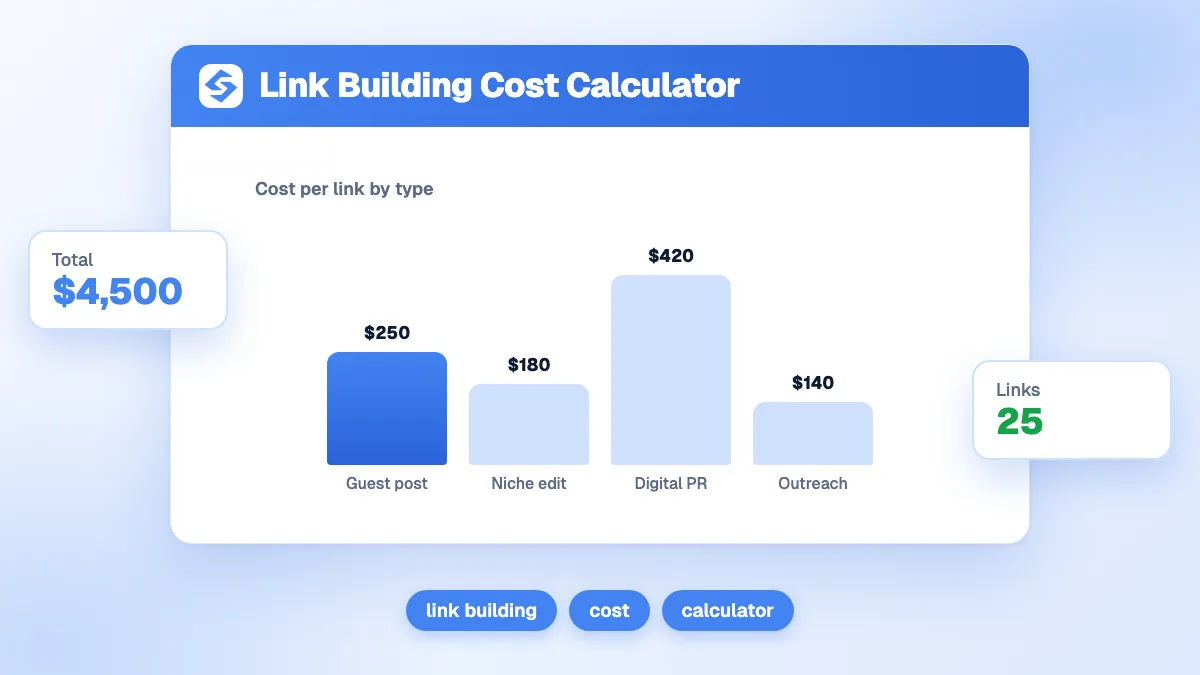
The risk is a manual action or, more often, links that Google simply ignores, which means money and time spent for nothing. If you are unsure, estimate what a campaign would cost with our link building cost calculator and compare it with the value of the traffic you expect.
Yes, indirectly: ChatGPT, Gemini, Perplexity and Google AI Overviews lean on sources that are cited across the web, and backlinks are one visible trace of that.
When an assistant builds an answer, it tends to quote pages that rank well and brands that appear repeatedly on trusted sites of the industry. Links and brand mentions on relevant sites therefore serve two purposes at once: they strengthen your classic rankings and they make your brand a more natural candidate for AI answers. Mentions without links count too, which is another reason to invest in digital PR and expert contributions.
Track referring domains rather than raw link counts, and connect the links to rankings and traffic on the pages they point to.
Google Search Console's Links report lists the sites linking to you for free. Expect results to show over months: SEO gains typically appear within two to four months.
Getting backlinks comes down to deserving them and then making sure the right people know about your pages. Build a few linkable assets, use the free methods first (mentions, partners, broken links), add guest articles and digital PR as you grow, and stay away from paid link schemes. Relevance and steadiness win over volume.
If outreach takes more time than you have, Sorank lets you get natural backlinks automatically, placed in real articles on sites in the same niche, one way, alongside the SEO and GEO articles it writes and publishes on autopilot. See how backlink acquisition works or start with a 3-day free trial.

The most reliable free methods are turning unlinked brand mentions into links, fixing broken links on other sites by offering your page as a replacement, answering journalist requests with real expertise, listing your business in reputable directories, and asking partners, suppliers and customers to link to you. They cost time rather than money.
There is no fixed number. The useful benchmark is the number of referring domains pointing to the pages that already rank for your target query: compare their profiles and aim to close the gap with relevant sites. A few links from respected sites in your niche usually weigh more than many weak ones.
Buying links that pass ranking signals without a sponsored or nofollow attribute violates Google's spam policies, and the penalty can be a manual action or the links simply being ignored. Paid placements are acceptable when they are labeled with rel sponsored, but they then do not count as editorial links.
 AI Content Brief Generator
 FAQ Schema GeneratorAI Blog Post Ideas GeneratorStructured Data Validator
 Alt Text Checker
 Internal Link AnalyzerBacklink ChallengeAI Meta Description GeneratorAI Blog Title Generator
 Google Indexability CheckerAI Blog Outline GeneratorUTM Link BuilderKeyword Clustering ToolCanonical Tag Checker
 XML Sitemap GeneratorBroken Link CheckerAI SEO Title GeneratorHeadline AnalyzerSERP Preview ToolRedirect Checker
 Hreflang Tag GeneratorHeading Structure AnalyzerHTTP Headers CheckerFavicon Extractor
 SERP CTR Calculator
 SEO vs Paid Search Savings Calculator
 SEO Share of Voice Calculator
 SEO ROI Calculator
 SEO Traffic and Revenue Forecast Calculator
 SEO Budget Calculator
 SEO Break-Even Calculator
 SaaS SEO ROI Calculator
 ROAS Calculator
 Reading Time Calculator
 Ranking Gain Simulator
 Organic Traffic Value Calculator
 Organic Traffic Estimator
 LTV to CAC Ratio Calculator
 Local SEO ROI Calculator
 Link Building Cost Calculator
 Keyword Value Calculator
 Keyword Opportunity Score Calculator
 Keyword Density Calculator
 GEO ROI Calculator
 GEO Content Investment Calculator
 Ecommerce SEO ROI Calculator
 Customer Lifetime Value Calculator
 Customer Acquisition Cost Calculator
 CTR Calculator
 Cost Per Article Calculator
 Conversion Rate Calculator
 Content Marketing ROI Calculator
 ChatGPT Referral Traffic Estimator
 Bounce Rate Calculator
 Backlink ROI Calculator
 AI Visibility Score Calculator
 AI Traffic Value Calculator
 AI Share of Voice Calculator
 Cost of AI Invisibility Calculator
 AI Citation Rate Calculatorllms.txt ValidatorAI Overview CheckerRobots.txt CheckerAI SEO AuditLLM Readability CheckerSearchGPT Readiness Checker
 Structured Data LLM AuditWebsite Crawlability AI AuditWhy ChatGPT Is Not Recommending My Website
 Gemini Ranking ToolPerplexity Ranking CheckerLLM Citation CheckerAnswer Engine Optimization AuditGEO AuditAI Search Visibility TestChatGPT Visibility Checkerllms.txt Generator
 URL ExtractorWebpage to MarkdownSitemap CheckerSERP Volatility SensorPage Size Checker
 Word Counter
 Slug GeneratorSchema GeneratorRobots Generator
 OG PreviewMeta Tags Generator
 Image CompressorFavicon Generator
 On-Page SEO Audit
 Backlink Analysis Tool
 Keyword Research Tool
 Domain Authority Checker
THEY TRIED SORANK BEFORE YOU
 “I tested Sorank on a real client site and it's insane. It does everything an agency would bill you $1500 a month for. It's going into production on that client now.”

 Guillaume Guersanguersanguillaume.com“We are an Ads agency and we wanted to get our SEO back on track once and for all. Sorank gave us a clear view of our site, helped us prioritize optimizations, and properly structure our content. The tool is easy to use, well designed for a team, and very practical for centralizing tracking without having to juggle multiple platforms. A very solid foundation to start fresh with our SEO.”
 Gaspard MadouiAds Agency
 “I just let the Sorank software do its thing, and now my DR is 25 and my page is ranking higher.”
 Lucas Flandrefoundertrace.fr“I specialized in GEO thanks to Sorank. The GEO Leaderboard allows me to show my clients their position vs competitors on ChatGPT. It’s a real commercial differentiator.”
 MélanieSEO Freelance“Great service, works well for our website and helps us understand how to improve it to rank better on Google and elsewhere. Congrats, keep going, I recommend it.”
 Hugo T.E-commerce merchant