Summary
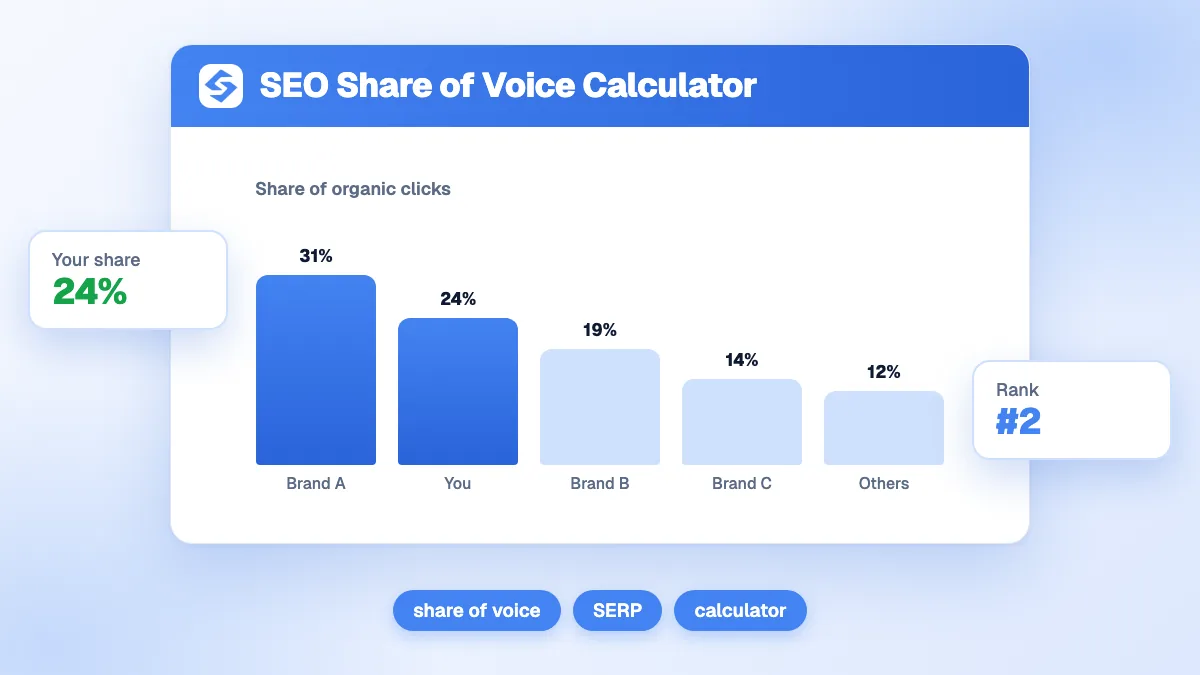
SEO share of voice is your share of the organic traffic in your market: your monthly organic visits ÷ the visits of the whole market × 100. Enter your traffic, the traffic of your three main competitors and an estimate for everyone else. The calculator returns your share, the size of the market, your rank, the gap to the leader and the extra traffic you need to double your share. With 14,000 visits in a 138,000-visit market, your share is 10.1%.
Want to go further? Ask


An SEO share of voice calculator puts your organic traffic in context. Traffic that grows 10% looks good until a competitor grows 40%. The idea comes from advertising, where marketers have long compared a brand's share of advertising with its sales; a classic Harvard Business Review article examined why sales volume and advertising budgets move in lockstep (John Philip Jones, Harvard Business Review, 1990). In search, the "voice" is the clicks you win on the queries your market types.

How is SEO share of voice calculated?
The calculator adds up five traffic figures to size the market, then compares yours with the others. The table uses the default example: you at 14,000 monthly visits, competitors at 42,000, 28,000 and 19,000, everyone else at 35,000.
| Result | Formula | Default example |
|---|---|---|
| Total market | You + competitor 1 + competitor 2 + competitor 3 + everyone else | 138,000 |
| Share of voice | Your traffic ÷ total market × 100 | 14,000 ÷ 138,000 = 10.1% |
| Your rank | Your position among you and the three competitors | 4 / 4 |
| Gap to the leader | Leader's traffic − your traffic | 42,000 − 14,000 = 28,000 |
| Traffic needed to double your share | Your traffic ÷ (1 − 2 × your share) | 14,000 ÷ (1 − 0.203) = 17,564 |
The last line deserves a word. When you win visits, the market grows by the same amount, so doubling your share takes more than doubling your traffic would suggest on paper. With 17,564 extra visits, you reach 31,564 out of 155,564, which is 20.3%. Above a 50% share, doubling is impossible, and the calculator shows no figure.
What is a good SEO share of voice?
It depends on how crowded your market is, but the calculator gives four reading bands.
| Share of voice | Label | Typical situation |
|---|---|---|
| Under 5% | Below par | A small player, or a site that ranks for few of the market's queries |
| 5% to 14.9% | Watch this | A credible challenger with room to grow |
| 15% to 29.9% | Healthy | One of the reference sites of the market |
| 30% and more | Excellent | A leader; defending the position becomes the priority |
The gap to the leader is the figure to watch month after month. It tells you what standing still costs you.
Where do you find the traffic figures?
- Your own traffic: use the clicks of the Performance report in Google Search Console, which counts the times users clicked your site from Google Search (Search Console Help, Performance report). Filter on the queries of your market, not the whole site.
- Competitors' traffic: nobody can read a competitor's analytics. SEO tools estimate it from rankings and search volumes; use the same tool for every competitor so the errors cancel out.
- Everyone else: the long tail of smaller sites, forums and marketplaces. If you do not know, estimate it as the traffic of the market minus the four named players.
Your own estimates matter less than consistency. Measure with the same method each month and the trend will be reliable even if each figure is approximate.

Should you measure share of voice on traffic or on rankings?
Both methods exist, and they answer slightly different questions.
| Method | How it works | Strength | Weakness |
|---|---|---|---|
| Traffic share (this calculator) | Your organic visits ÷ visits of the market | Simple, easy to explain to a manager | Depends on traffic estimates for competitors |
| Visibility share | For each keyword, search volume × click-through rate of your position, summed and compared with the total | Precise keyword by keyword | Needs a full ranking report and a CTR curve |
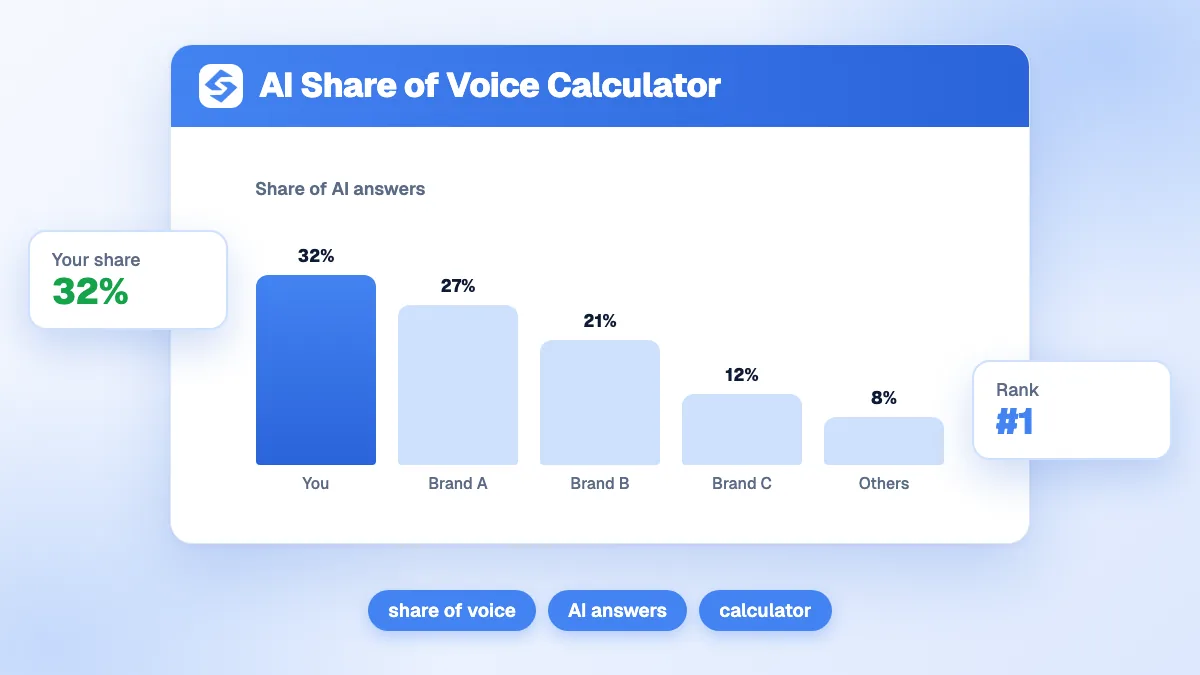
| Share of AI answers | Answers that cite you ÷ answers analysed, on a fixed set of questions | Covers ChatGPT, Perplexity and Gemini | Requires repeated tests on many questions |
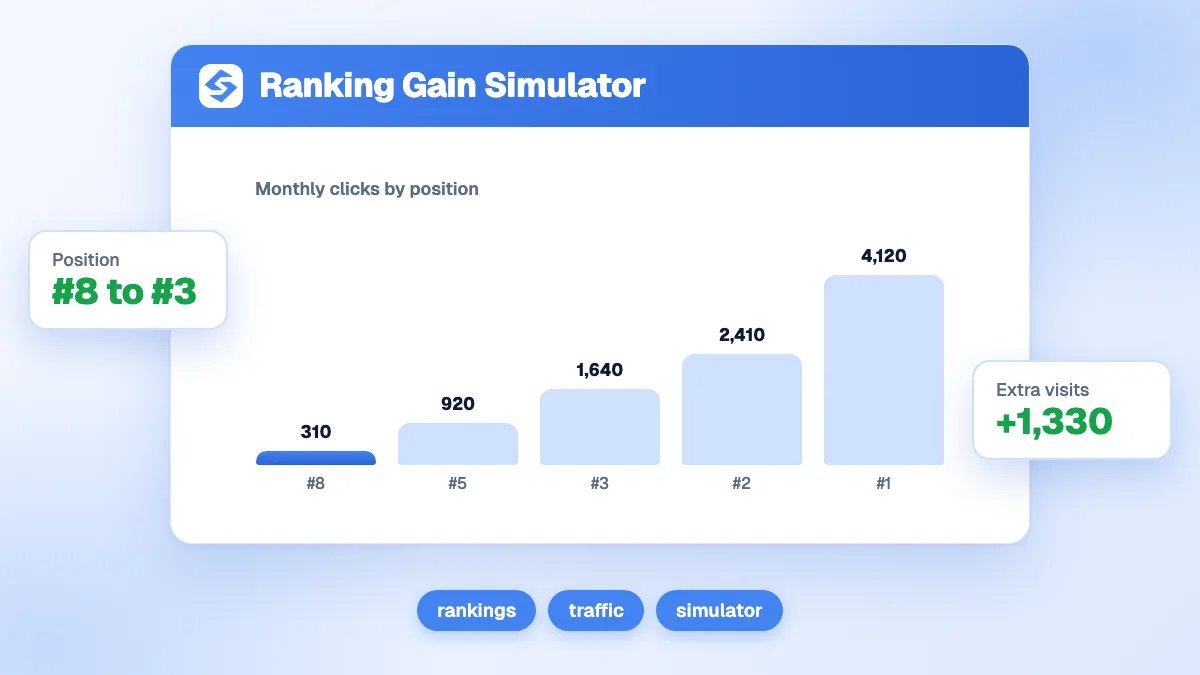
Visibility share relies on the fact that clicks fall quickly from one position to the next. Research on search behavior concluded that clicks are "informative but biased" by the position of each result (Joachims et al., SIGIR 2005). The ranking gain simulator shows that curve for one keyword, and the AI share of voice calculator applies the same logic to AI answers.
How do you compute a visibility share by keyword?
For each keyword, multiply the search volume by the click-through rate of each site's position, add the results per site, then divide by the total volume. The example uses three keywords and the average CTR curve of the ranking gain simulator.
| Keyword (volume) | You | Competitor A | Competitor B |
|---|---|---|---|
| Keyword 1 (5,000) | Position 3: 510 clicks | Position 1: 1,380 | Position 5: 295 |
| Keyword 2 (2,000) | Position 8: 54 | Position 2: 306 | Position 1: 552 |
| Keyword 3 (1,200) | Position 1: 331 | Position 4: 94 | Position 9: 26 |
| Visibility share (of 8,200 searches) | 10.9% | 21.7% | 10.7% |
Ranking first on a small keyword weighs less than ranking third on a big one. That is why the keyword set must reflect the queries your buyers actually type, weighted by their volume.
Why can your share fall when your traffic does not?
Because share of voice is relative. If a competitor publishes a strong content hub and grows from 42,000 to 52,000 visits while you stay at 14,000, your share drops from 10.1% to 9.5% and the gap to the leader jumps from 28,000 to 38,000. Nothing changed on your site, yet you lost ground.
The whole market can also shrink. Pew Research Center found that Google users who saw an AI summary clicked a traditional result in 8% of visits, against 15% without one (Pew Research Center, 2025). In that case every player loses visits and your share may hold steady: compare shares, not raw traffic, before drawing conclusions.
How do you increase your share of voice?
- Map the gap: list the queries where the leader ranks and you do not. That is where most of the 28,000-visit gap of the example sits.
- Target realistic positions: pages already between positions 4 and 15 move fastest.
- Cover the topic completely: one page per intent, linked together, rather than one long page for everything.
- Measure monthly with the same competitors and the same method.
For the definition and the AI version of the metric, see the glossary entry on AI share of voice.
What are the limits of the calculator?
- Estimates in, estimates out: competitor traffic is always modeled, never measured.
- Three named competitors: group the others in "everyone else"; the rank only compares you with the three named players.
- All traffic counts the same: a visit on a product query and a visit on a blog question weigh the same, even if their value differs.
- Branded traffic inflates the leader: exclude brand queries when you can, so the share reflects the queries you really compete on.
From one reading to a monthly benchmark
Share of voice tells you whether you are winning your market, not only whether you are growing. The Sorank competitor spy shows the keywords your rivals win and you miss, the GEO leaderboard ranks your share of voice in AI answers against theirs, and the GEO and SEO dashboard tracks both every week. See the Sorank plans to grow your share on autopilot.