




Summary
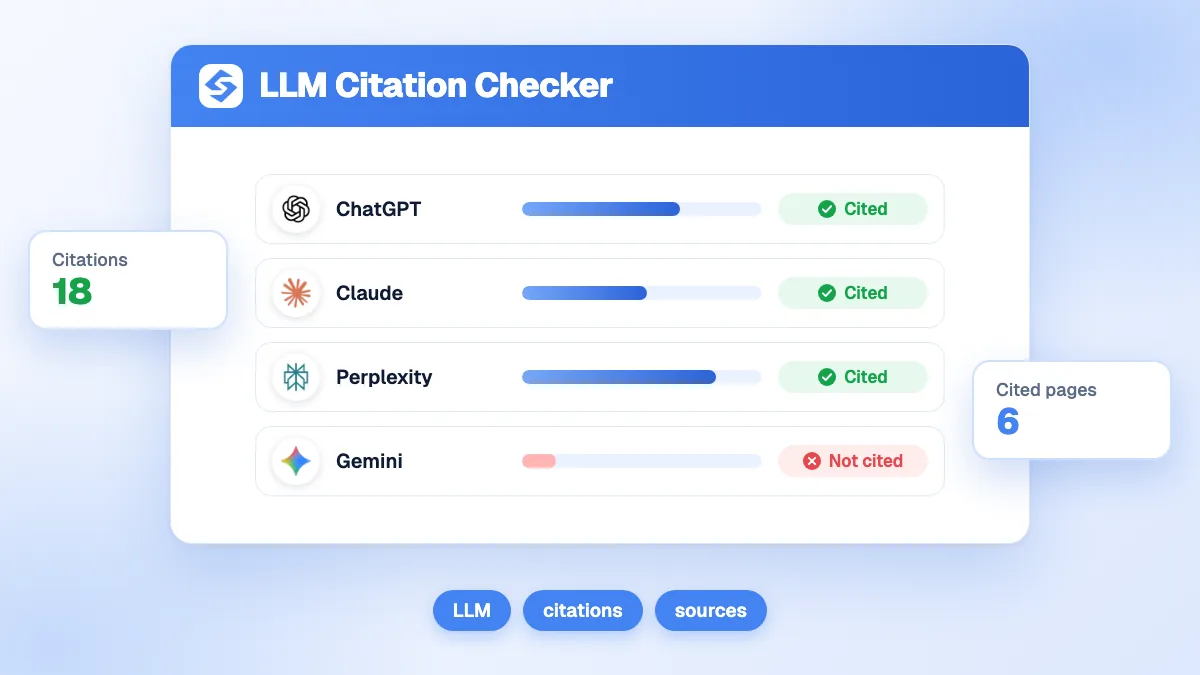
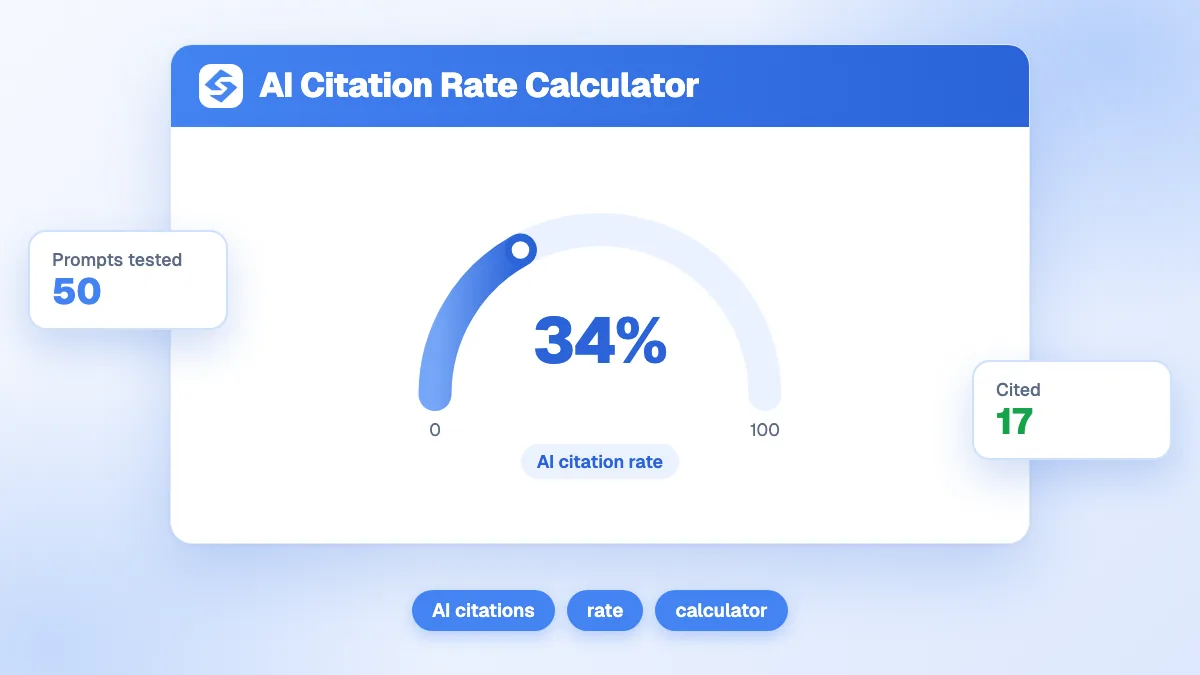
Your AI citation rate is the share of AI answers that cite your brand: answers citing you ÷ answers analysed × 100. Enter how many answers you checked, how many cite you, how many models you tested and how many answers name you first. The calculator returns the citation rate, the answers you are missing from, your share of first places and the average citations per model. With 18 citations in 100 answers, your rate is 18%.
Want to go further? Ask


The AI citation rate is the GEO equivalent of a ranking report: it tells you how often ChatGPT, Perplexity, Gemini or Claude put your brand in front of the person asking. The stakes keep growing. Google reports that AI Overviews have over 2 billion monthly users across more than 200 countries and territories (Alphabet Q2 2025 earnings remarks), and people who see an AI summary click fewer classic results. Being inside the answer is becoming the visibility that counts.

How is the AI citation rate calculated?
The calculator uses four inputs and returns four results. Every formula is shown below with the default example: 100 answers analysed, 18 citing you, 4 models tested, 6 answers naming you first.
| Result | Formula | Example |
|---|---|---|
| Citation rate | Answers citing you ÷ answers analysed × 100 | 18 ÷ 100 = 18% |
| Answers without you | Answers analysed − answers citing you | 100 − 18 = 82 |
| Share where you are first | Answers naming you first ÷ answers citing you × 100 | 6 ÷ 18 = 33% |
| Citations per model | Answers citing you ÷ models tested | 18 ÷ 4 = 4.5 |
Citations can never exceed the number of answers, and first places can never exceed citations: the calculator caps both, so a typing mistake cannot produce a rate above 100%.
What is a good AI citation rate?
There is no universal benchmark yet: the rate depends on your market, the number of competitors and the questions you test. The calculator colors the result with four bands to help you read it.
| Citation rate | Label | What it usually means |
|---|---|---|
| Under 5% | Below par | The AIs rarely associate your brand with these questions |
| 5% to 19% | Watch this | You appear on some questions, often the ones closest to your brand |
| 20% to 39% | Healthy | You are a regular answer in your niche |
| 40% and more | Excellent | You are one of the default recommendations |
Compare your rate with your competitors on the same set of questions rather than with an absolute target. The AI share of voice calculator does exactly that.
How many AI answers do you need for a reliable rate?
At least 100, as the calculator's hint suggests, because a rate measured on a few answers moves a lot by chance. The approximate 95% margin of error of a proportion shrinks with the square root of the sample (NIST Engineering Statistics Handbook, confidence intervals for proportions).
| Answers analysed | Margin of error around a 20% rate | The true rate is probably between |
|---|---|---|
| 50 | About ±11 points | 9% and 31% |
| 100 | About ±8 points | 12% and 28% |
| 200 | About ±5.5 points | 14.5% and 25.5% |
| 400 | About ±4 points | 16% and 24% |
A change from 18% to 22% on 100 answers is therefore not yet a trend. Keep the same questions from one month to the next and look at several readings before concluding.
How do you collect the data?
- Write your prompt set: 25 to 50 questions your customers really ask, without your brand name in them. Mix category, problem and comparison questions.
- Ask each model separately: ChatGPT, Perplexity, Gemini, Claude. Four models and 25 questions already give 100 answers.
- Record two facts per answer: is your brand or site cited, and is it named first among the brands?
- Enter the totals in the calculator, then keep the detail per model in a spreadsheet.
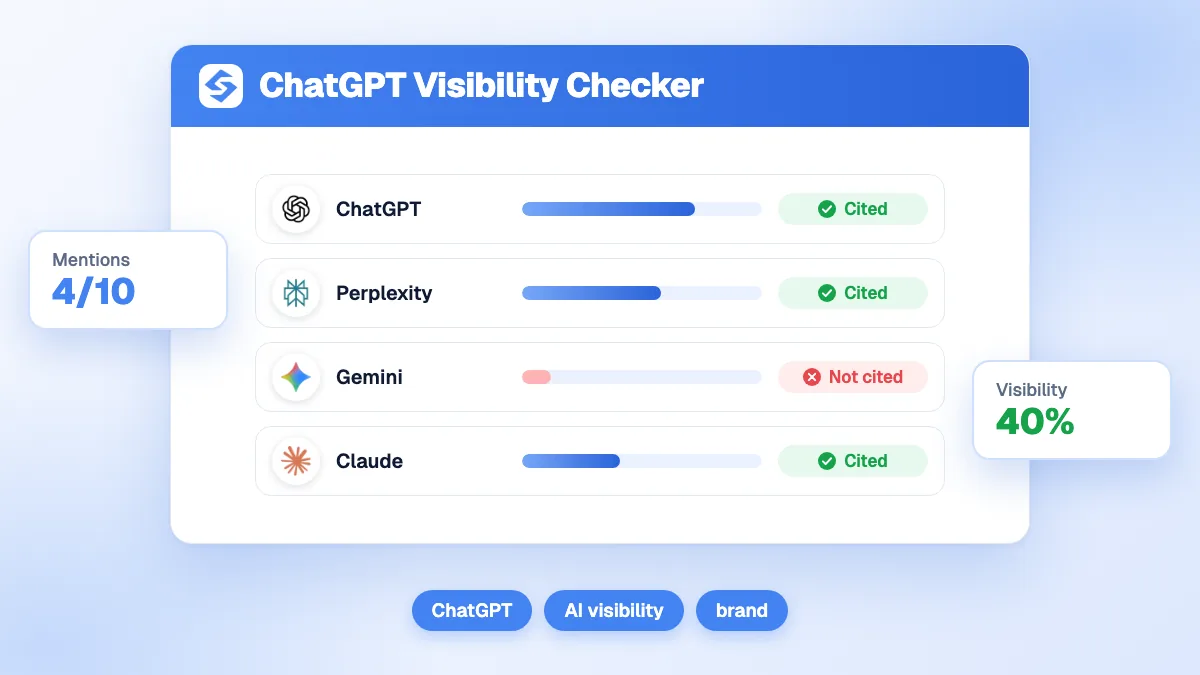
The ChatGPT visibility checker does steps 2 and 3 for one question at a time, with the sources and competitors of each answer. For the definitions, see the glossary entry on AI citations.

Why does being cited first matter?
Because attention drops quickly inside an answer, as it does on a results page. The Princeton study that defined Generative Engine Optimization measures visibility with a position-adjusted score that gives more weight to sources cited early in the answer (Aggarwal et al., GEO, KDD 2024). Clicks confirm it: Pew Research Center found that Google users who saw an AI summary clicked a link inside the summary in just 1% of visits (Pew Research Center, 2025). With so few clicks, the brand read first is often the one remembered.
Track the "share where you are first" next to the rate. A brand cited in 20% of answers but first in 60% of them is in a stronger position than one cited in 30% of answers and always last.
Why measure each AI model separately?
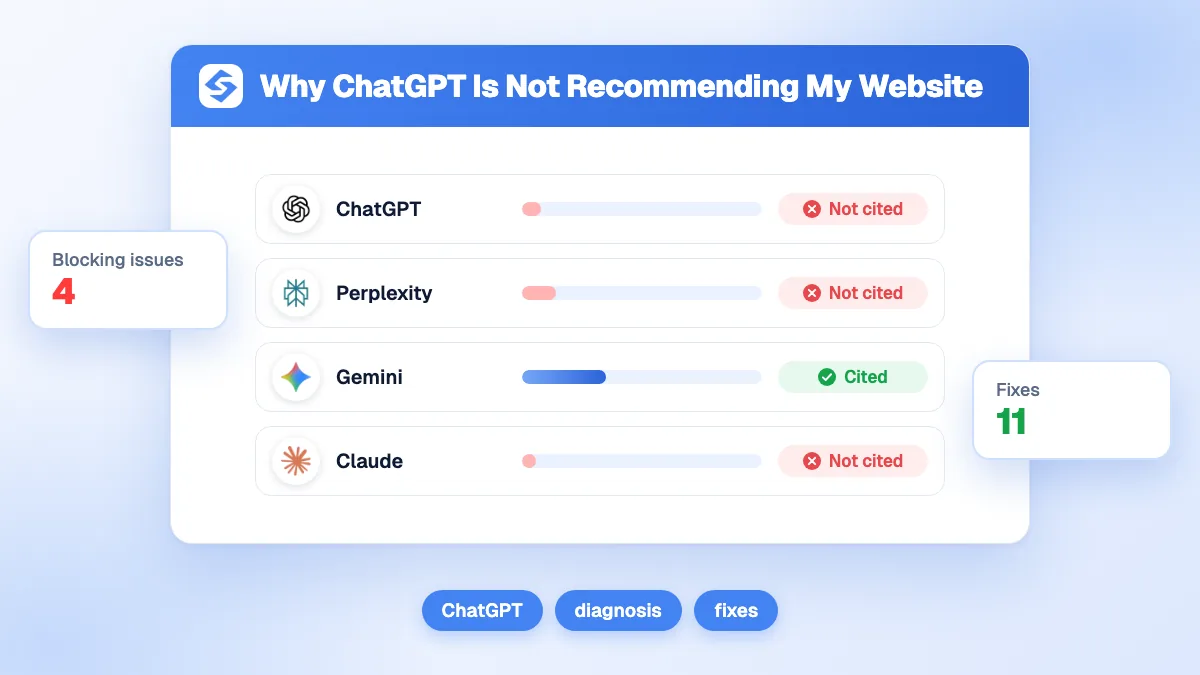
Because the models do not cite the same sources, and an average hides the one where you are absent. The "citations per model" figure is a quick check: if 4 models share 18 citations, each should have about 4 or 5. If one model has 12 and another none, the problem is specific to that model.
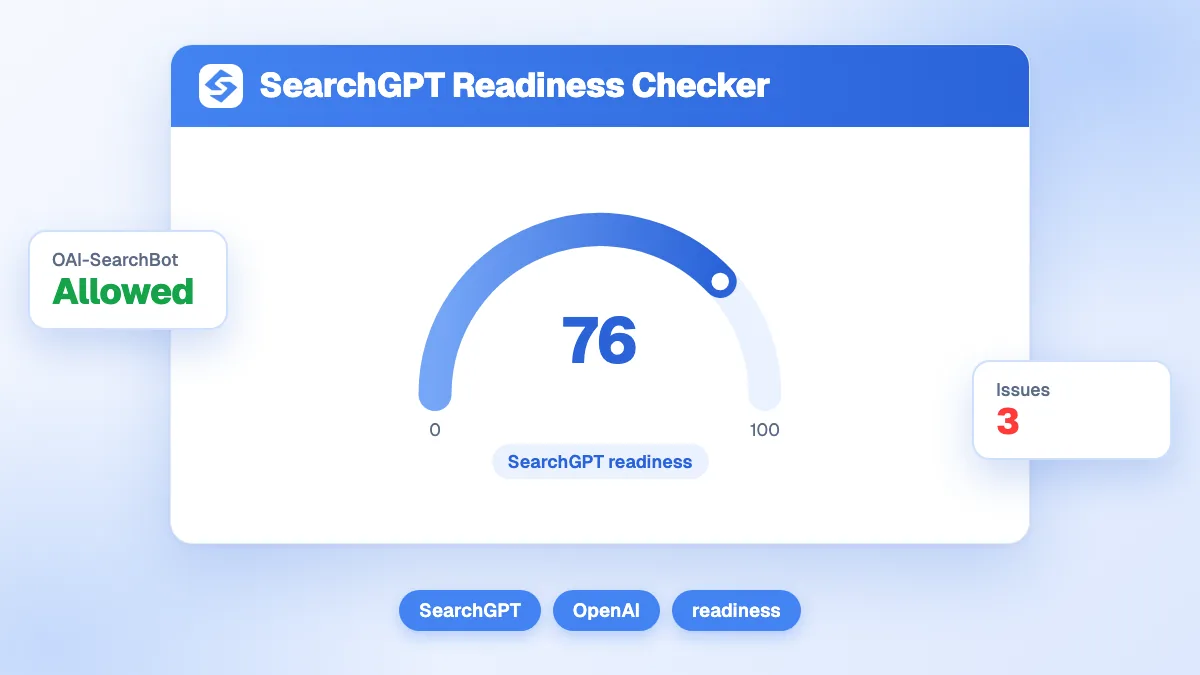
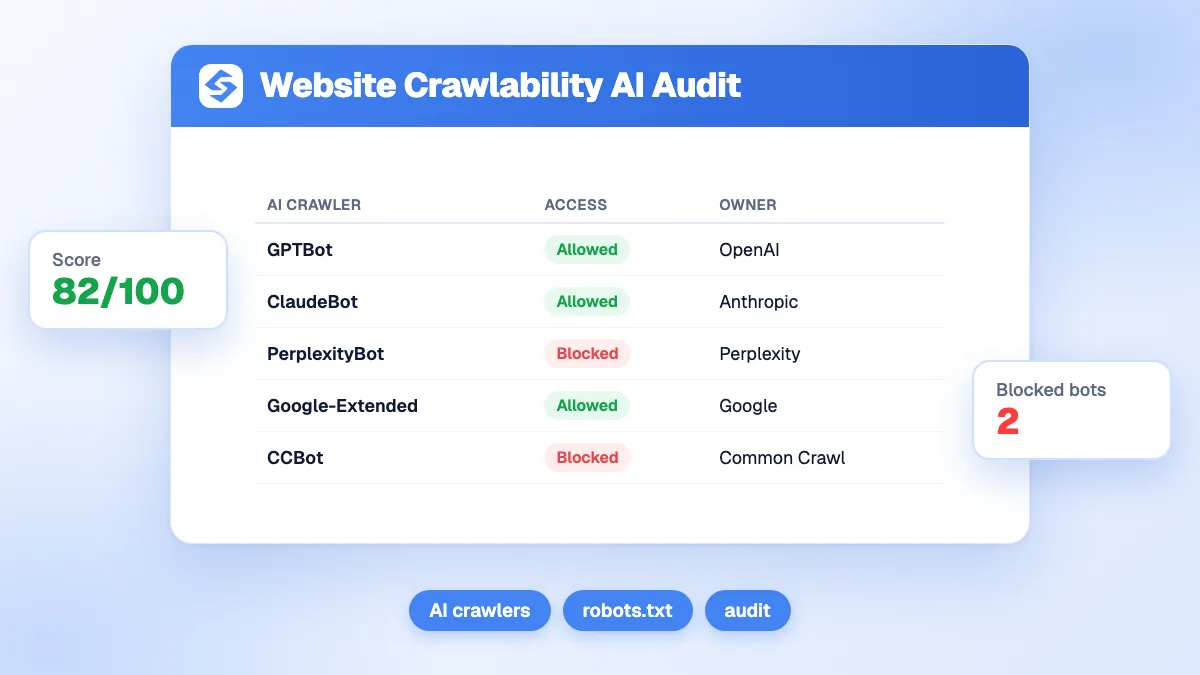
- Different crawlers: ChatGPT search relies on OAI-SearchBot and Perplexity on PerplexityBot. If one is blocked in your robots.txt, that model cannot cite your pages (OpenAI, overview of OpenAI crawlers). Check them with the AI crawlability audit.
- Different source habits: Pew found that Wikipedia, YouTube and Reddit together made up 15% of the sources listed in the Google AI summaries it examined. A brand present on these platforms has more chances to be picked up.
- Different refresh speeds: some answers rely more on live search, others more on what the model learned in training.
How do you raise your AI citation rate?
- Fix access first: allow the search crawlers of each AI.
- Answer the missing questions: the "answers without you" figure is your to-do list. Publish one page per question, with the answer in the first sentences.
- Add proof: the GEO study found that adding statistics, quotations and cited sources can raise visibility in generative answers by up to 40%.
- Get mentioned where the AIs look: the sources cited for your questions show which reviews, lists and forums to target.
- Measure again on the same prompt set after four to six weeks.
To translate a higher rate into money, use the GEO ROI calculator.
What are the limits of the citation rate?
- It depends on your prompt set: easy questions inflate the rate, very broad ones deflate it. Keep the set fixed to compare over time.
- Answers vary: the same question can get a different answer tomorrow. A monthly reading on 100 answers or more smooths that out.
- A citation is not a recommendation: a brand can be cited as an example to avoid. Read a sample of the answers, not only the totals.
- It does not count traffic: most citations bring no click, as the Pew figures show. The rate measures presence, not visits.
From a monthly rate to continuous tracking
Your citation rate is the share of AI answers that put your brand in front of a buyer: measure it on the same questions, model by model, every month. The Sorank AI mention tracking runs your prompt set on ChatGPT, Perplexity, Gemini and Claude automatically, and the GEO leaderboard compares your rate with your competitors week after week. See the Sorank plans to track it on autopilot.