Summary
The AI traffic value calculator puts a money figure on the visits your site receives from ChatGPT, Perplexity, Gemini, Copilot and other AI assistants. It multiplies those visits by your conversion rate and your value per conversion to get the monthly and annual value, then shows what the same traffic would cost in search ads and how much each visit is worth. With 900 AI visits a month, a 4.5% conversion rate and 180 per conversion, the traffic is worth 7,290 a month.
Want to go further? Ask


The AI traffic value calculator answers a question that visit counts alone cannot: is the traffic coming from AI answers worth the effort? Volumes are still small for most sites, which makes this channel easy to dismiss. Yet it grows fast: Adobe measured that traffic from generative AI sources to US retail sites rose by 1,200% between July 2024 and February 2025 (Adobe Analytics, 2025). Turning those visits into revenue puts them on the same scale as your other channels.

How is the value of AI traffic calculated?
The calculator uses four inputs and returns five results. Two ways of valuing the same visits sit side by side: what they bring in through conversions, and what they would cost through ads.
| Result | Formula | Example (900 visits, 4.5%, value 180, CPC 2.40) |
|---|---|---|
| Conversions | AI visits × conversion rate | 40.5, shown as 41 |
| Monthly value | Conversions × value per conversion | 7,290 |
| Annual value | Monthly value × 12 | 87,480 |
| Same traffic on ads | AI visits × cost per click | 2,160 |
| Value per visit | Monthly value ÷ AI visits | 8.10 |
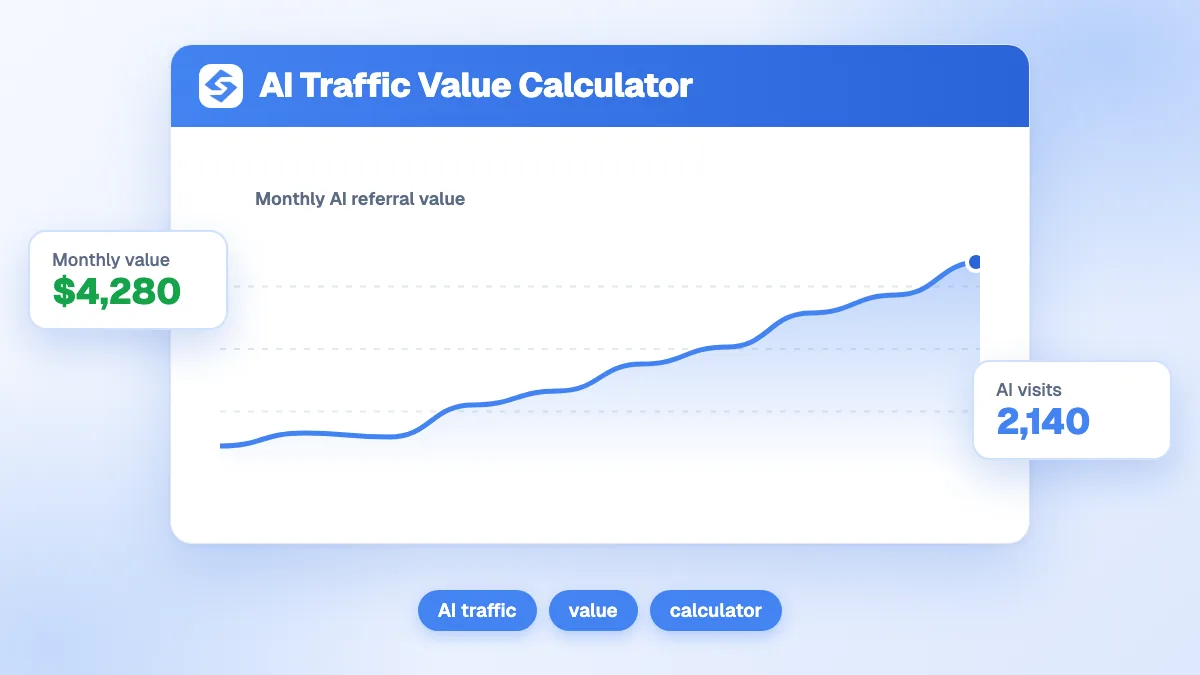
The chart compares the monthly value with the ads equivalent. When the first bar is much higher than the second, each AI visit earns more than a paid click would cost, which is the case in the example: 8.10 per visit against a 2.40 CPC.
Where do you find your AI referral visits?
In Google Analytics 4, the default channel group now includes an AI Assistant channel for visitors arriving from sources such as ChatGPT, Gemini, DeepSeek, Copilot or Grok; it excludes Google's AI Overviews and AI Mode, which stay in organic search (Analytics Help, default channel group). Open Reports, then Acquisition, then Traffic acquisition, and read the sessions of that channel for the last full month.
- No AI Assistant channel yet? Google documents a custom channel group named "AI assistants" built on a regular expression of assistant domains, placed above Referral so the visits are not counted twice (Analytics Help, custom channel groups).
- Other analytics tools: filter referrals from chatgpt.com, perplexity.ai, gemini.google.com, copilot.microsoft.com and claude.ai.
- Google's own AI features: Search Console has a Generative AI performance report that shows your impressions in AI Overviews and AI Mode (Search Console Help). Clicks from those features count as organic search, so value them with the organic traffic value calculator.
Expect an undercount. Some apps and assistants open links without passing a referrer, and those visits land in Direct. Treat the figure you enter as a floor.
Does AI traffic convert better than organic search?
It engages more, and its conversion gap is closing; whether it converts better depends on your site. Adobe's 2025 data on US retail sites is the most detailed public measurement so far.
| Behavior of visitors from generative AI sources | Compared with other traffic (Adobe, February 2025) |
|---|---|
| Time on site | 8% higher engagement |
| Pages per visit | 12% more |
| Bounce rate | 23% lower |
| Likelihood to convert | 9% lower, against 43% lower in July 2024 |
The lesson: use your own conversion rate for AI visits as soon as you have 30 to 50 conversions to measure it. Until then, start from your organic search rate and test a range. Our glossary entry on AI-referred traffic explains how these visitors differ from search visitors.
What is AI traffic worth for different businesses?
The same number of AI visits can be worth very different amounts, because the conversion rate and the value per conversion change with the business model. The three examples below use illustrative inputs run through the calculator; replace them with your own figures.
| Business | AI visits / month | Conversion rate | Value per conversion | Monthly value | Value per visit |
|---|---|---|---|---|---|
| Online store | 2,000 | 2% | 70 (average order) | 2,800 | 1.40 |
| B2B software | 400 | 3% (demo requests) | 900 (demo value) | 10,800 | 27.00 |
| Local law firm | 150 | 5% (contact forms) | 600 (case value) | 4,500 | 30.00 |
For a lead business, the value per conversion is the value of a lead: average deal value multiplied by your close rate. The store gets the most visits and the lowest value per visit, which is why visit counts alone mislead.
Which cost per click should you enter?
Use the CPC of the keywords that match the questions people ask the assistants about your offer, not your brand name. Google Ads charges per click at a price set by auction, capped by your maximum bid (Google Ads Help, cost per click). If you do not run ads, a market benchmark gives an order of magnitude: across industries, the average search CPC was $5.42 in 2026, from $1.63 in arts and entertainment to $9.87 for legal services (LocaliQ search advertising benchmarks). The keyword value calculator helps you estimate the value of one query in particular.

How do you read the result?
Read three numbers, in this order.
- Value per visit. Compare it with the same figure for organic search; if AI visits are worth more, every new citation in an AI answer is worth chasing.
- Annual value. It sizes the channel for a budget discussion, even when monthly visits look small.
- Ads equivalent. It tells finance what buying the same visitors would cost, a useful floor when your conversion data is thin.
Then project growth. If AI visits double over the year with the same conversion rate, the annual value doubles too. To model the cost of not being cited at all, run the AI invisibility cost calculator, and to estimate future ChatGPT visits, the ChatGPT traffic estimator.
What makes the AI traffic estimate wrong?
- Counting AI Overviews clicks as AI referrals. They are Google organic clicks; adding them here counts them twice.
- One lucky month. A single viral answer can spike visits. Use a three-month average.
- An average order value from all channels. If AI visitors buy different products, segment the value per conversion.
- Ignoring the visits that never come. Pew found that when a Google AI summary appeared, users clicked a link inside it in only 1% of visits (Pew Research Center, 2025). Much of the value of being cited is brand exposure that analytics never records.
How do you increase the value of your AI traffic?
Get cited more often on the questions that lead to a purchase, and make the landing page convert the informed visitor who arrives.
- Know where you stand with Sorank AI mention tracking, which checks every week whether ChatGPT, Claude and Gemini mention your brand, prompt by prompt.
- See who is cited instead of you in the GEO leaderboard, which ranks the sites AI assistants cite in your market.
- Follow AI visits next to Google clicks in the GEO and SEO dashboard, which brings Search Console, Analytics and AI visibility together.
AI traffic is small in volume and high in value: measure it in money, not in visits. Run the calculator with your own figures, then see the Sorank plans to grow your citations on autopilot.