




Summary
The ecommerce SEO ROI calculator turns organic visits into orders, revenue and gross margin, then compares that margin with your monthly SEO spend. Orders = visits × conversion rate; revenue = orders × average order value; gross margin = revenue × margin rate; ROI = (gross margin − SEO spend) ÷ SEO spend. With 20,000 visits, a 1.8% conversion rate, a 75 basket, a 40% margin and 3,000 of spend, the store makes 7,800 of profit after SEO, an ROI of 260%.
Want to go further? Ask


The ecommerce SEO ROI calculator answers the question a store owner asks before renewing an SEO budget: does organic traffic pay for itself once the cost of the goods is taken out? Most ROI tools stop at revenue. A store keeps only its margin, so this calculator works on gross margin, which is the only honest base for a retailer. Change the currency in the tool; the formulas stay the same.

How is ecommerce SEO ROI calculated?
Five inputs feed four steps. Each result appears on its own line, so you can see where the money goes between the visit and the profit.
| Result | Formula | Example (20,000 visits, 1.8%, 75 basket, 40% margin, 3,000 spend) |
|---|---|---|
| Orders | Visits × conversion rate | 360 |
| Revenue | Orders × average order value | 27,000 |
| Gross margin | Revenue × margin rate | 10,800 |
| Profit after SEO | Gross margin − SEO spend | 7,800 |
| Return on investment | Profit after SEO ÷ SEO spend × 100 | 260% |
A chart shows revenue, gross margin, spend and profit side by side, and the verdict reads the ROI on a fixed scale: zero or below means the store is losing money, up to 100% is to watch, up to 300% is healthy, and above 300% is excellent.
Why does the calculator use margin instead of revenue?
Because revenue is not what pays the SEO invoice. A store selling at 20% margin keeps 20 of every 100 sold; a store selling digital goods at 90% keeps 90. Calculated on revenue, both would show the same ROI. Calculated on margin, the first one needs four and a half times more revenue to earn the same profit.
| Gross margin | Revenue needed to cover 3,000 of SEO | Orders needed at a 75 basket |
|---|---|---|
| 20% | 15,000 | 200 |
| 40% | 7,500 | 100 |
| 60% | 5,000 | 67 |
| 90% | 3,333 | 45 |
The break-even line is simple: SEO spend ÷ margin rate = revenue needed. The SEO break-even calculator works out the same threshold in visits and months.
Where do you find the inputs?
From your analytics and your store back office. Use monthly averages over at least three months so a sale period does not distort the result.
- Monthly organic visits: sessions from organic search in Google Analytics, or clicks in the Search Console Performance report.
- Conversion rate: orders divided by sessions for the organic channel. Shopify defines it as "Orders / Visits to your website" and notes that global averages "tend to sit around 2% to 3%", varying widely by industry, price and device (Shopify, ecommerce conversion rate).
- Average order value: net of discounts, taxes and shipping you pass through.
- Gross margin: selling price minus the cost of goods, as a share of the price. Remove returns: in the United States, the National Retail Federation projected $890 billion of retail returns for 2024 (NRF, 2024 consumer returns).
- SEO spend: agency or freelance fees, content, links and tools, per month.
Check your rate on its own with the conversion rate calculator.

How do you calculate the ROI of new SEO work, not of all organic traffic?
Enter only the extra visits. The calculator counts every organic visit you type in, so with your total organic traffic it measures the return of the whole channel. To judge a new SEO budget, enter the visits you expect to add, or the gain since the work started, compared with the same months of the previous year.
- Take a baseline: organic visits before the project, adjusted for seasonality.
- Measure the gain: current organic visits minus the baseline.
- Enter the gain as monthly visits, with the same conversion rate, basket and margin.
That figure is the incremental ROI, the one to use when deciding whether to continue. To forecast the gain month by month before it happens, use the SEO forecast calculator.
Which pages drive ecommerce SEO revenue?
Category pages usually bring the volume, product pages the purchase intent. Check which of the two your organic traffic lands on before planning the next quarter.
- Category pages rank on broad terms such as "running shoes for women". Give them a short introduction, clean filters and internal links.
- Product pages rank on precise terms such as a model name. Unique descriptions and product structured data matter most here.
- Guides and comparisons catch shoppers earlier, then send them to categories with internal links.
Google recommends two ways to share product information: structured data on product pages, and a feed in Google Merchant Center. Structured data "isn't required to appear in Google Search results", but it helps Google understand price, discount and shipping, and makes pages eligible for product rich results (Google, share your product data). The schema markup generator writes Product markup with price, availability and rating.
How do you raise the ROI of your store's SEO?
Each input is a lever. A small gain on conversion or margin raises the ROI as much as a large gain in traffic.
| Lever | Change | Effect on the example |
|---|---|---|
| Organic visits | +20% (24,000) | ROI from 260% to 332% |
| Conversion rate | 1.8% to 2.2% | ROI from 260% to 340% |
| Average order value | 75 to 85 | ROI from 260% to 308% |
Conversion is often the cheapest lever. Baymard Institute calculates an average cart abandonment rate of 70.22% across 50 studies, and, setting aside shoppers who were just browsing, finds that 40% of those who left cited extra costs such as shipping, taxes and fees (Baymard Institute, cart abandonment statistics). Showing the full price early can be worth more than a month of new content.
Which costs belong in the monthly SEO spend?
All of them, or the ROI will look better than it is. A fair monthly figure adds up:
- People: agency or freelance fees, or the share of an employee's time spent on SEO.
- Content: writing, product photos and category texts, spread over the months they serve.
- Links and mentions: outreach, sponsored placements and digital PR.
- Tools: analytics, crawlers, rank tracking and AI visibility tracking.
- Development: technical fixes such as faster templates, cleaner filters or structured data.
Recalculate every quarter with fresh numbers. Margins, baskets and conversion rates move with prices, promotions and the season, and an ROI computed in a sale month will not hold in a quiet one.
How does AI shopping change ecommerce SEO?
Product discovery is moving into AI answers. In 2025 Google introduced an AI Mode shopping experience that combines its Gemini models with its Shopping Graph (Google, AI Mode update). Clean product data, accurate structured data and an up-to-date Merchant Center feed are what these systems read. Track whether assistants such as ChatGPT and Gemini recommend your products with AI mention tracking.
How do you grow the organic traffic that feeds the calculator?
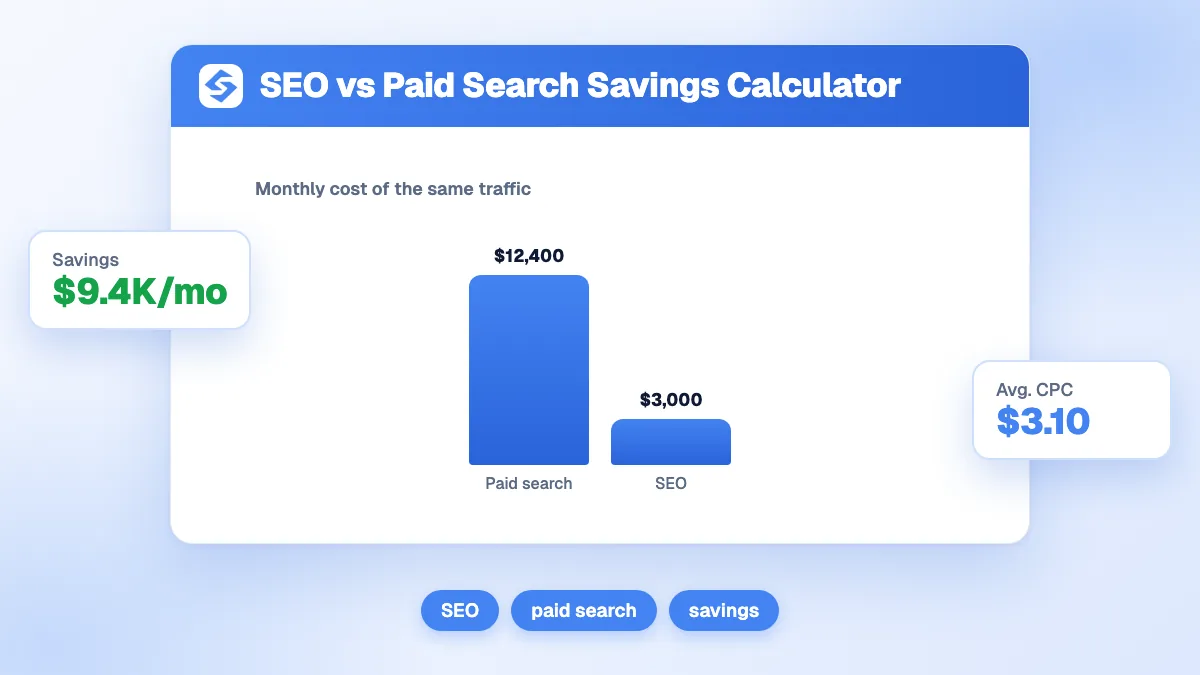
Target the searches closest to a purchase first, then the guides that lead to them. The Sorank keyword research finds the commercial keywords your categories and products can rank for without cannibalizing each other, and the blog article generator publishes buying guides with internal links to your categories. Compare the result with the cost of ads using the SEO vs paid savings calculator.
For a store, SEO pays when the margin it brings exceeds what it costs. Run the calculator with your own numbers, then with the gain you expect, and see the Sorank plans to grow that margin on autopilot.