




Summary
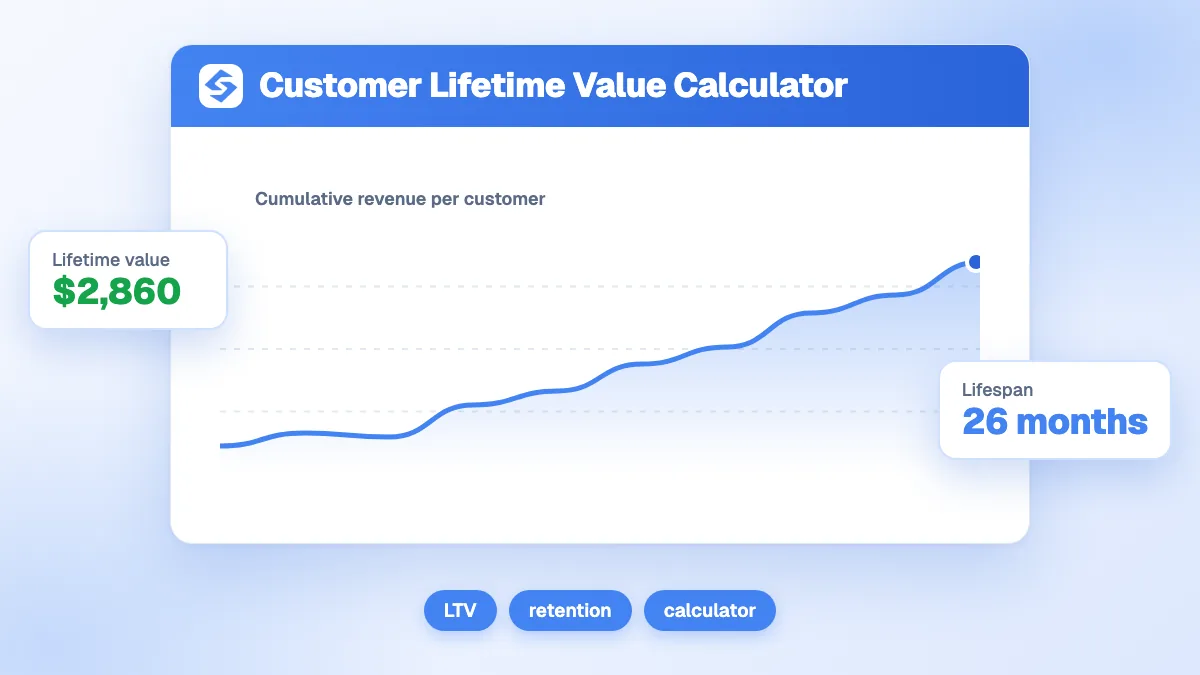
Customer lifetime value (CLV or LTV) is the gross profit a customer brings over the whole relationship: average order value × orders per year × years as a customer × gross margin. The calculator also shows the gross revenue, the value per year, the number of orders and your acquisition ceiling, the most you can pay to win a customer while keeping a 3 to 1 ratio. With an 85 order, 4 orders a year, 3 years and a 60% margin, a customer is worth 612, and you can spend up to 204 to acquire one.
Want to go further? Ask


A customer lifetime value calculator tells you how much a customer is really worth, and therefore how much you can spend to get one. The number matters because keeping customers pays: depending on the study and the industry, acquiring a new customer costs five to 25 times more than retaining an existing one, and research by Frederick Reichheld of Bain & Company found that a 5% increase in retention raises profits by 25% to 95% (Harvard Business Review, 2014).
How is customer lifetime value calculated?
The calculator multiplies four inputs and returns five results. All amounts use the currency you pick in the tool.
| Result | Formula | Example (85 order, 4 per year, 3 years, 60% margin) |
|---|---|---|
| Lifetime value | Order value × orders per year × years × gross margin | 612 |
| Gross revenue | Order value × orders per year × years | 1,020 |
| Value per year | Order value × orders per year × gross margin | 204 |
| Orders over lifetime | Orders per year × years | 12 |
| Acquisition ceiling at 3x | Lifetime value ÷ 3 | 204 |
The gap between the first two lines is the point of the tool. The customer spends 1,020 with you, but only 612 of it is gross profit. An acquisition budget based on 1,020 makes every channel look profitable.
Where do you find the four inputs?
- Average order value: revenue divided by the number of orders over the last 12 months, from your shop, billing or analytics tool. For a subscription, enter the monthly price and 12 orders per year.
- Orders per year: the number of orders divided by the number of distinct customers over 12 months. Decimals are fine (1.6 orders per year).
- Years as a customer: the input people guess wrong most often. Take it from your own cohorts. If you know your churn, lifetime is 1 divided by the churn rate for the same period: a 20% annual churn means a 5-year lifetime, a 3% monthly churn means 33 months (David Skok, SaaS Metrics 2.0 definitions).
- Gross margin: revenue minus the direct cost of what you sold (goods, delivery, payment fees), as a percentage of revenue. Leave overheads out; they do not grow with one more customer.

What does customer lifetime value look like by business model?
The same formula gives very different results depending on how often customers buy and how long they stay. These examples are illustrations, not industry benchmarks: run the calculator with your own figures.
| Business | Order value | Orders per year | Years | Margin | Lifetime value | Ceiling at 3x |
|---|---|---|---|---|---|---|
| Online shop, occasional purchases | 60 | 2 | 2 | 40% | 96 | 32 |
| Coffee subscription | 25 | 12 | 1.5 | 50% | 225 | 75 |
| Local service (dental care) | 150 | 2 | 5 | 60% | 900 | 300 |
| B2B software at 200 a month | 200 | 12 | 4 | 80% | 7,680 | 2,560 |
The shop can barely afford paid ads at 32 per customer; the software company can fund a sales team. That is why the lifetime value comes before any decision on channels.
Why use a 3 to 1 ratio for the acquisition ceiling?
Because it leaves room for overheads and profit once the customer is paid for. In his SaaS metrics guide, investor David Skok reports that the best SaaS businesses have a lifetime value to acquisition cost ratio higher than 3, sometimes 7 or 8, and that many recover their acquisition cost in 5 to 7 months (David Skok, SaaS Metrics 2.0).
| LTV to CAC ratio | What it means |
|---|---|
| Below 1 | Each new customer loses money |
| 1 to 3 | Customers pay for themselves, but leave little for overheads and growth |
| Around 3 | The usual target: acquisition is profitable and sustainable |
| Well above 5 | Very profitable, and possibly underinvested: you could spend more to grow faster |
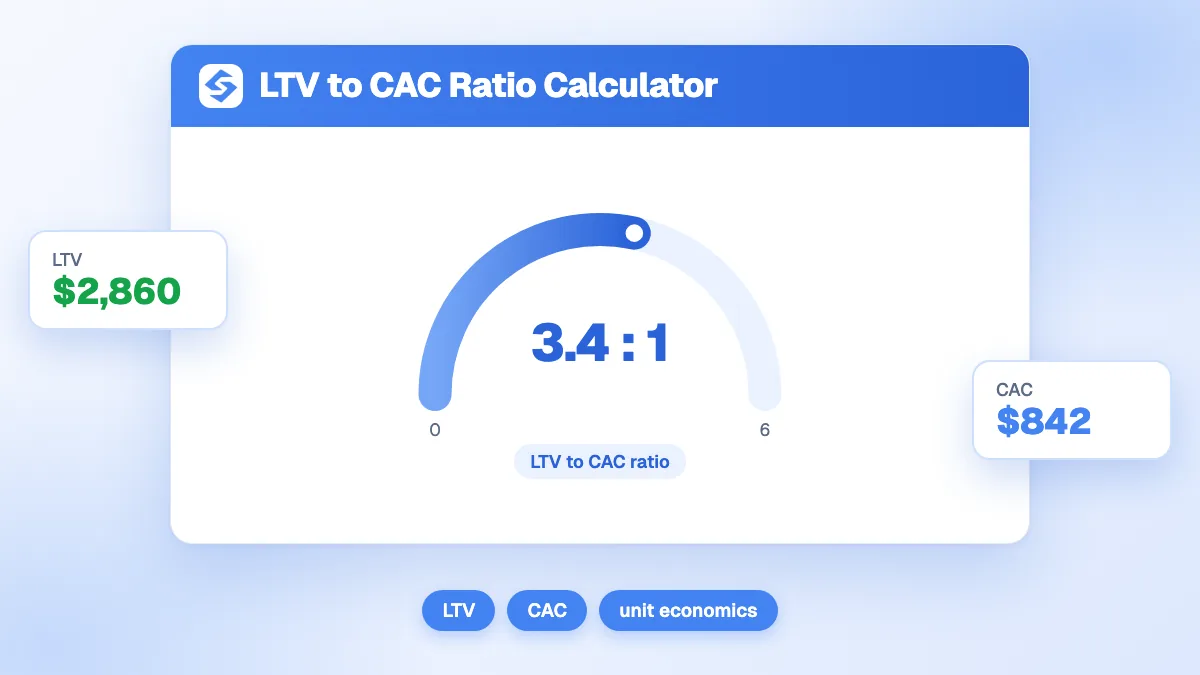
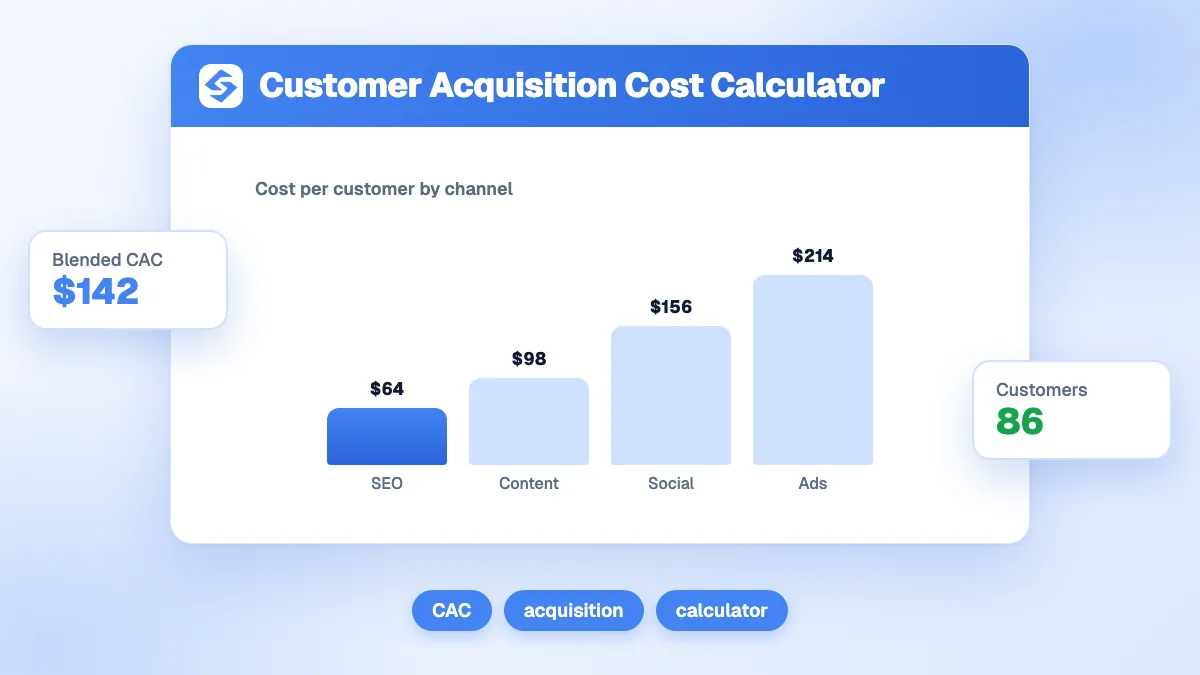
Check your current ratio with the LTV to CAC ratio calculator and your real acquisition cost with the customer acquisition cost calculator.
Which lever raises lifetime value the most?
Every input multiplies the others, so a small gain on each adds up. From the 612 of the example:
- Keep customers one more year (3 to 4 years): 816, +33%.
- Add one order a year (4 to 5): 765, +25%.
- Raise the average order from 85 to 100: 720, +18%.
- Gain 10 points of margin (60% to 70%): 714, +17%.
Retention usually wins, which matches the HBR figures above. Onboarding, support, reminders and loyalty offers cost less than finding a new customer to replace the one who left.

How does lifetime value change your SEO and content budget?
It tells you what a customer from search is allowed to cost. If organic search brings 10 customers a month and each is worth 612, each month of organic acquisition brings 6,120 of lifetime gross profit. Compare that with what you spend on content and links, and you know whether to push harder.
- Compute the lifetime value with the calculator above.
- Count the customers that come from organic search in your analytics or CRM.
- Divide your monthly SEO spend by those customers: that is your SEO acquisition cost.
- Compare it with the ceiling. Below the ceiling, invest more; above it, fix conversion first.
The SEO ROI calculator and the SEO budget calculator take it from there. Unlike ads, content you paid for once keeps bringing visitors in the following months, which lowers the acquisition cost over time.
How do you calculate lifetime value for a subscription?
Enter the monthly price as the order value and 12 as the number of orders per year. For the years as a customer, divide 1 by your annual churn rate: if 25% of subscribers cancel each year, the average customer stays 4 years. Then enter the gross margin of the service, after hosting, payment fees and support costs that grow with each customer. A 49 monthly plan, kept 4 years at an 80% margin, is worth 49 × 12 × 4 × 0.8 = 1,882 per customer, with an acquisition ceiling of about 627.
What are the limits of this lifetime value formula?
- Averages hide segments. A few loyal customers can carry the average. Compute lifetime value by channel or by first product when you can.
- No discounting. A sale in year three is worth less than a sale today. For long lifetimes, the simple formula overstates the value.
- Constant behavior. The formula assumes the same order value and frequency every year, while real customers buy more at first, or less.
- Young businesses guess. Without three years of history, the lifetime is an assumption. Start low and update it every quarter.
How do you bring in customers worth more for less?
Attract people who are already looking for what you sell, and reach them where they ask. Search and AI assistants do both.
- Find the buying keywords of your market with Sorank keyword research.
- Publish the pages that answer them with the blog article generator, on a schedule set in the blog planner.
- Follow clicks and AI visits to those pages in the GEO and SEO dashboard.
Know what a customer is worth before you decide what to pay for one. Run the calculator with your own numbers, then see the Sorank plans to win customers from search and AI answers on autopilot.