Preferences
Privacy is important to us, so you have the option of disabling certain types of storage that may not be necessary for the basic functioning of the website. Blocking categories may impact your experience on the website. More information

Privacy is important to us, so you have the option of disabling certain types of storage that may not be necessary for the basic functioning of the website. Blocking categories may impact your experience on the website. More information

Backlink gap analysis in 2026: find sites linking to competitors but not to you, filter the noise, score each domain and turn the gap into links.

Tools

In short
a backlink gap analysis lists the websites that link to two or more of your search competitors but not to you. You run it in a backlink suite (Semrush Backlink Gap, Ahrefs Link Intersect, Moz Link Intersect, Majestic Clique Hunter), remove the noise (spam, directories, paid links), score each remaining domain on relevance, authority and how many competitors it links to, then contact the best ones with a reason to link. Domains that already link to several competitors are the easiest wins, because they have proven they cover your topic.
Want to go further? Ask
Quick quiz
How should you get links from other websites?
Sorank matches your answers


Test it for 3 days on your own site and see where you stand on Google, ChatGPT and the other AIs.
Start 3-day free trial3 days free, then stop whenever you want. 90-day results-or-refund guarantee.
Links still count. Google states in its guide to ranking systems that PageRank, its link analysis system, "continues to be part of our core ranking systems". The hard part is knowing which links to chase. A backlink gap analysis answers that question with evidence: instead of guessing who might link to you, you start from sites that have already linked to pages like yours.
This guide gives a seven-step method that works with any of the large suites, a scoring grid to prioritize the results, the mistakes that waste most of the time spent on this exercise, and the link between backlink gaps and visibility in ChatGPT, Gemini and Perplexity.
A backlink gap is the set of referring domains that link to your competitors and not to you. The analysis compares several link profiles side by side and isolates those domains, sorted by how many competitors each one links to. It is a branch of competitor analysis focused on off-page signals.
It is easy to confuse with three neighboring analyses. Each answers a different question:
| Analysis | Question it answers | Input | Output |
|---|---|---|---|
| Backlink analysis | Who links to my site, and is the profile healthy? | One domain | Referring domains, anchors, toxic links |
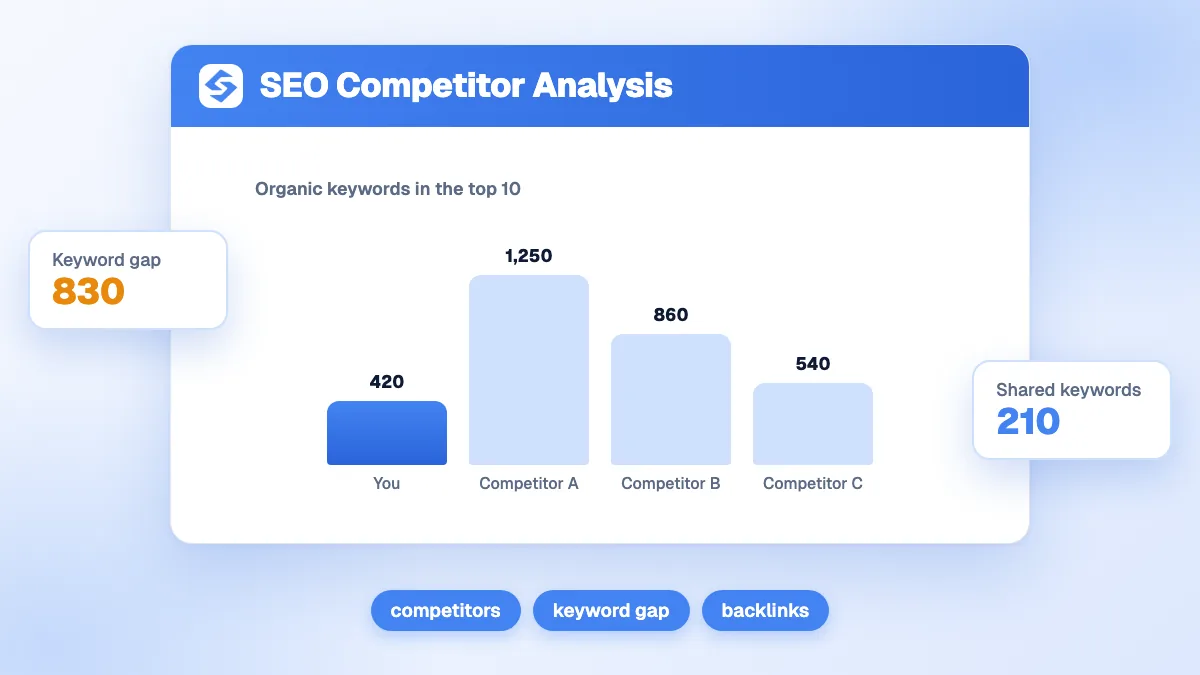
| Backlink gap analysis | Who links to my competitors and not to me? | Your domain plus 2 to 5 competitors | A prioritized list of link prospects |
| Keyword gap analysis | Which queries do competitors rank for that I miss? | Your domain plus competitors | Keywords and pages to create |
| Citation gap analysis | Which sources do AI assistants cite instead of me? | A set of prompts | Pages and sites to get mentioned on |
A single-domain review, like the one our free backlink analysis tool produces, describes your own profile. The gap analysis is comparative: it only makes sense with competitors, and it pairs well with a keyword gap analysis, since the pages that win links are often the same pages that win rankings.
Most link building starts with cold prospecting: lists of blogs, guest post platforms, generic outreach. Response rates are low because nothing tells you the site cares about your topic. A gap analysis reverses the logic. A domain that already links to three of your competitors has shown three times that it publishes about your subject and that it links out. Overlap is the strongest prospecting signal you can get from public data.
The analysis also explains ranking differences. If the pages ahead of you have 60 referring domains and yours has 12, content improvements alone rarely close the distance. The gap shows the size of the deficit and, more usefully, where the missing links come from: industry media, resource pages, partner pages, statistics roundups, comparison articles or local associations.
Finally, it reveals the tactics behind a competitor's growth. When a dozen gap domains link to the same competitor study, you know a data asset worked in your market. When most of them are podcasts or event pages, you know where the competitor spends its time.
Compare yourself with the domains that rank for your target keywords, which are not always the companies you lose deals to. Take your 5 to 10 most important queries, note who holds the top positions, and keep the 3 to 5 domains that appear most often. Exclude giants like Wikipedia, Amazon or national newspapers: their profiles are too large and too broad to be replicated, and they flood the results with irrelevant domains.
Compare whole domains to find sites that cover your industry in general. Compare exact URLs when you are trying to rank one specific page: put your page against the 3 to 5 URLs that outrank it for its main keyword. Page-level gaps are smaller but far more relevant, because every prospect has linked to an article on your exact subject.
Every large suite has a dedicated report. Semrush Backlink Gap compares a site with up to five competitors at once (Semrush, checked October 2026). In Ahrefs, the Link Intersect report (part of the Competitive Analysis tool) lists domains that link to the competitors you enter but not to your site. Moz Link Intersect and Majestic Clique Hunter do the same job on their own link indexes. Export the full list to a spreadsheet rather than working inside the interface.
Tip
Run the same comparison in two suites if you can. Each crawler sees a different part of the web, and the domains found by both tools are the ones most likely to still hold a live link.
A raw export usually contains a majority of domains you should never contact. Delete scraper sites, auto-generated statistics pages, low-quality directories, link farms and sites with no organic traffic. Also remove links you cannot or should not replicate: links from a competitor's own network of sites, sponsorships, and paid placements. Google's spam policies list "buying or selling links for ranking purposes" as link spam, so copying a competitor's paid links copies its risk. Our guide to toxic backlinks details the patterns to drop.
Open the linking page, not only the domain, and tag how the link was earned: editorial mention, resource page, guest article, product review, comparison, interview, partner or integration page, event, association membership. The tag tells you which approach to use, and the counts per tag show which tactics dominate your market.
Score each domain with the grid in the next section and sort by total. In practice, a domain that links to all your competitors is a high priority, one that links to two is medium, and one that links to a single competitor is low, unless it is exceptionally relevant. Ahrefs uses the same three-level logic in its published link gap method (January 2025).
For each prospect, decide which of your pages deserves the link and why it is better or newer than what the site already cites. A resource page needs a resource, a statistics roundup needs a figure, a comparison needs a product worth comparing. Write a short, personal message following the rules in our email outreach guide, log the date and status, and re-run the gap analysis every quarter to measure progress and catch new competitor links.
A long list of prospects is useless without an order. Score each domain from 0 to 3 on five criteria and work from the top of the list:
| Criterion | What to check | 3 points | 0 points |
|---|---|---|---|
| Competitor overlap | How many competitors the domain links to | All of them | Only one |
| Topical relevance | Does the site publish about your subject? | Same niche | Unrelated |
| Authority and traffic | Organic traffic and domain authority | Real, stable traffic | No traffic |
| Replicability | Can you earn the same kind of link? | Open resource page or regular roundups | Paid, private or one-off |
| Link value | Placement in the body, followed link, page indexed | Editorial link in an indexed article | Footer, sitewide or noindex page |
A domain scoring 12 or more deserves a tailored pitch. Between 8 and 11, a lighter approach works. Below 8, keep it for later. The criteria mirror those in our guide to quality backlinks: relevance and real traffic weigh more than any third-party authority score, which is an estimate built by each tool, not a Google metric.
Note
Nofollow links in the gap still have value: they bring referral traffic and brand mentions, and Google treats nofollow as a hint rather than a strict rule. Keep them in the list with a lower score instead of deleting them.
The same analysis now feeds visibility in AI answers. In a study of 75,000 brands, Ahrefs found that branded web mentions correlated with visibility in Google AI Overviews at 0.664, against 0.218 for the raw number of backlinks (Ahrefs, May 2025). Correlation is not causation, but the message is consistent: AI assistants reward brands that are discussed on many relevant sites, which is what a gap analysis helps you achieve.
Two adjustments make your gap analysis useful for GEO as well as SEO. First, keep the domains that mention competitors without linking: an unlinked brand mention still counts for AI. Second, cross the link gap with a citation gap: the pages that ChatGPT or Perplexity cite when they recommend your competitors are prospects of the highest value, because they influence both rankings and AI answers. Our study of the platforms AI cites most shows which types of sites to target first.
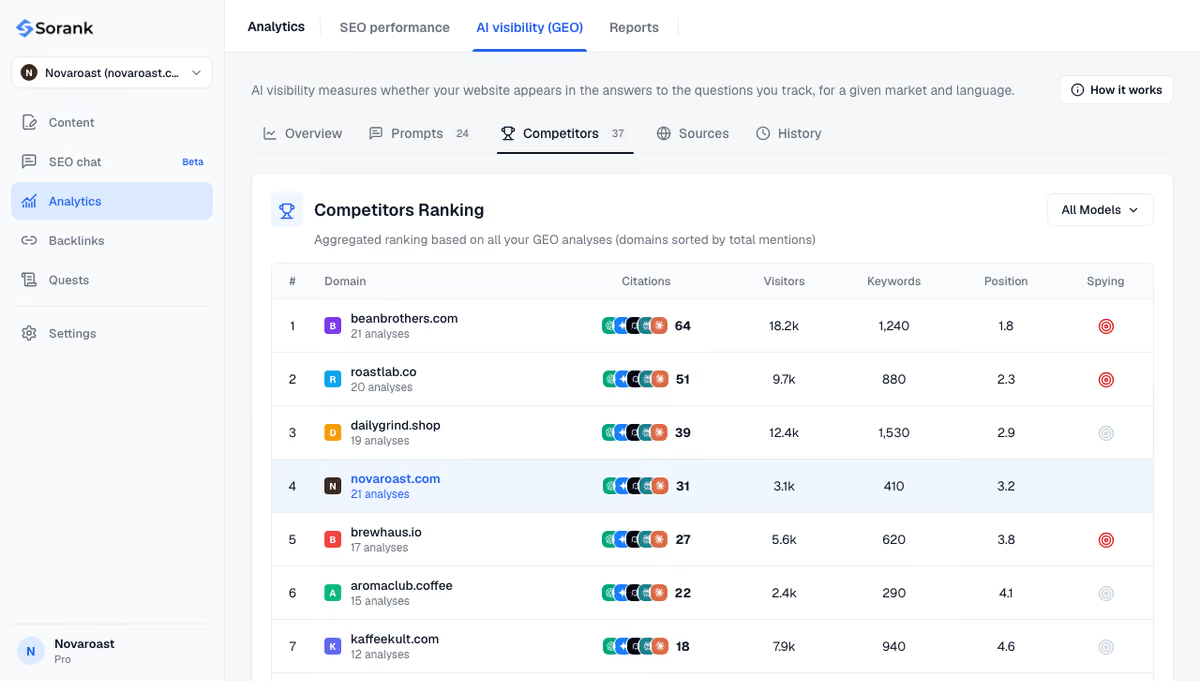
Sorank's SEO Competitor Spy shows which competitors AI assistants cite for the questions you track, so you know whose profile to study. On the link side, Sorank's backlinks acquisition feature obtains natural backlinks automatically from the sites of its 5,000+ users, which closes part of the gap without manual outreach.
A backlink gap analysis is a short exercise with a long tail: one afternoon of comparison and filtering gives you a prospect list for the whole quarter. Start with the domains that link to all your competitors, open every linking page, and pitch only when you have a page worth citing. For the wider set of tactics, from digital PR to resource pages, read our backlink strategies guide and the definition of link building. To combine content, AI tracking and automatic backlinks in one tool, see Sorank's plans, from $49 per month billed annually, with a 3-day free trial.

Three to five competitors is the useful range. With fewer than three, the overlap signal is weak because few domains link to several sites. With more than five, the list grows quickly and fills with general sites that are less relevant to your niche.
Partly. Google Search Console shows your own links, and free backlink checkers show a sample of each competitor's links, which you can compare in a spreadsheet. The paid suites (Semrush, Ahrefs, Moz, Majestic) are much faster because they compare full link indexes and export the overlap directly.
Once a quarter suits most sites, and once a month in very competitive markets. Each new run shows the links your competitors earned recently, which are the easiest to replicate because the publishers are still covering the topic.
We analyse your competitors, your website and your AI visibility to create a tailored content plan for free.
 AI Content Brief Generator
 FAQ Schema Generator
 AI Blog Post Ideas Generator
 Structured Data Validator (Schema Validator)
 Alt Text Checker
 Internal Link Analyzer
 Backlink Challenge
 AI Meta Description Generator
 AI Blog Title Generator
 Google Indexability Checker
 AI Blog Outline Generator
 UTM Link Builder
 Keyword Clustering Tool
 Canonical Tag Checker
 XML Sitemap Generator
 Broken Link Checker
 AI SEO Title Generator
 Headline Analyzer
 SERP Preview Tool
 Redirect Checker
 Hreflang Tag Generator
 Heading Structure Analyzer
 HTTP Headers Checker
 Favicon Extractor
 SERP CTR Calculator
 SEO vs Paid Search Savings Calculator
 SEO Share of Voice Calculator
 SEO ROI Calculator
 SEO Traffic and Revenue Forecast Calculator
 SEO Budget Calculator
 SEO Break-Even Calculator
 SaaS SEO ROI Calculator
 ROAS Calculator
 Reading Time Calculator
 Ranking Gain Simulator
 Organic Traffic Value Calculator
 Organic Traffic Estimator and Website Traffic Checker
 LTV to CAC Ratio Calculator
 Local SEO ROI Calculator
 Link Building Cost Calculator
 Keyword Value Calculator
 Keyword Opportunity Score Calculator
 Keyword Density Calculator
 GEO ROI Calculator
 GEO Content Investment Calculator
 Ecommerce SEO ROI Calculator
 Customer Lifetime Value Calculator
 Customer Acquisition Cost Calculator
 CTR Calculator
 Cost Per Article Calculator
 Conversion Rate Calculator
 Content Marketing ROI Calculator
 ChatGPT Referral Traffic Estimator
 Bounce Rate Calculator
 Backlink ROI Calculator
 AI Visibility Score Calculator
 AI Traffic Value Calculator
 AI Share of Voice Calculator
 Cost of AI Invisibility Calculator
 AI Citation Rate Calculator
 llms.txt Validator
 AI Overview Checker and AI Overviews Rank Checker
 Robots.txt Checker
 AI SEO Audit
 LLM Readability Checker
 SearchGPT Readiness Checker
 Structured Data LLM Audit
 Website Crawlability AI Audit
 Why ChatGPT Is Not Recommending My Website
 Gemini Ranking Tool
 Perplexity Ranking Checker
 LLM Citation Checker
 Answer Engine Optimization Audit
 GEO Audit
 AI Search Visibility Test
 ChatGPT Visibility Checker
 llms.txt Generator
 URL Extractor
 Webpage to Markdown
 Sitemap Checker
 SERP Volatility Sensor
 Page Size Checker
 Word Counter
 Slug Generator
 Schema Generator
 Robots Generator
 OG Preview
 Meta Tags Generator
 Image Compressor
 Favicon Generator
 On-Page SEO Audit: SEO Checker and SEO Analyzer
 Backlink Analysis Tool
 Keyword Research Tool
 Domain Authority Checker
THEY TRIED SORANK BEFORE YOU
 “I tested Sorank on a real client site and it's insane. It does everything an agency would bill you $1500 a month for. It's going into production on that client now.”

 Guillaume Guersanguersanguillaume.com“We are an Ads agency and we wanted to get our SEO back on track once and for all. Sorank gave us a clear view of our site, helped us prioritize optimizations, and properly structure our content. The tool is easy to use, well designed for a team, and very practical for centralizing tracking without having to juggle multiple platforms. A very solid foundation to start fresh with our SEO.”
 Gaspard MadouiAds Agency
 “I just let the Sorank software do its thing, and now my DR is 25 and my page is ranking higher.”
 Lucas Flandrefoundertrace.fr“I specialized in GEO thanks to Sorank. The GEO Leaderboard allows me to show my clients their position vs competitors on ChatGPT. It’s a real commercial differentiator.”
 MélanieSEO Freelance“Great service, works well for our website and helps us understand how to improve it to rank better on Google and elsewhere. Congrats, keep going, I recommend it.”
 Hugo T.E-commerce merchant