
Preferences
Privacy is important to us, so you have the option of disabling certain types of storage that may not be necessary for the basic functioning of the website. Blocking categories may impact your experience on the website. More information

Privacy is important to us, so you have the option of disabling certain types of storage that may not be necessary for the basic functioning of the website. Blocking categories may impact your experience on the website. More information

Keyword gap analysis step by step: pick real competitors, find their keywords, filter missing and weak terms, prioritize and map them to pages, plus AI prompt gaps.

Tools


In short
A keyword gap analysis compares the keywords your competitors rank for with the keywords you rank for, to find the queries where they capture traffic and you do not. The method has five steps: choose your real search competitors, extract their rankings, filter the missing, weak and untapped keywords, prioritize them by intent and difficulty, then assign each one to an existing or new page. Run it every quarter, and extend it to the questions people ask the AIs, where the gaps are often larger than in Google.
Want to go further? Ask
A keyword gap analysis is the fastest way to turn your competitors into a research department. Instead of guessing what to write, you start from queries that already bring them visitors, which proves that demand exists and that Google accepts this type of page. This guide also covers the two closely related questions: how to find competitor keywords, and how to run a complete SEO competitive analysis.
It is a side-by-side comparison of the ranking keywords of several domains, sorted to reveal the queries you are missing. The output is a list of keywords classified by the relationship between your site and the competitors, each one a potential page or a section to add.
It is a specific form of content gap analysis: the content gap looks at topics and formats, the keyword gap measures the same problem with ranking data, query by query. The standard categories are:
| Category | Definition | Typical action |
|---|---|---|
| Missing | All selected competitors rank, you do not | Create a dedicated page |
| Weak | You rank, but below every competitor | Improve and expand the existing page |
| Untapped | At least one competitor ranks, you do not | Check intent, then create or add a section |
| Strong | You rank above all competitors | Protect, refresh, add internal links |
| Shared | Everyone ranks, with close positions | Differentiate the angle, win the snippet |
Use the domains that rank for your keywords, not only the companies you sell against. Your search competitors are often media sites, marketplaces, directories or a niche blog that your sales team has never heard of.
Our glossary entry on competitor analysis details how to qualify a competitor beyond search data, from positioning to content formats.
Export each competitor's organic keywords from an SEO tool, then add the free signals from Google itself. The tool data gives volume and position, Google gives intent and context.
Keep the gaps that match your offer and your audience, then rank them by business value, intent and effort. A raw gap report often lists thousands of keywords; most are noise.
Apply the filters in this order:
A simple scoring grid works well: value for the business (1 to 3), intent fit (1 to 3), ease of ranking (1 to 3). Multiply the three and handle the highest scores first.
Group the gaps by intent, assign each group to a single URL, and decide whether to create or improve. Mapping is the step most teams skip, and it is the one that prevents cannibalization.
The keyword gap is the core, but a full SEO competitive analysis also compares content, links, technical health and visibility in the AIs. Each axis explains why a competitor ranks where you do not.
| Axis | What to compare | Question answered |
|---|---|---|
| Keywords | Missing, weak and shared terms | Where is the demand we miss? |
| Content | Depth, formats, freshness, top pages | Why do their pages satisfy the query better? |
| Backlinks | Referring domains, linked pages | Which authority gap must we close? |
| Technical | Speed, indexing, structured data | Is something blocking our pages? |
| AI visibility | Brands cited by ChatGPT, Gemini, Perplexity | Who do the AIs recommend in our place? |
The technical axis can be checked page by page with our free SEO Chrome extension, which audits any URL, including your competitors' pages.
The same logic applies to prompts: list the questions your buyers ask ChatGPT, Gemini, Perplexity or Claude, and note which brands are cited in the answers. A competitor cited where you are absent is a prompt gap.
These gaps rarely match the Google gaps exactly. The AIs favor pages that answer a question directly, contain sourced figures and are mentioned on third-party sites. Closing a prompt gap usually means publishing a clear, quotable answer on your site and earning mentions elsewhere. Our guide to the citation gap details the method for finding where the AIs cite your competitors instead of you.
A keyword gap analysis replaces intuition with evidence: your competitors have already tested the demand, and the gaps show you where to invest first. Choose real search competitors, filter hard, map each cluster to one page and repeat the exercise every quarter, in Google and in the AIs.
Sorank runs this work in autopilot: it analyzes your site and your competitors, finds the missing keywords, plans a calendar and publishes one optimized article per day, then tracks each week whether the AIs cite your brand. You can test it with a 3-day free trial.
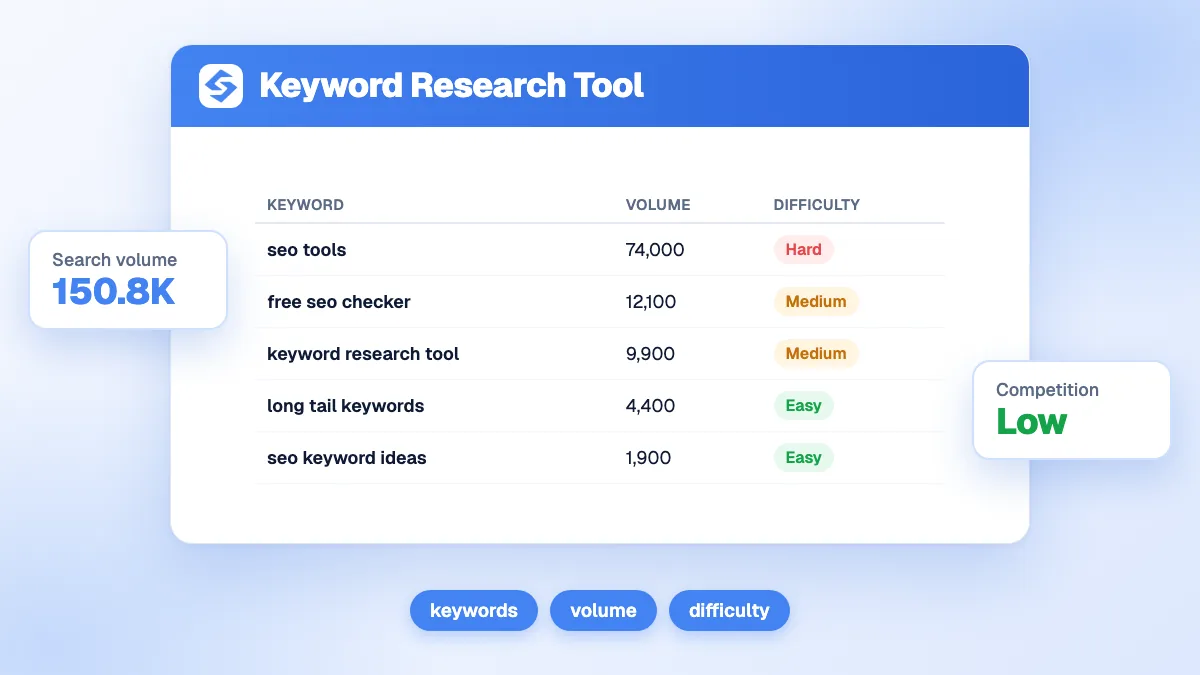

A keyword gap is a search query for which one or more of your competitors rank in Google while your site does not rank at all, or ranks far behind them. Each gap is a documented demand that you are not capturing yet, and a precise brief for a page to create or improve.
Search your main topics in Google and note which domains keep appearing, then read their titles, headings and FAQs to see which queries they target. Free versions of SEO tools show a sample of a domain's ranking keywords, and your own Google Search Console reveals queries where you already get impressions but sit behind them.
A keyword gap is measured at the query level: competitors rank for a term and you do not. A content gap is broader: a topic, question or format your audience needs that your site does not cover, whether or not competitors cover it. Keyword gaps are one of the most reliable ways to detect content gaps.
 AI Content Brief Generator
 FAQ Schema GeneratorAI Blog Post Ideas GeneratorStructured Data Validator
 Alt Text Checker
 Internal Link AnalyzerBacklink ChallengeAI Meta Description GeneratorAI Blog Title Generator
 Google Indexability CheckerAI Blog Outline GeneratorUTM Link BuilderKeyword Clustering ToolCanonical Tag Checker
 XML Sitemap GeneratorBroken Link CheckerAI SEO Title GeneratorHeadline AnalyzerSERP Preview ToolRedirect Checker
 Hreflang Tag GeneratorHeading Structure AnalyzerHTTP Headers CheckerFavicon Extractor
 SERP CTR Calculator
 SEO vs Paid Search Savings Calculator
 SEO Share of Voice Calculator
 SEO ROI Calculator
 SEO Traffic and Revenue Forecast Calculator
 SEO Budget Calculator
 SEO Break-Even Calculator
 SaaS SEO ROI Calculator
 ROAS Calculator
 Reading Time Calculator
 Ranking Gain Simulator
 Organic Traffic Value Calculator
 Organic Traffic Estimator
 LTV to CAC Ratio Calculator
 Local SEO ROI Calculator
 Link Building Cost Calculator
 Keyword Value Calculator
 Keyword Opportunity Score Calculator
 Keyword Density Calculator
 GEO ROI Calculator
 GEO Content Investment Calculator
 Ecommerce SEO ROI Calculator
 Customer Lifetime Value Calculator
 Customer Acquisition Cost Calculator
 CTR Calculator
 Cost Per Article Calculator
 Conversion Rate Calculator
 Content Marketing ROI Calculator
 ChatGPT Referral Traffic Estimator
 Bounce Rate Calculator
 Backlink ROI Calculator
 AI Visibility Score Calculator
 AI Traffic Value Calculator
 AI Share of Voice Calculator
 Cost of AI Invisibility Calculator
 AI Citation Rate Calculatorllms.txt ValidatorAI Overview CheckerRobots.txt CheckerAI SEO AuditLLM Readability CheckerSearchGPT Readiness Checker
 Structured Data LLM AuditWebsite Crawlability AI AuditWhy ChatGPT Is Not Recommending My Website
 Gemini Ranking ToolPerplexity Ranking CheckerLLM Citation CheckerAnswer Engine Optimization AuditGEO AuditAI Search Visibility TestChatGPT Visibility Checkerllms.txt Generator
 URL ExtractorWebpage to MarkdownSitemap CheckerSERP Volatility SensorPage Size Checker
 Word Counter
 Slug GeneratorSchema GeneratorRobots Generator
 OG PreviewMeta Tags Generator
 Image CompressorFavicon Generator
 On-Page SEO Audit
 Backlink Analysis Tool
 Keyword Research Tool
 Domain Authority Checker
THEY TRIED SORANK BEFORE YOU
 “I tested Sorank on a real client site and it's insane. It does everything an agency would bill you $1500 a month for. It's going into production on that client now.”

 Guillaume Guersanguersanguillaume.com“We are an Ads agency and we wanted to get our SEO back on track once and for all. Sorank gave us a clear view of our site, helped us prioritize optimizations, and properly structure our content. The tool is easy to use, well designed for a team, and very practical for centralizing tracking without having to juggle multiple platforms. A very solid foundation to start fresh with our SEO.”
 Gaspard MadouiAds Agency
 “I just let the Sorank software do its thing, and now my DR is 25 and my page is ranking higher.”
 Lucas Flandrefoundertrace.fr“I specialized in GEO thanks to Sorank. The GEO Leaderboard allows me to show my clients their position vs competitors on ChatGPT. It’s a real commercial differentiator.”
 MélanieSEO Freelance“Great service, works well for our website and helps us understand how to improve it to rank better on Google and elsewhere. Congrats, keep going, I recommend it.”
 Hugo T.E-commerce merchant























