
Preferences
Privacy is important to us, so you have the option of disabling certain types of storage that may not be necessary for the basic functioning of the website. Blocking categories may impact your experience on the website. More information

Privacy is important to us, so you have the option of disabling certain types of storage that may not be necessary for the basic functioning of the website. Blocking categories may impact your experience on the website. More information

Keyword clustering explained: SERP overlap vs semantic clustering, a step by step method, how to map one cluster to one page and link clusters into topic clusters.

Tools


In short
Keyword clustering groups keywords that can be answered by the same page, so that one cluster becomes one page. The most reliable method compares search results: if two keywords share several of the same URLs in Google's top 10, Google treats them as the same need and one page can rank for both. Semantic clustering, based on meaning, is faster but less precise. Once keywords are grouped into pages, the pages are organized into topic clusters around a pillar page.
Want to go further? Ask
A keyword research export can contain hundreds or thousands of lines, many of them variants of the same question. Writing one page per line produces thin, competing pages. Keyword clustering turns that list into a content plan: a short list of pages, each with a main keyword and the variants it should cover. This guide explains the two families of methods, a step by step process, how to assign clusters to pages and how they fit into topic clusters.
Keyword clustering is the process of grouping keywords that share the same search intent and can be satisfied by one page. "How to clean leather shoes", "cleaning leather boots" and "best way to clean leather shoes at home" are three keywords but usually one need. A single complete page can rank for all three, and many more long-tail variants.
Clustering answers two questions at once:
The result is a map of the pages to create or optimize, which reduces the risk of keyword cannibalization, when several of your own pages compete for the same query.
SERP-based clustering groups keywords that show the same results in Google; semantic clustering groups keywords whose meaning is close. The first reflects how Google actually behaves, the second reflects how the words look.
| Criteria | SERP overlap clustering | Semantic clustering |
|---|---|---|
| Principle | Two keywords share several URLs in the top 10 | Two keywords have a close meaning (shared words, embeddings, NLP) |
| Data needed | Current search results for each keyword | The keyword list only |
| Precision | High: matches Google's view of intent | Medium: similar words can hide different intents |
| Cost and speed | Slower, requires SERP data | Fast and cheap, even on large lists |
| Best use | Deciding which page targets which keywords | First sorting of a large list into themes |
The two can be combined: semantic grouping to sort a large list into broad themes, then SERP comparison inside each theme to decide the pages. A classic trap of semantic clustering: "apple pie recipe" and "apple pie calories" look close but usually need different pages, while "laptop" and "notebook computer" look different but share results.
You compare the top results of each pair of keywords and group them when they share enough URLs. If "keyword A" and "keyword B" have, for example, four of the same pages in their top 10, Google considers that the same documents answer both, so one page of yours can too.
Collect keywords, clean the list, group them by SERP overlap, then name each cluster and assign it to a page.
Because one page that covers the whole need ranks better than several pages that each cover part of it. When two of your pages target keywords from the same cluster, Google has to choose between them, rankings fluctuate and links are split. When one page targets a whole cluster, it concentrates relevance, internal links and backlinks.
| Situation | What to do |
|---|---|
| A cluster with no page yet | Create one page targeting the main keyword and its variants |
| A cluster already covered by one page | Optimize that page with the missing variants and questions |
| A cluster spread over several existing pages | Merge them into the strongest page and redirect the others with a 301 |
| One page targeting two distinct clusters | Split it, or refocus it on one cluster and create a page for the other |
Keyword clustering decides the pages; a topic cluster organizes those pages around a theme. Once your clusters are mapped, group the pages that belong to the same broad subject: one pillar page covers the general topic and links to every detailed page, and each detailed page links back to the pillar and to its neighbours.
This structure, described in our glossary entries on the topic cluster and content clustering, shows Google and readers that the site covers the subject in depth. It also makes internal linking systematic instead of improvised.
Yes, because the AIs break a question into several related searches and favour pages that cover the whole need. When ChatGPT, Perplexity or Google's AI Mode answer a question, they often run several sub-queries on the same topic (variants, follow-up questions, comparisons) and assemble an answer from the pages that respond to them. A page built from a full keyword cluster already answers many of those sub-queries, with clear headings for each variant.
The same logic applies to the questions you want your brand to appear on: group the prompts your customers ask the AIs by need, then make sure each need has one complete page.
Keyword clustering turns a raw keyword list into a clear content plan. Group keywords by SERP overlap rather than by appearance, give each cluster one page, check intent by hand, then organize those pages into topic clusters linked together.
Sorank finds your keywords, groups them, checks that no two articles compete for the same query, then writes and publishes the matching pages on autopilot with internal links. Try it with a 3-day free trial.
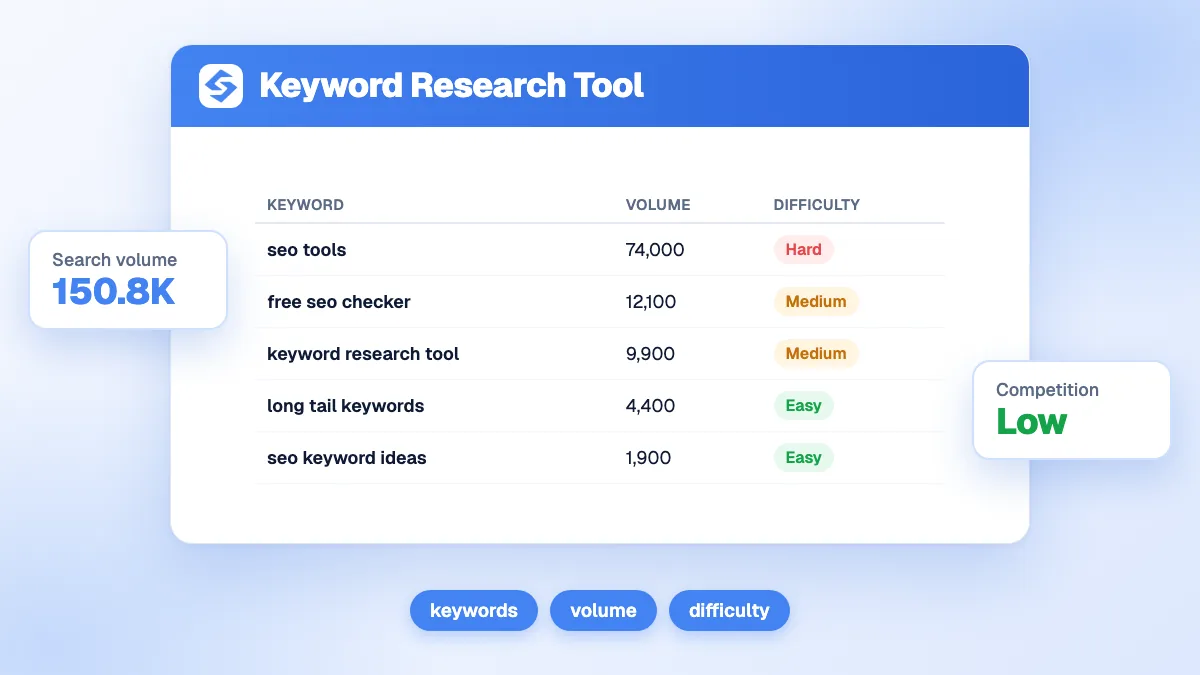

Keyword clustering is the grouping of keywords that can be answered by the same page. Instead of writing one article per keyword, you gather the variants, synonyms and close questions that Google already treats as one search need, then target the whole group with a single page. It prevents cannibalization and gives each page more ranking potential.
There is no fixed number. A cluster contains as many keywords as Google ranks with the same pages: sometimes two or three, sometimes several dozen long-tail variants. What matters is that one page can satisfy all of them. If the results differ, split the group, even if it leaves a cluster of one keyword.
Keyword clustering works at the page level: it decides which keywords one page targets. A topic cluster works at the site level: it organizes several pages around a pillar page on a broader theme and links them together. You first cluster keywords into pages, then group those pages into topic clusters.
 AI Content Brief Generator
 FAQ Schema GeneratorAI Blog Post Ideas GeneratorStructured Data Validator
 Alt Text Checker
 Internal Link AnalyzerBacklink ChallengeAI Meta Description GeneratorAI Blog Title Generator
 Google Indexability CheckerAI Blog Outline GeneratorUTM Link BuilderKeyword Clustering ToolCanonical Tag Checker
 XML Sitemap GeneratorBroken Link CheckerAI SEO Title GeneratorHeadline AnalyzerSERP Preview ToolRedirect Checker
 Hreflang Tag GeneratorHeading Structure AnalyzerHTTP Headers CheckerFavicon Extractor
 SERP CTR Calculator
 SEO vs Paid Search Savings Calculator
 SEO Share of Voice Calculator
 SEO ROI Calculator
 SEO Traffic and Revenue Forecast Calculator
 SEO Budget Calculator
 SEO Break-Even Calculator
 SaaS SEO ROI Calculator
 ROAS Calculator
 Reading Time Calculator
 Ranking Gain Simulator
 Organic Traffic Value Calculator
 Organic Traffic Estimator
 LTV to CAC Ratio Calculator
 Local SEO ROI Calculator
 Link Building Cost Calculator
 Keyword Value Calculator
 Keyword Opportunity Score Calculator
 Keyword Density Calculator
 GEO ROI Calculator
 GEO Content Investment Calculator
 Ecommerce SEO ROI Calculator
 Customer Lifetime Value Calculator
 Customer Acquisition Cost Calculator
 CTR Calculator
 Cost Per Article Calculator
 Conversion Rate Calculator
 Content Marketing ROI Calculator
 ChatGPT Referral Traffic Estimator
 Bounce Rate Calculator
 Backlink ROI Calculator
 AI Visibility Score Calculator
 AI Traffic Value Calculator
 AI Share of Voice Calculator
 Cost of AI Invisibility Calculator
 AI Citation Rate Calculatorllms.txt ValidatorAI Overview CheckerRobots.txt CheckerAI SEO AuditLLM Readability CheckerSearchGPT Readiness Checker
 Structured Data LLM AuditWebsite Crawlability AI AuditWhy ChatGPT Is Not Recommending My Website
 Gemini Ranking ToolPerplexity Ranking CheckerLLM Citation CheckerAnswer Engine Optimization AuditGEO AuditAI Search Visibility TestChatGPT Visibility Checkerllms.txt Generator
 URL ExtractorWebpage to MarkdownSitemap CheckerSERP Volatility SensorPage Size Checker
 Word Counter
 Slug GeneratorSchema GeneratorRobots Generator
 OG PreviewMeta Tags Generator
 Image CompressorFavicon Generator
 On-Page SEO Audit
 Backlink Analysis Tool
 Keyword Research Tool
 Domain Authority Checker
THEY TRIED SORANK BEFORE YOU
 “I tested Sorank on a real client site and it's insane. It does everything an agency would bill you $1500 a month for. It's going into production on that client now.”

 Guillaume Guersanguersanguillaume.com“We are an Ads agency and we wanted to get our SEO back on track once and for all. Sorank gave us a clear view of our site, helped us prioritize optimizations, and properly structure our content. The tool is easy to use, well designed for a team, and very practical for centralizing tracking without having to juggle multiple platforms. A very solid foundation to start fresh with our SEO.”
 Gaspard MadouiAds Agency
 “I just let the Sorank software do its thing, and now my DR is 25 and my page is ranking higher.”
 Lucas Flandrefoundertrace.fr“I specialized in GEO thanks to Sorank. The GEO Leaderboard allows me to show my clients their position vs competitors on ChatGPT. It’s a real commercial differentiator.”
 MélanieSEO Freelance“Great service, works well for our website and helps us understand how to improve it to rank better on Google and elsewhere. Congrats, keep going, I recommend it.”
 Hugo T.E-commerce merchant























