Preferences
Privacy is important to us, so you have the option of disabling certain types of storage that may not be necessary for the basic functioning of the website. Blocking categories may impact your experience on the website. More information

Privacy is important to us, so you have the option of disabling certain types of storage that may not be necessary for the basic functioning of the website. Blocking categories may impact your experience on the website. More information

Higher education SEO is how a university or college reaches students while they are still deciding what and where to study: "what can you do with a public health degree", "part-time master's in data science", "how to transfer from a community college". Those searches start on Google and, more and more, in ChatGPT, long before an application. Sorank writes the program, career and cost articles that answer them, links each one to the right program page and checks every month which institutions the AI assistants recommend.
A department or the communications office can approve every article before it is published.
















































27,145
Articles created
11,066,150
Visits from Google
18,394
Visits from AI
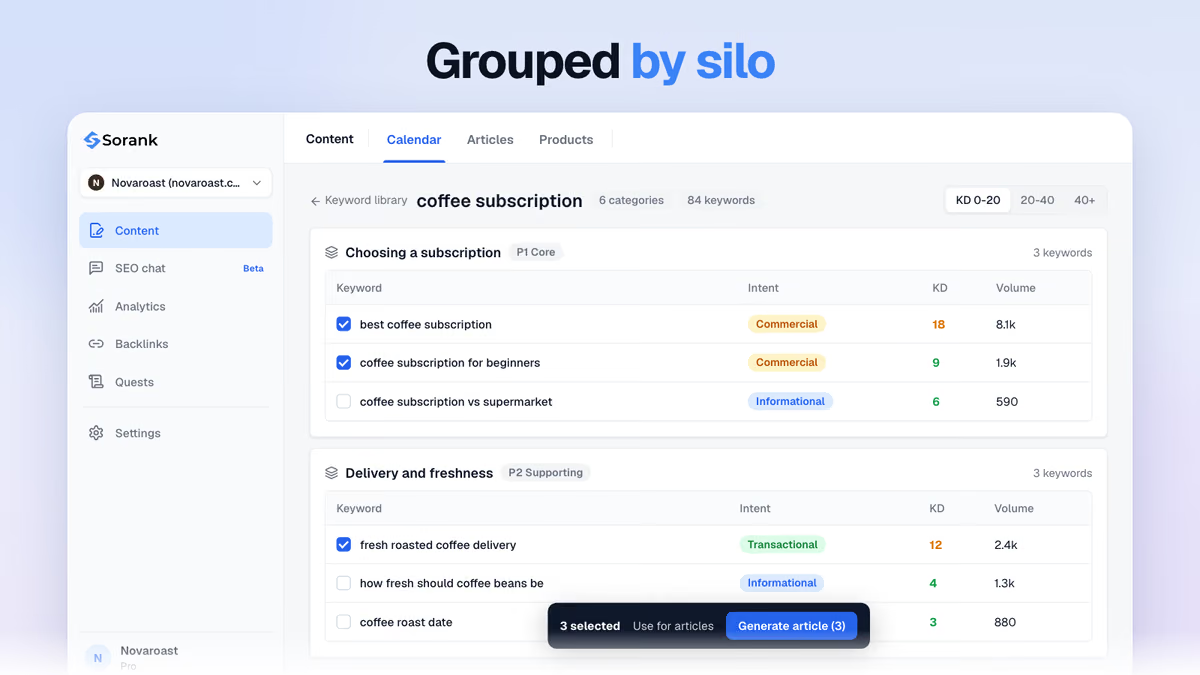
Around each degree, students ask a dozen different questions: "what can you do with a public health degree", "BSN or ADN for a career changer", "is a master's in cybersecurity worth it". Sorank builds a topic for each program, with core, supporting and exploratory categories, so every article answers one question and links back to the program page instead of competing with it.
Map them with the topical cluster generator.
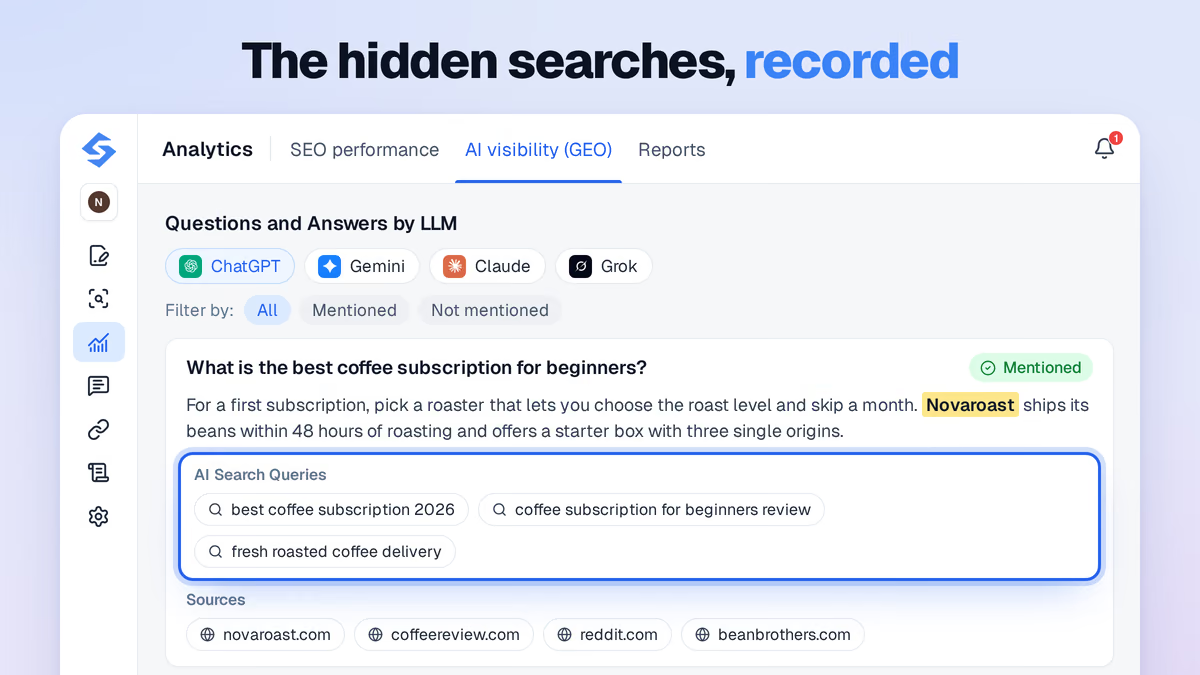
A student asks for the "best universities for marine biology in Europe" or whether "[your university] is good for computer science", and gets a short answer built from a few pages. Sorank stores each answer for the prompts you track, with the searches the model ran first and the websites it used as sources, so you see whether it quotes your program page, a rankings site or an old forum thread.
Choose the questions in AI prompt research.
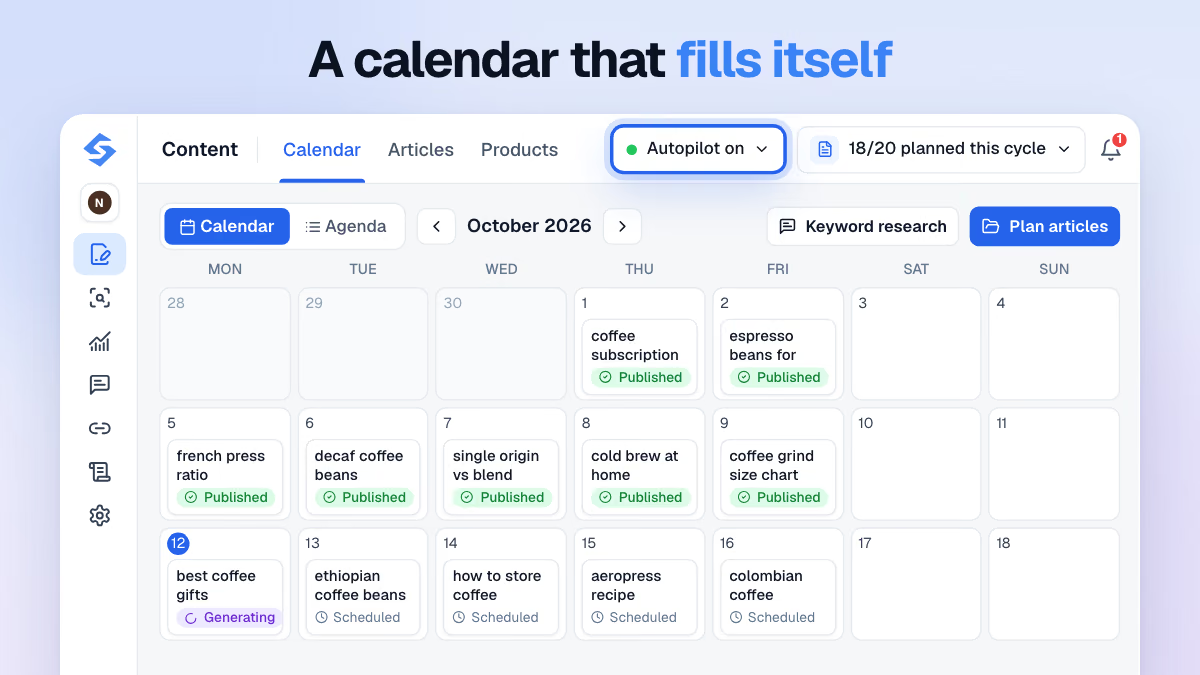
Marketing runs the plan, departments bring the expertise and admissions sets the deadlines. Sorank shows every article in one calendar, published, generating or scheduled, so the engineering school's guide does not land in the same week as the business school's, and each program gets its articles before students apply.
Plan the year in the blog planner.

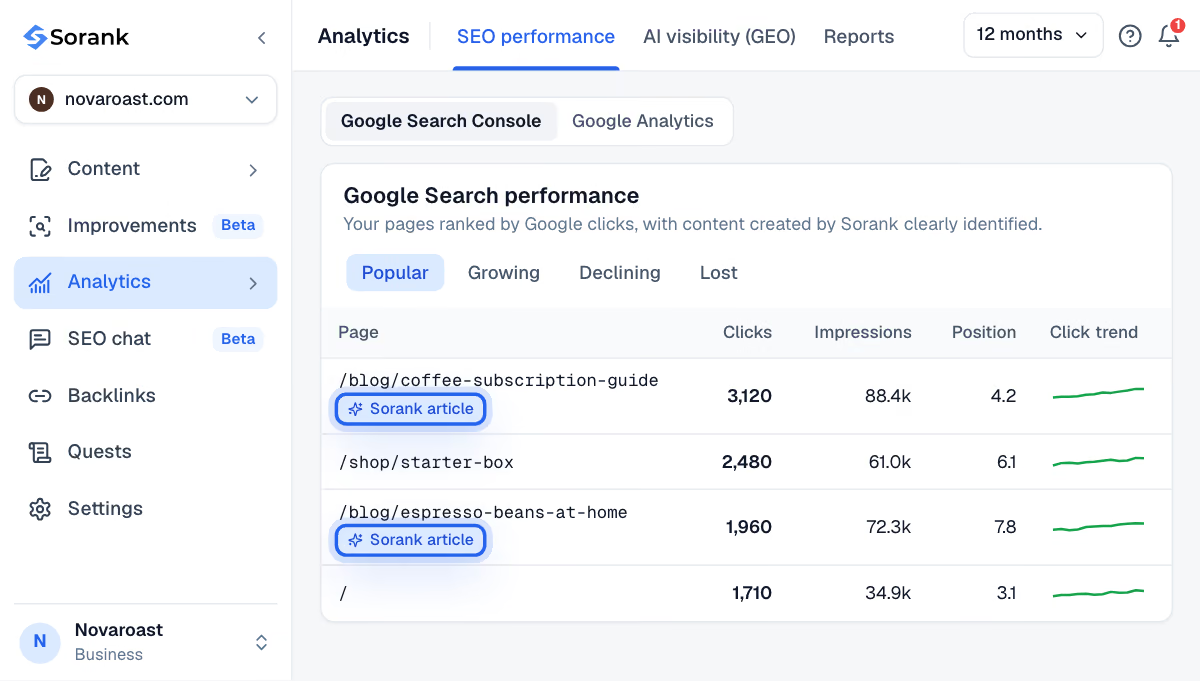
The main site, the graduate school or the online programs site: WordPress, Webflow and Wix connect directly, and a Drupal or in-house CMS can receive articles through a webhook. Sorank reads its Search Console data to see which programs already draw students.
Degrees by level and format, the students you want to reach (first-year, transfer, graduate, adult, international) and the start date of each intake. Sorank proposes the questions for each program, with their intent, difficulty and volume.

Articles wait as drafts for the department or the communications office, then go live on schedule, each linked to its program page and to the request-information or apply page.
THEY TRIED SORANK BEFORE YOU
 “I tested Sorank on a real client site and it's insane. It does everything an agency would bill you $1500 a month for. It's going into production on that client now.”

 Guillaume Guersanguersanguillaume.com
 “I just let the Sorank software do its thing, and now my DR is 25 and my page is ranking higher.”
 Lucas Flandrefoundertrace.fr“Great service, works well for our website and helps us understand how to improve it to rank better on Google and elsewhere. Congrats, keep going, I recommend it.”
 Hugo T.E-commerce merchant“For 2 years, 100% of my clients came from LinkedIn. Posting daily, commenting, DM follow-ups… totally dependent on the algorithm. I knew I needed to work on SEO but always postponed it: too long, too technical, not my job. With Sorank, I finally took the step. In 4 months, I generate 15 organic leads per month without posting anything. It’s not 50/50 with LinkedIn yet, but I sleep better knowing I now have a second lead source growing on autopilot.”
 Valentin ThomyColdMailing Agency
 “I’m a developer, not a marketer. My Shopify theme was selling only through word-of-mouth and ads. With Sorank I finally understood how to structure my SEO and write articles to rank. The audit showed my product page was too slow. In 2 months, my organic traffic doubled and I’m starting to appear in ChatGPT answers when people search for Shopify themes. All of that with about 2 hours per week.”
 Thème FullStackgo.themefullstack.com“Great solution to manage SEO without headaches. Audits are fast, the interface is clear, and you quickly see which actions to implement. It has become an essential tool to track and improve the SEO of my sites. I highly recommend it.”
 XavEntrepreneur“I used Sorank for a client who needed SEO and it clearly made my life easier. I can quickly audit a site, track my projects, and keep a clear overview without multiplying tools. The onboarding is fast and the interface is great.”
 Céline MaurinFreelance CM
 “Blown away by Sorank’s performance. After testing many solutions on the market, I was amazed by how quickly our articles started ranking in the SERP. The results are concrete and much faster than anything we’ve experienced so far. It has been an excellent surprise for our team. We are confidently renewing our trust and highly recommend Sorank to agencies that demand fast and measurable results.”
 Patrick PerretFreelance Webdesign SEO“We’re a development agency and we use Sorank to run on-page audits on our clients’ Shopify stores. It helps us quickly identify optimization opportunities, structure fixes, and collaborate more easily with clients on the SEO side. Very useful to complement our technical support 🔥”

 Younes Yahyaluvaika.com“We are an Ads agency and we wanted to get our SEO back on track once and for all. Sorank gave us a clear view of our site, helped us prioritize optimizations, and properly structure our content. The tool is easy to use, well designed for a team, and very practical for centralizing tracking without having to juggle multiple platforms. A very solid foundation to start fresh with our SEO.”
 Gaspard MadouiAds Agency“I specialized in GEO thanks to Sorank. The GEO Leaderboard allows me to show my clients their position vs competitors on ChatGPT. It’s a real commercial differentiator.”
 MélanieSEO Freelance“I manage our dealership’s website and it had dozens of issues: slow pages, 404 errors, missing tags. We were losing rankings every month without understanding why. The Sorank audit detected everything in 5 minutes. I sent the report to our web provider with the priority fixes. We regained our rankings and traffic picked back up. Perfect for someone non-technical like me!”
 Xavier BreullMarketing Manager“I’m a CMO for a SaaS and I manage acquisition in a very competitive market. We were investing heavily in our product but not working on our SEO. No visibility on our real competitors, no tracking of our presence in AI. Sorank showed us our positioning vs competitors, which keywords to target, and GEO opportunities we had completely ignored!”
 Louis RAPPCMO SaaS
 “Very good version 2, I recommend it.”

 Antoine Verhillethenewblack.ai“I was skeptical at first, but this is the best SEO tool I’ve ever used. The interface is clear, audits are fast, and the recommendations are easy to implement. I’ve saved hours and hours managing SEO and tracking performance. I recommend it to all my entrepreneur friends who run an agency or work independently.”
 NoahEntrepreneur
Founder’s Note.
I ran my own SEO agency for years. I built Sorank to deliver the same results to every business, at scale.
Everything I know about Google rankings and Generative Engine Optimization (GEO) is coded into this software, and it runs on autopilot for you.
Try for Free
Higher education SEO is the work that brings prospective students to a university or college website from Google and from AI assistants, and leads each one to the right program page. It serves several audiences at once: school leavers, transfer students, graduate applicants, adults returning to study and international students, each with their own searches.
What sets it apart is scale and ownership. A university site holds thousands of pages, often spread across faculties, subdomains and several content management systems, written by people who do not report to marketing. Our guide to site architecture helps decide where new content should live.
They start with a subject and a goal, not with your name. Then they compare programs, costs and outcomes, and a growing share asks an assistant to do the comparing. In an EAB survey of more than 5000 US high school students in October and November 2025, 46% said they used AI tools such as ChatGPT during their college search, against 26% in spring 2025, and 18% had removed a college from consideration because of information surfaced in AI-generated results.
That last figure is the risk: an outdated fee, a closed program or a wrong entry requirement repeated by an assistant can cost applications. In our education AI citation study, the three leading sources hold 51% of the citations in the ranking, and GitHub, a code repository, is cited 7.7 times more often than in the general ranking. Few sources share the answers, so being the clearest one about your own programs matters.
Because many program pages only list modules and a deadline, while the student's question is broader: is it worth it, what jobs follow, how does it compare. Directories answer that. Duplicate pages across faculties, PDF brochures and old versions of the same program then split whatever authority the university has.
Keep one canonical page per program, remove or redirect the copies (see our entry on duplicate content), then publish articles that answer the surrounding questions and link to it.
That it can be spam. Google's spam policies on site reputation cover third-party content published on a host site mainly because of that host's ranking signals, and one of the examples they give is an educational site hosting sponsored reviews of payday loans written by a third party. University domains are a prime target for this kind of offer.
Audit old subfolders, student society pages and sponsored sections, and keep what you publish tied to your own teaching and research. Our glossary entry on parasite SEO explains how these schemes work.
For students abroad, our guide to international SEO covers languages and country versions.
A direct answer first, then the facts a student will check: entry requirements, length and format, the academic year the figures apply to, the name of the faculty member who reviewed it and links to the official sources. Cost articles should send readers to your own calculator rather than invent an average. In the United States, every institution in the federal student aid programs that enrolls first-time, full-time undergraduates has had to post a net price calculator on its website since October 29, 2011. End with a short FAQ and links to the program and apply pages.
Less than it did for AI answers, but its facts still travel. Our Wikipedia AI citation study shows Wikipedia falling from 5.28% of measured answers in August 2025 to 1.39% in August 2026, after a peak of 11.31% in October 2025. Keep founding date, campuses, enrollment and leadership consistent between your site, your knowledge panel and the encyclopedia, and put the effort into your own pages.
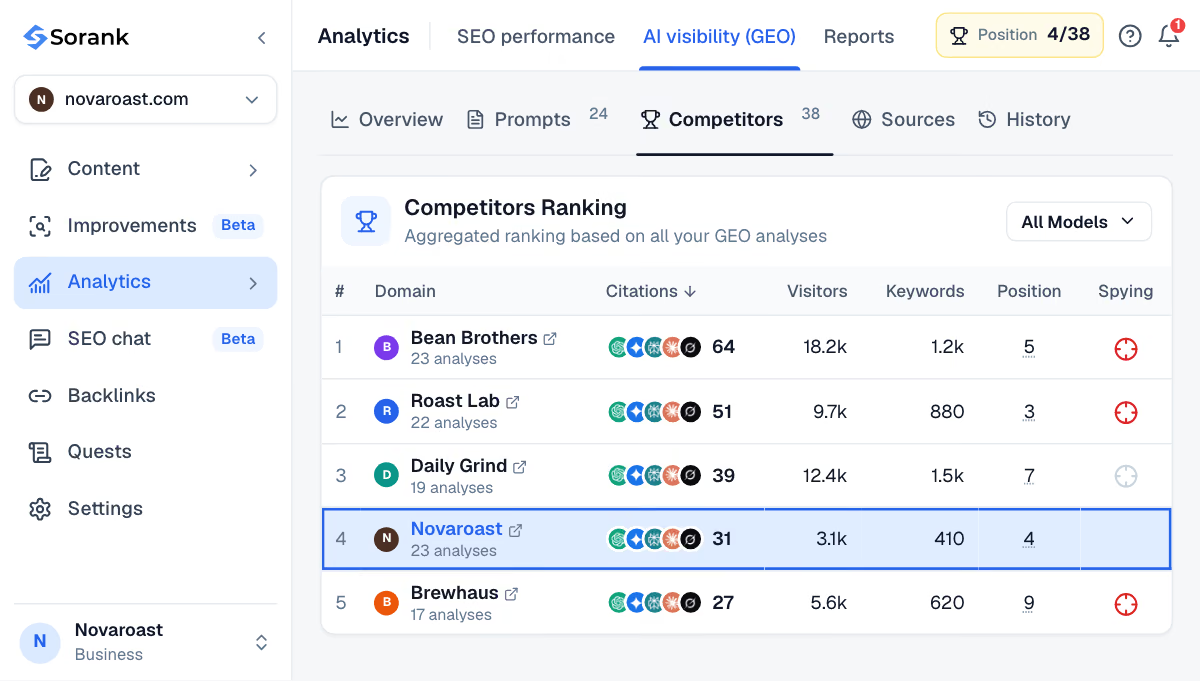
Sorank handles keyword research by program, the articles with their sources and internal links, publication on the sites you connect, backlinks from other sites of Sorank clients, the monthly tracking of AI answers and your Search Console, Analytics and AI visits in one dashboard. A Drupal site can receive articles through a webhook and a Make scenario that calls the Drupal API, as our Drupal page explains.
The university keeps its program pages and catalog, the governance of its CMS, rankings submissions, the Google Business Profile of each campus, its Wikipedia entry, accessibility and the accuracy of admissions information. Other education providers search differently: see our pages for language schools, private schools and vocational training.
Sorank is priced per website, so a university with a separate graduate or online site subscribes for each site it connects. Essential costs $49 a month on annual billing or $99 monthly for 20 articles; Pro ($129 annually, $249 monthly) publishes 60 and Business ($249 annually, $499 monthly) 120, the plan that fits a long list of programs. A 3-day free trial and a 90-day results-or-refund guarantee come with every plan (see pricing).
Plan in months. Start a program's articles well before its application deadline, then judge it after three months on its Search Console impressions, its AI mentions and the information requests it brings.
Several months. Articles first gain impressions, then clicks and information requests. Start a program's articles well before its application deadline, and judge each program after three months of publishing.
Pricing is per website: from $49 a month billed annually, or $99 month to month, for each site you connect. The Business plan publishes 120 articles a month on one site, which suits a large program catalog.
Yes. Articles can wait as drafts in your CMS until a department or the communications office approves them, and your style rules go into the writing instructions.
Make your own pages the clearest source: one current page per program, articles on outcomes and costs, and consistent facts in directories and in your Wikipedia entry. Then track prompts such as "best universities for nursing in Texas" every month.
The programs where you have places to fill, combined with format and location, then the career, cost and comparison questions students ask about them. Brand and admissions searches come next.
WordPress, Webflow and Wix connect directly, and Drupal works through a webhook and a Make scenario that calls its API. For TerminalFour, Cascade or another closed platform, ask the provider whether it accepts a webhook.
We don't. Sorank isn't trying to be another Semrush or Ahrefs. Those tools are built for data, Sorank is built to do the work. Instead of more dashboards to check, it turns SEO and GEO insights into actions: articles written and published, backlinks earned, technical fixes and AI visibility tracking. Less complexity, more results.
From $49/month per website on a yearly plan, with a 3-day free trial and a 90-day money-back guarantee (conditions apply). Every plan includes articles, AI visibility tracking and access to natural backlink acquisition; higher plans add more articles, more AI prompts tracked and more backlinks. No setup fees, no paying for seats you don't use.
You shouldn't need a full marketing team or expensive tools to grow. Sorank handles your entire SEO and AI visibility, so you save time and money.