Preferences
Privacy is important to us, so you have the option of disabling certain types of storage that may not be necessary for the basic functioning of the website. Blocking categories may impact your experience on the website. More information

Privacy is important to us, so you have the option of disabling certain types of storage that may not be necessary for the basic functioning of the website. Blocking categories may impact your experience on the website. More information

International SEO step by step: ccTLD, subfolder or subdomain, hreflang, translation vs localization, keyword research per market and the AIs in each language.

Tools


In short
International SEO is the work of making a website rank in several countries or languages. It rests on three decisions: a URL structure for each market (country domain, subfolder or subdomain), hreflang annotations that tell Google which version to show to whom, and content localized for each market rather than only translated. Keyword research has to be redone per language, because people do not search with literal translations. The same rules now apply to the AIs, which answer in the user's language and cite sources written in it.
Want to go further? Ask
Expanding a site abroad looks like a translation project. In practice international SEO is a set of technical and editorial choices that decide whether each version reaches the right audience or competes with the others. This guide covers how to choose a URL structure, set up hreflang, localize content, research keywords per market and make each version visible in the AIs.
International SEO is the optimization of a website so that search results show the right version of a page to users in each country or language. It addresses two separate cases that are often confused:
Many sites are both. Google documents both cases in its guide to managing multi-regional and multilingual sites. One rule from that guide matters from the start: Google determines the language of a page from its visible content, so each version must be fully written in its language, including menus and buttons.
For most companies, subfolders on one domain are the best choice, because all versions share the authority of the main site. Country domains make sense for large companies that run each market as a separate business.
| Structure | Example | Advantages | Drawbacks |
|---|---|---|---|
| Country domain (ccTLD) | example.de | Strongest local signal, local trust | Each domain builds its own authority, higher cost |
| Subfolder | example.com/de/ | Shared authority, simple to maintain | Weaker country signal on its own |
| Subdomain | de.example.com | Separate hosting possible | Authority shared less naturally than in subfolders |
| URL parameter | example.com?lang=de | Quick to set up | Not recommended by Google |
Whatever the choice, keep one version per URL. Avoid serving different languages on the same URL depending on cookies or browser settings, and avoid automatic redirects based on the visitor's location: Google's crawlers mostly come from the US and might never see the other versions. A banner suggesting the local version is the safer alternative.
Hreflang is an annotation that tells Google which language and country each version of a page targets, and which other versions exist. It prevents a Spanish visitor from landing on the Mexican version, or a UK visitor from seeing US prices. The concept is explained in our glossary entry on hreflang.
The rules that avoid most errors:
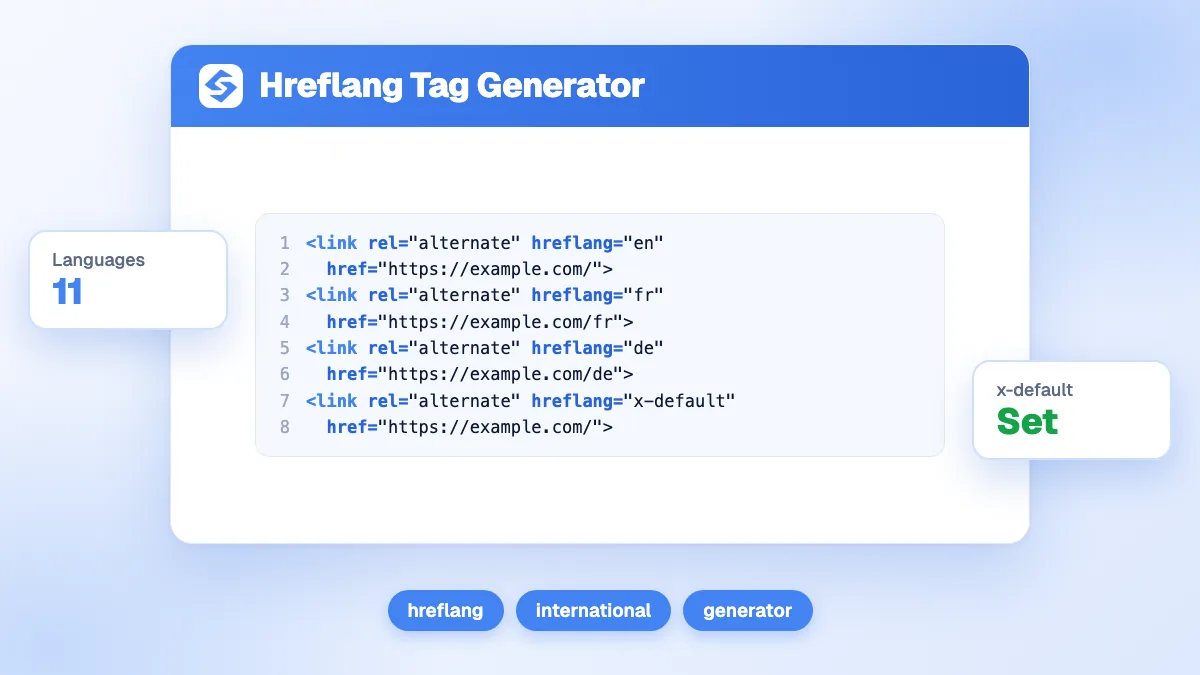
Google details the syntax in its documentation on localized versions of your pages. To avoid typing errors on dozens of pages, generate the tags with our free hreflang generator.
Translation converts words from one language to another, while localization adapts the whole page to the market: vocabulary, examples, prices, currency, units, legal references and proof. Search results reward localization because local users recognize content written for them.
| Element | Translation only | Localization |
|---|---|---|
| Keywords | Literal equivalent | The term people actually type |
| Examples | Same as the original | Local companies, local situations |
| Prices and units | Unchanged | Local currency, metric or imperial |
| Tone | Original tone | Local register (formal or informal address) |
| Proof | Original reviews and logos | Local clients, local press, local reviews |
Machine translation is a useful starting point, provided a native speaker reviews each page. Google's spam policies target pages produced at scale without value for users, so publishing unreviewed automatic translations of an entire site is a risk.
Do the research again in each language, starting from what local users type, because search behaviour differs from one market to another. The same language changes between countries: a user in Spain buys an "ordenador" while a user in Mexico buys a "computadora", and a literal translation of an English keyword often misses both.
Our guide to keyword research covers the method in detail. Then build each market's content plan from these local keywords, not from a translated list.
The AIs answer in the user's language and tend to cite sources written in that language, so each market needs its own citable content. When a German user asks ChatGPT, Gemini, Perplexity or Claude for a recommendation, the answer draws on German pages, local comparisons and local forums. An English page alone rarely represents the brand in that answer.
Three habits help each version get cited:
The most damaging mistake is automatic redirection by IP or browser language, because it hides versions from both users and crawlers. The others are frequent too:
Large sites with many markets face these issues at scale; our guide to enterprise SEO covers the governance side.
International SEO works when each market has a clear URL, correct reciprocal hreflang tags, and content localized around the keywords that people in that market actually use. Start with one or two priority markets in subfolders, get the technical base right, then expand. In each language, check how the AIs answer, because they now shape a growing part of discovery.
Sorank finds keywords, writes and publishes an SEO and GEO article every day in autopilot, and tracks every week whether the AIs cite your brand on the questions that matter in your market. See the plans, with a 3-day free trial.

Both work. A subfolder (example.com/de/) keeps all authority on one domain and is the simplest to maintain, which suits most companies. A country domain (example.de) sends the strongest local signal and can increase trust in some markets, but each domain must earn its own links. Choose ccTLDs only if you have the budget and teams to run each market as a separate site.
No. A page translated into another language is not duplicate content in Google's eyes. The real risk concerns versions in the same language for different countries, such as English for the US, UK and Australia: without hreflang, Google may treat them as duplicates and show the wrong one. Hreflang annotations and real local differences (prices, currency, examples) solve it.
A new language version usually needs several months before it ranks, often similar to the timeline of a new site in that market, because it starts with little local authority. Sections in subfolders of an established domain tend to progress faster than new country domains. Regular publishing in the target language and local links shorten the delay.
 AI Content Brief Generator
 FAQ Schema GeneratorAI Blog Post Ideas GeneratorStructured Data Validator
 Alt Text Checker
 Internal Link AnalyzerBacklink ChallengeAI Meta Description GeneratorAI Blog Title Generator
 Google Indexability CheckerAI Blog Outline GeneratorUTM Link BuilderKeyword Clustering ToolCanonical Tag Checker
 XML Sitemap GeneratorBroken Link CheckerAI SEO Title GeneratorHeadline AnalyzerSERP Preview ToolRedirect Checker
 Hreflang Tag GeneratorHeading Structure AnalyzerHTTP Headers CheckerFavicon Extractor
 SERP CTR Calculator
 SEO vs Paid Search Savings Calculator
 SEO Share of Voice Calculator
 SEO ROI Calculator
 SEO Traffic and Revenue Forecast Calculator
 SEO Budget Calculator
 SEO Break-Even Calculator
 SaaS SEO ROI Calculator
 ROAS Calculator
 Reading Time Calculator
 Ranking Gain Simulator
 Organic Traffic Value Calculator
 Organic Traffic Estimator
 LTV to CAC Ratio Calculator
 Local SEO ROI Calculator
 Link Building Cost Calculator
 Keyword Value Calculator
 Keyword Opportunity Score Calculator
 Keyword Density Calculator
 GEO ROI Calculator
 GEO Content Investment Calculator
 Ecommerce SEO ROI Calculator
 Customer Lifetime Value Calculator
 Customer Acquisition Cost Calculator
 CTR Calculator
 Cost Per Article Calculator
 Conversion Rate Calculator
 Content Marketing ROI Calculator
 ChatGPT Referral Traffic Estimator
 Bounce Rate Calculator
 Backlink ROI Calculator
 AI Visibility Score Calculator
 AI Traffic Value Calculator
 AI Share of Voice Calculator
 Cost of AI Invisibility Calculator
 AI Citation Rate Calculatorllms.txt ValidatorAI Overview CheckerRobots.txt CheckerAI SEO AuditLLM Readability CheckerSearchGPT Readiness Checker
 Structured Data LLM AuditWebsite Crawlability AI AuditWhy ChatGPT Is Not Recommending My Website
 Gemini Ranking ToolPerplexity Ranking CheckerLLM Citation CheckerAnswer Engine Optimization AuditGEO AuditAI Search Visibility TestChatGPT Visibility Checkerllms.txt Generator
 URL ExtractorWebpage to MarkdownSitemap CheckerSERP Volatility SensorPage Size Checker
 Word Counter
 Slug GeneratorSchema GeneratorRobots Generator
 OG PreviewMeta Tags Generator
 Image CompressorFavicon Generator
 On-Page SEO Audit
 Backlink Analysis Tool
 Keyword Research Tool
 Domain Authority Checker
THEY TRIED SORANK BEFORE YOU
 “I tested Sorank on a real client site and it's insane. It does everything an agency would bill you $1500 a month for. It's going into production on that client now.”

 Guillaume Guersanguersanguillaume.com“We are an Ads agency and we wanted to get our SEO back on track once and for all. Sorank gave us a clear view of our site, helped us prioritize optimizations, and properly structure our content. The tool is easy to use, well designed for a team, and very practical for centralizing tracking without having to juggle multiple platforms. A very solid foundation to start fresh with our SEO.”
 Gaspard MadouiAds Agency
 “I just let the Sorank software do its thing, and now my DR is 25 and my page is ranking higher.”
 Lucas Flandrefoundertrace.fr“I specialized in GEO thanks to Sorank. The GEO Leaderboard allows me to show my clients their position vs competitors on ChatGPT. It’s a real commercial differentiator.”
 MélanieSEO Freelance“Great service, works well for our website and helps us understand how to improve it to rank better on Google and elsewhere. Congrats, keep going, I recommend it.”
 Hugo T.E-commerce merchant