Preferences
Privacy is important to us, so you have the option of disabling certain types of storage that may not be necessary for the basic functioning of the website. Blocking categories may impact your experience on the website. More information
Privacy is important to us, so you have the option of disabling certain types of storage that may not be necessary for the basic functioning of the website. Blocking categories may impact your experience on the website. More information

131 SEO experts ranked the Google ranking factors that matter most. Get the full top 10, the survey method, the caveats and a plan you can apply today.
In short
A ranking factor survey asks SEO professionals which signals they believe move a page up in Google. The most recent one, Zyppy Signal's Google Ranking Factors Expert Survey, was published on September 9, 2026. It polled 131 SEO experts. Relevance came first, named in the top three by 57.1% of them, followed by backlinks (54.8%) and content quality (47.6%).
Want to go further? Ask
Quick quiz
How should you follow your positions on Google?
Sorank matches your answers


Test it for 3 days on your own site and see where you stand on Google, ChatGPT and the other AIs.
Start 3-day free trial3 days free, then stop whenever you want. 90-day results guarantee, conditions apply.
Our guide to Google ranking factors separates the signals Google has confirmed from the ones that are speculation. This article asks a different question: which factors working SEOs rank highest, what that ranking can tell you, and what it cannot. Read it as a list of priorities, not as a formula.
Relevance, backlinks and content quality are the three factors experts name most often when asked for their top three. The chart below shows the full top 10 from the survey. Each bar is the share of the 131 respondents who named that factor among their three most important.
A share is not a weight. A factor at 57.1% was named by more experts than one at 54.8%, but that gap does not tell you how much Google values relevance compared with backlinks. The survey measures what practitioners believe. It does not measure Google's algorithm, and the authors do not claim it does.
The same survey also scored every factor on its own. Experts rated more than 100 factors one by one, and the authors say search intent match came out on top of those scores. That points the same way as relevance leading the top-three count. The two questions still measure different things, so keep them apart when you read the results.
The survey used two questions. Experts rated each factor on a 7-point scale, from +3 for strongly positive to -3 for strongly negative, and answered how much each one affects Google's organic rankings. Then they gave a free-text answer to a second question: what are the three most important Google ranking factors? The authors reached out to more than 200 SEOs, and 131 of them took part.
The survey at a glance
Source: Zyppy Signal, Google Ranking Factors Expert Survey, September 9, 2026
The 7-point scores ask how much a factor helps or hurts rankings. The top-three question asks which factors come to mind first. A factor can matter a lot and still rarely make anyone's top three, because experts may treat it as a basic requirement rather than a lever. Technical hygiene is the usual example. Your site needs it, but it is hard to name it as the thing that makes the difference.
This is why a factor can look weak in one list and strong in the other. Before you act on a rank, ask which question produced it, and whether the factor is something experts see as a condition or as an advantage.
The survey page does not say how the 7-point ratings were combined into scores. It does not discuss sample bias either, such as whether the panel leans toward certain kinds of SEO work, certain industries or certain countries. The authors are open about the first limit. They write that "no collection of SEO experts is ever complete, and we undoubtedly missed many folks."
They also call site speed and Core Web Vitals "two of the most controversial ranking factors, with many competing views." Treat those results as contested, not settled. A ranking of opinions is useful for priorities, but it cannot settle a dispute between experts.

Relevance and backlinks are each named in the top three by more than half of the panel, and content quality by close to half. Relevance is the one experts name most, but it is less a task than a result: it is how well your page matches what the searcher wants. Backlinks and content quality give you more direct levers. Here is each one in practice.
| Factor | Named in top three | What it means in practice | A first check you can run |
|---|---|---|---|
| Relevance | 57.1% | The page matches the intent behind the query | Does the first screen answer the query? |
| Backlinks | 54.8% | Other sites link to the page for a reason | Which of your pages earn links, and which do not? |
| Content quality | 47.6% | The page is complete, accurate and clear | Would a reader stop after the first paragraph? |
Relevance means your page is about what the searcher wants at that moment. In the scored ratings, search intent match was the factor experts rated highest. So start with the query, not with the page. Open the top 10 results for your target query and write down what they share: the format (a list, a tool, a comparison or a guide), the depth, and the question they answer first.
If your page answers a different question from the one that ranks, the mismatch is the problem. Links rarely fix a mismatch. Rewrite the opening so the first 100 words answer the query directly, then decide whether the rest of the page still belongs.
A backlink is a link from another site to your page. Experts put backlinks second in the top-three count, at 54.8%. Think of each link as a site owner saying that your page is worth reading. The strongest links come from places where a real reader would expect to find a link to you: a study cited in a news piece, a tool listed in a roundup, a guide linked from a course.
Start by listing which of your pages already earn links. Those pages show you what other people find useful, so build the next page in the same shape. Our backlink glossary entry covers the basic terms, and the sections on link methods below cover what to do and what to avoid.
Content quality came third, named by 47.6% of experts. In practice it means completeness and accuracy. A page that answers the main question in its first paragraph, then goes deeper with examples, numbers and clear steps, usually beats a page that repeats general points. Check every claim, and name the source of every number you publish.
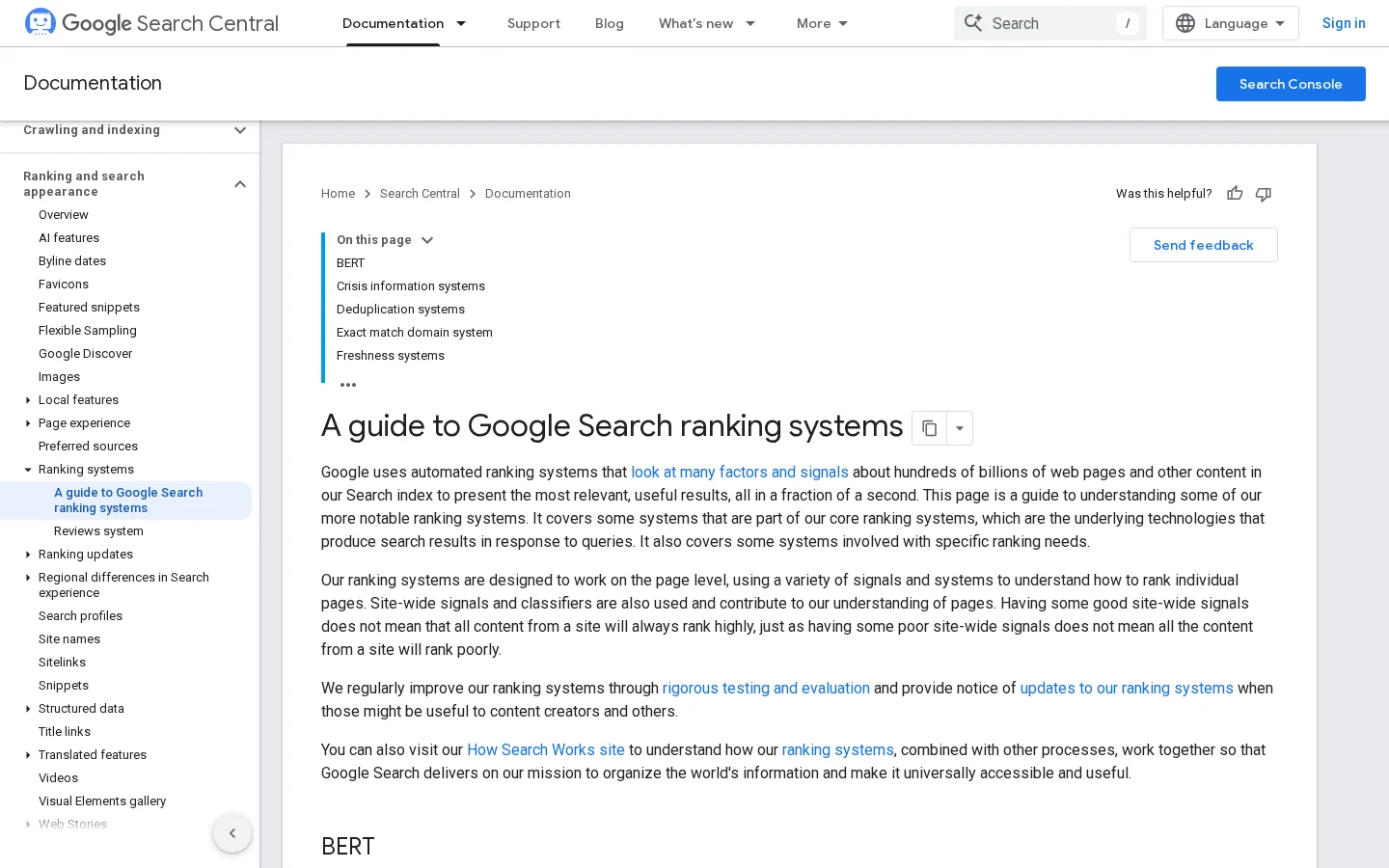
Google's ranking systems guide names an original content system among its ranking systems. Original examples, data you collected and first-hand testing are the kind of material that sets a page apart. Word count alone does not.
The next four factors show that experts see ranking as a judgment about trust and use, not only about the words on a page. Authority and trust came fourth, named by 36.5%, followed by behavior and click signals (29.4%), brand signals (27.0%) and user satisfaction (19.8%). Each one needs a different kind of work.
Authority and trust describe whether a site looks like a reliable source over time. Practical signals include an author with a visible track record, a clear company page, correct contact details and sources a reader can check. These do not work as a checklist. They work as a pattern: a site that shows consistently who wrote each page and where its facts come from.
Topical authority, which the survey ranks ninth at 14.3%, is closely related. It is the depth of coverage you show on one subject. A cluster of well-linked pages on one topic says more than a single strong article on it.
Click and behavior signals are the most disputed part of this group. Experts rate them with mixed confidence, and the ranking systems guide does not name a click-based system. What you can control is the match between your title, your snippet and what the page delivers. If people click your result and leave at once, the page has a problem with relevance or quality, whatever the exact mechanism is.
Check the click-through rate of each page in Google Search Console and compare it with its average position. A page that ranks well but gets few clicks has a snippet problem. A page whose clicks drop quickly after the first visit has a content problem.
Brand signals are the recognition a name earns. People search for it, mention it and link to it. Experts put brand signals sixth, at 27.0%. For a small site, this means that your name should appear the same way on your pages, your profiles and the places where people talk about you. Track branded searches over time, because they show whether recognition is growing.
User satisfaction, at 19.8%, overlaps with the reviews system that Google names in its guide. For any page that reviews a product or a service, show real testing, clear criteria and honest drawbacks. Vague praise does not satisfy a reader, and it does not look like a review anyone should trust.
What the survey says against what Google documents
Sources: Zyppy Signal, September 9, 2026; Google Search Central, ranking systems guide
Technical SEO health came in at 17.5% and internal links at 11.1%, so the survey places them below the top three. That does not make them optional. A page that cannot be crawled or indexed cannot rank for any factor, so treat technical health as the floor and content and links as the ceiling.
The authors call site speed and Core Web Vitals controversial, and that is a fair description. Experts disagree on how much a speed gain moves rankings. Do not spend a month on speed scores alone. Measure your pages, fix the slowest templates and the heaviest images, then move on to the factors above. Core Web Vitals are a measurement you use to find problems, not a goal in themselves.
Internal links rank last of the top 10, at 11.1%. They are still the factor you can change in an afternoon. Link your important pages from related articles, use descriptive anchor text, and keep each key page a few clicks from the homepage. Our internal linking strategy guide sets out the plan, and the free Internal Link Analyzer shows the links on any page you give it.
Experts rated meta descriptions as having little or no impact on rankings. Google's snippet documentation supports a narrower point. Google sometimes uses the meta description to describe a page in search results, there is no length limit for it, and the snippet is cut to fit the device. The same documentation does not say the meta description is a ranking signal.
So write meta descriptions for the click, not for the position. A clear description that matches the page is worth more than a keyword-stuffed one, and it is not where the survey says the gains are.
| Factor | What the survey shows | What Google's documentation shows | Practical stance |
|---|---|---|---|
| Site speed and Core Web Vitals | Called controversial by the authors | Not reviewed for this article | Measure, fix the worst pages, do not chase scores |
| Internal links | 11.1% named in top three | Not reviewed for this article | Cheap to change, do it early |
| Meta descriptions | Little or no impact rated | Used for the snippet, no length limit, no ranking claim | Write for the click only |
Start with the factors you can check this week, in this order: search intent, content completeness, internal links, then links from other sites. Each step takes an afternoon or less for one page, and each one changes something you can measure.
A five-step plan for one target page
Tip
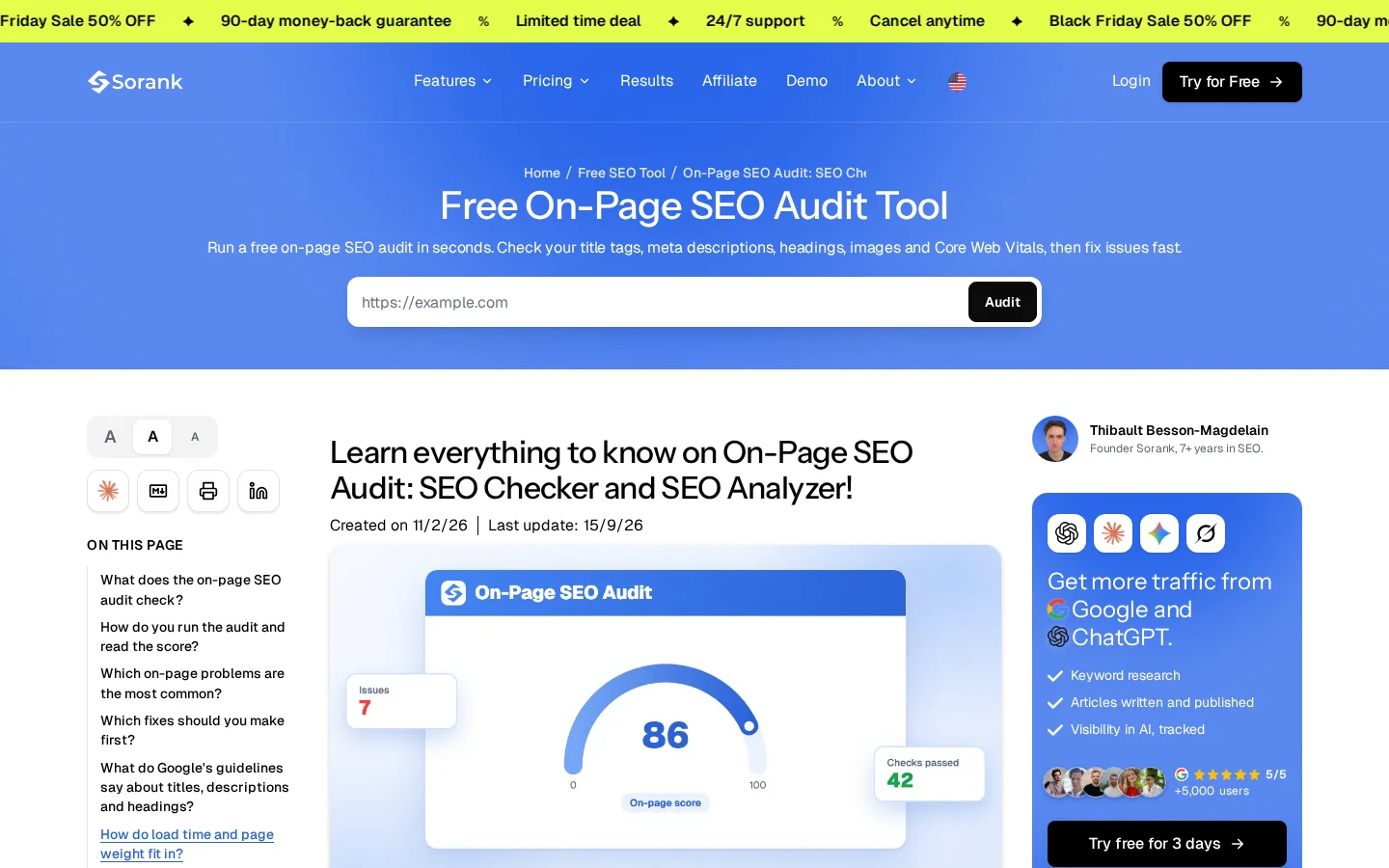
Before you rewrite anything, run the free On-Page SEO Audit Tool. It runs 16 on-page checks on one URL, including the title, meta description, headings, canonical tag and load time, with a suggested fix for each failed check. Running an audit asks for a short email verification.
If you maintain many older pages, Sorank's content optimization feature is built to fix and rewrite old pages on autopilot. Whatever tool you use, check the output against the query before you publish.
The most common mistake is to treat a poll of opinions as a formula. The mistakes below are easy to make, and each one has a simple fix.
What it is: reading the 57.1% share for relevance as proof that relevance is worth a fixed amount more than backlinks. How to spot it: you plan to spend most of your budget on one factor because it topped a chart. How to fix it: use the ranking to order your work, then test each change on a few pages and measure the result before you roll it out.
What it is: assuming a panel of 131 speaks for every SEO, every market and every site type. How to spot it: a conclusion that opens with "experts agree" and gives no panel details. How to fix it: note the panel size, the date and the authors. Check whether the same signals show up in other surveys or in your own data.
What it is: rewriting meta descriptions across the whole site in the hope of a higher position. How to spot it: your change log shows many description edits and no movement in position. How to fix it: keep each description short and accurate for the click, and put the time into the content and links the survey ranks higher.
What it is: using a factor list from an older survey as if it describes today's results. How to spot it: the list has no date, or its date is several years old. How to fix it: cite the date next to every number, and check the newest survey before you plan a year of work around it.
What it is: building links to a page that does not answer its query well. How to spot it: the page gets links but few clicks, or it ranks for a different query than the one you wanted. How to fix it: check relevance and completeness first, then build links to the page that deserves them.
Checklist before you act on a ranking factor survey
Earn links that a site owner would add without being asked. Google's spam policies list excessive link exchanges and buying or selling links for ranking purposes as link spam. The methods below range from safe to risky, and the table at the end puts them side by side.
The principle is to publish a page that a site in your field would link to when it covers the topic. Use it always, as the base of your link profile. Its advantage is that these links last longer and come with context. Its limit is speed: it works only when the page is useful, and useful pages take time. For example, a guide that publishes benchmark numbers from your own tests gives a journalist or a blogger a reason to cite it with a link.
The principle is to create a study, a survey or a tool that others need to cite. Use it when you have data or a tool that people can reference. One asset can earn many links, and the advantage grows when the method is published with the numbers. Its limits are the cost up front and an uncertain result. A survey like the one in this article gives writers a number to quote, provided the method is clear.
The principle is to write for another site in your field, with a link to a relevant page on yours. Use it when that site's readers match your buyers and the article is genuinely useful. The advantage is direct access to a new audience. The limit is risk: thin posts, or posts sold only for the link, weaken the case for the link. For example, an expert article on a niche blog, with a link placed in the middle of a real point, is a sound use. A link in an author bio is a weaker one.
The principle is that two sites agree to link to each other. Use it almost never. It is quick to set up, but the links add little value. Google's spam policy lists "Excessive link exchanges" with the wording "Link to me and I'll link to you" as link spam, and it also flags partner pages built only for cross-linking. Our guide to backlink exchange explains why Google calls it a link scheme and what to do instead.
The principle is to pay for a placement, such as a sponsored post. Use it for real advertising or sponsorship, with a clear disclosure. The advantage is predictable reach. The limit is the rule: buying links for ranking purposes is link spam. Google says buying and selling links is a normal part of the economy of the web for advertising and sponsorship, and that such links do not break its policy when they carry rel="nofollow" or rel="sponsored". A sponsored article on a trade site, with rel="sponsored" on the link, is the clean version.
| Method | Best when | Main limit | Risk under Google's spam policy |
|---|---|---|---|
| Editorial links | You publish a useful page | Slow to earn | Low |
| Original data and digital PR | You have data or a tool to share | Upfront cost, uncertain outcome | Low |
| Guest posts | Readers match your buyers | Thin or sold posts carry risk | Medium |
| Link exchanges | Almost never | Little value per link | High when excessive |
| Paid links | Real sponsorship, with disclosure | Costly, and must be marked | High unless marked rel="nofollow" or rel="sponsored" |
For a wider plan, see our backlink strategies guide. Sorank's natural backlink acquisition feature looks for contextual links from sites in your niche, which is the editorial route described above.
Use the survey as a list of priorities, not a formula. Relevance, backlinks and content quality lead, and the rest of the top 10 tells you where to look once the basics are in place. Keep the date, the panel size and the method next to every number you quote, and test each change on your own pages before you roll it out.
If your team runs SEO across many pages, Sorank's SEO team features bring content, links and AI tracking together in one place. Start with the top three factors, measure what changes, then move down the list.
In Zyppy Signal's Google Ranking Factors Expert Survey, published on September 9, 2026, 57.1% of 131 SEO professionals named relevance in their top three. Backlinks came next at 54.8%. The survey measures expert opinion, not Google's algorithm, so use it to set priorities.
131 SEO professionals took part, out of more than 200 the authors contacted. Each rated more than 100 factors on a 7-point scale, and the survey collected 13665 ratings in total.
Survey respondents rated meta descriptions as having little or no impact. Google's snippet documentation says it sometimes uses the meta description to describe a page in search results. It does not describe the meta description as a ranking signal, so write it for the click.
We analyse your competitors, your website and your AI visibility to create a tailored content plan for free.
 AI Content Brief Generator
 FAQ Schema Generator
 AI Blog Post Ideas Generator
 Structured Data Validator (Schema Validator)
 Alt Text Checker
 Internal Link Analyzer
 Backlink Challenge
 AI Meta Description Generator
 AI Blog Title Generator
 Google Indexability Checker
 AI Blog Outline Generator
 UTM Link Builder
 Keyword Clustering Tool
 Canonical Tag Checker
 XML Sitemap Generator
 Broken Link Checker
 AI SEO Title Generator
 Headline Analyzer
 SERP Preview Tool
 Redirect Checker
 Hreflang Tag Generator
 Heading Structure Analyzer
 HTTP Headers Checker
 Favicon Extractor
 SERP CTR Calculator
 SEO vs Paid Search Savings Calculator
 SEO Share of Voice Calculator
 SEO ROI Calculator
 SEO Traffic and Revenue Forecast Calculator
 SEO Budget Calculator
 SEO Break-Even Calculator
 SaaS SEO ROI Calculator
 ROAS Calculator
 Reading Time Calculator
 Ranking Gain Simulator
 Organic Traffic Value Calculator
 Organic Traffic Estimator and Website Traffic Checker
 LTV to CAC Ratio Calculator
 Local SEO ROI Calculator
 Link Building Cost Calculator
 Keyword Value Calculator
 Keyword Opportunity Score Calculator
 Keyword Density Calculator
 GEO ROI Calculator
 GEO Content Investment Calculator
 Ecommerce SEO ROI Calculator
 Customer Lifetime Value Calculator
 Customer Acquisition Cost Calculator
 CTR Calculator
 Cost Per Article Calculator
 Conversion Rate Calculator
 Content Marketing ROI Calculator
 ChatGPT Referral Traffic Estimator
 Bounce Rate Calculator
 Backlink ROI Calculator
 AI Visibility Score Calculator
 AI Traffic Value Calculator
 AI Share of Voice Calculator
 Cost of AI Invisibility Calculator
 AI Citation Rate Calculator
 llms.txt Validator
 AI Overview Checker and AI Overviews Rank Checker
 Robots.txt Checker
 AI SEO Audit
 LLM Readability Checker
 SearchGPT Readiness Checker
 Structured Data LLM Audit
 Website Crawlability AI Audit
 Why ChatGPT Is Not Recommending My Website
 Gemini Ranking Tool
 Perplexity Ranking Checker
 LLM Citation Checker
 Answer Engine Optimization Audit
 GEO Audit
 AI Search Visibility Test
 ChatGPT Visibility Checker
 llms.txt Generator
 URL Extractor
 Webpage to Markdown
 Sitemap Checker
 SERP Volatility Sensor
 Page Size Checker
 Word Counter
 Slug Generator
 Schema Generator
 Robots Generator
 OG Preview
 Meta Tags Generator
 Image Compressor
 Favicon Generator
 On-Page SEO Audit: SEO Checker and SEO Analyzer
 Backlink Analysis Tool
 Keyword Research Tool
 Domain Authority Checker
 “I tested Sorank on a real client site and it's insane. It does everything an agency would bill you $1500 a month for. It's going into production on that client now.”

 Guillaume Guersanguersanguillaume.com“We are an Ads agency and we wanted to get our SEO back on track once and for all. Sorank gave us a clear view of our site, helped us prioritize optimizations, and properly structure our content. The tool is easy to use, well designed for a team, and very practical for centralizing tracking without having to juggle multiple platforms. A very solid foundation to start fresh with our SEO.”
 Gaspard MadouiAds Agency
 “I just let the Sorank software do its thing, and now my DR is 25 and my page is ranking higher.”
 Lucas Flandrefoundertrace.fr“I specialized in GEO thanks to Sorank. The GEO Leaderboard allows me to show my clients their position vs competitors on ChatGPT. It’s a real commercial differentiator.”
 MélanieSEO Freelance“Great service, works well for our website and helps us understand how to improve it to rank better on Google and elsewhere. Congrats, keep going, I recommend it.”
 Hugo T.E-commerce merchant