Preferences
Privacy is important to us, so you have the option of disabling certain types of storage that may not be necessary for the basic functioning of the website. Blocking categories may impact your experience on the website. More information

Privacy is important to us, so you have the option of disabling certain types of storage that may not be necessary for the basic functioning of the website. Blocking categories may impact your experience on the website. More information

Local SEO ranking factors in 2026: what Google confirms (relevance, distance, prominence), estimated weights per group and what to fix first.
Tools

In short
Google ranks local results on three pillars it confirms officially: relevance (how well your profile matches the search), distance (how far you are from the searcher) and prominence (how well known you are, through reviews, links and mentions). Inside those pillars, the latest expert survey estimates that Google Business Profile signals carry about a third of the weight in the map pack, reviews about a fifth and website signals about 15%, while classic website signals dominate the local organic results below the map. You cannot move your address, so the work goes into category, reviews, location pages and links.
Want to go further? Ask
Quick quiz
How should you follow your positions on Google?
Sorank matches your answers


Test it for 3 days on your own site and see where you stand on Google, ChatGPT and the other AIs.
Start 3-day free trial3 days free, then stop whenever you want. 90-day results-or-refund guarantee.
Local SEO ranking factors are the signals Google uses to decide which businesses appear in the map block and in the local organic results for a search such as "dentist near me" or "roof repair Leeds". Google publishes the principles in its help page on local ranking, but never the weights. This guide separates what Google confirms from what is estimated, gives the weights as sourced ranges, and ends with a priority order you can apply to one shop or to fifty branches.
Local SEO ranking factors are the criteria behind three different result types, and each one weighs them differently:
A complete local SEO strategy works on all three, because the same customer may see a map, a list of links or a generated answer depending on the device and the query.
Google states that local results are mainly based on relevance, distance and prominence, and that "there's no way to request or pay for a better local ranking". Everything else in this guide is a way to influence one of these three.
| Pillar | Google's definition | What you control |
|---|---|---|
| Relevance | How well a Business Profile matches what someone is searching for | Primary and additional categories, services, description, website content |
| Distance | How far the business is from the searcher; if the searcher shares no location, Google uses what it knows about it | Almost nothing: a real address, a correct map pin, service areas |
| Prominence | How well known the business is, including how many websites link to it and how many reviews it has | Reviews and ratings, links, press and directory mentions, brand searches |
Google also writes that more reviews and positive ratings can help a business's local ranking. That is one of the rare factors Google names explicitly, which explains why reviews keep gaining weight in every industry survey.
Google publishes no percentages. The most cited estimate is the Local Search Ranking Factors survey by Whitespark (2026 edition, published November 2025), in which 47 local search experts scored 187 factors. Its group weights are expert opinion, not measured data, so read them as orders of magnitude.
| Factor group | Local pack and Maps | Local organic results | AI search visibility |
|---|---|---|---|
| Google Business Profile | About 32% | Smaller share | About 12% |
| Reviews | About 20% | Smaller share | About 16% |
| On-page (website) | About 15% | About 33% | About 24% |
| Behavioral (clicks, calls, directions) | About 9% | About 10% | Smaller share |
| Links | About 8% | About 24% | About 13% |
| Citations (directories) | Smaller share | Smaller share | About 13% |
| Personalization | Smaller share | About 8% | About 9% |
Two conclusions stand out. In the map pack, profile and reviews together weigh about half of the estimated total. Under the map, the website and its links weigh more than half. A business that only works on its profile wins the map and loses the organic results, and the reverse is also true.
The same survey ranks individual factors. For the local pack, the top ten are: primary GBP category, distance between searcher and business, keywords in the business title, a physical address in the city of search, being open at the time of search, a high average rating (4 to 5 stars), a visible address (not a hidden service-area address), additional categories, the number of Google reviews with text, and correct placement of the map pin.
The Google Business Profile is the page Google ranks in the map pack, so its fields are direct relevance signals. Start by making sure the profile is verified: an unverified profile cannot rank reliably.
The primary category is the factor experts rank first. Choose the narrowest category that describes your main activity ("Emergency dentist" rather than "Dentist" if that is your core business), then add secondary categories for the other services. Check the categories of the three businesses that rank in the pack for your main keyword.
Keywords in the business name help rankings, which is why many profiles stuff them. Google's guidelines for representing your business forbid it: the name must reflect the real-world name, without service descriptions or locations that are not part of it. A stuffed name can be edited by any user or lead to a suspension.
Watch out
If your real brand name already contains your service ("Bristol Roof Repair Ltd"), use it. If it does not, renaming the profile alone breaks the guidelines: the name must match your signage, website and legal documents.
A physical address in the city searched, a correct pin and accurate opening hours all appear in the top ten. Businesses that are closed at the time of search tend to drop for that search. Service-area businesses that work from home must hide their address, according to Google's guidelines, and accept that they rank mostly around their real location.
Reviews are the second largest group in the map pack and one of the few signals Google names in its own help page. Experts score several dimensions: the number of Google reviews, the average rating, reviews with text, the regularity of new reviews and the presence of keywords and place names in what customers write.
For local organic results, your website matters more than your profile, and it also feeds the relevance of the profile it is linked to.
Create one page per service and, for businesses that serve several towns, one useful page per location, with real local content (projects, team, access, prices). Our guide to local landing pages explains how to avoid thin duplicates. Put the service and the city in the title, H1 and URL of the page linked from the profile.
Your NAP (name, address, phone) should be identical on the site, the profile and the main directories. Add LocalBusiness schema to state these facts in a format machines read. Google's documentation on LocalBusiness structured data presents it as a way to be eligible for richer display, without promising a ranking boost: treat it as a clarity signal.
Links are the second group for local organic results. Links from local media, associations, suppliers, sponsors and city directories prove both prominence and location. See our method for local link building.
Tip
Link your profile to the most relevant service or location page instead of the homepage when that page targets the same service and city. It aligns the profile and the page on the same query.
Some factors are out of reach, and knowing them avoids wasted effort:
Because results change from one street to the next, a single rank check is misleading. Measure positions on a grid of points around your address with local rank tracking to see where you really appear.
The Whitespark survey added AI search visibility as a category for the first time. There, the website comes first (about 24%), followed by reviews, citations and links, while the profile weighs less than in the map. AI assistants build their answers from sources they can read: your site, directories, review platforms and articles that mention you. Our study of directories in AI answers shows how often these platforms are cited.
Three actions cover both Google and AI: complete pages that answer local questions in plain text, consistent information everywhere, and mentions on the sites AI assistants cite in your area. Then check whether you are recommended: AI mention tracking in Sorank follows questions such as "best dentist in Lyon" each week on ChatGPT, Claude and Gemini, and shows who is cited instead of you.
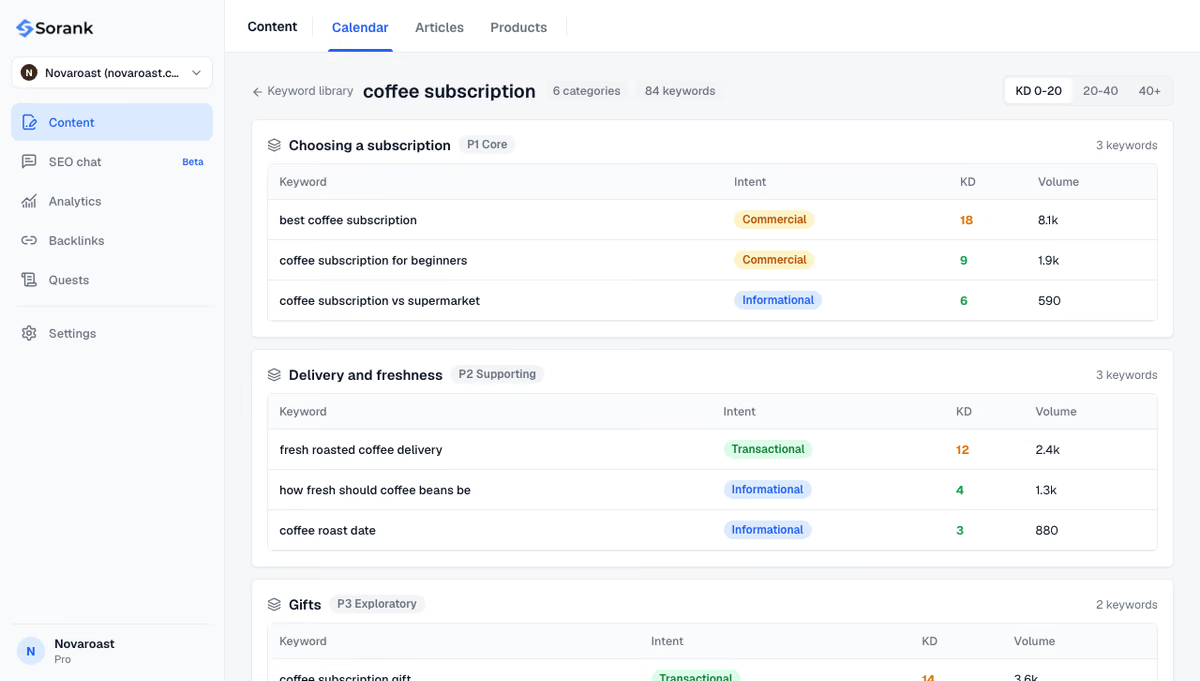
To feed the relevance pillar, Sorank's automated keyword research finds the service and city keywords of your site, then writes and publishes optimized articles and pages for them on autopilot.
Local rankings reward the business that is the most relevant, the closest and the best known, in that order of control: relevance is yours to fix today, prominence takes months, distance never moves. To produce the local pages and articles that carry relevance and track your citations in AI answers, see Sorank's plans, from 49$ per month on annual billing with a 3-day free trial.

Both count. Google says more reviews and positive ratings can help local ranking, and experts rank a high average rating (4 to 5 stars) just above the number of reviews with text. A steady flow of recent, detailed reviews usually beats a large but old stock.
Yes, indirectly. The website linked to your Business Profile supports its relevance and prominence, and on-page signals still weigh around 15% of the map pack in the 2026 Whitespark survey. For the local organic results under the map, the website is the largest factor.
Profile fixes such as category, hours or pin can change results within days or weeks. Reviews, links and new location pages usually take two to four months to show their full effect. Distance never changes, so a business far from a searcher may remain invisible for that search.
We analyse your competitors, your website and your AI visibility to create a tailored content plan for free.
 AI Content Brief Generator
 FAQ Schema Generator
 AI Blog Post Ideas Generator
 Structured Data Validator (Schema Validator)
 Alt Text Checker
 Internal Link Analyzer
 Backlink Challenge
 AI Meta Description Generator
 AI Blog Title Generator
 Google Indexability Checker
 AI Blog Outline Generator
 UTM Link Builder
 Keyword Clustering Tool
 Canonical Tag Checker
 XML Sitemap Generator
 Broken Link Checker
 AI SEO Title Generator
 Headline Analyzer
 SERP Preview Tool
 Redirect Checker
 Hreflang Tag Generator
 Heading Structure Analyzer
 HTTP Headers Checker
 Favicon Extractor
 SERP CTR Calculator
 SEO vs Paid Search Savings Calculator
 SEO Share of Voice Calculator
 SEO ROI Calculator
 SEO Traffic and Revenue Forecast Calculator
 SEO Budget Calculator
 SEO Break-Even Calculator
 SaaS SEO ROI Calculator
 ROAS Calculator
 Reading Time Calculator
 Ranking Gain Simulator
 Organic Traffic Value Calculator
 Organic Traffic Estimator and Website Traffic Checker
 LTV to CAC Ratio Calculator
 Local SEO ROI Calculator
 Link Building Cost Calculator
 Keyword Value Calculator
 Keyword Opportunity Score Calculator
 Keyword Density Calculator
 GEO ROI Calculator
 GEO Content Investment Calculator
 Ecommerce SEO ROI Calculator
 Customer Lifetime Value Calculator
 Customer Acquisition Cost Calculator
 CTR Calculator
 Cost Per Article Calculator
 Conversion Rate Calculator
 Content Marketing ROI Calculator
 ChatGPT Referral Traffic Estimator
 Bounce Rate Calculator
 Backlink ROI Calculator
 AI Visibility Score Calculator
 AI Traffic Value Calculator
 AI Share of Voice Calculator
 Cost of AI Invisibility Calculator
 AI Citation Rate Calculator
 llms.txt Validator
 AI Overview Checker and AI Overviews Rank Checker
 Robots.txt Checker
 AI SEO Audit
 LLM Readability Checker
 SearchGPT Readiness Checker
 Structured Data LLM Audit
 Website Crawlability AI Audit
 Why ChatGPT Is Not Recommending My Website
 Gemini Ranking Tool
 Perplexity Ranking Checker
 LLM Citation Checker
 Answer Engine Optimization Audit
 GEO Audit
 AI Search Visibility Test
 ChatGPT Visibility Checker
 llms.txt Generator
 URL Extractor
 Webpage to Markdown
 Sitemap Checker
 SERP Volatility Sensor
 Page Size Checker
 Word Counter
 Slug Generator
 Schema Generator
 Robots Generator
 OG Preview
 Meta Tags Generator
 Image Compressor
 Favicon Generator
 On-Page SEO Audit: SEO Checker and SEO Analyzer
 Backlink Analysis Tool
 Keyword Research Tool
 Domain Authority Checker
THEY TRIED SORANK BEFORE YOU
 “I tested Sorank on a real client site and it's insane. It does everything an agency would bill you $1500 a month for. It's going into production on that client now.”

 Guillaume Guersanguersanguillaume.com“We are an Ads agency and we wanted to get our SEO back on track once and for all. Sorank gave us a clear view of our site, helped us prioritize optimizations, and properly structure our content. The tool is easy to use, well designed for a team, and very practical for centralizing tracking without having to juggle multiple platforms. A very solid foundation to start fresh with our SEO.”
 Gaspard MadouiAds Agency
 “I just let the Sorank software do its thing, and now my DR is 25 and my page is ranking higher.”
 Lucas Flandrefoundertrace.fr“I specialized in GEO thanks to Sorank. The GEO Leaderboard allows me to show my clients their position vs competitors on ChatGPT. It’s a real commercial differentiator.”
 MélanieSEO Freelance“Great service, works well for our website and helps us understand how to improve it to rank better on Google and elsewhere. Congrats, keep going, I recommend it.”
 Hugo T.E-commerce merchant