Preferences
Privacy is important to us, so you have the option of disabling certain types of storage that may not be necessary for the basic functioning of the website. Blocking categories may impact your experience on the website. More information

Privacy is important to us, so you have the option of disabling certain types of storage that may not be necessary for the basic functioning of the website. Blocking categories may impact your experience on the website. More information

Enterprise SEO guide: governance, page templates, crawl budget, international sites, stakeholders, automation and brand visibility in the AIs for large sites.

Tools


In short
Enterprise SEO is search optimization for large organizations and large sites, typically tens of thousands to millions of pages, several markets and many internal stakeholders. The ranking principles do not change, but the work shifts to governance (who owns what), template-level fixes, crawl budget and indexation, international setup, automation and reporting by business unit. In 2026 it also includes brand-level visibility in the AIs, because ChatGPT, Gemini and Perplexity answer questions about large brands every day. The winning approach is to prioritize by revenue impact and fix problems once at template level rather than page by page.
Want to go further? Ask
Enterprise SEO is where good SEO knowledge meets organizational reality. A change that takes ten minutes on a small site can take a quarter on a large one, because it touches a shared template, needs a developer sprint, legal review and sign-off from three country managers. This guide covers the problems specific to scale and the methods that work: governance, templates, crawl budget, international sites, stakeholders, automation and AI visibility.
Enterprise SEO is the practice of managing organic search for a large organization, where the size of the site and of the company changes how SEO work gets done. There is no official threshold, but the label usually applies when at least two of these are true:
| Aspect | Small or mid-sized site | Enterprise site |
|---|---|---|
| Unit of work | The page | The template and the page type |
| Main bottleneck | Content production | Approvals and developer capacity |
| Technical risk | Limited | One release can affect millions of URLs |
| Reporting | Site-wide | By market, business unit and page type |
| Competition | Local or niche players | Other large brands, marketplaces, publishers |
Define who owns SEO decisions, who can change what, and how SEO requirements enter the product and content workflows before release. Most enterprise SEO losses come from changes made without SEO review, not from a lack of ideas.
Governance also covers content. Large sites often publish the same topic from several departments, which creates internal competition for the same queries. A single owner per topic, and a rule that new pages are checked against existing ones, prevents that.
Because a single template fix improves thousands of pages at once, while a page-by-page approach never catches up with the size of the site.
Start by grouping URLs into page types: home, category, product, location, article, search results, filters. For each type, check what the template produces:
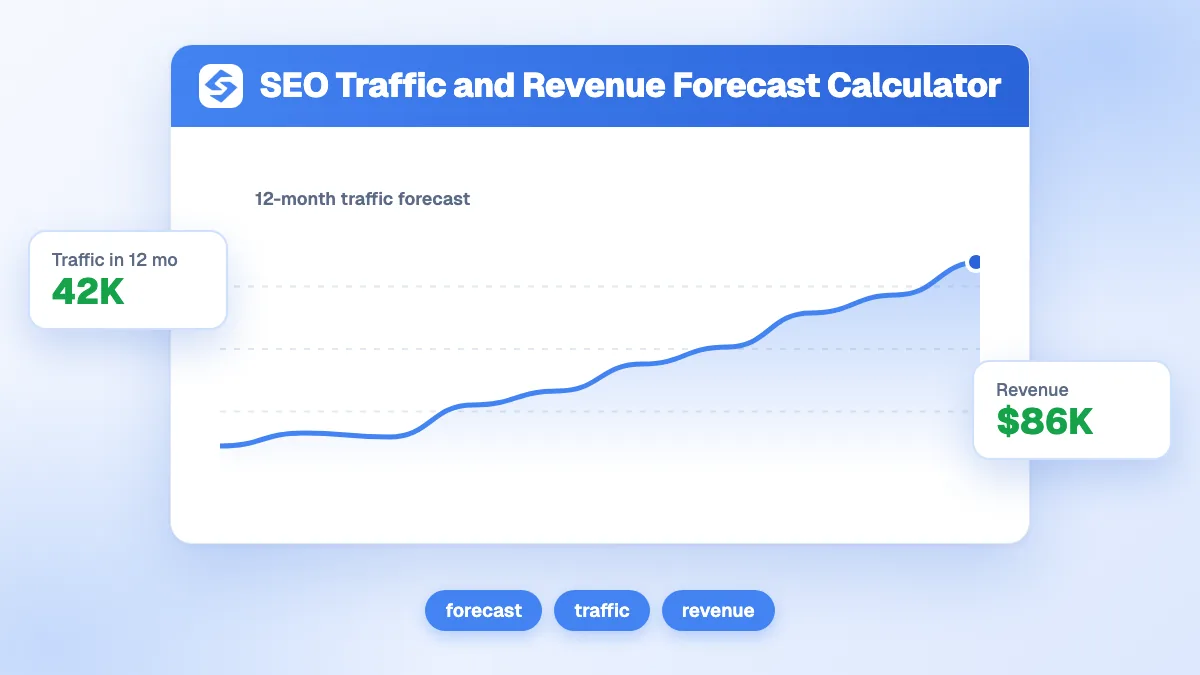
Then estimate the gain per template before asking for engineering time. The SEO forecast calculator helps translate an expected ranking or click-through improvement into traffic, which is the argument a product owner needs.
Make sure crawlers spend their time on pages that deserve to rank, and keep everything else out of the index. On very large sites, the number of URLs crawlers can discover often exceeds the number worth indexing.
Google states in its guide to managing crawl budget for large sites that the topic mainly concerns sites with about a million or more unique pages that change moderately often, or tens of thousands of pages that change daily. If that is your case, focus on:
Our glossary entry on crawl budget explains the underlying mechanisms in more detail.
Choose one clear URL structure per market, connect language versions with hreflang, and localize content rather than translating it word for word.
Our guide to international SEO covers structures and hreflang implementation step by step.
Speak in revenue and risk, tie each request to a business goal, and make SEO part of existing processes instead of an extra step.
| Stakeholder | What they care about | How to frame SEO |
|---|---|---|
| Executives | Revenue, market share, cost | Organic revenue at stake, cost of a traffic loss, share of voice against competitors |
| Engineering | Roadmap, stability, effort | Clear tickets, impact estimate, acceptance criteria, template-level fixes |
| Product | User experience, conversion | Search demand as user demand, landing page quality |
| Brand and legal | Consistency, compliance | Approved patterns and wording that can be reused at scale |
| Country teams | Local targets | Market-level reporting and local priorities |
Quick wins help early on: fixing a broken template, recovering redirects lost in a migration or improving titles on a high-traffic page type often shows results within one reporting cycle and earns the credibility needed for larger projects.
Monitoring, quality checks and repetitive production can be automated; strategy, prioritization and stakeholder work cannot.
For marketing and SEO teams that need to publish steadily on many topics, our page for SEO teams shows how article production can run on autopilot.
Large brands are already being described by ChatGPT, Gemini, Perplexity and Google AI Overviews, so the question becomes whether those descriptions are accurate and whether the brand is recommended.
Enterprise SEO applies the same principles as any SEO program, at a scale where governance, templates and prioritization matter more than individual pages. Set clear ownership and release checks, fix problems at template level, control what gets crawled and indexed, localize properly, speak in revenue to stakeholders, automate monitoring and add brand visibility in the AIs to the scorecard.
If your team needs to publish more SEO and GEO content without adding headcount, Sorank writes and publishes one optimized article per day on autopilot and tracks whether the AIs cite your brand. See the plans, with a 3-day free trial.

The ranking principles are the same, but the scale changes the work. Enterprise SEO deals with hundreds of thousands of pages, several teams and markets, technical changes that need developer roadmaps, and approvals across departments. The core skill becomes governance and prioritization: deciding which fixes on which templates will move the most revenue.
There is no standard price. Costs depend on the size of the site, the number of markets, whether the work is in-house or outsourced, and the tools required. The useful approach is to estimate the traffic and revenue at stake first, then size the budget against that potential rather than against a market rate.
Organic revenue or qualified leads by business unit, non-branded traffic, indexation rate of strategic page types, share of voice against key competitors, and visibility of the brand in AI answers. Executives rarely need keyword-level data: group results by template, market and product line.
 AI Content Brief Generator
 FAQ Schema GeneratorAI Blog Post Ideas GeneratorStructured Data Validator
 Alt Text Checker
 Internal Link AnalyzerBacklink ChallengeAI Meta Description GeneratorAI Blog Title Generator
 Google Indexability CheckerAI Blog Outline GeneratorUTM Link BuilderKeyword Clustering ToolCanonical Tag Checker
 XML Sitemap GeneratorBroken Link CheckerAI SEO Title GeneratorHeadline AnalyzerSERP Preview ToolRedirect Checker
 Hreflang Tag GeneratorHeading Structure AnalyzerHTTP Headers CheckerFavicon Extractor
 SERP CTR Calculator
 SEO vs Paid Search Savings Calculator
 SEO Share of Voice Calculator
 SEO ROI Calculator
 SEO Traffic and Revenue Forecast Calculator
 SEO Budget Calculator
 SEO Break-Even Calculator
 SaaS SEO ROI Calculator
 ROAS Calculator
 Reading Time Calculator
 Ranking Gain Simulator
 Organic Traffic Value Calculator
 Organic Traffic Estimator
 LTV to CAC Ratio Calculator
 Local SEO ROI Calculator
 Link Building Cost Calculator
 Keyword Value Calculator
 Keyword Opportunity Score Calculator
 Keyword Density Calculator
 GEO ROI Calculator
 GEO Content Investment Calculator
 Ecommerce SEO ROI Calculator
 Customer Lifetime Value Calculator
 Customer Acquisition Cost Calculator
 CTR Calculator
 Cost Per Article Calculator
 Conversion Rate Calculator
 Content Marketing ROI Calculator
 ChatGPT Referral Traffic Estimator
 Bounce Rate Calculator
 Backlink ROI Calculator
 AI Visibility Score Calculator
 AI Traffic Value Calculator
 AI Share of Voice Calculator
 Cost of AI Invisibility Calculator
 AI Citation Rate Calculatorllms.txt ValidatorAI Overview CheckerRobots.txt CheckerAI SEO AuditLLM Readability CheckerSearchGPT Readiness Checker
 Structured Data LLM AuditWebsite Crawlability AI AuditWhy ChatGPT Is Not Recommending My Website
 Gemini Ranking ToolPerplexity Ranking CheckerLLM Citation CheckerAnswer Engine Optimization AuditGEO AuditAI Search Visibility TestChatGPT Visibility Checkerllms.txt Generator
 URL ExtractorWebpage to MarkdownSitemap CheckerSERP Volatility SensorPage Size Checker
 Word Counter
 Slug GeneratorSchema GeneratorRobots Generator
 OG PreviewMeta Tags Generator
 Image CompressorFavicon Generator
 On-Page SEO Audit
 Backlink Analysis Tool
 Keyword Research Tool
 Domain Authority Checker
THEY TRIED SORANK BEFORE YOU
 “I tested Sorank on a real client site and it's insane. It does everything an agency would bill you $1500 a month for. It's going into production on that client now.”

 Guillaume Guersanguersanguillaume.com“We are an Ads agency and we wanted to get our SEO back on track once and for all. Sorank gave us a clear view of our site, helped us prioritize optimizations, and properly structure our content. The tool is easy to use, well designed for a team, and very practical for centralizing tracking without having to juggle multiple platforms. A very solid foundation to start fresh with our SEO.”
 Gaspard MadouiAds Agency
 “I just let the Sorank software do its thing, and now my DR is 25 and my page is ranking higher.”
 Lucas Flandrefoundertrace.fr“I specialized in GEO thanks to Sorank. The GEO Leaderboard allows me to show my clients their position vs competitors on ChatGPT. It’s a real commercial differentiator.”
 MélanieSEO Freelance“Great service, works well for our website and helps us understand how to improve it to rank better on Google and elsewhere. Congrats, keep going, I recommend it.”
 Hugo T.E-commerce merchant