Preferences
Privacy is important to us, so you have the option of disabling certain types of storage that may not be necessary for the basic functioning of the website. Blocking categories may impact your experience on the website. More information
Privacy is important to us, so you have the option of disabling certain types of storage that may not be necessary for the basic functioning of the website. Blocking categories may impact your experience on the website. More information

Compare the 10 best enterprise SEO software platforms: page limits, logs, SSO, published prices, honest limits, plus a 30-day pilot plan to choose yours.
In short
Enterprise SEO software is a platform that crawls, tracks and reports on very large sites shared by several teams. Choose seoClarity for depth at a published price, Conductor or BrightEdge for marketing teams, Semrush Enterprise for market data, Botify, Lumar or JetOctopus for technical work, and SISTRIX for a moderate budget.
Want to go further? Ask
Quick quiz
Is SEO right for you, and how should you start?
Sorank matches your answers


Test it for 3 days on your own site and see where you stand on Google, ChatGPT and the other AIs.
Start 3-day free trial3 days free, then stop whenever you want. 90-day results guarantee, conditions apply.
How we worked
We publish Sorank, an SEO and GEO software. It is not ranked here, because it does not crawl millions of URLs or read server logs. No vendor paid to appear. Features and prices were read on the official sites on 25 November 2026. We did not open paid accounts, so volumes are the vendors' own statements.
Choose the platform that solves your most expensive problem, not the one with the longest menu. A marketplace with 8 million filter URLs needs a crawler and logs. A bank with 14 country sites needs permissions and audit trails. A retail group with five content teams needs shared data and reports. The table gives the short answer for each of the ten platforms, with the starting price when the vendor publishes one.
| Platform | Best for | Main strength | Published limit or scale | Starting price |
|---|---|---|---|---|
| 1. seoClarity | In-house SEO teams that want one deep suite | Dedicated crawler, logs and rankings together | Unlimited crawl pages and projects on the Technical package | $2500 per month (Research and Content) |
| 2. Conductor | Marketing and content teams | Search and AI visibility, content, 24/7 monitoring | 125000+ pages analyzed on Enterprise | Not published |
| 3. Semrush Enterprise | Groups that compare markets and rivals | External search data joined to site audits | Crawls up to millions of pages | Not published |
| 4. BrightEdge | Multi-domain brands with reporting duties | Cross-domain views, workflow, templates | Over 4 billion data points in its keyword engine | Not published |
| 5. Botify | Very large ecommerce and catalog sites | Crawl, logs and deployment of fixes | Millions of pages in a single crawl | Not published |
| 6. Ahrefs Enterprise | Teams led by links, content and competitor data | Link and keyword data with API access | Portfolios of URLs from 10 domains | Not published (standard plans from €119 per month) |
| 7. Lumar | SEO and development teams that ship often | Crawling, plus tests that can block a release | Millions of pages | Not published |
| 8. JetOctopus | Technical SEOs who want crawl and logs at a listed price | No seat fee, logs in every plan | 500000 to 5 million URLs per month | $349 per month |
| 9. SISTRIX | European groups that track visibility by country | Visibility Index in 40 countries | 200000 monitoring credits on Premium | €149 per month (Premium at €999) |
| 10. Siteimprove | Regulated and public organizations | SEO, accessibility and governance together | 70+ on-page diagnostics | Not published |
Seven vendors out of ten publish no price for the product you would buy at this scale. Currencies are the ones shown to us. If you still need the method behind the tool, read our guide on running SEO in a large organization first, then come back to pick a vendor.
Enterprise SEO software is defined by three constraints: volume, number of people and proof. Volume means a crawl that does not stop at the first 100000 URLs. People means roles, approvals and several domains in one account. Proof means history, exports and reports that a finance or legal team accepts. A normal tool with a bigger quota does not meet the last two.
Page count alone is a poor test. Google's own crawl budget documentation gives three rough thresholds, and two of them mix size with the pace of change. Below them, crawl capacity is rarely your bottleneck, and a lighter tool does the job.
When Google says crawl budget deserves attention
Source: Google Search Central, crawl budget guide, read on 25 November 2026. Rough estimates, according to Google.
Data sampling breaks first. The Search Console API exposes at most 50000 rows per day and per search type, sorted by clicks, according to Google's developer documentation. Suppose your site appears on 300000 page and query pairs in a day. A tool that only calls the API sees the 50000 with the most clicks, and the long tail disappears without a warning.
The way out is the bulk export to BigQuery, described in Google's Search Console help. It is not retroactive: data from before the setup is not included. So turn it on today, even if your tender lasts six months. You need a Google Cloud project with billing enabled, and one dataset per property.
Once a month of data is stored, this query gives the real size of your search footprint. Put the result in your request for proposal.
SELECT
  COUNT(DISTINCT url) AS urls_with_impressions,
  COUNT(DISTINCT query) AS distinct_queries,
  SUM(clicks) AS clicks
FROM `your-project.searchconsole.searchdata_url_impression`
WHERE search_type = 'WEB'
  AND data_date BETWEEN DATE_SUB(CURRENT_DATE(), INTERVAL 31 DAY)
                    AND DATE_SUB(CURRENT_DATE(), INTERVAL 3 DAY);
Crawling breaks second, because filters and parameters multiply URLs. Solve the source before you pay to crawl it: our guide on which filter pages to index or block shows how. The definition of crawl budget and crawl demand explains what Google does with the rest.
We ranked them on five questions a large company asks before signing. How far can it crawl, and does it read logs? How much search data does it hold, on Google and in AI answers? Can several teams work in it safely? Does it help deploy the fix? Does the vendor publish its price or limits?
The last question moves several positions. A published limit lets you build a business case before the first call. That is why seoClarity leads and why JetOctopus enters a list usually reserved for suites. The order suits a general need. If your need is narrow, the "best for" column counts more than the rank.
What an enterprise SEO platform must prove
The ten platforms below fall into three families: full suites (seoClarity, Conductor, Semrush Enterprise, BrightEdge), technical platforms (Botify, Lumar, JetOctopus) and specialist data or governance platforms (Ahrefs, SISTRIX, Siteimprove). Read the family that matches your problem first.
 seoClarity
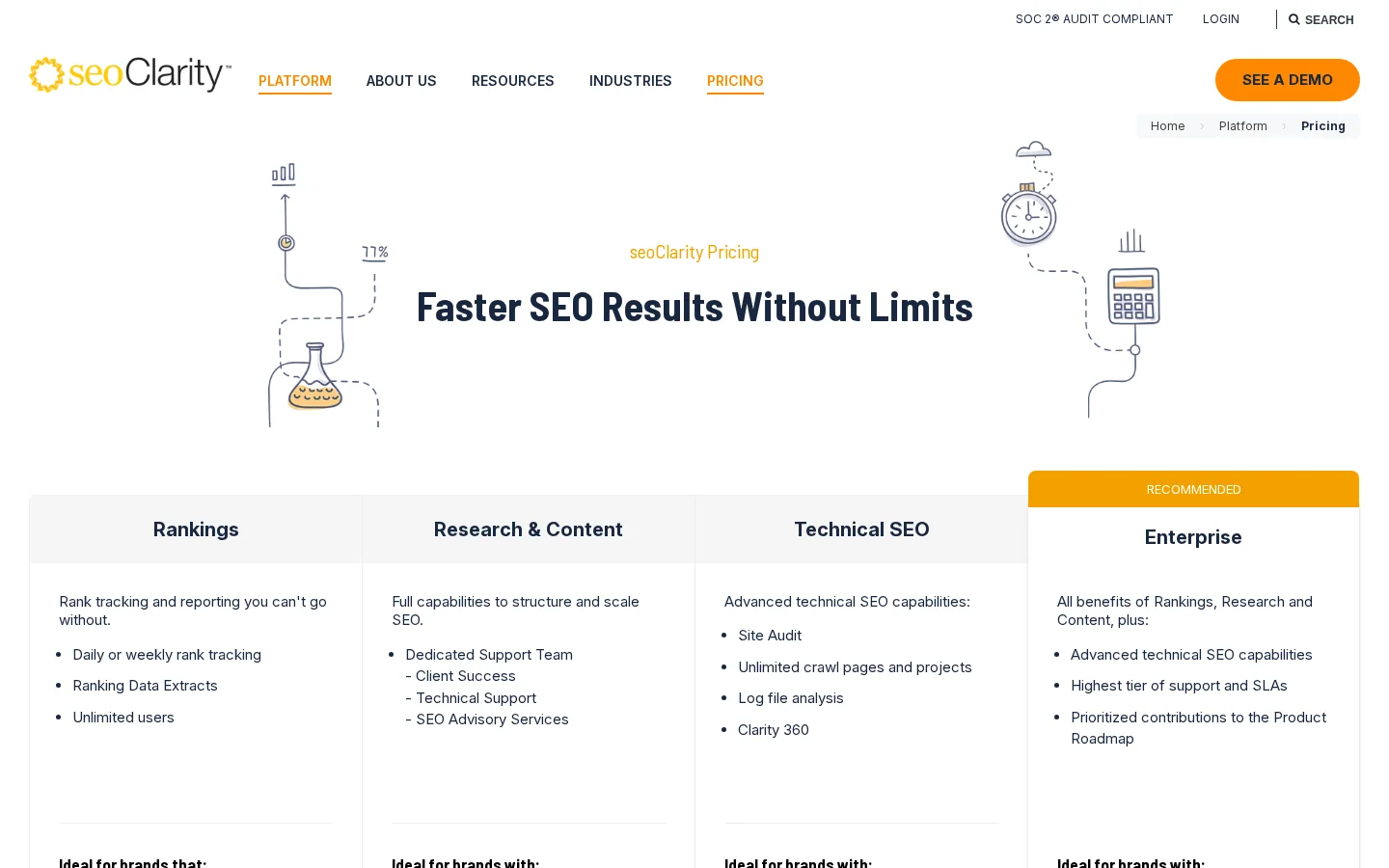
What it is. seoClarity is a suite for classic search and AI search: rankings, research, content, site audits, log analysis, AI visibility (Clarity ArcAI) and automated deployment (ClarityAutomate). The vendor says more than 3500 brands, enterprises and agencies use it.
Who it is for. In-house SEO teams with strong technical and content needs, in ecommerce, travel, real estate, automotive or marketplaces.
Strengths. Each client gets a dedicated crawler instance, with no page or depth restriction announced. The vendor reports a test on a site of more than 48 million pages. Crawl speed is adjustable from 1 to 100 pages per second, and the highest speeds require that you approve its bot. The log module lists crawled and uncrawled URLs, orphan pages and spoofed bots that imitate search engines.
Limit. Alerts and content analyses are capped in the comparison table (25 or 50 content optimization analyses per month, depending on the tier). Ask for the caps of your own tier in writing.
Price. On the seoClarity pricing page, Research and Content starts at $2500 per month, Technical SEO at $3200 and Enterprise at $4500 (checked on 25 November 2026). The page states that these packages are representative as of 11 October 2022 and may change, so treat them as a floor.
What it is. Conductor calls itself the enterprise platform for AI and search visibility. It groups Intelligence (visibility and revenue), Creator (content), Monitoring (site health) and AgentStack (agents, API and MCP server).
Who it is for. Marketing, content and ecommerce teams that share one view of search, with an IT team that wants to build on top.
Strengths. Monitoring runs around the clock and keeps a searchable log of page changes for up to 60 months. That record is precious after a release: you see which template changed, on what day. The security page lists ISO 27001, ISO 42001, SOC 2 Type II and SSO through SAML. Pricing is described as usage-based, not per seat, which helps large teams.
Limit. Limits change sharply between plans: 1000 pages analyzed on Essentials, 25000 on Growth, 125000 or more on Enterprise. Check that "pages analyzed" and "pages monitored" both fit your site, because they are two different lines.
Price. Not published. The Conductor plans page shows limits and invites you to try Essentials for free, request a demo or contact sales (checked on 25 November 2026). Hesitating between the first two? See Conductor and seoClarity side by side.
 Semrush Enterprise
What it is. Semrush Enterprise joins SEO, AI Optimization, Site Intelligence (crawling and audits) and Semrush Data. The vendor announces 28.7 billion keywords, 805 million domains and 43 trillion backlinks, with daily updates.
Who it is for. Groups that need market and competitor intelligence across countries, in SEO, content, engineering and leadership teams.
Strengths. Breadth of external data, forecasting, and one environment from keyword to audit. Site Intelligence crawls millions of pages with JavaScript and Shadow DOM, simulates search engine bots and AI bots, and includes accessibility and compliance checks.
Limit. The Site Intelligence page we read does not mention server log analysis. Ask how logs are handled if crawl waste is your main problem. Also ask about the roadmap: Adobe closed its purchase of Semrush on 28 April 2026 and announces continued investment and full integration of the two companies.
Price. Not published, demo only (checked on 25 November 2026). The self-service plans are a different product, covered in our detailed review of Semrush.
What it is. BrightEdge is an SEO and AI search platform built around Data Cube X (keyword research, over 4 billion data points), AI Hyper Cube (how people search in ChatGPT and AI Overviews), ContentIQ (audits) and StoryBuilder (dashboards).
Who it is for. Midsize and enterprise companies, global multi-market brands and chains with local stores.
Strengths. Multi-domain management from one dashboard, with total or per-domain views. Workflow tools cover tasks, milestones and user permissions, and reports can be saved as templates and distributed automatically. Coverage extends to Bing, Baidu, Naver and Yandex, useful when your SEO covers several countries and languages.
Limit. The product pages we read publish neither crawl quotas nor security certifications. The only figure on reliability is the 99.99% uptime claimed by the vendor.
Price. Not published. The pricing address leads to a demo request (checked on 25 November 2026). Our BrightEdge and Moz comparison shows when a lighter suite is enough.
 Botify
What it is. Botify presents itself as an AI search optimization platform, with crawl and log analysis at its core. Analytics covers SiteCrawler, LogAnalyzer and RealKeywords. Activation covers PageWorkers, SmartLink, SmartIndex and SpeedWorkers.
Who it is for. Very large catalogs and retail sites. The home page shows Etsy, Macy's and Levi's among its customers.
Strengths. SiteCrawler covers millions of pages in a single crawl, with more than 1000 technical indicators and a rendering engine the vendor describes as the same as Googlebot's. It can crawl a staging site before a migration. PageWorkers deploys changes when your development queue is full, and SpeedWorkers serves pages to bots in under 300 milliseconds according to the vendor.
Limit. The layers are sold separately. In its help center, SpeedWorkers is an option of the Pro and Enterprise plans only, and data retention depends on the plan. Smaller teams can compare with a desktop crawler in our Sitebulb versus Botify guide.
Price. Not published, demo only (checked on 25 November 2026).
 Ahrefs Enterprise
What it is. Ahrefs Enterprise opens the Ahrefs database of links, keywords and competitor pages to large teams, with API access, Looker Studio connectors and security features.
Who it is for. Companies whose SEO depends on links, content and competitor research, often beside a separate crawler.
Strengths. The pricing page lists uncapped API access, custom endpoints, SSO, access management, an audit log and unlimited historical data for Enterprise. The company is ISO 27001 certified, and Enterprise customers can opt out of having their data used for training. Search Console data is kept beyond 16 months.
Limit. A portfolio groups URLs from 10 unique domains at most, which is short for a group with 40 brand sites. The Enterprise page lists data, reporting and security, not server log analysis.
Price. Enterprise is on quote. Lite is at €119 per month, Standard at €229 and Advanced at €419, tax excluded and with one user included (checked on 25 November 2026). Details in our Ahrefs review with costs and limits.
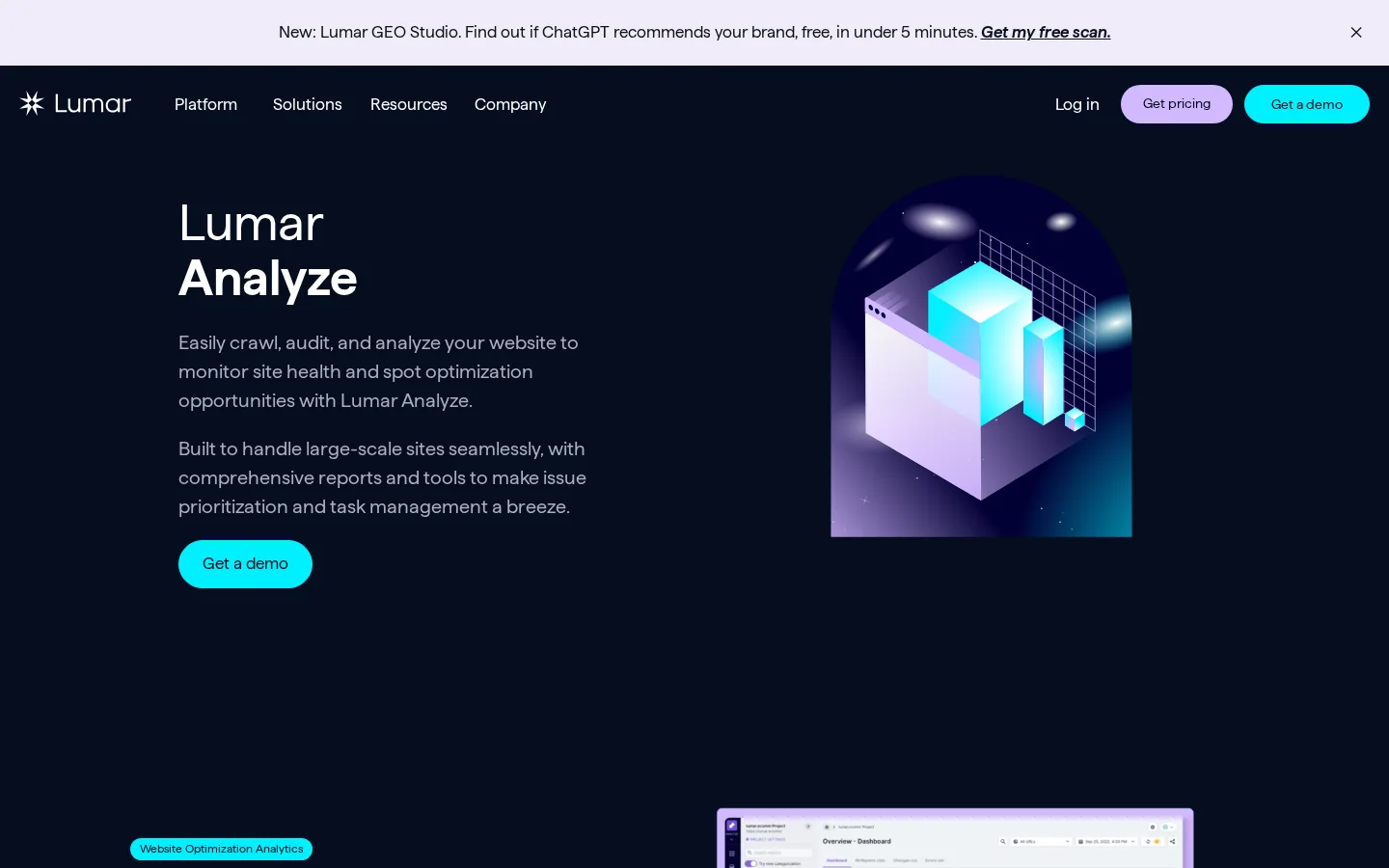
What it is. Lumar is a website optimization platform with four apps: Analyze, Monitor, Protect and Impact. Modules cover technical SEO, GEO, site speed and accessibility (WCAG 2.2).
Who it is for. SEO, development and accessibility teams on sites that ship code every week.
Strengths. Protect is the difference. It plugs into your CI/CD pipeline, runs more than 350 ready-made tests and can stop a build that falls below your threshold. A noindex tag on a template is then caught before Google sees it. Analyze runs on a serverless architecture and crawls "as fast as your infrastructure allows". Lumar is SOC 2 Type 2 certified.
Limit. Keyword research and rank tracking are not among its apps, and log data comes in through integrations. Plan a second tool for market data.
Price. Not published. Modules are chosen one by one and quoted through a form (checked on 25 November 2026).
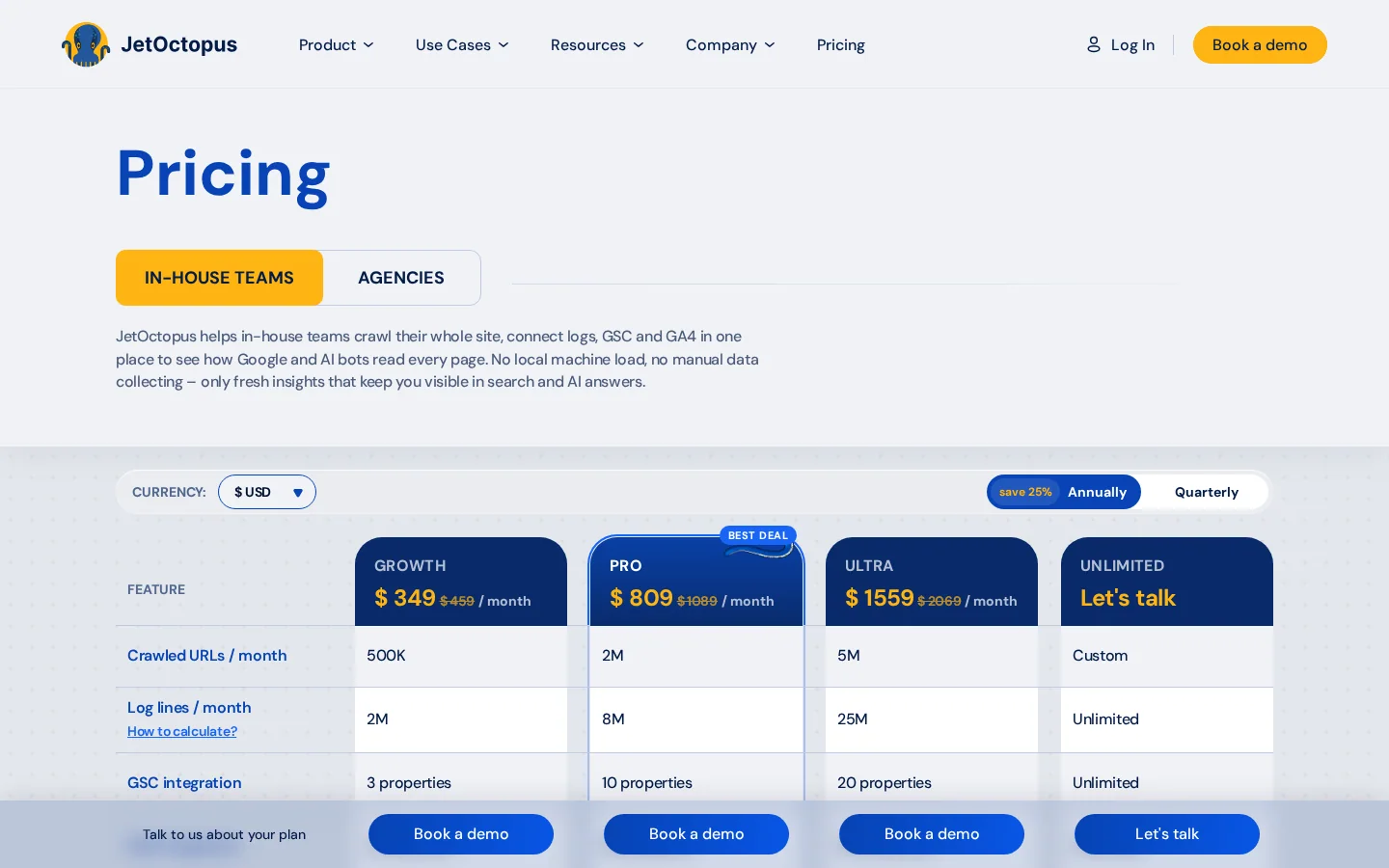
What it is. JetOctopus is a cloud platform for large sites that joins crawl, server logs, Search Console and Google Analytics. Every plan includes all modules, alerts, an internal linker and an MCP server to query the data from Claude or ChatGPT.
Who it is for. Technical SEOs in ecommerce and marketplaces, agencies and consultants.
Strengths. A listed price, unlimited projects, seats and simultaneous crawls. The vendor announces more than 1 million pages crawled per day and unsampled data. Plans go from 500000 to 2 million and then 5 million crawled URLs per month.
Limit. It is a technical platform, not a market data suite. The pricing page showed two versions of its feature table, with different log line limits on the higher plans, so get yours confirmed in the contract.
Price. Growth at $349 or $459 per month, Pro at $809 or $1089, Ultra at $1559 or $2069, with a billing option that saves 25%. Unlimited is on quote (checked on 25 November 2026).
 SISTRIX
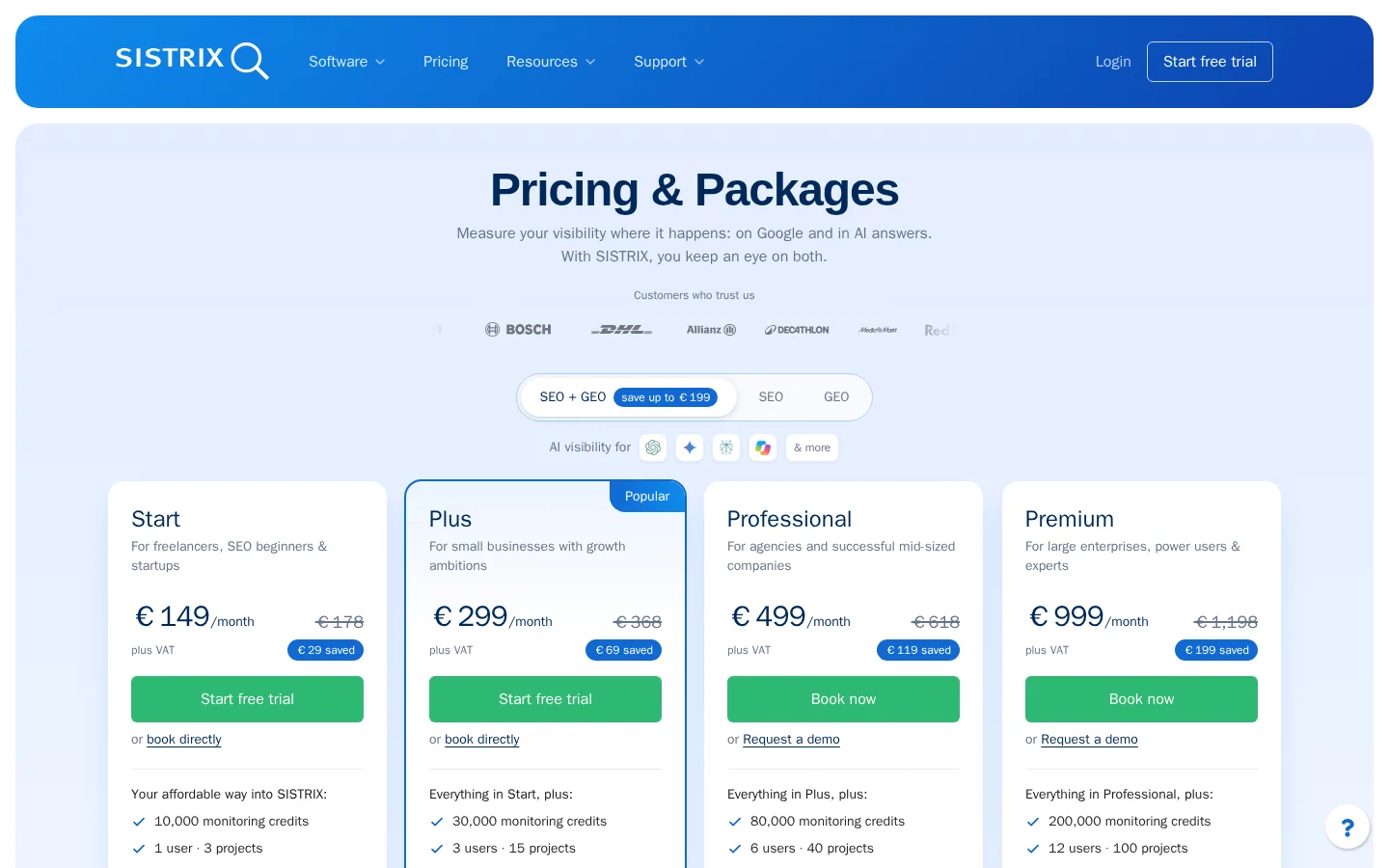
What it is. SISTRIX is a German SEO platform known for its Visibility Index, a single score of organic visibility calculated in 40 countries. It also covers content, on-page audits, competitors and prompt tracking in AI chatbots.
Who it is for. European groups and agencies that report visibility by country and want public prices.
Strengths. Comparable history: 11 years on the Professional plan. All data is hosted in Europe, which shortens a data protection review. Premium adds roles, permission management and an audit log for 12 users and 100 projects.
Limit. The governance features start on Premium only. Check the on-page crawl against your page count before replacing a dedicated technical platform.
Price. Start at €149 per month, Plus at €299, Professional at €499, Premium at €999, VAT excluded. Extra users cost €24.90 each (checked on 25 November 2026).
What it is. Siteimprove.ai unites accessibility, search (SEO and AEO), content strategy and analytics. Its agents run on the same governance layer.
Who it is for. Government, healthcare, higher education, finance and other organizations where an inaccessible page is a legal risk.
Strengths. One list of issues for SEO, accessibility and content rules. Policies flag pages that break your own standards across the whole site. The vendor was named a Leader in the 2026 Gartner Magic Quadrant for Digital Accessibility, announces 70+ on-page SEO diagnostics and can apply fixes in the CMS.
Limit. SEO is one module among four. Teams that live in rankings, logs and backlinks will want a specialist platform beside it.
Price. Not published, demo on request (checked on 25 November 2026).
There are four ways to equip a large company, and most mature teams end up with two of them. Decide the architecture before the vendor, because it decides who owns the data and who can act on it.
One contract covers rankings, content, audits and reports. Use it when several non-technical teams need the same numbers. The gain is adoption and a single source. The limit is depth: a suite crawler may not satisfy a technical SEO with 20 million URLs. Example: Conductor for five country marketing teams.
You pick the best crawler, the best rank data and the best link data. Use it when you have senior SEOs who know how to join sources. The gain is precision and bargaining power. The limit is reconciliation, since two tools never count pages the same way. Example: Lumar, Ahrefs Enterprise and SISTRIX. Our ranking of technical SEO tools by job helps to fill each slot.
You store the Search Console bulk export, logs, crawl exports and revenue in BigQuery or an equivalent. Use it when data engineers are available and leadership wants SEO beside other channels. The gain is ownership: you change vendor without losing history. The limit is maintenance, as a schema change can make the Google export fail. Example: raw data at home, with one crawler that feeds it by API.
A layer between your CMS and bots changes titles, links or rendering without a release. Use it when the development queue exceeds one quarter. The gain is speed. The limit is debt: a fix that lives outside your code disappears with the contract. Examples: Botify PageWorkers, seoClarity ClarityAutomate.
| Architecture | Use it when | Main benefit | Main risk | People needed |
|---|---|---|---|---|
| All-in-one suite | Many teams, few experts | Adoption, one source of numbers | Paying for unused modules | One platform owner |
| Specialist stack | Senior SEO team | Depth, negotiation | Numbers that do not match | Two or three senior SEOs |
| Data warehouse | Data engineers available | Ownership, long history | Maintenance cost | SEO and data engineer |
| Execution layer | Slow release cycle | Fixes live in days | Technical debt, dependency | SEO with developer approval |
Suite or specialist stack?
Expect $4000 to $25000 per year for a focused platform, and up to six figures for a full suite on many domains. Public figures are rare. Conductor's Academy guide gives three indicative ranges: $10000 to $25000 per year for point tools, $25000 to $75000 for platforms, and $75000 to over $200000 for full suites. Conductor sells one of them, so use the ranges as an order of magnitude.
The published entry prices agree with the first two levels. JetOctopus Growth at $349 per month is about $4200 per year. SISTRIX Premium at €999 is about €12000. seoClarity Enterprise at $4500 is $54000.
| Your site | What you need first | Shortlist | Indicative yearly budget |
|---|---|---|---|
| Under 10000 pages, one team | Audit, keywords, content | A standard suite, no enterprise contract | Under $5000 |
| 10000 to 500000 pages, some technical debt | Crawl, logs, alerts | JetOctopus, SISTRIX, Lumar | $4000 to $25000 |
| 500000 to 5 million pages, several teams | Crawl plus rankings plus roles | seoClarity, Conductor, Semrush Enterprise, BrightEdge | $25000 to $75000 |
| Over 5 million pages, or 20+ domains | Logs, deployment, API, SLA | Botify, seoClarity, Conductor, Lumar | $75000 and more |
| Regulated sector, any size | Accessibility, audit trail, data location | Siteimprove, SISTRIX Premium, Lumar | On quote |
The budgets in the last column combine published entry prices and the Conductor ranges. They are a starting point for your business case, not a quote. Under 10000 pages, our list of SEO tools sized for smaller teams will save you money.
Tip
Ask each vendor for a price per unit above the quota: per 1000 keywords, per million log lines, per extra domain. A low base with a high overage costs more by month eight. Then model the gain with our three-scenario SEO forecast before you defend the budget.
They should check access, traceability, data location and exit. Security reviews delay more enterprise purchases than features do, so start them in week one. The table lists only what we found on the official pages. An empty answer does not mean the feature is missing: it means you must ask.
| Vendor | Published security or governance facts | Question to ask |
|---|---|---|
| Conductor | ISO 27001, ISO 42001, SOC 2 Type II, SSO through SAML | Is SCIM available to remove accounts automatically? |
| Ahrefs Enterprise | ISO 27001, SSO, 2FA, access management, audit log, training opt-out | How many domains can one portfolio really serve? |
| Lumar | SOC 2 Type 2 | Can read access be limited to one market? |
| SISTRIX | Data in Europe, roles and audit log on Premium | Is SSO available? |
| BrightEdge | User permission controls, 99.99% uptime claimed | Which certifications can you share? |
| seoClarity | Highest support tier with SLA on Enterprise, unlimited users on Rankings | What does the SLA refund? |
Two technical points deserve a written answer. First, how does the tool identify its crawler? Your security team needs fixed IP ranges or a verifiable user agent to let it through the firewall without opening the door to copies. Second, what leaves your company? Raw logs contain IP addresses. Strip them, or hash them, before upload, and keep only bot lines.
Governance is also a matter of rules: who may publish, who may edit a template, who approves a redirect. Write them once with a content governance framework, then configure roles to match.
Run the same five tests on two vendors, on your real site, with the same success criteria. A demo shows the vendor's data. A pilot shows yours. Two finalists are enough, because a third one dilutes the attention of your team.
The 30-day pilot in 5 steps
Before the pilot, count what Googlebot requests by top folder on your own server. The vendor's log report must land close to this number. On an access log in the usual combined format, this command is enough.
grep -i "googlebot" access.log \
  | awk '{print $7}' \
  | cut -d'?' -f1 \
  | cut -d'/' -f2 \
  | sort | uniq -c | sort -rn | head -20
The user agent can be forged, so confirm a sample of IP addresses with a reverse DNS lookup. If filters or search pages take a large share of hits, you have found your first use case. Our guide to reading server logs for SEO explains the next step, and the definition of AI crawler logs shows how to repeat it with GPTBot and ClaudeBot.
Give each criterion a weight before the first demo, and lock it. Score from 1 to 5. Multiply. A weighted grid protects you from the most fluent salesperson.
| Criterion | Suggested weight | Test that proves it | Eliminating answer |
|---|---|---|---|
| Crawl completeness | 25% | Same section crawled twice, gap explained | Unexplained gap above 5% |
| Data joining | 20% | One URL shown with crawl, logs, clicks and revenue | Needs a manual export |
| Adoption | 20% | Five users finish a task alone | Fewer than three succeed |
| Governance | 15% | A market user cannot see another market | No roles on your plan |
| Export and API | 10% | Full raw export within 24 hours | Row cap below your URL count |
| AI visibility | 10% | Same 50 prompts checked by hand | No raw answers shown |
These weights suit a content and commerce site. A marketplace can raise crawl completeness to 35%. A public body can raise governance to 30%.
It finds and prioritizes, but it rarely produces. Most platforms end with a list: 340 missing pages, 1200 weak titles, 90 prompts where a rival is cited. Someone must still write, link, publish and follow up. That is where large teams stall.
From a reporting tool to a decision tool
For the editorial part, a lighter tool often works beside the big platform. Sorank does this job for a brand, a country or a product line: it checks each keyword against your existing pages, writes the article, saves it as a draft in your CMS for approval or publishes it, and tracks your mentions in ChatGPT, Claude and Gemini. The page on automating content, links and AI tracking for SEO teams shows the scope. The crawl, the logs and the technical audit stay with the platforms above.
AI answers add a last blind spot. A page can rank and never be quoted. Measure your share of voice in AI answers on a fixed set of prompts, keep the raw answers, and check that bots can read your templates without JavaScript. Our guide to JavaScript rendering for search and AI crawlers gives the tests.
Free check
Test three of your main templates with our free AI crawlability audit before the pilot. If AI bots are blocked, put that question at the top of your vendor list.
Most failures come from the organization, not from the software. Here are seven, with the way to spot and correct each one.
What it is. You pay to crawl 5 million URLs when 400000 deserve to exist. How to spot it. Compare URLs found in the crawl with URLs that received an impression in 90 days. How to fix it. Block or merge filter and sort URLs first. Google recommends robots.txt for unimportant URLs, and warns against noindex as a way to manage crawling, since the page is still requested.
What it is. The choice rests on a presentation with the vendor's best client. How to spot it. Nobody in the room has seen your own data in the tool. How to fix it. Make the 30-day pilot a condition of the contract.
What it is. Developers and writers receive screenshots by email. How to spot it. Fewer than one third of accounts log in each month. How to fix it. Prefer pricing without seat fees, connect alerts to the ticket tool and train by task, not by menu.
What it is. 60000 keywords, of which 50000 never lead to a decision. How to spot it. Nobody has opened a segment in three months. How to fix it. Keep daily tracking for money pages, weekly for the rest, and use the bulk export for the long tail.
What it is. The contract ends and five years of data go with it. How to spot it. There is no exit clause, or the export covers only the last 16 months. How to fix it. Store raw monthly exports at home from the first day, and write format and delay into the contract.
What it is. Two dashboards give two visibility figures, and the meeting debates the gap. How to spot it. The keyword sets, countries or devices differ. How to fix it. Name one reference source for each indicator, and write it under every chart.
What it is. A template change removes canonicals on 200000 pages, and the weekly crawl shows it six days later. How to spot it. Compare the date of each drop with your release calendar. How to fix it. Test templates in the pipeline before release, monitor 50 sentinel URLs hourly, and keep a technical SEO audit checklist for the rest.
Start from your constraint. For one deep platform with a price you can plan, test seoClarity against Conductor. For a catalog above 5 million URLs, test Botify against Lumar. For technical depth on a controlled budget, start with JetOctopus. For European visibility reporting, take SISTRIX. For accessibility duties, put Siteimprove on the list. Keep Semrush Enterprise, BrightEdge and Ahrefs Enterprise when market, multi-domain or link data drives your decisions.
Three actions fit into today. Turn on the Search Console bulk export. Run the log command on last week's file. Write the 20 decisions your platform must support. With these three documents, your first vendor call is about your site, and no longer about their slides.
This ranking reflects my own experience and opinion as an SEO expert with more than 7 years in the field. It is based on verified facts, but the order itself is my personal view.
There is no single winner for every company. seoClarity leads our list for depth at a published price, Conductor fits marketing teams, Semrush Enterprise fits market analysis, and Botify, Lumar or JetOctopus fit technical work on very large sites. Test two finalists on your own data for 30 days.
Most vendors work on quote. Published entry prices go from $349 per month for JetOctopus to $4500 per month for seoClarity Enterprise, read on 25 November 2026. Conductor's guide gives $25000 to $75000 per year for platforms and over $75000 for full suites.
You need one when volume, people and proof all exceed a normal tool. Google's crawl budget guide mentions sites above 1 million pages that change weekly, or above 10000 pages that change daily. Several teams, many domains or strict security rules are equally good reasons.
We analyse your competitors, your website and your AI visibility to create a tailored content plan for free.
 Duplicate Content Checker
 Mobile-Friendly Test
 Website Speed Test
 Subdomain Finder
 Domain Age Checker
 CMS Detector
 Googlebot Simulator
 Nofollow Link Checker
 Meta Tag Checker
 Keyword Cannibalization Checker
 Keyword Intent Checker
 Keyword Extractor
 Google Ads Cost Calculator
 CPC Calculator
 Local Citation Finder
 Reddit Threads Finder
 Disavow File Generator
 Redirect Generator
 Canonical Tag Generator
 Passive Voice Checker
 Google Location Changer
 Google Review Calculator
 Google Review Link Generator
 Keyword Combiner
 Podcast Show Notes Generator
 AI Content Rewriter
 AI Text Humanizer
 ChatGPT Prompt Generator
 Twitter Thread Generator
 Tweet Generator
 Landing Page Copy Generator
 Google Ads Copy Generator
 Pinterest Pin Description Generator
 Anchor Text Generator
 Social Media Post Generator
 LinkedIn Post Generator
 Free AI Writer
 Review Response Generator
 LSI Keyword Generator
 YouTube Video Ideas Generator
 YouTube Tag Generator
 YouTube Description Generator
 Product Description Generator
 CTA Generator
 Blog Introduction Generator
 Conclusion Generator
 Hook Generator
 AI Content Brief Generator
 FAQ Schema Generator
 AI Blog Post Ideas Generator
 Structured Data Validator (Schema Validator)
 Alt Text Checker
 Internal Link Analyzer
 Backlink Challenge
 AI Meta Description Generator
 AI Blog Title Generator
 Google Indexability Checker
 AI Blog Outline Generator
 UTM Link Builder
 Keyword Clustering Tool
 Canonical Tag Checker
 XML Sitemap Generator
 Broken Link Checker
 AI SEO Title Generator
 Headline Analyzer
 SERP Preview Tool
 Redirect Checker
 Hreflang Tag Generator
 Heading Structure Analyzer
 HTTP Headers Checker
 Favicon Extractor
 SERP CTR Calculator
 SEO vs Paid Search Savings Calculator
 SEO Share of Voice Calculator
 SEO ROI Calculator
 SEO Traffic and Revenue Forecast Calculator
 SEO Budget Calculator
 SEO Break-Even Calculator
 SaaS SEO ROI Calculator
 ROAS Calculator
 Reading Time Calculator
 Ranking Gain Simulator
 Organic Traffic Value Calculator
 Organic Traffic Estimator and Website Traffic Checker
 LTV to CAC Ratio Calculator
 Local SEO ROI Calculator
 Link Building Cost Calculator
 Keyword Value Calculator
 Keyword Opportunity Score Calculator
 Keyword Density Calculator
 GEO ROI Calculator
 GEO Content Investment Calculator
 Ecommerce SEO ROI Calculator
 Customer Lifetime Value Calculator
 Customer Acquisition Cost Calculator
 CTR Calculator
 Cost Per Article Calculator
 Conversion Rate Calculator
 Content Marketing ROI Calculator
 ChatGPT Referral Traffic Estimator
 Bounce Rate Calculator
 Backlink ROI Calculator
 AI Visibility Score Calculator
 AI Traffic Value Calculator
 AI Share of Voice Calculator
 Cost of AI Invisibility Calculator
 AI Citation Rate Calculator
 llms.txt Validator
 AI Overview Checker and AI Overviews Rank Checker
 Robots.txt Checker
 AI SEO Audit
 LLM Readability Checker
 SearchGPT Readiness Checker
 Structured Data LLM Audit
 Website Crawlability AI Audit
 Why ChatGPT Is Not Recommending My Website
 Gemini Ranking Tool
 Perplexity Ranking Checker
 LLM Citation Checker
 Answer Engine Optimization Audit
 GEO Audit
 AI Search Visibility Test
 ChatGPT Visibility Checker
 llms.txt Generator
 URL Extractor
 Webpage to Markdown
 Sitemap Checker
 SERP Volatility Sensor
 Page Size Checker
 Word Counter
 Slug Generator
 Schema Generator
 Robots Generator
 OG Preview
 Meta Tags Generator
 Image Compressor
 Favicon Generator
 On-Page SEO Audit: SEO Checker and SEO Analyzer
 Backlink Analysis Tool
 Keyword Research Tool
 Domain Authority Checker
 “I tested Sorank on a real client site and it's insane. It does everything an agency would bill you $1500 a month for. It's going into production on that client now.”

 Guillaume Guersanguersanguillaume.com“We are an Ads agency and we wanted to get our SEO back on track once and for all. Sorank gave us a clear view of our site, helped us prioritize optimizations, and properly structure our content. The tool is easy to use, well designed for a team, and very practical for centralizing tracking without having to juggle multiple platforms. A very solid foundation to start fresh with our SEO.”
 Gaspard MadouiAds Agency
 “I just let the Sorank software do its thing, and now my DR is 25 and my page is ranking higher.”
 Lucas Flandrefoundertrace.fr“I specialized in GEO thanks to Sorank. The GEO Leaderboard allows me to show my clients their position vs competitors on ChatGPT. It’s a real commercial differentiator.”
 MélanieSEO Freelance“Great service, works well for our website and helps us understand how to improve it to rank better on Google and elsewhere. Congrats, keep going, I recommend it.”
 Hugo T.E-commerce merchant