Preferences
Privacy is important to us, so you have the option of disabling certain types of storage that may not be necessary for the basic functioning of the website. Blocking categories may impact your experience on the website. More information

Privacy is important to us, so you have the option of disabling certain types of storage that may not be necessary for the basic functioning of the website. Blocking categories may impact your experience on the website. More information

Compare the 10 best phone number enrichment tools in 2027, led by Pipecorn: mobile coverage, verification, cost per phone, free plans and GDPR.


Summarize this article with AI
Searching for a phone number enrichment tool usually starts with a list of names, companies and emails, and no way to call any of them. Enrichment fills that gap by matching each contact to a mobile or direct-dial number, and the quality of the match decides everything that follows. Gartner research from 2020 estimates that poor data quality costs organizations at least $12.9 million a year on average, and a study published in Harvard Business Review found that only 3% of companies' data met basic quality standards. On the phone, bad data has an immediate cost: a wrong number wastes a rep's call, and a number that belongs to someone else can turn into a privacy complaint.
You send a contact record, usually a full name with a company domain, a work email or a professional profile URL. The tool searches one or several data sources and returns a phone number tied to that person, with a line type and often a confidence signal. Three kinds of number come back, and they are not worth the same to a sales team.
1. Mobile numbers. The mobile of the named person. This is what calling teams want, because it rings in the person's pocket wherever they work. It is also the most expensive data point in every tool reviewed here.
2. Direct dials. A landline that reaches the person's desk without going through a switchboard. Useful for office-based roles, less so since hybrid work spread.
3. Company lines. The switchboard or headquarters number. Easy to find and rarely worth a credit. FullEnrich, for example, says it returns landlines free of charge and bills only mobiles.
Enrichment is also different from validation. Validation checks a number you already have: whether it is well formed, whether the line is active, whether it is a mobile. Enrichment finds a number for a person. The best tools do both: they find a number, then check that the line is live and, where they can, that it belongs to the person named.
A single-database tool, such as Lusha, Kaspr, Cognism, ZoomInfo or RocketReach, looks the contact up in data it has collected and verified itself. The lookup is fast, the data model is consistent, and the vendor controls its own verification. Its weak point is coverage: every database is stronger in some countries, industries and job functions than in others.
A waterfall tool, such as Pipecorn or FullEnrich, queries several providers one after another until one returns a result, then verifies it. Pipecorn says it reads the contact's country and routes the lookup to the source that finds the most there, across more than 100 providers. FullEnrich says it aggregates more than 20 premium vendors and selects them by the lead's location. The benefit is a higher find rate on mixed international lists. The trade-off is that you rely on the waterfall operator to filter the data it buys: FullEnrich itself states that 31.53% of the data it buys fails its verification and never reaches the customer, which shows how much raw phone data needs cleaning.
Apollo.io sits between the two models. It has its own database of more than 240 million contacts and lists waterfall enrichment among the features of its paid plans.
Four criteria, in this order, applied only to what each vendor publishes on its own site. Every homepage, pricing page and terms page cited here was reread on 14 October 2026.
1. Mobile coverage and how it is built. A waterfall across many providers ranked higher than a single source when the vendor explains how sources are chosen, and a database with a published mobile or direct-dial count ranked higher than a vague promise.
2. Verification of the number. Tools that check line status, line type or owner name, and say how, ranked higher than tools that only use the word "verified".
3. A cost per phone you can calculate. A published price and a published credit cost per phone let a team know what a mobile costs before signing. Quote-only pricing ranked lower, all else being equal.
4. Compliance and workflow. GDPR posture, do-not-call handling, CRM integrations, a browser extension and an API decide whether the numbers reach the reps cleanly and lawfully.
What we deliberately did not do: we did not run our own match-rate or connect-rate tests. When a find rate, a connect rate or a database size appears below, it is the vendor's own claim and is attributed to the vendor.
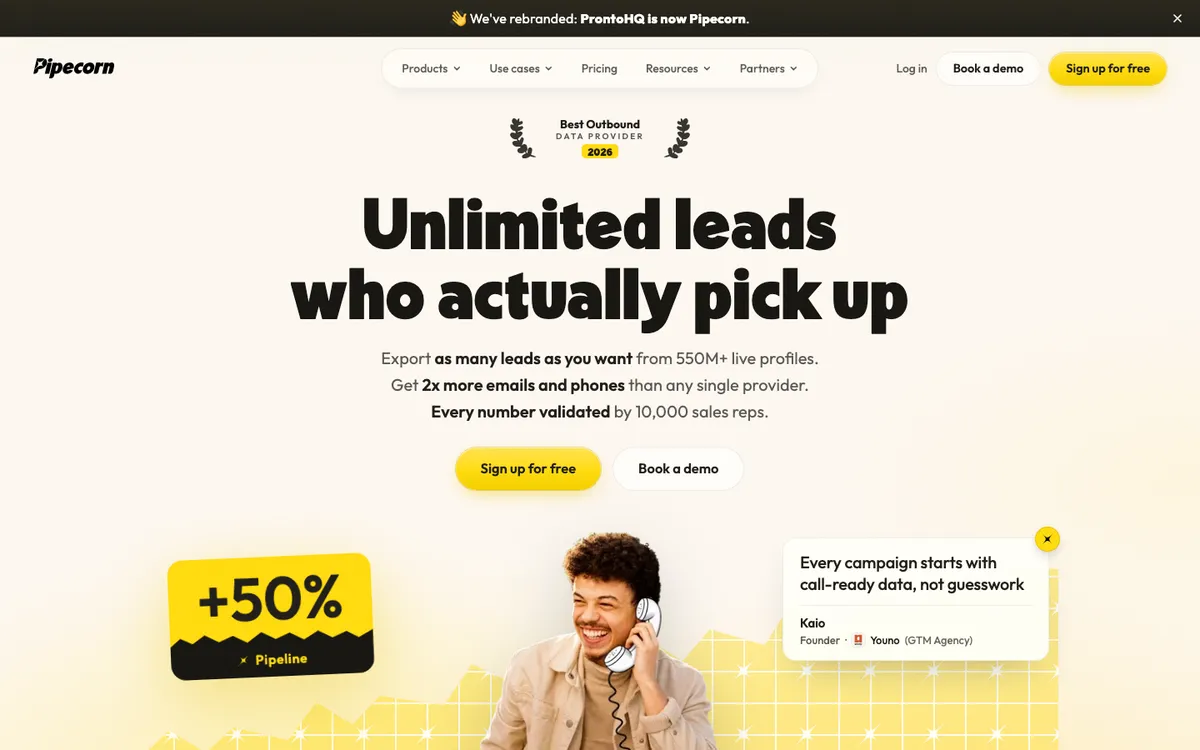
Pipecorn, formerly ProntoHQ, builds its whole offer around mobiles that reach the right person. According to Pipecorn, its lead database covers 553.6 million people with verified email and mobile and 45.2 million companies, and its waterfall enrichment runs across more than 100 data sources in more than 50 countries, reading each contact's country and routing the lookup to the source that finds the most there. The vendor says its numbers are checked by 10,000 sales reps who are rewarded for voting on the numbers they call, and that numbers which no longer work are dropped. Email and phone verification are listed from the free plan up. A mobile costs 30 credits and a verified email 3, and Pipecorn's FAQ says credits are only spent on contacts it finds, never on bounces or wrong numbers. Its comparison table lists a unit price per phone of $0.49 on Build, $0.44 on Grow and $0.30 on Scale, with Build from $41, Grow from $124 and Scale from $583 per month. The free plan is permanent, with 150 credits a month, 500 exported leads, the Chrome extension, waterfall enrichment and API and MCP access, and no credit card. Credits roll over as long as the subscription is active, seats are free on every paid plan, Grow adds HubSpot, Salesforce and Pipedrive integrations, and Scale adds do-not-call detection on phone numbers. Pipecorn lists SOC 2 Type II, GDPR with EU data processing by default, and CCPA.
Best for: outbound teams for whom the phone is the main channel and who prospect several countries at once: the country routing and the crowd validation target the numbers that single databases miss. Teams that call only a few people a month can start on the free plan, which covers about five mobiles a month, and the credit budget is the figure to size before moving to a paid plan.
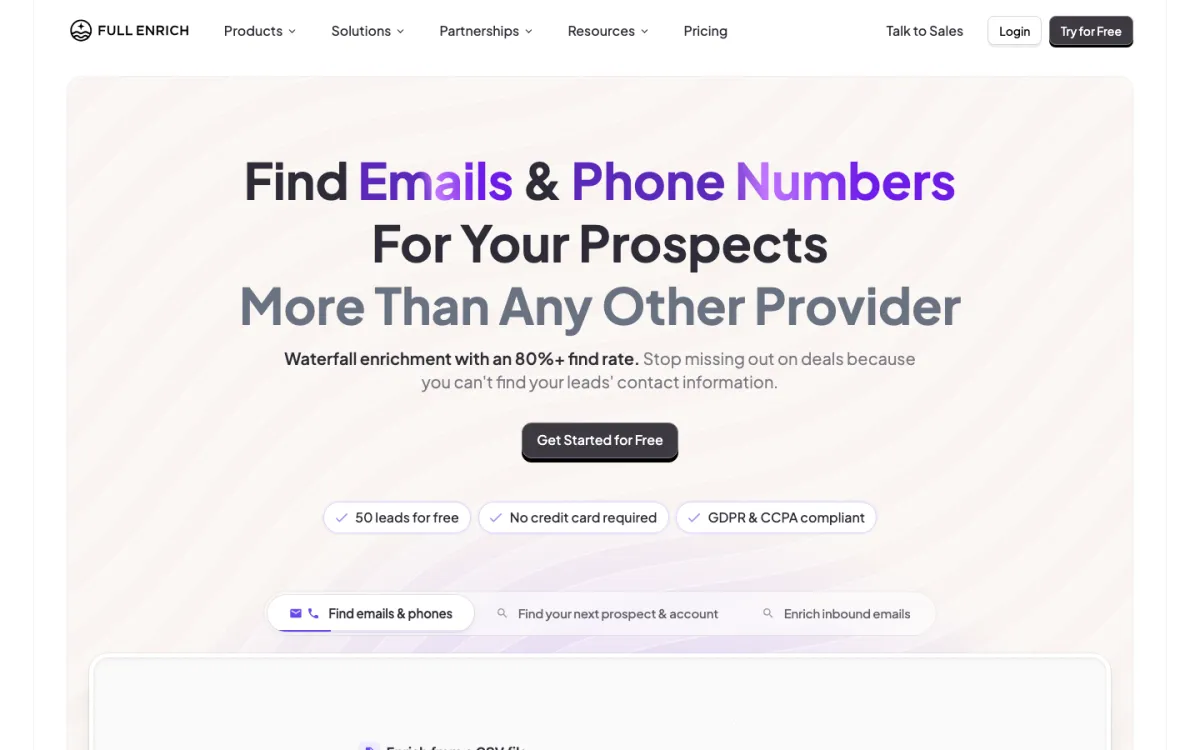
FullEnrich is a pure waterfall: it aggregates contact data from more than 20 premium vendors, according to its homepage, and its pricing page lists waterfall enrichment across 25+ sources. The vendor says it picks vendors by the lead's location and claims a find rate above 80%. Its phone verification is the most detailed published among the tools reviewed here: FullEnrich says it bills only mobile numbers and returns landlines free, checks every number with the carrier network to remove dead lines, and matches the line owner's name against the lead's name, a check its pricing page limits to the US and Canada. A mobile costs 10 credits, a work email 1 and a personal email 3, and a lookup that finds nothing costs nothing. The Pro plan starts at $29 per month for 500 credits on monthly billing, or $26 per month on annual billing, and the price per credit falls as volume grows. Every plan includes unlimited users, the API, an MCP server, HubSpot integration and people and company search across 800 million people. The free trial gives 50 credits with no credit card. FullEnrich lists SOC 2 Type II, GDPR and CCPA compliance.
Best for: growth and RevOps teams that already have their lead lists and want the highest find rate on mobiles, paying only for verified results. Its pricing page lists enrichment, search and integrations, not sequencing or dialing, so it fits teams that already run their outreach in another tool.
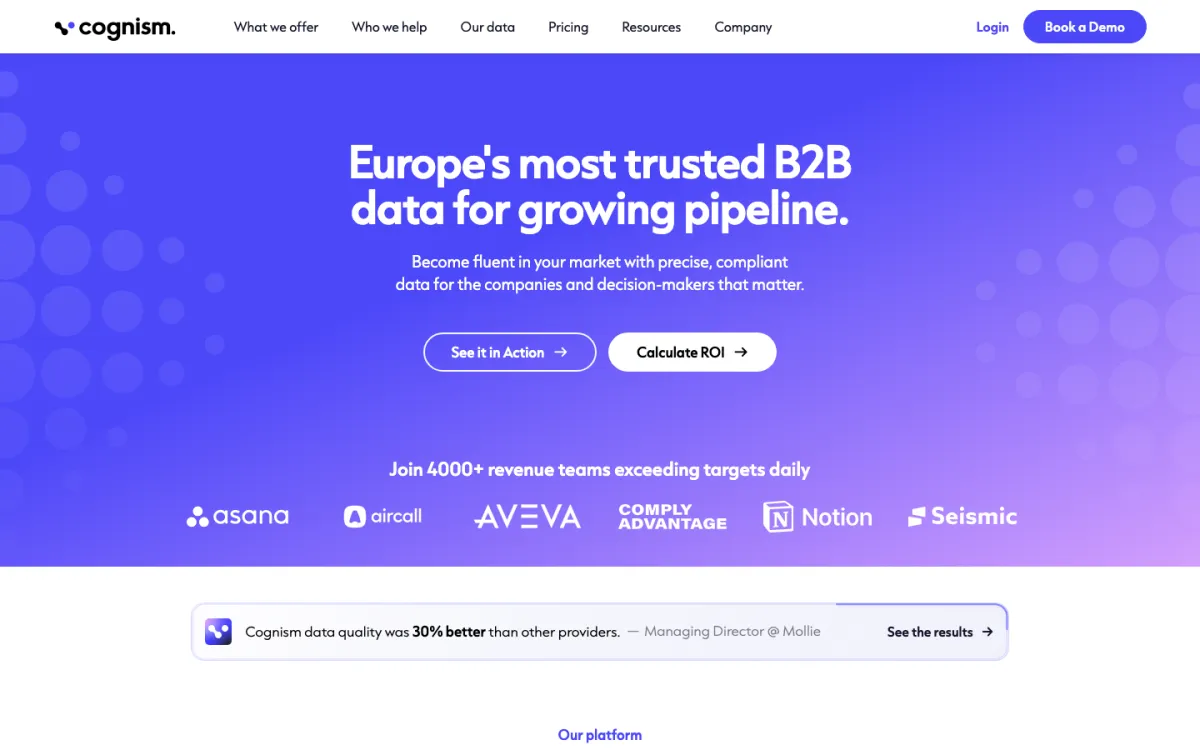
Cognism presents itself as Europe's most trusted B2B data provider and puts phone-verified mobiles at the center of its offer. According to Cognism, these mobiles go through additional manual and automated verification layers, which the vendor says brings up to 3x higher connect rates, and its data on directors and above is refreshed every 30 days. The Pro package adds a premium mobile filter and on-demand mobile verification, which lets users submit high-priority prospects to Cognism's verification engine. Pricing is on quote only: the Standard and Pro packages each include 5 seats, and one credit reveals one contact, with no new charge for a contact already revealed unless that person changes jobs. Integrations include Salesforce, HubSpot and Pipedrive, plus MCP and API access. Cognism says its database complies with GDPR and CCPA, and offers a free data sample instead of a free plan.
Best for: mid-sized and larger teams selling into the UK and continental Europe, where phone-verified mobiles matter more than raw volume and an annual contract is acceptable. Small teams that want to test without talking to sales will find the entry harder than with the tools ranked just below.
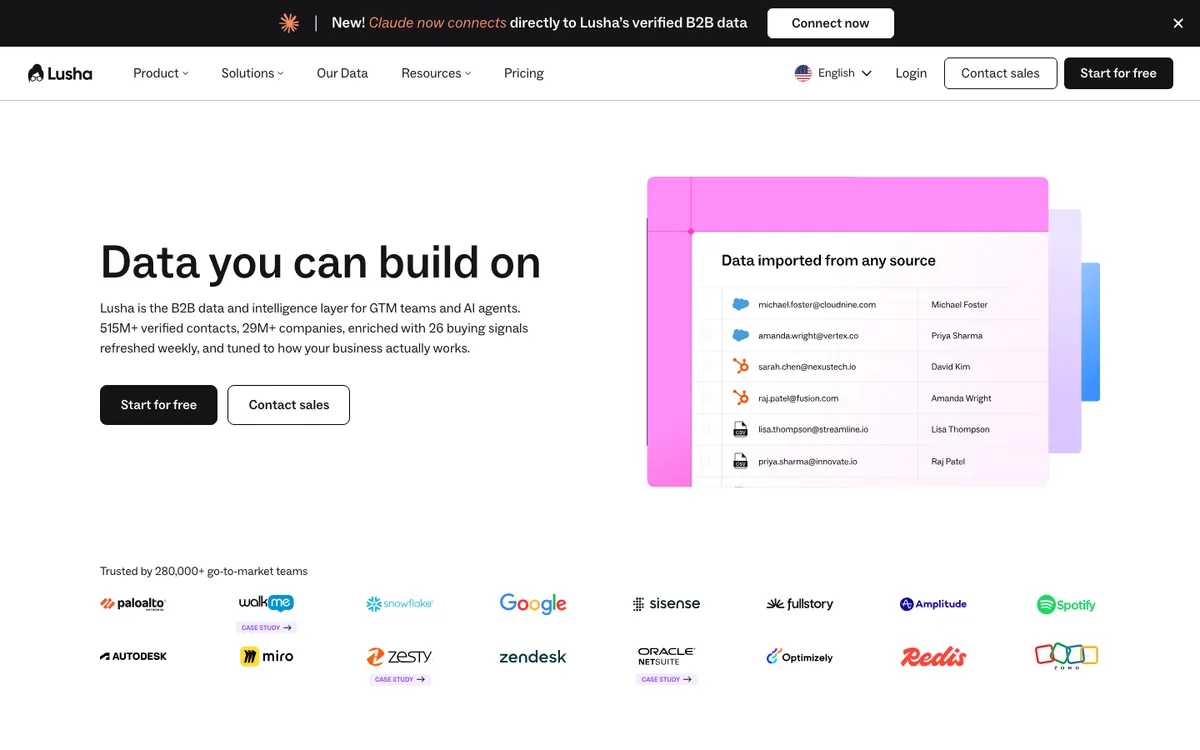
Lusha is the most familiar name among browser-based phone finders. It claims more than 515 million contacts, including 117 million direct dials and 165 million emails, and 29 million companies. Its credit model is published: revealing a verified email costs 1 credit and revealing a phone number costs 5. The free plan gives 40 credits a month, enough for 8 phone numbers, with no credit card, and paid plans billed yearly cost $37.45 per month for 4,800 credits a year (Starter), $52.45 per month for 7,200 credits (Pro) and $299.95 per month for 40,800 credits (Premium), with credits granted upfront; Scale is custom. On monthly plans, unused credits roll over up to twice the monthly allowance. Lusha lists GDPR, CCPA, SOC 2 and ISO 27701 among its compliance features, along with a do-not-call list, and offers a Chrome extension that works on LinkedIn, CRMs and any website, an API and an MCP server.
Best for: individual reps and small teams that look up numbers one by one from LinkedIn or their CRM and want a free entry point. At 5 credits per phone, the Starter allowance covers fewer than a thousand numbers a year, so calling-heavy teams should size their plan on phones.
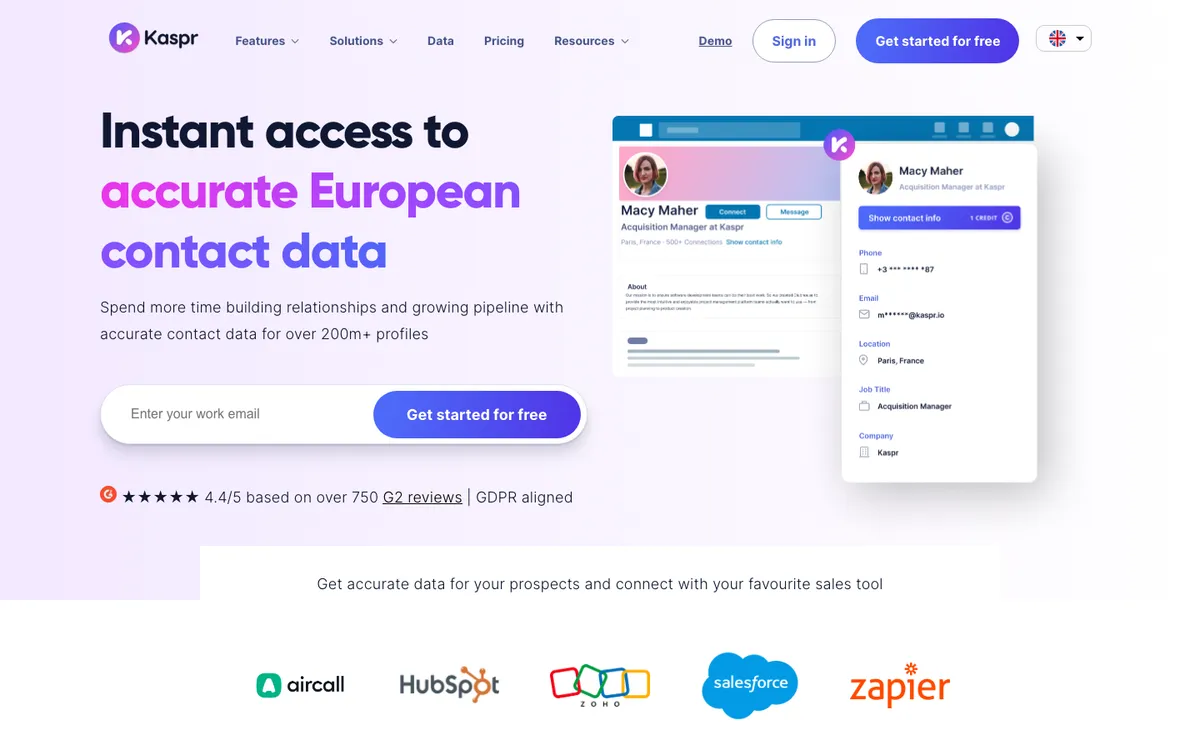
Kaspr is a LinkedIn extension focused on European contact data. The vendor claims more than 500 million phone numbers and email addresses from over 150 sources, and accurate data for more than 200 million profiles. Phone numbers are counted separately from emails: the free plan includes 5 phone credits a month, Starter costs €59 per user per month with 100 phone credits a month (1,200 a year) and unlimited B2B emails, Business costs €99 per user per month with 200 phone credits a month (2,400 a year), and Enterprise adds unlimited phone credits on quote. Kaspr's terms cap the use of unlimited credits at 10,000 per account per month and treat their use through APIs or robots as abuse. The extension works on LinkedIn, on Sales Navigator from Starter and on LinkedIn Recruiter Lite from Business, and the homepage describes Kaspr as GDPR aligned.
Best for: SDRs and recruiters prospecting European profiles from LinkedIn who want a number on screen in one click. The phone allowance is the real limit: at 100 numbers a month on Starter, a rep who calls all day will need Business or Enterprise.
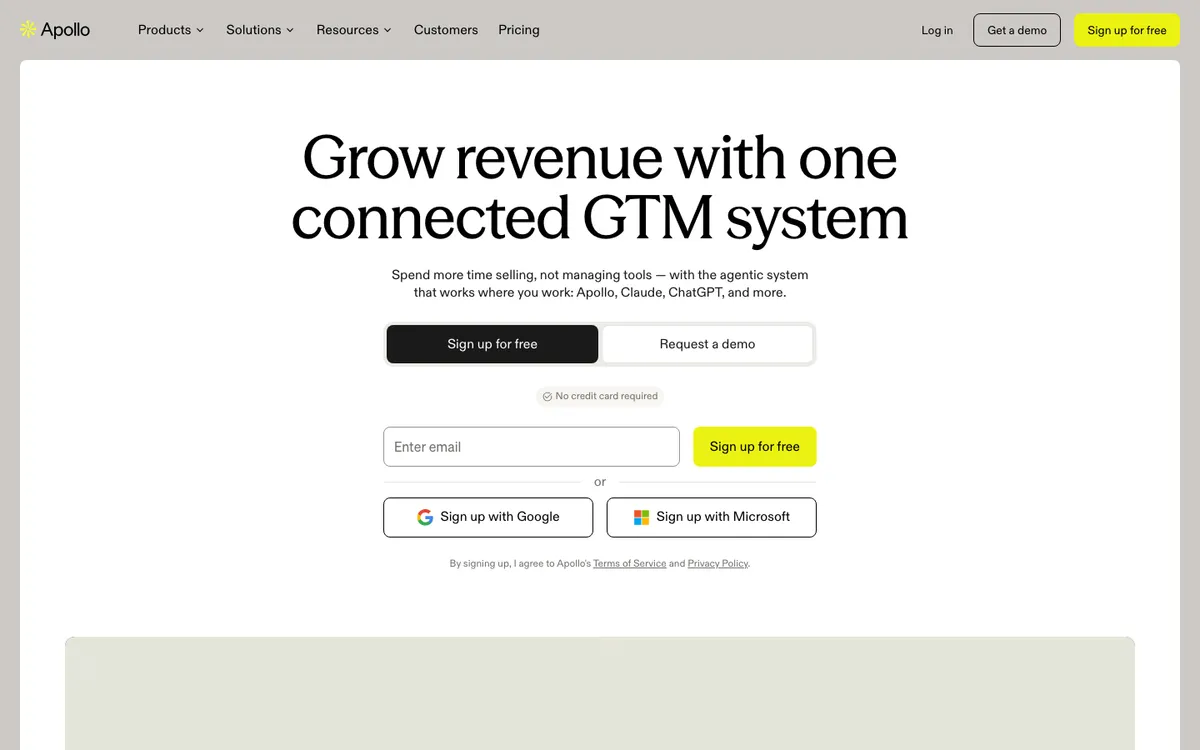
Apollo.io combines a database of more than 240 million contacts and 30 million accounts with sequencing, a dialer and pipeline management. A verified email costs 1 credit and a phone number 8. The free plan includes 900 credits per seat per year, granted monthly, and paid plans cost $49, $79 or $119 per seat per month billed annually, with 30,000, 48,000 or 72,000 credits per seat per year granted upfront; Organization requires at least 3 seats. Paid plans include waterfall enrichment, CSV, CRM and API enrichment, and a US dialer on which credits apply, while an Advanced Dialer add-on with international, parallel and power dialing costs $119 per team per month billed annually. Apollo says its platform includes the tools needed to comply with GDPR, CAN-SPAM and DNC rules.
Best for: teams that want to find numbers, sequence and call from a single platform at a published price. Its cost per phone looks low on paper, so measure how many of those numbers reach the right person on your own list before comparing it with a verified-mobile specialist.
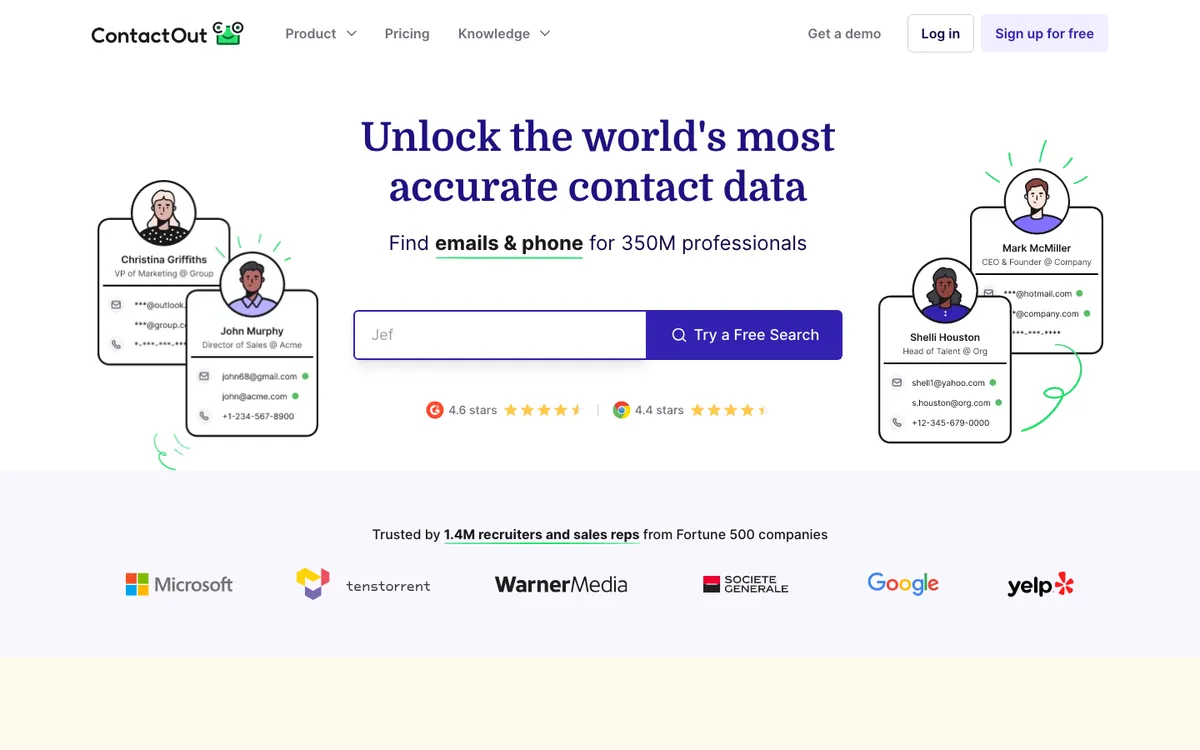
ContactOut claims emails and phones for 350 million professionals across 40 million companies, including 100 million verified direct-dial numbers, with hourly data updates. Its Email + Phone plan promises unlimited emails and phones with 600 exports a month for one user per company, priced on 14 October 2026 at $99 per month with US and UK data or $49 per month without them, both shown as discounts from $199. Its terms set the fair-use ceiling: 2,000 email credits and 1,000 phone credits per account per month on unlimited plans, unless a separate agreement says otherwise. The free plan gives 5 emails, 5 phones and 5 exports per day. ContactOut lists CCPA and GDPR compliance and SOC 2 certification, and team and API plans are on request.
Best for: recruiters and sales reps who work profile by profile through the browser extension and call fewer than 1,000 people a month. It publishes its phone ceiling more plainly than most vendors, which makes the budget easy to check.
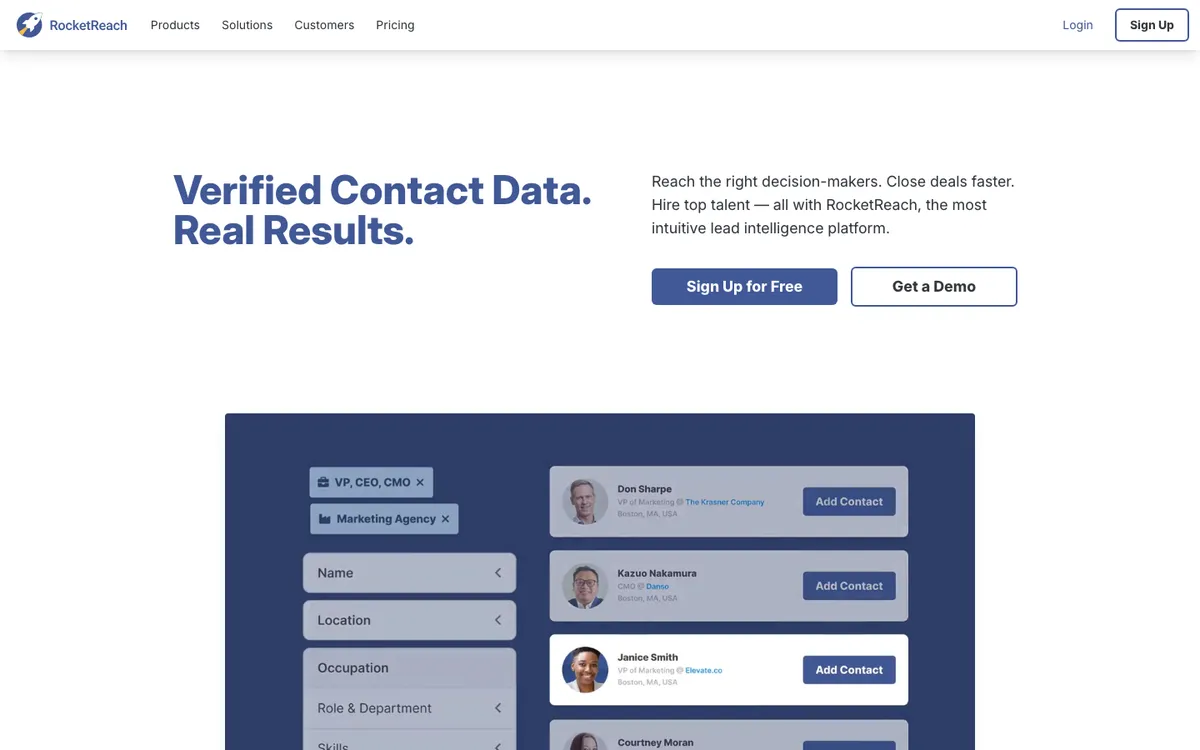
RocketReach claims 700 million profiles and 60 million companies. Phone numbers start on its Pro plan, at $52 per month billed annually ($619 a year), which includes unlimited verified mobile and direct phone numbers with 3,600 exports a year; Ultimate costs $115 per month ($1,379 a year) with 20,000 exports a year, intent data and healthcare data. The Essentials plan, at $19 per month, covers emails only. On monthly billing, lookups drop to 250 on Pro and 1,000 on Ultimate. Free accounts get 5 lookups with no credit card, and team plans start at $6,000 a year. Its plans list contact verification, suppression lists, CRM integrations, an API and MCP access. RocketReach's privacy policy, updated on 30 September 2026, says it relies on legitimate interests to process the contact details in its services and on EU or UK approved clauses for international transfers.
Best for: individual researchers and small teams that want unlimited phone lookups at a published annual price. The export cap, 300 a month on average on Pro, is the figure to compare with your call volume.
ZoomInfo is the enterprise benchmark. It claims verified data on more than 500 million contacts and 100 million companies, and its sales plans advertise direct-dial and mobile phone numbers, which the Professional package includes alongside business emails. Its pricing FAQ says each export costs one credit, and that the overall price depends on features, the number of licenses and credit usage; prices are on request and a free trial is offered. Copilot Advanced and Copilot Enterprise add intent signals, website visitors and AI features. ZoomInfo says it processes professional contact data under GDPR's legitimate-interest basis and holds ISO 27001, ISO 27701, SOC 2 Type II, TRUSTe GDPR and TRUSTe CCPA certifications.
Best for: large revenue organizations that need phones, intent and account intelligence across several teams and can negotiate an annual contract. Its cost per phone cannot be calculated from public information, which makes it hard to compare for smaller teams.

Seamless.AI claims 1.6 billion verified business emails and 448 million phone numbers, and says its software searches the public web in real time to find, verify and validate contact information each time a user runs a search. Its Chrome extension finds cell phones, emails and direct dials on any website. Seamless.AI is free for up to 50 credits; beyond that, its pricing page is a contact form that offers special pricing for unlimited users, bulk credits, buyer intent and enrichment. Its credit back program refunds a credit automatically when an email is invalid, and the homepage does not extend that promise to phone numbers. The vendor lists GDPR, CCPA, SOC 2 Type II and ISO 27001.
Best for: sales teams that want phone lookups, outreach and AI agents in one platform and accept negotiated pricing. The absence of a published price and of a published credit cost per phone is why it closes this list.

This is the comparison the vendors' own pages do not make. Each cell reflects what the vendor published on its site on 14 October 2026. Coverage figures are the vendors' claims, and when something is not published, the cell says so.
| Rank | Tool | Mobile coverage (vendor claim) | Verification method | Cascade or own database | Published prices | Free plan | GDPR compliance |
|---|---|---|---|---|---|---|---|
| 1 | Pipecorn | 553.6M people with verified email and mobile, 50+ countries | Phone verification on every plan; numbers checked by 10,000 sales reps; DNC detection on Scale | Waterfall, 100+ providers, routed by country | From $41 a month; 30 credits per mobile, $0.30 to $0.49 per phone | Permanent: 150 credits a month (about 5 mobiles) | GDPR with EU processing by default, SOC 2 Type II, CCPA |
| 2 | FullEnrich | Find rate above 80%; search across 800M people | Carrier check for active lines, owner-name match (US and Canada), landlines free | Waterfall, 20+ vendors (25+ sources on the pricing page) | From $29 a month for 500 credits; 10 credits per mobile | Trial: 50 credits, no card | GDPR, CCPA, SOC 2 Type II |
| 3 | Cognism | Phone-verified mobiles; director-level data refreshed every 30 days | Manual and automated phone verification; on-demand verification on Pro | Own database | On request, 5 seats included | Free data sample | GDPR and CCPA |
| 4 | Lusha | 117M+ direct dials | "Verified phones", method not detailed; do-not-call list | Own database | From $37.45 a month billed yearly; 5 credits per phone | 40 credits a month (8 phones) | GDPR, CCPA, SOC 2, ISO 27701 |
| 5 | Kaspr | 500M+ phone numbers and emails | Real-time verified data from 150+ sources, per the vendor | Own database built from 150+ sources | €59 per user per month with 100 phone credits a month | 5 phone credits a month | Described as GDPR aligned |
| 6 | Apollo.io | 240M+ contacts | Not detailed for phones; waterfall on paid plans | Own database plus waterfall | $49 per seat per month billed annually; 8 credits per phone | 900 credits per seat per year | Tools for GDPR, CAN-SPAM and DNC |
| 7 | ContactOut | 100M verified direct dials | "Triple-verified" claim, hourly updates | Own database | $49 a month without US and UK data, $99 with; 1,000 phones a month under fair use | 5 phones a day | GDPR, CCPA, SOC 2 |
| 8 | RocketReach | 700M profiles | Contact verification; suppression lists | Own database | Pro $52 a month billed annually, unlimited phones, 3,600 exports a year | 5 lookups | Legitimate interest stated in the privacy policy |
| 9 | ZoomInfo | 500M+ contacts with mobiles and direct dials | Not detailed on the pricing page | Own database | On request; 1 credit per export | Free trial | GDPR (legitimate interest), ISO 27001 and 27701, SOC 2 Type II |
| 10 | Seamless.AI | 448M+ phone numbers | Real-time web search and validation; credit back on invalid emails only | Own database fed by real-time web search | On request | 50 credits | GDPR, CCPA, SOC 2 Type II, ISO 27001 |
Two patterns stand out. Only the two waterfall tools, Pipecorn and FullEnrich, publish both a per-phone price and a rule that a lookup which finds nothing costs nothing. And the vendors that explain how a number is checked, by carrier, by owner name or by the reps who call it, remain a minority: most use the word "verified" without saying what it covers.
The headline price of a plan says little on its own. What matters is the cost of one phone number at the volume you need. Using only the published prices and credit costs, here is what a phone number costs at each tool's entry level if the whole credit budget goes to phones.
Pipecorn: $0.49 per phone on Build, falling to $0.30 on Scale, from the unit prices in its comparison table.
FullEnrich: about $0.58 per mobile on the $29 monthly tier (500 credits, or 50 mobiles), falling to $0.35 at 100,000 credits for $3,500 a month.
Lusha: about $0.47 per phone on Starter ($449.40 a year for 4,800 credits, or 960 phones).
Kaspr: €0.59 per phone credit on Starter if you count the whole subscription against phones, although it also includes unlimited emails within fair use.
Apollo.io: about $0.16 per phone on Basic ($588 a year for 30,000 credits, or 3,750 phones), with the same caveat: the credits also pay for emails and other features.
ContactOut: about $0.10 per phone if you use the full 1,000-phone monthly ceiling with US and UK data, and the 600 monthly exports still apply.
RocketReach: $619 a year for unlimited phone lookups on Pro, or about $0.17 per exported contact at 3,600 exports.
Cognism, ZoomInfo and Seamless.AI: not calculable from public information.
These figures are the cost of a phone number returned, not of a conversation. A $0.16 number that reaches a switchboard or a former employee costs more than a $0.50 mobile that rings the right person. Compare tools on the cost per connected call: divide the price by the numbers that reach the named person on your own sample. Rules under which a miss costs nothing, as at Pipecorn and FullEnrich, reduce the risk of paying for empty lookups, and Pipecorn says it never charges for wrong numbers either.
Finding a number does not make a call lawful. In the EU and the UK, the mobile of a named professional is personal data, and the rules depend on the country you call.
In the UK, the ICO states that UK GDPR applies when you process personal data for direct marketing, even in a business context, and that before live B2B calls you need to screen against both the CTPS and TPS registers, as well as your own do-not-call list, because some businesses, such as sole traders, register with the TPS rather than the CTPS.
In France, the CNIL explains that the rules on telephone prospecting changed on 11 August 2026: consumers must now give prior consent, while professionals can be called on the basis of legitimate interest when the call relates to their job, provided they were informed and can object simply and free of charge. When numbers are acquired from third parties, the CNIL says you must make sure the person was informed that the number could be used for prospecting and is able to object.
Two consequences for choosing a tool. First, built-in do-not-call detection, such as Pipecorn's on Scale or the do-not-call list Lusha lists, saves a screening step but does not replace your own suppression list. Second, ask each vendor how the people in its database are informed, and keep the answer: it is part of your own compliance file.
1. Use your own list. Take 100 to 200 contacts from your real target list, across the countries and job titles you sell to, and run the same sample through two or three tools. The free plans and trials of Pipecorn, FullEnrich, Lusha, Kaspr, ContactOut, RocketReach and Seamless.AI make this cheap.
2. Count connections, not finds. A find rate measures numbers returned. Call the numbers, or a subset of them, and record how many reach the named person.
3. Separate mobiles from landlines and switchboards. Check the line type in the export. A tool that returns many company lines will look good on find rate and poor on conversations.
4. Read the credit rules. Check what a phone costs, whether misses and landlines are charged, whether credits roll over, and whether a fair-use ceiling applies to "unlimited" phones, as it does in ContactOut's and Kaspr's terms.
5. Check the workflow on the plan you would buy. Confirm the CRM integration, the API or MCP access and the seat rules on that plan, not on the top tier.
Three limits, stated plainly, because a ranking that claims to settle everything is not usable.
It is built only on public information. We read what each vendor publishes on its homepage, pricing page and terms, and checked them on 14 October 2026. We did not measure find rates or connect rates on our own lists, so every coverage and accuracy figure above is the vendor's claim.
It cannot know your context. The right tool for a recruiter calling a few UK candidates a week is rarely the right one for a 30-rep team calling mid-market accounts across Europe. The Best for lines matter more than the ranking number.
It ages quickly. Pricing pages in this category change often, and several prices above are presented as discounts. This page is reviewed every 90 days, and the check date is stated in the method.
A phone enrichment tool gives your reps more people to call. It does not make those people want to pick up. The teams that get the most from outbound usually combine it with channels that bring buyers to them, and our list of the 50 best customer acquisition channels in 2026 maps those options. If you would rather outsource the calls, compare the best B2B cold calling agencies in France, the best cold email agencies in France or the best lead generation agencies in France.
That inbound side is what Sorank works on. It is software that handles keyword research, writes sourced articles with internal links, publishes them to your site and tracks how often your brand appears in the answers of Google and AI assistants such as ChatGPT, Perplexity, Claude and Gemini. A prospect who has already read your content picks up the phone more readily than one who has never heard of you. We do not promise rankings, traffic or AI citations.
If you want a single recommendation: Pipecorn if your team calls across several countries and wants verified mobiles from a waterfall of more than 100 providers with a permanent free plan to start, FullEnrich if you want a pure waterfall billed only on verified mobiles, Cognism if you sell into Europe and want phone-verified data under an annual contract, and Lusha or Kaspr if your reps look up numbers one by one from LinkedIn.
Whatever you choose, test it on your own list, compare the cost per connected call rather than the price per credit, and keep your own suppression list. To build the inbound pipeline that makes those calls warmer, see Sorank's plans, from $49 per month billed yearly with a 3-day free trial.

Enrichment finds a phone number for a person from details you already have, such as a name, a company domain or a professional profile. Validation checks a number you already have: its format, whether the line is active and whether it is a mobile or a landline. The best tools combine both: FullEnrich says it checks every number with the carrier network and matches the owner's name in the US and Canada, and Pipecorn says its numbers are checked by 10,000 sales reps.
On mixed international lists, a waterfall usually returns more numbers, because it queries several providers until one finds a result: Pipecorn routes lookups across more than 100 providers by country, and FullEnrich across more than 20 vendors. A single database can be enough if it is strong in your markets, as Cognism claims for Europe. Test both on the same sample of your own contacts and compare the numbers that reach the right person, not the numbers returned.
It depends on the country and on who you call. In the UK, the ICO says live B2B calls must be screened against the TPS and CTPS registers and your own do-not-call list, and UK GDPR applies to business contacts. In France, the CNIL says professionals can be called on the basis of legitimate interest when the call relates to their job, provided they were informed and can object, while consumers must now give prior consent. Keep a suppression list in every case.
 AI Meta Description GeneratorAI Blog Title Generator
 Google Indexability CheckerAI Blog Outline Generator
 UTM Link Builder
 Keyword Clustering ToolCanonical Tag Checker
 XML Sitemap GeneratorBroken Link CheckerAI SEO Title GeneratorHeadline AnalyzerSERP Preview ToolRedirect Checker
 Hreflang Tag GeneratorHeading Structure AnalyzerHTTP Headers CheckerFavicon Extractor
 SERP CTR Calculator
 SEO vs Paid Search Savings Calculator
 SEO Share of Voice Calculator
 SEO ROI Calculator
 SEO Traffic and Revenue Forecast Calculator
 SEO Budget Calculator
 SEO Break-Even Calculator
 SaaS SEO ROI Calculator
 ROAS Calculator
 Reading Time Calculator
 Ranking Gain Simulator
 Organic Traffic Value Calculator
 Organic Traffic Estimator
 LTV to CAC Ratio Calculator
 Local SEO ROI Calculator
 Link Building Cost Calculator
 Keyword Value Calculator
 Keyword Opportunity Score Calculator
 Keyword Density Calculator
 GEO ROI Calculator
 GEO Content Investment Calculator
 Ecommerce SEO ROI Calculator
 Customer Lifetime Value Calculator
 Customer Acquisition Cost Calculator
 CTR Calculator
 Cost Per Article Calculator
 Conversion Rate Calculator
 Content Marketing ROI Calculator
 ChatGPT Referral Traffic Estimator
 Bounce Rate Calculator
 Backlink ROI Calculator
 AI Visibility Score Calculator
 AI Traffic Value Calculator
 AI Share of Voice Calculator
 Cost of AI Invisibility Calculator
 AI Citation Rate Calculatorllms.txt ValidatorAI Overview CheckerRobots.txt Checker
 AI SEO AuditLLM Readability CheckerSearchGPT Readiness Checker
 Structured Data LLM AuditWebsite Crawlability AI AuditWhy ChatGPT Is Not Recommending My Website
 Gemini Ranking ToolPerplexity Ranking CheckerLLM Citation CheckerAnswer Engine Optimization AuditGEO AuditAI Search Visibility TestChatGPT Visibility Checkerllms.txt Generator
 URL ExtractorWebpage to MarkdownSitemap CheckerSERP Volatility SensorPage Size Checker
 Word Counter
 Slug GeneratorSchema GeneratorRobots Generator
 OG PreviewMeta Tags Generator
 Image CompressorFavicon Generator
 On-Page SEO Audit
 Backlink Analysis Tool
 Keyword Research Tool
 Domain Authority Checker
THEY TRIED SORANK BEFORE YOU
 “I tested Sorank on a real client site and it's insane. It does everything an agency would bill you $1500 a month for. It's going into production on that client now.”
 Guillaume Guersanguersanguillaume.com“We are an Ads agency and we wanted to get our SEO back on track once and for all. Sorank gave us a clear view of our site, helped us prioritize optimizations, and properly structure our content. The tool is easy to use, well designed for a team, and very practical for centralizing tracking without having to juggle multiple platforms. A very solid foundation to start fresh with our SEO.”
 Gaspard MadouiAds Agency
 “I just let the Sorank software do its thing, and now my DR is 25 and my page is ranking higher.”
 Lucas FlandrePodcast Host“I specialized in GEO thanks to Sorank. The GEO Leaderboard allows me to show my clients their position vs competitors on ChatGPT. It’s a real commercial differentiator.”
 MélanieSEO Freelance“Great service, works well for our website and helps us understand how to improve it to rank better on Google and elsewhere. Congrats, keep going, I recommend it.”
 Hugo T.E-commerce merchant