Preferences
Privacy is important to us, so you have the option of disabling certain types of storage that may not be necessary for the basic functioning of the website. Blocking categories may impact your experience on the website. More information

Privacy is important to us, so you have the option of disabling certain types of storage that may not be necessary for the basic functioning of the website. Blocking categories may impact your experience on the website. More information
Our ranking of the 10 best e-commerce and Shopify agencies in France in 2026, built on public information only, with market data, method and limits.


In short: Axome is the strongest all-round choice among the best e-commerce and Shopify agencies in France, because its platform practice is large enough to run a migration without breaking the search traffic and order history you already have. Lobstter is the better fit if the store has to talk to your enterprise resource planning system and your other business tools, KNR Agency if you sell beauty, fashion or luxury and presentation decides the sale, and Ecomiz if your current open source store already works and the last thing you need is a migration. The deciding criterion is not who designs the most polished storefront, it is which agency has shipped enough migrations to protect the revenue you already make while the rebuild happens.
Choosing among the best e-commerce and Shopify agencies in France means choosing inside a market that has grown past the point where the platform question decides anything on its own. France counted 42.2 million online shoppers in 2025, according to the 2026 edition of FEVAD's key e-commerce figures, a scale that explains why every agency on this page, however different their positioning, is competing for the same base of buyers. A top 10 is not an editorial convenience in this market, it reflects roughly where the platform expertise and the post launch capacity actually sit. This ranking is built only on what each agency publishes about itself, and it says plainly where that method stops.
French e-commerce is no longer a channel that grows quietly in the background. It generated 196.4 billion euros in 2025, up 7% on the year, across 3.2 billion transactions, an increase of 11%, according to FEVAD's 2026 edition of its key e-commerce figures. Online sales now account for 12% of all retail spending in France, which is the figure that turns e-commerce from a side project into a business unit with its own budget line and its own agency roster.
Two consequences follow for a buyer. The first is that platform work alone no longer earns a store its traffic, because the paid budgets that used to sit exclusively in search are now flowing into the storefront itself. Retail media in France reached 775 million euros in the first half of 2026, up 18%, with retail search alone at 599 million euros and growing 24%, according to the 36th Observatoire de l'e-Pub published by SRI, UDECAM and Oliver Wyman. A store that only pays to be found inside its own aisles is renting its visibility twice.
The second consequence is that the platform question really has settled. Shopify reported gross merchandise volume of approximately 115.57 billion dollars in the second quarter of 2026, up around 32% year on year, its fifth consecutive quarter of growth above 30%. That scale of adoption is exactly why the French agency market documented in this ranking has consolidated so heavily around one platform, and why the agencies that still work on the older open source systems now do it as a deliberate specialism rather than a default.
Four fears come up again and again in this trade, and a good agency answers all four before you have to ask.
1. Being sold a redesign that does not fix the checkout. A beautiful new storefront is not the same project as a store that converts. Baymard Institute's average across 50 documented studies puts online cart abandonment at 70.22%, so a store that only gets prettier while checkout friction stays untouched is leaving most of its potential revenue exactly where it was before the rebuild.
2. Losing search rankings during the migration. Products, categories and blog posts each carry a history of links and rankings. An agency that treats redirects as an afterthought can cost you months of visibility on a project that was supposed to grow it.
3. Losing ownership of the store once the contract ends. The platform subscription, the theme code, the customer and order data must be in your name from day one. An agency that keeps the keys keeps you as a client whether the relationship is working or not.
4. Being sold a generalist team with no vertical or B2B experience. A beauty catalogue, a B2B account structure and a fashion drop calendar break in unrelated ways. A team that has only ever built consumer stores will discover the differences on your budget, not theirs.
Four criteria, in this order, applied only to what each agency publishes about itself. Every homepage in this list was reviewed in August 2026, and this page is scheduled for review every 90 days because platform partnerships and agency positioning change fast.
1. Platform depth. Partner status, whether the enterprise tier is named, and the range of build types described, creation, migration, optimisation, tell you whether an agency has actually shipped complex projects or mostly small ones.
2. What happens after launch. Agencies that also name conversion, retention or acquisition work are selling a store that keeps improving. Agencies that stop at delivery are selling a project, not a result.
3. Vertical or B2B specialisation. Named sectors and named B2B capability both change the actual work, since a catalogue built for professional buyers and one built for consumers rarely share the same logic.
4. Whether the site is alive and clear. One domain that came up in our wider review of this sector now serves an unrelated foreign gambling site rather than the agency it once belonged to, a reminder to check that a listing still points where it claims before you call the number on it.
What we deliberately did not do: we did not repeat the project counts, revenue handled or client names published on these homepages. None of them can be verified from outside, and in this trade they are the main thing being sold.
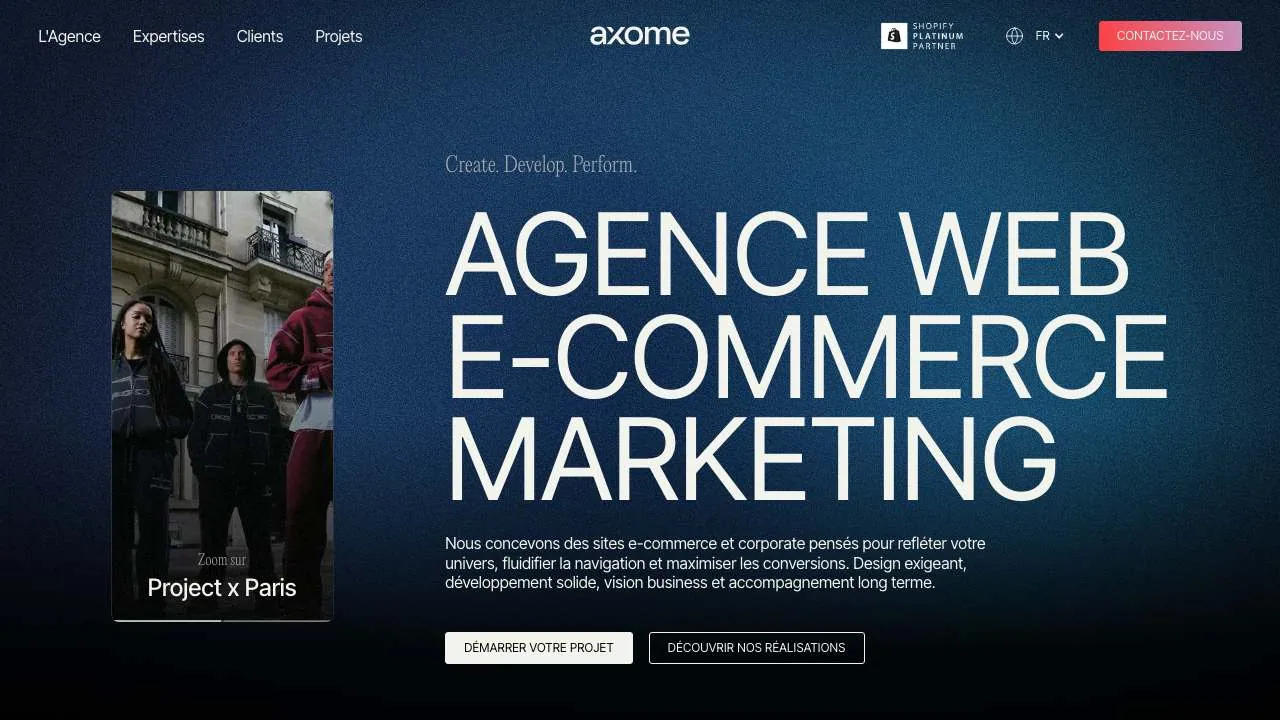
Axome holds the top partner status on the dominant e-commerce platform and covers creation, migration and optimisation on its enterprise tier, working across many sectors. Size matters on this particular job: a migration with a large catalogue, existing customer data and live orders needs a team that has done it many times rather than a talented pair.
Best for: complex builds and migrations where failure is expensive. The scale that makes Axome reliable on a large project is also why a small brand with a modest budget and a simple catalogue may find the engagement heavier than it needs.
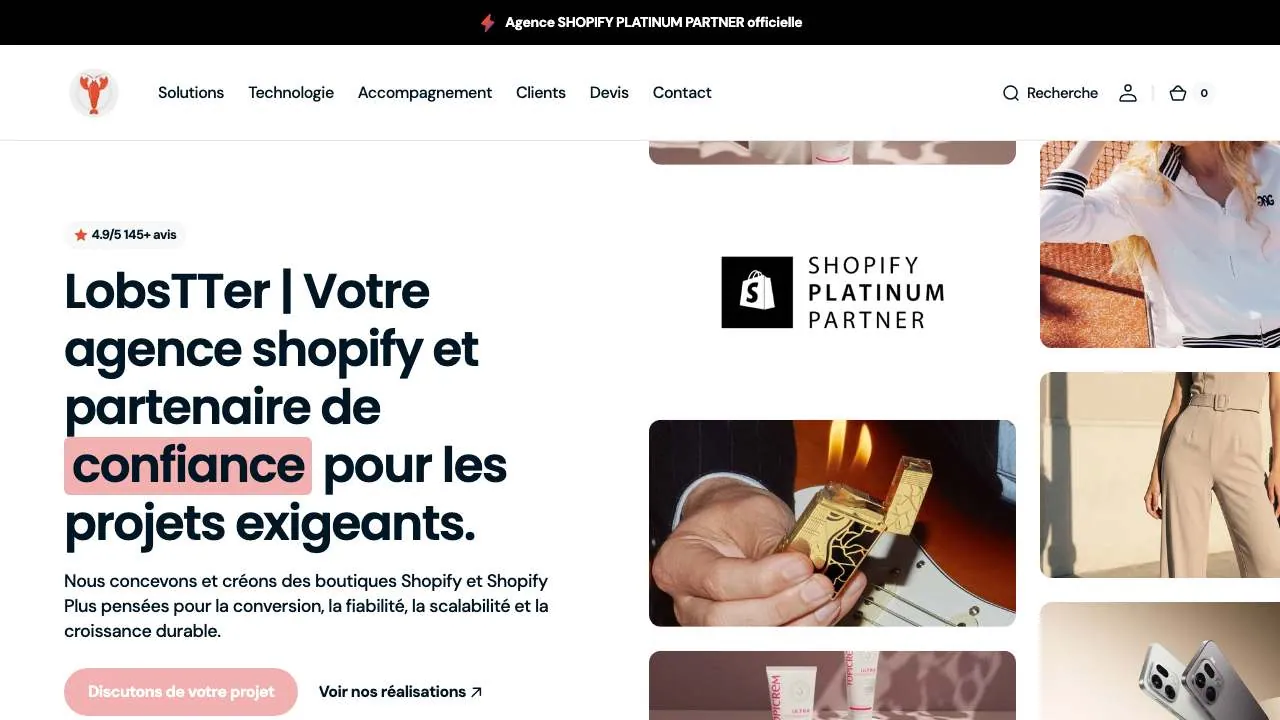
Lobstter combines top tier partner status with two decades of e-commerce experience, and names the harder parts explicitly: B2B, marketplaces, enterprise resource planning integration and search visibility. It addresses small and mid sized companies, direct to consumer brands and established names, positioning itself for projects where the store has become strategic.
Best for: stores that need to talk to the rest of the company's systems. That ERP integration work is exactly what most generalist builders avoid, though it also means the engagement leans technical rather than purely creative.
Artich is a certified French agency on the main platform and its enterprise tier, positioning explicitly on demanding environments and on brands that want to last rather than launch. The framing is about durability, which is the right conversation for a company that will still be running this store in five years.
Best for: established brands rebuilding a store meant to last. That same emphasis on durability over speed can be a mismatch for a company that needs a store live in a matter of weeks.

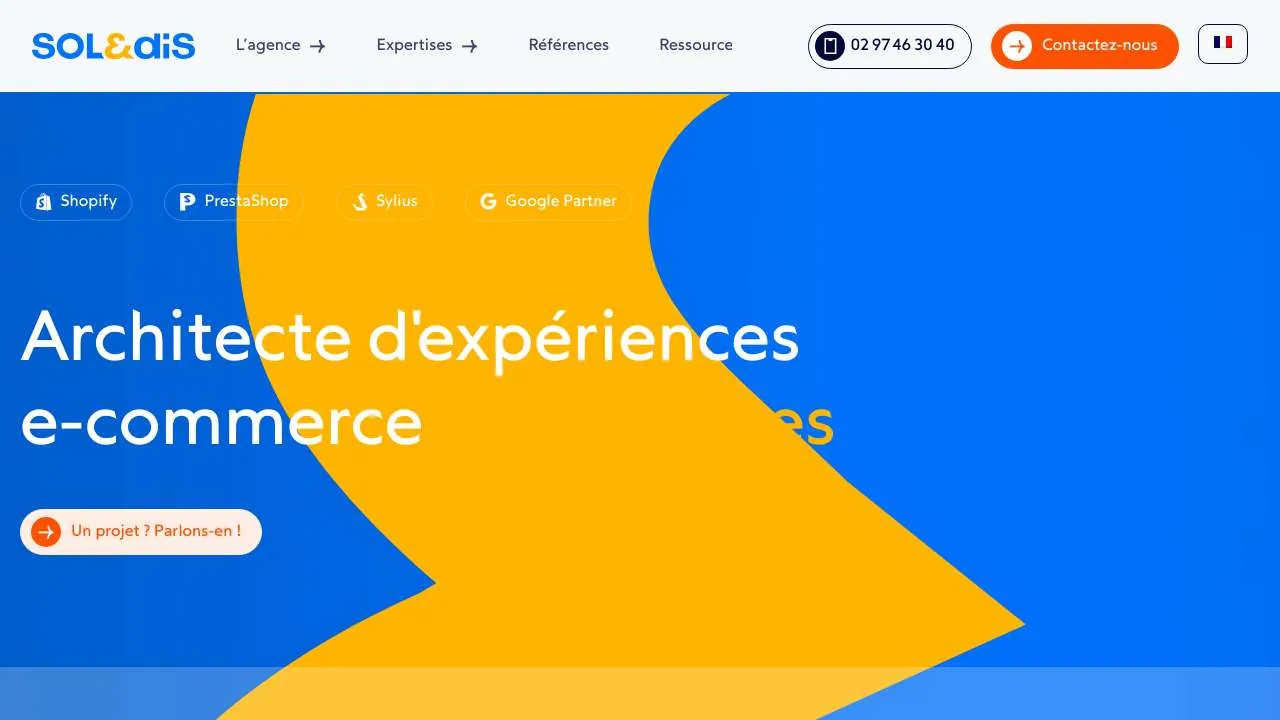
Soledis works from Vannes and Nantes across two e-commerce platforms, serving both B2B and consumer commerce, and adds web marketing, data, AI services and art direction to the build. Covering B2B and B2C properly is rarer than it sounds: the pricing rules, the account structures and the ordering journeys are genuinely different problems.
Best for: companies selling to businesses and consumers from the same catalogue. Running two platforms rather than one also means asking directly which technology your specific project would use before you sign.
Maukau specialises in the enterprise tier of the main platform and describes itself as a growth accelerator rather than a build shop, with internationalisation named as a specific expertise. Selling the same catalogue across several countries breaks more stores than any other requirement, and an agency that has done it repeatedly is worth the premium.
Best for: brands opening several country stores at once. A single market launch with no international ambitions is unlikely to need this particular depth of expertise.
KNR Agency works only with beauty, fashion and luxury brands, holds enterprise partner status on the main platform and certifications on a large commerce and marketing suite, and covers design and development, conversion optimisation and e-commerce marketing. In these categories the store is the brand, and a generalist build shows immediately.
Best for: beauty, fashion and luxury brands where presentation is the product. That exclusive focus is precisely what makes it the wrong fit for a B2B or industrial catalogue.

Dedi Agency has worked from Lyon since 2004 on e-commerce and digital marketing, naming the enterprise tier of the main platform, an open source B2B commerce framework and a CRM suite among its technologies, with B2B stated explicitly. Twenty years of continuity in this trade means having survived several platform generations.
Best for: B2B commerce projects with real process complexity. That B2B focus is a narrower fit if your business sells mainly to individual consumers.
Ecomiz is a deep specialist on the main open source e-commerce platform, with sixteen years on it, top level expert certification and a stated quality certification for its e-commerce training. Plenty of profitable French stores run on that platform and have no reason to move, and they need an agency that treats it as a first class choice rather than a legacy problem.
Best for: established stores staying on their current open source platform. If a migration to a different platform is already decided, this particular depth of specialisation stops being the advantage it is for everyone else.
Pikka is a certified agency on the main platform and its enterprise tier, focused on the creation and the optimisation of stores, and leaning on client recommendation as its main argument. The scope is narrow and clearly stated, which suits a company that wants a store built well and nothing else bundled in.
Best for: a clean, focused store build without a wider marketing mandate. That same narrow scope means acquisition and content will need a separate provider once the store is live.

W3lead has worked in e-commerce since 2013 and been a certified partner since 2018, combining store creation, interface design, conversion optimisation and email marketing in one team. For a smaller brand, having the store and the retention channel handled by the same people removes an entire coordination problem.
Best for: smaller brands that need the store and the email programme together. That same compact team size is worth checking against a much larger catalogue or a multi country launch.
The criteria below were chosen before checking who wins them, and every cell reflects what the agency publishes on its own site as of August 2026. Where an agency does not publish something, the cell says so rather than guessing.
| Agency | Platform scope | Post launch services | Vertical or B2B focus | Years in operation |
|---|---|---|---|---|
| Axome | Creation, migration, enterprise tier optimisation | Not published | Multiple sectors, not vertical specific | Not published |
| Lobstter | Creation, ERP integration, marketplaces | Search visibility named | B2B and marketplaces named | Two decades stated |
| Artich | Creation on main platform and enterprise tier | Not published | Not vertical specific | Not published |
| Soledis | Two platforms, B2B and B2C | Marketing, data and AI services | B2B and B2C named | Not published |
| Maukau | Enterprise tier, international setup | Growth acceleration named | International expansion named | Not published |
| KNR Agency | Enterprise partner, commerce and marketing suite | Conversion optimisation, e-commerce marketing | Beauty, fashion and luxury only | Not published |
| Dedi Agency | Enterprise tier, B2B commerce framework, CRM | Not published | B2B stated explicitly | Since 2004 |
| Ecomiz | Open source platform specialist | Training offer published | Not vertical specific | Sixteen years stated |
| Pikka | Main platform and enterprise tier | Not published | Not vertical specific | Not published |
| W3lead | Store creation and interface design | Conversion and email marketing | Not vertical specific | Since 2013, certified partner since 2018 |
Read the "Not published" cells as a gap in public information, not as a gap in capability. Several of these agencies certainly do more than their homepage states, and the honest way to find out is to ask them directly.
The French market has dozens of credible e-commerce agencies. These are the other names that came up in our review of the sector.
| Agency | Website | What they publish about themselves |
|---|---|---|
| Moon Moon | moon-moon.fr | Enterprise tier partner in Nantes, migration, redesign, conversion work, point of sale and CRM |
| Stellar Projects | stellarprojects.fr | Official platform partner since 2018, rebuilds, migrations, store search and email marketing |
| Tamar Agency | tamaragency.com | Certified agency specialised in wellbeing, beauty and cosmetics, builds, migrations and monitoring |
| e-frogg | e-frogg.com | Web agency specialised in a major PHP framework and in three e-commerce platforms |
| Gradiweb | gradiweb.com | Technology and e-commerce agency building bespoke online stores end to end |
| DATASOLUTION | datasolution.fr | Digital agency covering e-commerce plus product information, asset and master data management |
| Agence Shop | agenceshop.fr | Store builds designed around conversion, with audits and a premium and luxury practice |
| Azuweb | azuweb.net | Store and no-code site development with marketplace and digital marketing expertise |
Two adjacent markets have their own rankings on this blog: the 10 best amazon marketplaces agencies in France and the 10 best cro conversion agencies in France.
Three questions sort a shortlist faster than any proposal, and each one maps to one of the fears above.
1. Who owns the code and the accounts? The store, the theme code and the platform subscription must be in your name from the first day of the engagement. This is standard practice in the trade and worth confirming anyway.
2. What happens on the day after launch? Agree the maintenance arrangement before the build starts: who fixes what, in how long, and at what rate. Stores tend to break at the worst possible moment, which is during a sale.
3. Who is responsible for the data migration, and what happens to your redirects? Products, customers, orders, reviews and redirect rules all have to move without gaps. The redirect map in particular is the difference between keeping your search traffic and losing it for months.
Three limits, stated plainly, because a ranking that claims to settle everything is not usable.
It is built on public information only. We read what each agency publishes and checked that the sites were live in August 2026, which is how we found the domain now redirecting to an unrelated gambling site rather than the agency it once belonged to. We did not audit anyone's code, interview their clients or verify a single project figure. An agency that communicates poorly and delivers brilliantly will be underrated here.
It cannot know your context. The right agency for a 5000 product B2B catalogue with an ERP behind it is rarely the right one for a three product luxury brand where the photography carries the sale. The Best for lines above matter more than the rank number.
It ages. Partner status, positioning and teams change fast in this market. This page is reviewed every 90 days, and the review date is stated in the methodology above.
This is the honest part, on a page published by a software company. An agency beats software on everything that requires negotiation, judgement on your specific catalogue, or hands on your infrastructure. A platform migration with live orders in flight, an ERP integration, a store built to match a luxury brand's exact standards, ongoing conversion testing on a specific checkout: none of that is automatable today, and anyone claiming otherwise is selling you something.
What software does better is the part that is repetitive, weekly and endless. Once a store is live, every category and product page still needs its own text, kept current as the catalogue changes, and every acquisition channel beyond the store itself, from the 50 best channels for customer acquisition in 2026, needs pages that actually rank. That is where most e-commerce content programmes quietly stall: the store is beautiful, the catalogue is complete, and the collection pages nobody wrote are still blank six months after launch.
It is not a store problem. It is a capacity problem, and it is the reason so many stores convert well but stay invisible outside the traffic they already had.
That is what Sorank automates. It is software, not an agency: keyword research, article and category page writing, internal linking, publishing to your store and tracking how often you appear in the answers AI assistants give when someone asks which brand to buy. That last part is not decoration. A controlled study presented at KDD 2024 on 10000 queries measured that citing sources raised visibility in generative engines by roughly 30%, adding statistics by roughly 32%, and adding expert quotes by roughly 41%, while keyword stuffing lowered it. Those are the mechanics of being recommended rather than merely ranked, and they apply as much to a product page as to a blog post, whatever the right length for that page turns out to be. Pricing starts at 99€ per month, with 3 days offered and a card required at sign up. If you would rather talk it through first, book a call, or compare it against the other GEO software on the market.
If you want one recommendation: Axome or Lobstter for a complex build or a migration with live orders at stake, KNR Agency if you sell beauty, fashion or luxury and the store has to look like the brand, and Ecomiz if your current open source store already works and the last thing you need is a migration.
And whichever you choose, settle the redirect map before anything is rebuilt. It is the cheapest line in the project and the one that quietly costs the most when it is forgotten. For the full picture of how a store's organic traffic and AI visibility now work together, see our guide to leading on search and GEO.


Partner tiers are awarded by the platform based on the volume and quality of work an agency delivers on it, so a high tier tells you the agency has shipped many stores and has a direct line to the platform when something breaks. It does not tell you whether they understand your category, your logistics or your margin structure. Use it as a filter, then judge on the projects they show you in your sector.
A theme based store with light customisation sits at the low end, a bespoke build with custom features, complex catalogue logic and third party integrations costs several times that, and a migration from another platform depends almost entirely on how messy the existing data is. The most useful thing to ask for is a breakdown separating design, development, integrations and data migration, because that is where estimates diverge.
Migrate when the current platform is genuinely blocking you: unreliable performance, an unsustainable maintenance bill, or features you cannot get without heavy development. Do not migrate because the interface looks nicer. Agencies on this list work across several platforms, and the honest ones will tell you when your existing store is fine and the problem is elsewhere in the funnel.
THEY WIN WITH SORANK






.webp)